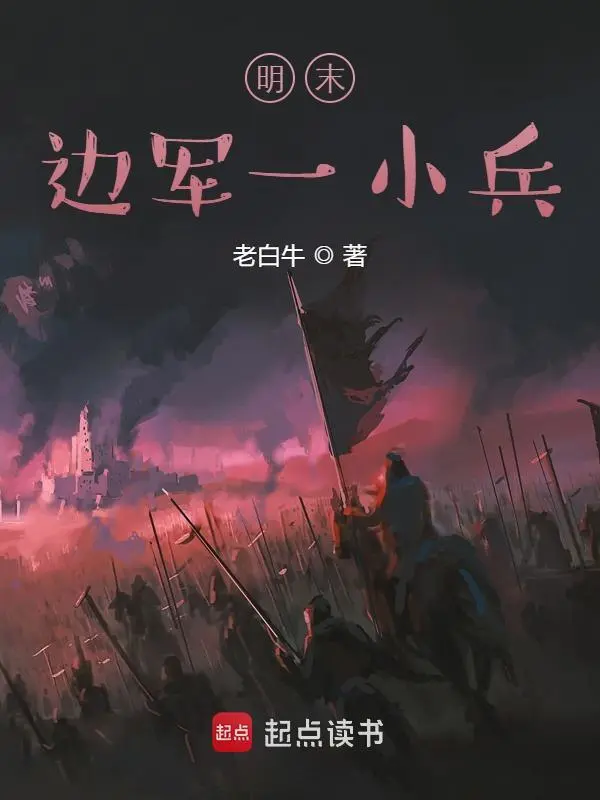
A Small Soldier of the Border Army in the Late Ming Dynasty
明末边军一小兵
- Status
- Completed
- Length
- 3.5M Words
- Genre
- Historical
- Audience
- Male
- Subgenre
- Song-Yuan-Ming Dynasties
- Updated
- 10y ago
- Source
- Qidian
Stats
Tags
Synopsis
Reader comments
In booklists 402
Explore more →
Interesting Historical Novel
I sincerely recommend good books to take you to appreciate the ancient scenery and survey the long history. They are all very interesting historical novels that save the country from danger, change history, and achieve different careers. Parallel time and space, ancient China, ancient Europe, different social backgrounds. Book lovers, this is a list of historical topics, please do not recommend other genres.
[Twenty Years of Internet Writing, Complete Historical Work]
A specially recommended book list for novices. Lao Bai should have read it before, so you don't need to read it. A good start with more than one million words, a complete book
The History of Wearing
Can be seen
Historical Seedlings🔥complete Classic
It includes some completed historical classics, as well as some seedling books that are in line with popular tastes and have been highly recommended. Friends who like them can collect them!


Muzi Blue's Selected, Classic, and Premium Book Lists!
They are all carefully selected classics and good books.
[Farming Style] Don't Live in Fantasy, Don't Live in Vain 🌾
🌹🌹🌹🌹 Farming is a label with extremely rich connotations. "Farming" originally originated from strategy video games. Players follow the principle of "build walls high, accumulate grain widely, and slowly become king" to hide their strength and bide their time on their own territory, gradually expand their power, and finally conquer it all. It tests the player's overall planning ability. The essence is to work hard and make progress step by step. Early farming novels are usually set in fictiona
Big Historythe One I Love Is Named Huaxia🧐
The Spring and Autumn Period and the Warring States Period - the modern times of the Republic of China, as well as the fictional history of demonic reform, you want it and I have it. ️⚛️⚛️⚛️⚛️⚛️⚛️⚛️⚛️⚛️⚛️ Why do we love historical texts so much? Because every rabbit has a dream of a great country in his heart. Listen to my strongest voice of China—— "Everything in the world is the land of the king; on the shore of the land, there is nothing but the king's ministers." "I am the First Emperor.

Shinju's Bookshelf
After more than ten years of reading, the book list contains novels with three correct views and good writing. Because I am picky about reading books, the writing and plot can be improved with my writing, but if the three views are inconsistent, I will definitely not be able to read them. Most of the heroines have no CP, and there are one-on-one ones who will mark it. (Except male videos) From now on, the book list will only recommend novels that I have read and feel are of good quality. Thank
Loves Cultivation and Fantasy. Read the Book Carefully and Get a Star Rating.
March 2023. I am dissatisfied with my starting point and rarely read books recently. Many of the books at the top of the monthly charts look disappointing! The works I have carefully read will all have evaluations for your reference to avoid repeated poisoning. The more stars the better. I have read too many books and have too high standards, so I have discarded many books (all are true thoughts and venomous remarks, please forgive me). Very few of them catch my eye (as the book is updated, I wi
Novels from the Late Ming Dynasty
Professionally fight against the Qing Dynasty, three or four years!




My Own Little Library~
No matter old books or new books, Just order the main flavor, It will be included~ Preferences: science fiction, suspense, urban and funny, IQ online, sadistic, etc. ~
Reading Articles for Many Years, Recommended Quality Products
This book was revised for the fourth time in October 2020. The quality is consistent and it is guaranteed to be a work that the owner has personally read. Under normal circumstances, we will still recommend the best works after finishing them, but in general, the recommendation style will shift to new works that are very readable. The source of the subject matter will be recommended by a single author after reading it by himself, so please forgive me for the slow speed. Some older works will be
Ding, Congratulations on Discovering the Epic Book List O(∩_∩)O~~
The handsome person has already collected it √√❤ Click to add it to your favorites and you will no longer be short of books~~❤ 1.❤ The recommended ones are the highest quality and most popular ones in the series! √ 2.❤ After collecting this super luxurious book list, will you still be hungry for books? ! √ 3.❤ This book list: contains the hottest, hottest and most popular books in various genres
Good Books Worth Ordering_recommended by a Ten-Year-Old Bookworm
I also tried to write a book "Hearthstone: The End of the World", and everyone is welcome to comment. I have been a bookworm for more than ten years. After reading too many books, I felt itchy and wrote one myself. Please support me and collect it.
Farming Stream, Construction Stream Selected
The fun part of farming style is to climb science-level trees or develop yourself well, and then use the developed advantages to defeat your opponents! The cool thing is not only the results, but also the process. In other words, the process of strengthening oneself is fun! (Continuously updated) If you have any farming articles you would like to recommend, please leave a message. There is a shortage of books recently.
💯[Xuanji Pavilion] a Classic Book from Qidian💯
To enter the book, click on the author's avatar in the lower left corner to lay flowers. Thank you for your support and encouragement! Because I read a lot of miscellaneous books, the book list covers a variety of genres. The books in this list are all my personal favorites. There are some books that I am currently following, and there are some books that I have read part of and found to be quite good, and are now being fattened and ready to be slaughtered... Author friends can go to the comme

A Book with a Particularly Good Plot
The book list has been re-edited, and the theme has been determined to be the most worthy new subject to try at the moment. Welcome to add to it! In addition, the book list is full, and some old books that have received less attention will be moved to the comment area soon. If you see a book you like in the book list, be sure to remember to like it, otherwise you may only see it in the comment area one day...
Complete a Wonderful Novel
Misty Journey, Immortal Legend, Heaven's Wrath, Demon God Tan, Dog Luck God of War, Human Paradise, Eternal Life, Great Sage, Leisurely Life in the Cultivation Civilization, Yi Ding, Great Reversal 1906, Official Qi, Biochemical Dynasty, Semi-immortal Civilization, Heshi's Disciples, Gods and Demons, Stealing the Sky, Urban Warfare System, Fake Heroes, God's Tomb, Earth OL, Infinite Terror, True Swordsmanship, Cultivation World, Blasphemy, Cold-faced Life, Tao Fa Ziran, Cun Mang, Search for the
If We Could Go Back to the Past...
If you change history, will you change who you are today? As a military fan and history buff, I really want to travel back in time. Think about the unknown past and the bloody battles, the suffering of the ancestors and the plunder of the barbarians, the budding ideas of science and technology and the conservative habits... Back in the past, the Chinese nation might not have suffered so much, and the Chinese culture might not have been so dusty. However, history is still moving forward firmly,
The Spiritual World of Self-Appreciation of Ancient Music
Only care about your own feelings, only care about the world of dreams
Mainly Recommend Novels from the Late Ming Dynasty!
No marriage, no indemnity, no land cession, no tribute. The emperor will guard the country, and the king will die in the country. The Ming Dynasty was a Han dynasty re-established by the Han people on the land of China after the fall of the Yuan Dynasty. His establishment improved the status of the Han people, allowing the Han people, who accounted for the majority of the population, to return to the status of civilians, creating favorable conditions for China's further development in the future
It's About Hegemony and Entertainment in Troubled Times in History, Both at Home and Abroad, and the Ending Story Basically Doesn't Abuse the Protagonist.
History, single time travel, struggle for hegemony in troubled times, no system (for China, I mainly recommend the Warring States, late Qin, Wei, Jin, Southern and Northern Dynasties, late Sui Dynasty, Five Dynasties and Ten Kingdoms, and the late Song, Yuan, Ming and Qing Dynasties. Military is the main line. Basically, you make your own decisions, and most of them have a low starting point.) There are a few entertainment anthologies that I think are better written, mainly about Chinese enterta
Romance in the Late Ming Dynasty
At the end of the Ming Dynasty, there was suffering, waves and clouds. The rise of Jiannu brought disaster to China. Look at how our Han people wrote the magnificent epic of the late Ming Dynasty.
Realm of Gods
A gathering place for masters to slowly share the good articles they have read ~ Wow, there is an upper limit, so you can select and select the best! Some authors only recommend one book due to quantity restrictions. If you think it is good, you can read the author's other books Qidian should open up a few more book lists, at least one to complain about and one to recommend.
Readers also read
 Northern Qi, Sage Khan
 After Lying in Bed for Three Years, He Was Forced to Help the Han Dynasty
 Red Mansion: Start Escaping and Farming from the Equipment Bar
 Fu Ming 1627
 China Entertainment: Start by Throwing the Eighteen Holy Grails
 A Lifetime of Wealth
 Chief Assistant of the Ming Dynasty
 The Sports Miracle Doctor Who Started in Milan
 1995, Started as a Criminal Investigation Expert
 Bashu
Bashu
 I Want to Be the First Assistant
 General of the Song Dynasty
 Return to the Ming Dynasty and Become a Thousand Households
 Continue Nanming
I skipped through them one by one and felt angry. The protagonist was a saint, but he did not proclaim himself emperor. Everyone in the countryside was a saint. No one advised the protagonist to proclaim himself emperor. Chongzhen was good at killing. The prince did nothing for the country. They killed all the upright and famous ministers. In this case, the protagonist actually saved them regardless of the casualties of his subordinates. He gave away a great foundation and talked about establishing a country overseas. You fool! I just want to say, it's a good thing I didn't subscribe. The more I read, the more depressed I feel. I don't claim to be emperor when I have the ability, but help the other party to strengthen the imperial power. When the protagonist dies, the consequences will be that his family will be confiscated and his family will be exterminated. It's really disgusting...
The protagonist is so naive and childish that he continues to be a slave!
You have the ability to make this country better, why don't you take the position? If you don't rise to power, and then the foolish king and deceitful ministers step on your head, what will happen to this country? Your brothers, your relatives, your siblings, what should they do? What is the meaning of your hard work? When you return to ashes, what will happen to your relatives, brothers, and the tens of thousands of descendants who have united around you? Do you think it was a charity in ancient times? Can you treat your descendants kindly? Twenty years later, the protagonist's family was killed by the Nine Tribes. The daughter and granddaughter were turned into prostitutes, the son and grandson were cut into pieces, and the corpse of the protagonist who had just been buried less than a day was hung on the city gate. Emperor Zhu laughed loudly, this is the fate of being a rebel!
The biggest feature of this book is that it can make up a story, but for the level of a wonderful novel, it only scratches the surface in all aspects, but the refreshing writing makes people feel deeply involved. The advantage is that the plot is seamlessly connected, but the development logic has fatal loopholes. At the same time, this book should be one of the pioneering works in this area. Everything is difficult at the beginning, innovation is difficult, and the founder deserves the most credit. Because it was early and fresh, it had a great impact. Later, many people were influenced by this work and imitated it. In this sense, this work is a mountain that cannot be ignored in the fictional history genre. Having said that, the so-called superficial taste means that all aspects are not in-depth or outstanding, and all the energy is spent on making up the story. The outline is okay, just like the human skeleton, but to become a flesh-and-blood person, you must have nerves and flesh and blood, and it will be more exciting to read. However, this novel is like a person's nerves and flesh and blood are not full and shriveled. In addition to the historical references, some of the data developed may have been discussed with other netizens, and the information was carefully checked. This is better than most other novels that are made up at random. ——,, The description of each character flows with the story, with a few light strokes. The one with better character creation and more outstanding character can be recommended as "My Grandfather Was Zhu Yuanzhang". Here you can read and compare it. In the early works "Return to the Ming Dynasty to Be a Prince" and "Night Walk in Jinyi" by Yue Guan, they were good at using various means and techniques such as character dialogue, scene description, detail description, and novel conflicts to shape the characters in multiple dimensions. While appreciating the story, the characters are vivid, vivid and prominent, which further adds to the charm of the novel and the pleasure of reading, making people feel fresh and beautiful. As for this novel, basically none of the above-mentioned aspects are involved. It is all about a few superficial sentences. Except for the flow of the story driven by the war, dialogue, character development, internal conflicts, etc. Are only briefly seen, so it is said to be a superficial taste. ——Necessary conflicts should be avoided briefly. The structure developed by the author is relatively long-term and far-reaching. But there is no ability to grasp it completely. This novel develops as it develops, and then enters the war. It has a skeleton, that is, the story we mentioned earlier, but this development basically does not include the characters, interest group conflicts, and internal and external struggles that must be presented in the novel, or a few words. The original text seems to be dissatisfied with the mountains, and the more twists and turns the plot has, the more interesting it is. However, this book does not pay much attention to the twists and turns. All the above are just a few touches and a superficial taste. There are other aspects that I won't talk about. It is said that his advantage is that the plot develops continuously. Compared with other novels, an invention suddenly pops up, something suddenly comes out, and a big development occurs in a few months. There is no basic foreshadowing and connection, and there is no normal logic of life. Unless it is supported by a system, it will have a sense of jump, distortion, and random fabrication. There is no jump in the story of this book, which is its advantage. This aspect is somewhat similar to "Late Ming". From a development point of view, it is stable, but it is this stability that seriously affects the twists and turns. There are no ups and downs. It can be said that there are no lows and highs that a real novel should have, there are only slightly intense scenes of war and the transition between two war scenes - but this seems to be "stable", There are several fatal loopholes, just like the transmission system of a car. At first glance, the power comes out from the engine to the wheels, and all the joints are good. But a closer look shows that there is a big problem with the connection between the engine and the gearbox. The power of the engine cannot be transmitted to the gearbox, and then the gearbox and the transmission gear cannot be connected. How many big questions are there? One is the land issue. This is the fundamental foundation of the author's development and a key to the protagonist's rise, but this author is distorted. That is to say, in the late Ming Dynasty, so much wasteland was opened up without disturbing the interests of the landlords. This is absolutely impossible, absolutely impossible. If land reclamation can be solved, the problem of the late Ming Dynasty will not be a problem. The author actually solves this super problem in a very easy and idealized fairy tale way for this key power. Therefore, the engine and the power it comes out cannot be transported here, which is a big loophole. But if this was written, the protagonist would not be able to develop according to real logic, and he would probably have been pinned to death by vested interest groups. And this will cause the novel to face a larger and more complex pattern, which may make it difficult for the author to continue writing. The protagonist cannot develop in just a few years, and cannot develop quietly, because in order to allocate land to those people, there must be a struggle with the landlords and gentry group, and to take their cake. This is a life-and-death struggle. The author should not want to or deliberately avoid touching this big thunder, otherwise the novel will be countless times more complicated, and it will not be a good novel. The second issue is firearms. This is the core strength of the author's battle, and it is the author's real advantage in fighting the Qing army in the following article. If this was taken away, I am afraid that the author himself would be embarrassed to write later. The battle was fought so smoothly and he could crush everything. The protagonist was just the owner of a small place at the beginning. Judging from the logic of life in the Ming Dynasty at that time, it was impossible for that small place to produce so many muskets, or even to produce muskets of such good quality. This treatment is also idealized and fairy-tale-like, and it is even said that it would be impossible without the support of the system. But the author just used a few craftsmen, found some time, and was still able to solve the problem in a few easy steps given the region and technical level at the time. So these are the places where the chain is lost. , It can be said that if we are serious about it, during the development process, the author specifically estimated in detail how many cattle and sheep were seized (data), how much gold and silver materials were captured, specifically to create a sense of reality for you as it developed step by step. It was trampled on by the loopholes of easily having a musket and then having such a powerful firepower output. Here, the logic of reality is unreal. This makes the author deliberately check the data, and the sense of reality he wants to create with that kind of development data is greatly weakened. The third question is to establish supply warehouses across regions. This was impossible at that time in the late Ming Dynasty, and at the level of the protagonist's development and mobilization of forces, it was impossible to build such a cross-regional campaign-level material reserve. Because of the real logic of life in the late Ming Dynasty, such a large-scale distribution of materials to the mainland at that time could be completed quietly. This completely impossible thing further weakened the sense of real substitution. Here the author also touches upon it lightly, and then writes a lot about the battle scenes, and only touches on various aspects to advance the story. ,,,,,,,,,, ,,,,, The author needs to consult more information, improve the outline in more detail, and add more nerves and flesh to the skeleton of the outline. So in general, he has his advantages, but they can only be relative. However, if you read it as a refreshing novel, you can't ask for so much. After all, the structure of the novel and other aspects are fine, and a lot of homework has been done. But the key big issues can only be solved in an idealistic, simplistic, fairy tale way, and there are many problems. Therefore, in terms of its rigor, it can only be said to be passable. Compared with other novels, it has done more homework. But, as long as leisurely novels make people happy, why do you want to think so much, hahahaha!
Quan ordered this book because he liked "Late Ming", and because the author of "Late Ming" ceremoniously recommended this book, saying that it inspired him to write "Late Ming", Quan was inspired to order this book. This book does have many highlights, but compared with "Late Ming", "Late Ming" is better.
Wang Dou and his group are following the line of Prussian military aristocracy + industrial capital. The advantages of this social line are its military tradition, strong combat effectiveness, and, to put it more fashionably, abundant martial virtue! With the blessing of industrial capital, productivity is far greater than that of feudal landlords, financial capital and commercial capital. This can be seen from the British victory over Spain and the Netherlands. Of course, Wang Dou Group also has commercial capital and financial capital. What are the disadvantages of this route? First, the Prussian military aristocracy, or Junker landlords, that is, the landlord armies under Wang Dou, must maintain their economic independence! They cannot be oppressed by bureaucrats, and their land cannot be annexed by the powerful at will. Otherwise, sooner or later, they will collapse like the military system. And this determines that the Junkers landowners need the protection of an authority, or in other words, they need to support an authority. This person cannot be the Ming Emperor, but can only be Wang Dou! Because the Emperor of Ming Dynasty represented a complete set of authoritarian bureaucracy and the tradition of using civil society to control military affairs, he always wanted to turn warriors into slaves! Wang Dou is the representative of the samurai! Therefore, the contradiction between the Wang Dou Group and the Ming Dynasty imperial power is irreconcilable. Either the former will eliminate the latter, follow the Bismarck line, turn the King of Prussia into the German Emperor, and Wang Dou will become an emperor representing the Chinese circle. Either the emperor and the Confucian gentry group counterattacked after Wang Dou's death and wiped out Wang Dou's efforts. Of course, no matter what, in this time and space with kings fighting, the Chinese people will not usher in the most tragic ending. The second shortcoming is that industrial capital needs the market, and the hostility of China's Confucian gentry group to industrial capital determines that the two must win or lose. Of course, the biggest possibility is that the Wang Dou Group has used force and imperial power to gain access to the national market. There is no doubt about the power of industrial capital. The third shortcoming is the navy! 17. The world is in the Age of Discovery. Without a navy, we will miss the opportunity to establish and maintain an advantage for a thousand years! I also missed the vast land and living space of the New World, and even more missed the opportunity to relieve the pressure of the local population! For a long time, most of the Wang Dou Group's energy needs to be fought against the stubbornness of the traditional Confucian gentry, and the development of naval power may take a long time. However, the environment in China in the mid-17th century where Wang Dou lived was much better than the situation of the Second German Empire in the 19th century. I think that in this time and space, maybe there are Chinese people in most parts of America and Australia!
This is the best Chuan Ming novel I have ever read. There is no other one. The author's writing is really great. Some places may be a little less sophisticated, but it doesn't hurt. The plot is very exciting, but what struck me was the few small details that 99% of people who read this book will not realize. But I know what you are thinking, author. All other Ming Dynasty novels including a huge amount of historical literature of other dynasties, as long as you use technology, you can do whatever you want, Arabic numerals. What do you believe? Ridiculous bullshit that Chinese characters hinder technological development. Just bring the Arabic numerals up indiscriminately. They will never know what kind of system ancient Chinese mathematics is. They only think that words are just symbols, and they have not understood ancient mathematics. We can never imagine that each mathematical Chinese character has its own astronomical and practical significance. The author shows his own attitude in the article. Very good, at least the author really understands it. Secondly, all Chuanming novels, including "Late Ming" that many people say is the first Chuanming book, have a common idea, that is, foreigners = technology, crazy foreigners, including but not limited to letting missionaries teach young people in their own schools. They really thought that missionaries came to China to help the ignorant. Ridiculous. The author also showed a corresponding attitude. Very good. There is also the author's obscure description of the political darkness of the Ming Dynasty. Maybe it's because I'm afraid of being labeled a conspiracy theory. But the author can realize that the antagonistic relationship between the cabinet and the emperor is very good. Finally, there is the ending. I just couldn't understand it after reading it. But when I think about it carefully, I understand. There are enough regrets in history, you want to be less sad. Be more happy, what will happen if you think about reality like most people say? So what's the point of writing a novel? Why don't you read "Records of the Ming Dynasty" by yourself? Completing the inner regrets is the key point. The only drawback of this book is that it has too few words. In fact, there are still a lot of things to write about going forward. For example, how did Li Dingguo and the others get surrendered? How can we uproot the roots of the southern gentry? How did Zheng Chenggong surrender? How to conquer such ambitious places as Japan and Malaysia? How to defeat the Western Alliance? How to create Neo-Confucian characters? How has the structure of government changed? I can write at least another 3 million words.
Thoughts after reading "A Small Soldier in the Border Army in the Late Ming Dynasty"
After reading the introduction of the author "Lao Bainiu", I know that this is only his second finished product in Qidian. It is not easy to write such a high level. According to the hundred-point system, my personal point of view is the range of 80-85 points. The dictionaries are basically correct, the writing is delicate, the descriptions are vivid but not boring, and there is a bit of dry humor. The layout of the article is basically reasonable and balanced, and it avoids the shortcomings of "starting at the beginning but ending at the end" that Internet article authors usually make. The construction of a worldview and the elaboration of values can be logically self-justifying. What is particularly rare is that the author, as a Fujianese who has never been to Shanxi and surrounding areas, did not make any mistakes in describing the geographical location. It can be seen that he has put a lot of effort into data collection and research, and his spirit is commendable and worthy of praise. Come on, author!
I just finished reading this book and I really like it. Can be included in the top ten of fictional history articles
After reading more than a dozen chapters, the subordinates were promoted, and the leaders were promoted as well? What logic? Is it enough credit? Is there any location arrangement? The author is really awesome
What a pity, a generation of loyal minister Lu Xiangsheng! Wang Dou's spiritual mentor and Bole! Lu Xiangsheng went to Shunxiang Fort to inspect and saw the beginning of Wang Dou, and supported Wang Dou with important positions. The strong support of Governor Xuan made the Shun Xiang Army gradually grow and develop! With Bole, combined with his own efforts, he practiced both military and farming, and Wang Dou also went from a fortress defensive officer to a garrison and even to a mid-level general like a guerrilla general, completing the most important quantitative change before the qualitative change.
I read the book "Xiao Bing" when I was in junior high school and fell in love with it. However, because I had no income in the past, I read pirated copies. Today I finally paid off the debt to Lao Bainiu 😁
The detailed description of the war is really good! The scene is grand and majestic
I was so disgusted that the protagonist was like Zeng Guofan of the Qing Dynasty. All the shortcomings of the Ming Dynasty were written down, but if none of them were solved, the end of the Ming Dynasty would be ruined for another 100 years. I don't know what the meaning of this article is? The whole text is about wiping the butt, putting out fires, and supporting pig teammates in various ways. The protagonist clearly knows why the peasants revolted, but he still portrays the rebels as heinous. He knew that the Ming Dynasty had a big problem, but he refused to change, thinking that he had finally conquered the world and needed to govern and reform. In the end, he gave up all the fruits of the revolution to the pedantic feudal ruling class.
The protagonist is really a licking dog of the Zhu family, without getting any help, licking the superiors, licking the eunuchs, licking the emperor, and conquering the world by himself. In the end, he supported a scared prince of the Zhu family to ascend the throne, and then led his men to Nanyang to become a savage, right? After death, wait for the family to be wiped out and liquidated!
Why do so many "famous novels" end with the male protagonist becoming the "Zhu family's dog"? After he conquered the empire, the Zhu family became the emperor in the end... The male protagonist replaced him. Isn't it bad to change dynasties? At that time, the Ming Dynasty was already rotten to the core. The Ming Dynasty's Zhu family vassal king and clan were no weaker than the Manchus in exploiting the common people! Some people still miss it! It made me laugh! The clan of the Ming Dynasty spent millions of dollars to support the descendants of the Zhu family, leaving the country unable to make ends meet... And these people continued to suck the blood of the common people... The destruction of the Ming Dynasty by Li Zicheng was also a historical necessity
I really can't stand it anymore. The cowardly protagonist is so cowardly to the core. The protagonist is fighting on the front line, and a group of people behind him are trying to trip up the protagonist. The protagonist is so stupid that he gave that official Chen more than 600 military medals and ran away. Forget it, Lu Xiangsheng and his brothers who have been with the protagonist through life and death were also tricked to death by people in the court. If they didn't come to rescue, how many people did this cowardly male protagonist kill? ? Only a few soldiers are fighting, what are the rest of the court doing? ? You actually made several piles of heads for others to watch. The basic problem of food and grass cannot be solved. What do you think the court has? Why don't you stand up and resist? Why are you still going to fight if you are so cowardly? His brothers were tricked to death and yet he still helped the court, which is really awesome.
After the protagonist's death, the protagonist's family is liquidated. The daughter and granddaughter were turned into prostitutes, the son and grandson were quartered, and the body of the protagonist who had just been buried less than a day was hung on the city gate. Emperor Zhu laughed loudly. This is the fate of being a rebel. Hahaha……
I only read the book "Little Soldier" in 16 years. I was addicted to it as soon as I came across it. I couldn't help but love it deeply! I have read the book 4 times since 2016! This book is well written, really good! Thank you to the author "Lao Bainiu", and I also wish "Lao Bainiu" a speedy recovery!
The young man is equipped with a sword and follows his teacher to garrison Youzhou. In the land of soldiers and horses of Yan and Zhao, only ancient hills can be seen. Climbing the Great Wall and looking north, you can see the autumn of barbarians thousands of miles away. The whole Qing Dynasty has been punished, and the conqueror has become old.
[Comment] Regarding [Constitutional Monarchy] and [Taking the Capitalist Road], I would like to give my personal opinion
I started watching Xiaobing in 2013, and three years have passed in the blink of an eye. During the period of Eunuch, I read Little Soldier over and over again. Who knew that these few days of [Re-cultivation] would be the prelude to finishing the book. Such a good book ended like this, I couldn't help but feel a lot of emotion. After reading it for three years, I finally have feelings for it. Before finishing the book, I rushed to write a good book review for Lao Bainiu, which can be regarded as making up for my guilt of always reading it. Since Xiao Bing finished the book, the final whereabouts of the Ming Dynasty has become the focus of discussion among book fans. There are many opinions, but basically everyone agrees on one thing: "Constitutional monarchy, Ming Dynasty followed the path of capitalism". I think so too. After all, this is the inevitable direction of the development of human civilization, and there is no need to violate it. But I also believe that although the Ming Dynasty currently has the foundation for constitutional monarchy and capitalism, it will never be smooth sailing or achieved overnight; it will definitely go through twists and turns. Generally speaking, Wang Dou has four major disadvantages in pursuing capitalism: 1. Capitalist production relations are still lacking 2. There is no support from the national bourgeoisie 3. The perfection of traditional Chinese feudal system 4. Lack of experience in the new social system 5. First of all, the first point is production relations. During Wang Dou's time, Chinese society was at its peak as an agricultural society (nothing was going on), and the peasant class and the landlord class accounted for more than 90% of the entire Chinese society. It is an agricultural country through and through. Even Wang Dou's own Jingbian Army was a new type of landlord armed force composed of peasants (Old Bainiu's original words). After the decisive battle in the capital, the surrounding areas of Ming Dynasty were completely stable. In the Ming Dynasty that was rebuilt after the disaster, farmers would farm and sell food while their wives and children would live on the bed. Tenants would continue to work for landlords to make ends meet, and landlords would then plan to annex two acres of land from others. The self-sufficient small-scale peasant economy has once again taken over the mainstream, and is once again a stable backwater. In a capitalist society, you must at least have a group of factory owners and workers to work. What kind of capitalism is going on when all the land is farmed? Even though the advanced force represented by Wang Dou led the Ming Dynasty forward, the transformation of national production relations in the Ming Dynasty was not an easy task. After all, Wang Dou's territory was the Mongolian Plateau + Xuanfu Town, which affected Shaanxi, Shanxi, and the capital at the same time. It is not easy to stir up the national industrial transformation in a short period of time. Second, the Ming Dynasty where Wang Dou lived lacked the support of the bourgeoisie for reform. In Wang Dou's own territory, although the new production relations of wage labor have been established, the size of the bourgeoisie and the working class is also very large. But generally speaking, it is still based on the three places of Xuanda + Mobei Grassland. Shaanxi-Gansu, Hebei-Liaoning, Huguang, Sichuan, Yunnan-Guizhou, Hebei and Shandong and other places still have agricultural economies and lack of bourgeoisie. Let's not mention that Henan and Anhui were turned into no man's land by bandits. Apart from the Wang Dou Group, the only ones that can be called bourgeois are Zheng Zhilong and his gang on the southeast coast. However, I personally feel that the pirate forces and Jiangnan merchants represented by Zheng Zhilong are just interest groups with a bourgeois nature, and are still feudal forces in essence. The bourgeoisie is the employer of wage labor and coexists with workers [both producers and sellers]; the bourgeoisie is [the class that uses capital to produce]. Who are Zheng Zhilong's gang? [The class that uses capital to sell food]! A group of pirates + landowners whose source of profit is not factory production. Instead, he traveled all over the country to sell goods and speculate, buying and selling to make a profit on the price difference, smuggling arms, and selling officials to win titles; he only sold and did not produce, and made money to cast silver winter melons for his family. In economics, Wang Dou's kind is called industrial capital, while Zheng Zhilong's kind is commercial capital. A typical example of industrial capital defeating commercial capital is the British Empire defeating Portugal, Spain, and the Netherlands. Third, the perfection of traditional Chinese feudal society. Rebellion returned to chaos at the end of the Ming Dynasty, but after the chaos was over, post-disaster reconstruction was still dominated by a self-sufficient small-scale peasant economy. As long as the people are hungry, they will not rebel. With the introduction of high-yielding crops such as sweet potatoes and corn into China, the Ming Dynasty could grow to a population of 400 million without facing food shortages. Coupled with the strong control that Neo-Confucianism has over people's thoughts, it will be difficult to engage in capitalism once social relations are stabilized. Fourth, there is a lack of experience in the new social system. Unlike making flintlock guns, the entire social production relations trend, changes in the economic foundation, changes in the political system, and the distribution of power brought about by the establishment of a constitutional monarchy after the Ming Dynasty took the capitalist road all need to be solved by the Wang Dou Group themselves. And by
In the end, not having a yellow robe is the biggest failure. Forcing loyal ministers is undesirable. It is irresponsible to yourself and your subordinate officers and soldiers. Without a superior, he is just a minister after all. He cannot escape the death of people and the end of political power. How can a minister be qualified to issue a national long-term policy such as the abolition of feudal lords across the country and the unified payment of food by the gentry? Even if the world is afraid of the army and dare not oppose it in the first two years, what will happen next? The leader of Dadong Kingdom is even willing to die. Will he go overseas to command his troops? What should I do if I go to Xuanfu Jiye? What should I do with Mobei Strategy? Without a large army to guard him, all the dregs will be swallowed up within two years. If he is not taken away, his followers will be leaderless and they will die without a burial place. Besides, Chongzhen was as afraid of Wang Dou as a tiger and would rather die than recruit Wang Dou and King Qin, so the prince would be completely unwary of Wang Dou? Even if he forces Xiaobai, people in the world whose interests have been harmed will definitely hate Wang Dou deeply and instigate him every day? To kill or not? Killing him would confirm his intention to rebel against the thief. What's more, destroying the Ming Dynasty is the best time to replace it. If we don't follow the trend, we will regret it when the Zhu family is stable in the future.
I'm curious about those people who praise the author's writing skills, but the whole book is just a running account plus some messy "historical materials", so that they can score 80 points? Do you have any strange definition of writing style? When I read the book, I tried very hard to read it without thinking, but from time to time I always wanted to complain, such as "The first pot of gold is to get rich by beating bandits." If the bandits were so rich, they would not become bandits. At the end of the Ming Dynasty, everyone was poor, so where would the bandits go to rob? There is also the weird daily march, which often marches hundreds of miles a day. It is still infantry, or infantry carrying cannons and food. Do you know why the People's Liberation Army is called "millet plus rifles"? It's because since ancient times, armies carrying large amounts of food just can't move fast. Even if the road conditions are good now, leaving the road requires you to carry thirty kilograms of grain, oh, by the way, and thirty kilograms of armor. Let's walk fifty miles a day. Try it for three consecutive days, not to mention the common malnutrition at that time. Alas, buying a book is like ordering food in a restaurant. The food is not delicious and the guests will scold you. Please forgive me.
Burning, killing, and looting were not unique to the Manchus, right? Which dynasty war has not staged this scene? I feel that the novels of the late Ming Dynasty all describe the destruction of the Manchu and Qing Dynasties as ethnic conflicts. It seems that surrendering to the Manchu and Qing Dynasties is a heinous crime. Personally, I think this is a normal change of dynasties. There have been many wars and massacres in history. Cao Cao also massacred the city. Why is no one calling him a traitor?
The intention is low and the level of writing is average. Originally, books written more than ten years ago should not be criticized harshly, but when compared with those written in the late Ming Dynasty at the same time, the judgment is clear.
This book is only suitable for people with no brains to read. The author has too much material, and the word count is probably too low. There are many brainless plots, such as a beautiful woman eloping with the male protagonist, and a series of actions of the male protagonist are all in the service of the rebellion. The result is a route of destroying the peasant uprising and cooperating with the emperor's civil servants. There is too much private information to dare to think about.
The writing is good, but I feel that the protagonist is too virginal and childish. He does not want food and salary, brings his own equipment and dry food, and does not want the court's pension. He is transferred by the court to the most dangerous place to die. The court's army is watching and making soy sauce. In the end, the heads and silver are captured. However, most of the food and salary must be given to various warlords and the imperial court, and a large amount of expensive advanced equipment produced by themselves must be given free of charge in exchange for the worthless so-called favor of some warlords. Brother, this is not how to build relationships. If you do this, you will be second-rate in the eyes of others. Idiot Kaizi, in the end, every time the protagonist was promoted, he was always the slowest and lowest, and they were all empty positions, with no real power and practical benefits. The people who were watching the soy sauce game at the beginning were basically made marquises and uncles, and they were all high-ranking generals and governors, while the protagonist went around as a money-splitting boy. He gave gifts to the emperor, eunuchs and officials everywhere, including one gift of 500,000 taels to an unknown young eunuch. The Ming Dynasty's annual fiscal revenue was only two to three million, but he did not receive any practical benefits or official positions, and he was always slandered and attacked by officials. , What is that Li Banghua? He plots against the protagonist at every turn, and the protagonist even kneels and licks him, and grovels at him. Ninety-nine percent of the officials around the protagonist, including his brother-in-law, are corrupt or colluding with wild boar skins and foreign enemies, but the protagonist doesn't even dare to let go of a fart!
It looked good at the beginning, but then I read the spoiler at the end, and he turned out to be a loyal minister who saved the imperial court. I would understand if he traveled back in time to Chongzhen to save the decaying imperial court. But if he traveled back in time to become a frontier soldier who had been abused by the imperial court for many years, and then had to save the decaying imperial court, it was too holy. I felt inexplicable and couldn't figure it out, so I decisively gave up the book.
One-third of the way through it is clear that the author has lost control of the war. He describes the Qing army as too weak, and the protagonist's army is not even considered a modern army. He can often beat the rising Qing army to a battle loss ratio of more than 10:1. This is too much.
Dissatisfaction with the book
If he doesn't claim to be emperor or save the Ming Dynasty, it feels like the protagonist has no meaning in his existence. Because in Chapter 776, the Ming Dynasty has perished, and the protagonist does not proclaim himself emperor in the ending. The actual effect is to advance China's strength and prosperity. However, the article stops abruptly, which means that the actual effect has not been seen. Naturally, I feel that the entire book has been in vain, and history has not changed.
The starting point is super funny. This novel by Lao Bainiu was a masterpiece 5 years ago. It only has this little score here. Those junk articles have higher scores than it. I laughed to death...