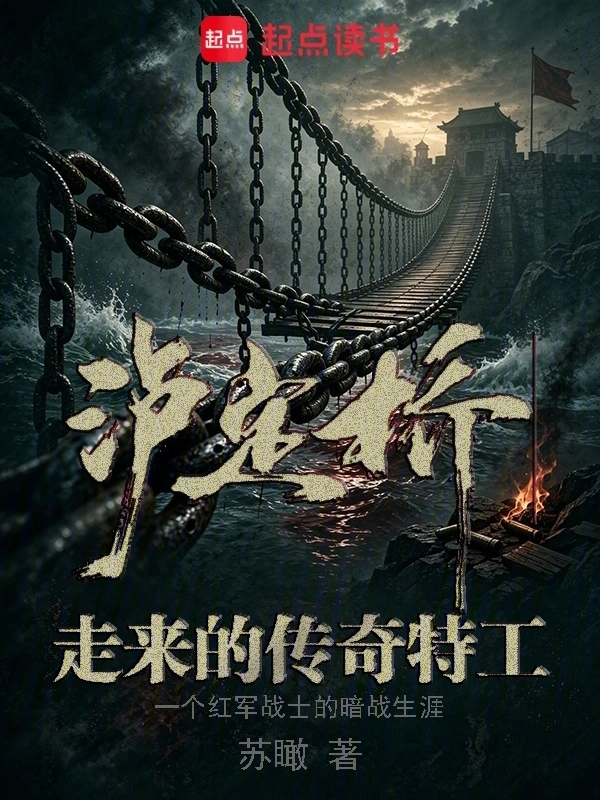
A Red Army Spy: From Luding Bridge to the Heart of the Japanese Puppet Regime
红军的潜伏:从泸定桥到日伪心脏
- Status
- Ongoing
- Length
- 254k Words
- Genre
- Military
- Audience
- Male
- Subgenre
- Spy Thriller
- Updated
- 3d ago
- Source
- Qidian
Stats
90Chapters
155Votes
664Recs
9Fans
Tags
Honours
Synopsis
Readers also read
 1950: Starting with the Seventh Reinforcement Company
 Pockmarked Face, Frying Pan: Killing Japanese Invaders from the Start
 Starting Out as an American Military Contractor
 Espionage: This Agent Is a Little Improper
 Please Call Me Your Majesty, the Tsar
 My War of Resistance Began at Gubeikou
 Popularity Above All: My Art Style Is Way Too Eccentric!
 I Just Went to College and Was Laid Off. the Counterattack System Is Coming.
 Going Undercover, Starting as a Temporary Agent for the Military Statistics Bureau
 Espionage: The Agent Who Can Leave His Body
 Forensic Pathologist 1994
😁, who was deceived by the author from somewhere, would like to give a first review. Two suggestions 1. If a pure southerner wants to learn Northeastern dialect for a few days, it is still impossible to act like a real local. Modify to add some northern background to the protagonist. 2. It is still a bit unrealistic for the protagonist to directly investigate Lao Han. Even if you don't suspect that the protagonist is also a spy, you will still consider the possibility that he will miss his old relationship and let Lao Han run away.
Song Shuyun
Beautiful, educated, but her true identity is questionable.
Deliver a valuable piece of information while keeping yourself out of it. This is true intellectual crushing. Allowing the other party to "reconnaissance" the information on their own is safer than actively handing over a small piece of paper, and it also makes the authenticity of the information unquestionable. Su Zhenmin can always create conditions for the military to reunify, for the Anti-Japanese Alliance, and for all anti-Japanese comrades to detect the information he wants to convey. In this case, he also has a God's perspective. He knows what the comrades are going to do next, but everyone does not know that there is someone secretly planning all this.
It can barely be regarded as food and fodder. The first ten chapters are all foreshadowing. The plot progresses quickly and there is no detailed and in-depth writing. It feels a bit semi-streamlined.
If you do things too frequently, your enemies will be too weak.
Yu Chunsheng
Special Service Police Officer, Su Zhenmin's successor.
Su Zhenmin
Red Army soldiers who have gone through the Long March are lurking in the Puppet Manchukuo Police Department, deputy chief and chief of the Secret Service Unit.
Meng Qingyu
Telecommunications personnel, lurking in the archives of the Secret Service Section of the Puppet Manchukuo Police Department
Zhou Dali
The shopkeeper of Yongchang Grain Store and the person in charge of the liaison station of the railway group
The title of the book has already summarized his origin: he climbed on the iron cable of Luding Bridge, he walked on the Long March, and he confirmed who he was in the gunfire in Zhiluo Town. Then in 1936, he was selected to do intelligence work and joined the Special Agent Section of the Changchun Police Department of the Puppet Manchukuo. He changed from a gun-carrying Red Army soldier to the Su Section Chief in the puppet Manchukuo spy system. The most attractive thing about the whole novel is not how he gets promoted, how he solves cases, or how he saves the day from danger time and time again, but the unique way he performs his tasks, allowing everyone to discover what he has to give.
This novel is still different from other pilot novels. The protagonist is an old Red Army soldier who gradually grows into an agent. In addition, it is also true that the underground party organizations in Manchuria were severely damaged in 1938.
Song Shiqian
Song Shi's business owner, Song Shuyun's father, was sympathetic to the anti-Japanese war.
Northeast underground organizations, this topic is very sensitive
Especially the Zhang Zuolin era and the Puppet Manchukuo era
Liu Tingxun
Head of the Secret Service Section, extremely egoistic.
Will these people appear? Hu and Hu's wife, Hu's wife's brother, the strange people who have been to the United States, Russia, England, France and Germany, will those from Tongwen Academy appear?
There is no omniscient enemy in this book, nor is there an omniscient protagonist. Therefore, everyone can only act based on what they see, hear, and their own judgment and logic. Why doesn't Liu Tingxun doubt Su Zhenmin? Because what he saw was: Chang Longqi was rescued from the outside, the traitor to the military reunification died in Ma Xiaozhi's leak, Kusumoto's leak pointed to the railway system, the movie change pointed to a problem with the film runners during transportation, and Su Zhenmin's files were verified by Xu Zhilai personally. When everything has other directions, he will investigate those directions first. He would not investigate a person who has not yet appeared in the evidence chain for no reason. If he were omniscient and omnipotent, of course he would be suspicious. But in the real underground struggle, the information everyone sees is fragmented, and their judgments are based on their respective positions and needs, not God's perspective. If you say "the enemy is too mentally retarded", you actually need to clarify the logic of the battle of wits first: instead of letting the protagonist fight against the enemy, let the enemy investigate in the direction he is most accustomed to, and then draw the conclusion that the protagonist needs. It's not that they are unintelligent, they just can't see the entire card table.
If I were Liu Tingxun and I found out that Su Zhenmin might be a traitor, my first choice would be to find a way to remove him and let others investigate, rather than find him out directly. In that case, I would also be unlucky. Uncovering a traitor from one's own department is not merit, but will lead to comprehensive scrutiny by the Japanese. This is the true psychology of a traitor.
The background of the times is that when the underground party in the Northeast has lost contact, it works without superiors and no organization. It is not an environment with a complete underground network. So the behavioral logic is different. You can refer to historical facts. When Pan Hannian rebuilt the underground network in Shanghai, he interviewed dozens of members one by one to determine their positions and tasks. It was quite dangerous, but someone also needed to do these things. The main purpose of developing members is to recruit original members, rather than easily instigating people in the hostile camp. This is reflected in the book. Instigating rebellion will only happen when there is absolute certainty. To instigate rebellion casually is to seek death.
No one is born a super agent, and neither is Su Zhenmin. He took advantage of Liu Tingxun's selective blind spots and achieved some initial results, but the threads left behind will be picked up by others. When someone is really ready to pull out the thread, he must learn how to defuse it and learn to protect himself and his comrades when danger comes. Grow into an excellent lurker step by step.
There are some things that are not consistent with common sense. People are developing too fast, it feels too straightforward, and there is too little attention to confidentiality and safety. It's not enough to mention the firewall. There are almost none of them. If you catch one and take out a bunch of them, they will all be ruined. If you care too much, once the seeds of doubt are planted, it will be exposed sooner or later.