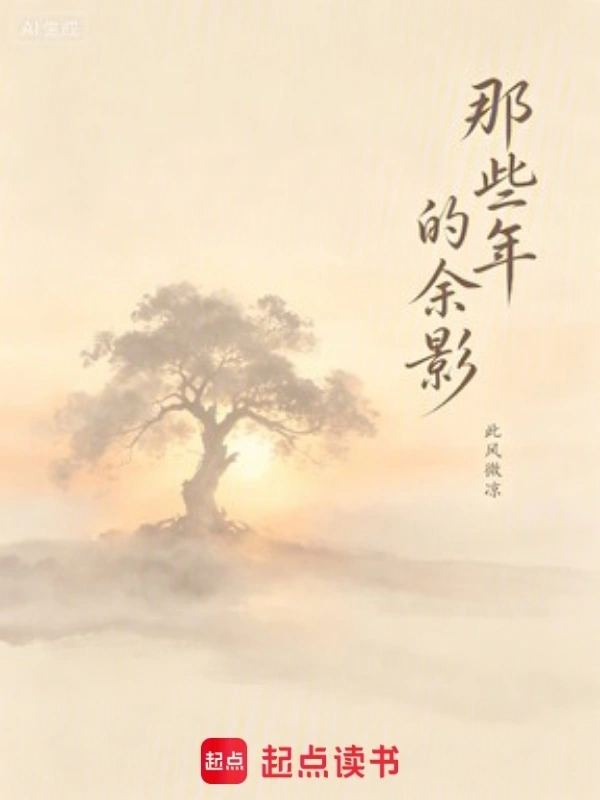
Remaining Images of Those Years
那些年的余影
- Status
- Completed
- Length
- 19k Words
- Genre
- Short Story
- Audience
- Female
- Subgenre
- Poetry & Prose
- Updated
- 23d ago
- Source
- Qidian
Stats
0Monthly votes
0Recommends
0Fans
9Chapters
Synopsis
Reader comments
Readers also read
 After My Brother and I Failed to Redeem Ourselves, the Movie Queen and the Female CEO Regretted Going Crazy.
 On the Fourth Day After My Death, My Whole Family Went Crazy
 After I Escaped and Left, the Empress Went Crazy
 Back to 1985, Salted Fish Turned Around and Went Overseas to Become Rich
 Lao Ji, Help Me Become an Immortal
 Green Hills
 Xuanjian Immortal Clan
 Traveling Through Time at the Same Time, How Come No One Is Human?
 Master Tao, I Became an Immortal, Only Then Did I Realize It Was the Red Mansion
 Alien Hotel
 Become a God from Water Monkey
 In the Name of Supernatural Power
 I Am the Destroyer of the World
Hometown is not a point on the map, but the melting snow
In the flood of readings about fantasy and immortality, "The Remaining Shadows of Those Years" is like a piece of cinders falling out of an old cotton-padded jacket - inconspicuous, hot to the touch, and filled with the unique pyrotechnics of winter in the northern countryside. It calls itself a "coming-of-age novel", but it reads more like a local chronicle warmed by the body temperature of a teenager. The author does not tell stories, he salvages relics; he does not create heroes, he watches a group of ordinary people disappear into the dust of the times. 1. Objects are tombstones: a sophisticated memory encoding system The most touching thing about this book is that it establishes a set of life codes that are almost impossible to copy. From the "white and tender cicada nymph with an enlarged head as it expands" in "Cicada", to the hexagonal coal stove with "rust and smoky marks on the outer shell" in "Heart of the Furnace", to the locust tree with "forty-seven and forty-nine rings" of annual rings in "Shadow of the Tree" - these are not props for describing scenes, but the hard currency of the author's memory. He wrote that the structure of the coal stove was as precise as an engineering student's drawing work: the air duct, grille, iron ash trough, the slope of the black iron chimney, and even such details as "the joints were all sealed with sticky yellow mud" are clearly visible. This way of writing comes with a price: you must have actually done your homework in front of such a stove, roasted sweet potatoes, and listened to the sound of your mother sucking the soles of her shoes. When urban literature still uses the big word "nostalgia" to express emotions, the author has already understood that hometown is composed of countless touchable objects. When the locust tree falls, the hometown loses a pillar; when the coal stove is abandoned, there is less warmth in the winter; when the cicada's chirping is stopped by the stick, the summer becomes deaf. There are eight chapters in the book, each chapter is a disappearing object, and together they are the collapse scene of a private museum. 2. The cunningness of perspective: who is watching, who is crying The author has an almost cunning awareness of the narrative perspective. The chapter "Mountain Travel" can be called the masterstroke of the whole book - he makes that "inconspicuous little stone hill" speak. Shan calls himself "I" and recalls that the boy "climbed trees to dig out bird's nests in spring and caught cicada nymphs in the forest in summer" on the slope, watching himself being "digged up by iron arms and put on trucks heading far away". This change of perspective is not just a show of skill, it also implies a cruel truth: in the disappearance of hometown, people are passive bystanders, while the demolished mountains and felled trees are the silent victims. When the young man "stands on the edge of the field and looks at the slope in the distance" but "finally stops on the spot", the identity of man and mountain is completed - man becomes the carrier of nostalgia, and the mountain becomes nostalgia itself. In "Guarding the Shore", the perspective falls steadily back to the human world. The image of Dr. Lin has ranged from SARS to COVID-19, from a young village doctor to a half-century-old man. He guarded the dilapidated clinic and refused to move, "taking the shade under the tree at the entrance of the village and chatting." If this character were placed in the main theme narrative, it would be easy to be written as a devotee of Gao Daquan; but the author writes that he was called a "bad guy" when giving injections to his children, and that he asked "me" to hoe grass to cure a cold before the college entrance examination - he is first a living person with a temper, quirks, and limitations, and then a symbol. This kind of disenchantment gives the word "persistence" a weight. It is no longer a slogan, but a calloused palm. 3. The wrinkles of time: from "that year" to "these years" The arrangement of the eight chapters implies a timeline, but it is not linear. From the early summer of "Cicadas" to the midwinter of "Snow Trails", from the childhood fears of "That Night" to the adult choices of "Clear Blue", from the cold window of "Heart of the Furnace" to the bitter reading of the collapse of the hometown in "Mountain Journey" - the author is constantly switching time and space, like a person rummaging through old boxes in the attic. This structure is a "disadvantage" in the logic of online novels: there is no main line conflict, no upgrades to defeat monsters, and no "cool points". But in prose narrative, this is the honest form of memory - when we recall childhood, it is never the order from A to Z, but the floodgates suddenly opened by a certain smell, a certain song, a certain weather. There is an unforgettable description in "Snow Traces": My father pushed his bicycle to send "me" to school in the town on the icy yellow mud road. "My feet became weak for a while, the ice was slippery, and I was trembling with every step." This scene does not have any dramatic twists, but it describes the Chinese-style father-son relationship - the father does not hug or express love, he is just "agile, thanks to excellent professionalism, and has strong and powerful steps on the ice", and then let his son push the bicycle "at least there is a fulcrum." Looking back many years later, the author realized that the bicycle was all the support his father could give him. This kind of "hindsight" pain is both a gift from time and a plunder from time. 4. Why is it "not enough for the Internet" but therefore precious I must honestly say that "The Remaining Shadows of Those Years" is an anomaly in the literature ecosystem. It has no golden fingers, no system, and no counterattack in the face; its "exhilaration" is ruminant, the empty relief after "I bought all the cicadas, ran more than ten kilometers for this purpose, and released them." It is not even a "realistic theme" enough - because it is not about the grand narrative of rural revitalization, but about how the countryside is losing itself inch by inch. But precisely because of this "untimeliness", it has another value. In an era where algorithmic recommendations are becoming more and more accurate, and in a world where readers are trained to accept only the rhythm of "three chapters and one cool spot", this book stubbornly maintains the breathing sense of prose. It allows itself to slow down, allows an explanatory text about the structure of a coal stove to exist, and allows a heavy snowfall to cover the old days without immediately "lighting the path underfoot." The author said: "Mountain travel is never just about people walking through mountains and rivers, it is also about mountains lasting forever through people's memories." This sentence can almost be regarded as a footnote to the whole book. What he wrote was not the story of a person walking out of the mountain, but how a mountain stood up again on paper with the help of a person's pen. 5. Conclusion: The Aftermath of Those Years has not disappeared, it just changed its carrier After reading the whole book, I remembered what Benjamin said: "The storyteller draws on the life he has experienced or heard about." In this sense, "The Aftermath of Those Years" is the last storyteller - his way of telling is ancient, his materials cannot be copied, and his sadness is not publicized. If you are looking forward to the adrenaline rush of your subway commute, this book is not for you. But if you suddenly smell a long-lost smell of coal smoke late one night, or inexplicably miss the noise of cicadas in an air-conditioned room - then turn it on. You will find that your hometown never really disappears, it just turns into a shadow and continues to grow on the pages through the pen of a young man. Rating: ★★★★☆ Recommendation: For all those who were once children and are now learning to be adults. To all those whose hometowns are disappearing or have disappeared.