


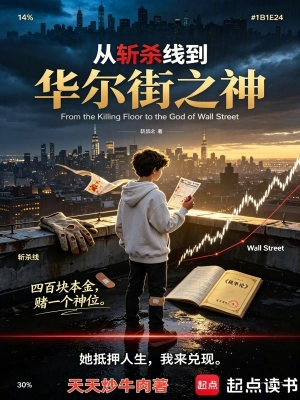
From the Kill Line to the God of Wall Street
从斩杀线到华尔街之神
- Status
- Ongoing
- Length
- 1.6M Words
- Genre
- Urban
- Subgenre
- Business & Workplace
- Updated
- 1d ago
- Source
- Qidian
Stats
220Chapters
758Votes
10.2kRecs
80.3kFans
Tags
Honours
Synopsis
In booklists 2





System Book Recommendations
A systematic list of new releases, well-written novels, imaginative stories, and more. Readers are welcome to leave recommendations in the comments. I'll do my best to read them and add any good ones to the list.
55Books4kFollows9hUpdated




Tian Juan's Reading List
Books I've read
9Books2Follows1moUpdated
Readers also read
 I’m a Cop, Why’d You Give Me an Esports System?
 There’s a Door in My Warehouse
 In the Americas, From Security Guard to Call of Duty
 Hong Kong Tycoon: 1963
 Simultaneous Transmigration: Is Everyone Starting Out in Prison?
 I’m a Genius Trader!
 The Art of Making Money
 A Dual Status Panel Descends into the Abyss, and the Assassin's Potion Is Right at the Entrance
 The Black Witch's Journey to Another World
 America: Starting Out as a Wall Street Intern
 From Legendary Short Seller to God of American Capital
 Building a Tycoon Dynasty on Hong Kong Island
Reader comments 49
Google Translate
I have seen the latest chapter. The core point of this book is to dig into the details and thoroughly study every line of financial reports and various related news in order to discover the correct direction of the market. This method is correct, but the vast majority of retail investors and financial practitioners cannot do it even if they know it. Even if they do it, they cannot understand the logic behind the details. There is always a pattern throughout the book. Whichever stock the protagonist buys, he must arrange for another person to place an order in the opposite direction as a comparison. Also, unless you are a reborn person, do not touch leverage trading. Even if you think the market has given a definite answer and then copy the answer, leverage can still kill you.
The protagonist will lose a lot in the end, because the protagonist is increasingly being mythologized by the people around him. Strictly speaking, the protagonist is not self-discovering the market, but using the memory of past lives to verify the occurrence of nodes in the market. Once the protagonist is out of the rearview mirror, how much is left for the protagonist? The 2008 subprime mortgage crisis and these big shorts will be closed. God, but later on, Burry went short on AI and went long on Chinese concept stocks and lost money until he retired. Paulson lost more than 80-300 a few years and then switched to M&A.
The more I look at it, the more I find the logic to be weird.
The author's writing tone: All operating information in the market can be searched and analyzed by the software system, and the information is completely public. So Linton can talk openly in public places, on Facebook, and disclose all his operational information. The only factor that determines Linton's success or failure is his "logical framework of thinking." This is ridiculous! In the famous "GameStop" incident on Wall Street, short sellers were beaten up by retail investors. If we follow Linton's "logical framework of thinking", short sellers should have no problem. As a result, due to the exposure of short positions, the Wall Street capital hidden behind the scenes used the emotional impulses of retail investors to guide the market trend and destroy the short positions. Does Linton's logical thinking framework include the factor of "retail investor sentiment"? The founder of Greenlight Capital, the famous Einhorn, wrote a book "Cheating All the Way to the End", telling the story of his eight-year struggle with United Capital. Einhorn discovered that United Capital was cheating and he shorted the company. As a result, United Capital used all its connections and means to refuse to admit defeat. Einhorn was furious and got into a fight with United Capital. As a result, it lasted eight years! Although United Capital was eventually exposed, Einhorn won. But it took eight years and consumed too much of his energy and time. Finally, he published the book "Cheating All the Way to the End" to record the entire process. If the subsequent subprime mortgage crisis is all based on the writing tone of "operating information disclosure → waiting for logical verification → silly dog betting and dog jumping → company information will be mined on time → big victory", it will be meaningless. I have read a novel before, about the United States stopping the exchange of U. S. Dollars for gold: a veteran banker, a Soviet foreign trade official, and a Jewish trader. They all judged through various methods that the United States would stop converting US dollars into gold. The veteran banker has a large number of long positions in U. S. Dollars, and he must close his position quickly without letting other market operators know about it. The Jewish traders were approached by an Arab family who had a large amount of gold in hand. Arabs have always liked to use gold as a means of trade circulation. The Arabs fought several wars with Israel in the last century and were sworn enemies. As a result, in the novel, they started a business. Arab families asked Jewish traders to help them with the U. S. Dollar foreign exchange market. The veteran banker saw the Jewish trader's transactions and was afraid that he would affect his closing of the position. Through his transactions in the Swiss Bank, he asked the Swiss police to find a crime and lock up the Jewish trader, so that he could not complete the transaction. Next, the United States stopped converting U. S. Dollars into gold, and veteran bankers made huge profits and were touted as investment superstars. The veteran banker took his wife on vacation. On the winding mountain road, I was blocked by a broken down Arab car. Behind, the banker's car falls off a cliff. If the author continues writing like this, Linton and his mother will have no other ending than "people under the Atlantic Ocean".
After reading the latest chapter, this book gave me a feeling of either good or bad, somewhere between them. The details, writing style, and professional knowledge were all fine, but it felt dry. Everything was a cycle, short selling, debating with others, questioning by others, discussing with school people, expressing opinions, and making a lot of money by slapping people in the face. What I don't understand is why so many people question a person who can be right several times or more than a dozen times? Also, why do you have to explain to so many people? I wish I knew everything about the market. Don't I need to keep it secret? Can I just tell others about my strategies? Or is it to make friends with powerful people? If that's the case, it's understandable. Then when writing, emphasize that it is to pave the way for the future and make connections, and slap in the face is to win over people in the future. Otherwise, I don't understand that others don't agree with you at all, and you just explain it to me and just ignore it.
When the cook and the dishwasher were talking about stocks, they quickly ran away. Except novels.
This is my record. I think the author's novel still has some insights.
The beginning is amazing, with no nonsense or procrastination. Even when it reaches the killing line, there are no complaints about bitterness and hatred, just like an old man telling the story of that period of time lightly. Very good.
If you don't understand, just ask, is Lao Li the real protagonist?
I have a feeling after reading the latest chapter There are so many supporting characters that are very strange. I have saved up my family fortune for several years and then go to stock trading as soon as my brain gets hot, and I still go into it all at once? Even if a normal person wants to invest in stocks, how dare you invest all your money for eight or ten years? Don't you just take your time and put in a little bit to test the water first? Are the supporting characters not normal people just to highlight that they do the opposite of the protagonist every time?
The novel should be renamed "10,000 Ways to Die on Wall Street"
Seeing now, there is no book in the novel that does not involve gambling! The first type, Linton, has always been option selling. The only difference is that Linton came from later generations and has a solid foundation and knows the historical trends. The second type is hedge funds such as Paulson Fund. But they are really the gambling gods in the world. The third type, Anna, the heir to old money. He has a unique vision, but he is also a gambler. She sold short, then put on leverage and exploded. The fourth type, the third life, is the old money among old money. Even if you are too old, you still have to take a big gamble in a crisis. The fourth type is company employees like Xie Yongnian. Turning a blind eye to the company's plight has cost him his entire fortune. The fifth type is retail investors betting on dogs. There is something I don't understand here: Are American investors so gambling? Every time you invest, it's all about your net worth! And whether you are a retail investor or an heir to old money, you are all levered! TMD is crazier than Big A investors! Only Koreans can compete!