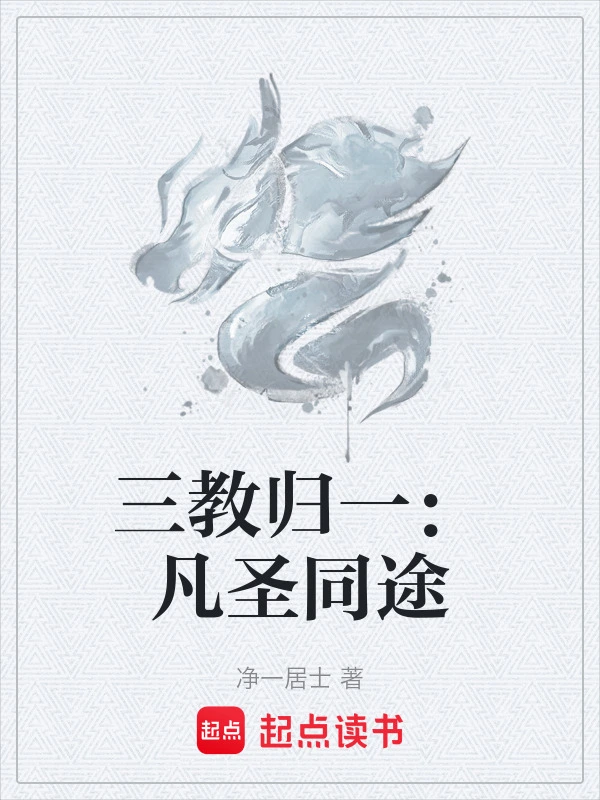
Three Religions Unified: All Saints Are on the Same Journey
三教归一:凡圣同途
- Status
- Completed
- Length
- 1.2M Words
- Genre
- Eastern Fantasy
- Audience
- Male
- Subgenre
- Eastern Xuanhuan
- Updated
- 1mo ago
- Source
- Qidian
Stats
0Monthly votes
3.7kRecommends
0Fans
220Chapters
Synopsis
Reader comments
Readers also read
 America: I Loaded the Plague Doctor Template
 The Fairy Struck Out a Genius with a Mallet
 Cultivation to Immortality 30,000 Years in Advance, the Myth Comes
 Starting from a Spiritual Medium and Becoming a Martial Artist
 Lao Ji, Help Me Become an Immortal
 Handbook of Human Anomalies
 American Demon Hunting Idol
 Traveling Through Time at the Same Time, How Come No One Is Human?
 Master Tao, I Became an Immortal, Only Then Did I Realize It Was the Red Mansion
 Qualified Candidates: Start as a High Wall Worker
 Red Dragon
 Become Infinitely Stronger Starting from Receiving the Thank You Letter
China
"Zuo Zhuan" says: "China has great etiquette, so it is called Xia; it has the beauty of uniforms, so it is called Hua.
Remarks at the end of the third volume of "Questioning in Heaven: The Return of the Three Religions"
When the fairy tale narrative is often trapped in the stereotype of "fighting monsters to upgrade, fighting for power and gain". The third volume of "Three Religions Return to One: Mortal Saints on the Same Journey" "Ask the Heavenly Realm·The Return of the Three Religions" tells the story of a reincarnation of cause and effect spanning a hundred thousand years, the awakening of the three religions of blood and fire, and the rush to the love of death and life again and again. The core of "asking" has been sublimated from the obsession of personal immortality to the responsibility of protecting all living beings. Completed the fundamental transition from "skill" to "Tao", from "division" to "combination". This volume is a key chapter connecting the previous and the following chapters of the whole book. It starts with the establishment of the Trinity Palace by Su Qingxuan, and spends hundreds of years laying out the difficult journey of "the unification of the three religions" from concept to practice. I did not rush to advance the plot, but concentrated on writing Su Qingxuan's "pragmatism": Compiling common classics, resolving preaching disputes, formulating fair regulations, eliminating resource conflicts, and establishing co-cultivation schools to break sectarian opinions. This kind of governance wisdom of "not being radical and not biased" makes "the unity of three religions" no longer a slogan in the air, but a system and consensus that has taken root. It also laid the most solid foreshadowing for the subsequent desperate situation of unity and the integration of the three religions into a consensus. The bloody battle at the Meteorite Origin is a small climax of this volume and one of the most shocking chapters in this volume. I used an almost cruel brushstrokes to describe the devastating consequences of sectarianism: 90% of the one million coalition troops were lost, tens of millions of creatures in the Green Underworld were devastated, and not a single one of the 30,000 elites in the Trinity Palace was left. Chen Song's self-destruction, the life and death dependence of the Han Xue sisters, Ling Xue's fall like an autumn leaf, Yunqing Taoist's determination to follow the Tao with his broken arm... The passing of these fresh lives is not a cold number, but a heavy hammer that will hit the reader's heart. It was the blood everywhere that shattered the last stubbornness of the conservative factions such as Qing Bing, Kong He, and Huiming. It also allowed Su Qingxuan to break through the shackles of the Golden Immortal and achieve the sub-sage dharma of the three religions in the midst of extreme grief and guardianship. "The heart of the Tao returns to its true form through repeated training, and is no longer empty talk in the blood." This battle proved with blood and fire: the way for the three religions to survive is never to fight independently, but to work together with one heart and one mind. If the Battle of the Falling Star Plains is a "practical breakthrough", then the Lingxiaotai Discussion is an "ideological revolution". Su Qingxuan did not use the coercion of Da Luo to overwhelm others. Instead, he used thousands of years of data, classics of the three religions, and comparisons of battle cases to gradually dismantle the fallacies that "the ancestral system cannot be violated" and "I am the only one who respects the Taoism." He proposed that "the three religions are united into one, which combines the heart of controlling demons and protecting the world, and the ambition of helping the world and saving people, rather than annihilating the characteristics." He accurately hit the core of the dispute between the three religions. When the Jade Emperor and the saints of the three religions nodded their heads in approval, and when the most stubborn elder confessed his mistake with tears, the ice of thought that had been in the world for thousands of years finally melted. This paragraph of discussion not only makes the story logically consistent, but also gives the "three religions unification" a philosophical meaning that transcends Xianxia itself: True tolerance is seeking common ground while reserving differences; true strength is harmony without difference. The awakening of memory in Guizhen Cave is the most fatalistic ending to this volume, and even to this book. I am here to reveal the biggest foreshadowing throughout the book: Su Qingxuan is not Su Lie's descendant, but Su Lie's "returning body" that has been laid out for 100,000 years by relying on his true spirit at the cost of his military liberation. The four fairies have been reincarnated for a hundred thousand years, the deep love that follows them through martyrdom, and the tragic story of Su Lie sacrificing his life to protect the Tao, stealing the sky and changing the sun. At this moment, they are intertwined into a great network of cause and effect that spans time and space. It turns out that "emotional calamity" has never been an obstacle to spiritual practice, but the only way to achieve the perfection of Taoism; It turns out that the recasting of the three teaching seals is not only the fusion of power, but also the inheritance of a hundred thousand years of unfinished ambition. This setting allows the love between Su Qingxuan and the four fairies to get rid of the cliché fairy romance and sublimate it into the compatibility of souls and the resonance of mission. The author believes that the most touching thing about this volume is the warmth and responsibility under the grand narrative. Su Qingxuan was cleaning the tombstones alone in the Yinghun Mausoleum. His fingertips touched the cold names one by one, carving the promise to the deceased into his heart; He and the four fairies accompanied his parents to drink tea and play chess. In the smoke of fireworks in the bamboo forest, the burden of being the leader of the three realms was lifted off; In front of the reincarnation stage, the five people jumped into the whirlpool hand in hand. There was no sorrow of life and death, only the determination of "we will never be separated again". These details give the aloof immortals a human warmth, and also give the most vivid interpretation of the theme of "Mortal Saints on the Same Journey": The reason why saints are saints is not to transcend the mortal world, but to always have their hearts attached to the mortal world. When Su Qingxuan and the five self-proclaimed cultivators stepped into the reincarnation passage leading to the modern human world, the third volume came to an end. The storm in heaven has paused, but a greater test is waiting in the world of mortals. This volume not only completes the preliminary unification of the three religions, but also deepens the root of the demonic calamity from "the external demon" to "the common cause of the human heart", and points out the ultimate direction of "it is better to transform the demon with the heart than to seal the demon with force". It tells us: The real avenue is not in the palace in the clouds, but in the ordinary alleys of the world; The real salvation is never the heroism of one person, but the passing on of the torch of unity among all living beings. The blood fertilizes thousands of peaks to melt old grudges, and the Taoist ginseng and thousands of legal evidences are of the same mind. The third volume begins with blood and fire and ends with love and responsibility, showing us a world of practice with a grand structure, sincere emotions and profound thoughts. The upcoming fourth volume, "Mortal Tribulation: The Fire of Civilization", will turn its perspective to the modern world. Let us look forward to how Su Qingxuan and the four fairies will renew their relationship and resolve the cause and effect in the reinforced concrete jungle; how to light up the eternal lamp of civilization in the era of prosperous science and technology. The author said: As the person who wrote this story, when I typed the last period of the third volume, my fingertips were still warm. From early spring to midsummer, I spent more than four or five months at my desk day and night. The moment Su Qingxuan and the four fairies jumped into the whirlpool of reincarnation hand in hand, I knew in my heart: The "final chapter" here is not the end, but a journey spanning eternity, the true beginning of a greater story. Looking back at the journey of these three volumes, it feels like I have walked a complete path of cultivation with Su Qingxuan. In the first volume, he is still the young man from the south of the Yangtze River holding the "Analects of Confucius", carrying his luggage and traveling around famous mountains and rivers. He understands benevolence and righteousness in the sound of Confucian books, understands nature in the clouds of Taoism, understands compassion in the bells of Buddhism, and plants the seeds of the unity of the three religions in the world of mortals. In the second volume, he stepped into the turbulent court, worshiped the prime minister as a scholar, used the wisdom of the three religions to clean up the government, quell the border troubles, and appease the people. On the land of the world, he turned the ideal of "helping the world and ferrying people" into a real scene and prosperity. And in the third volume, when he ascends to heaven as a saint on earth, I have to let him "start from scratch" again. Without innate authority, he could only build the Trinity Palace step by step in the heaven where the three religions are numerous and the gates are strict. He gathered the Sanxian Alliance and the Sword Sect little by little, and battled wits and courage with the conservative faction time and time again. The trial of life and death in the Demon Sea, the difficulty of the Assistant Secretary, the bloody battle in the Falling Star Plains... Those days and nights when he gritted his teeth and persevered, those moments when he lost his disciples, those moments when he defied everyone's opinions. No matter how difficult it was for me to write, how heavy it was for him to walk away. The way of the unity of the three religions, from the hazy ideal of a young man to the common belief of all immortals in the heaven, he walked on this road for three full volumes, and I also stayed with him through countless sleepless nights. Many readers asked me why there are so many "confrontations" in the third volume? Why should Su Qingxuan be asked to sue the God of Wealth, to confront the Ten Palaces of Yama, to challenge the superior and unquestionable authority of the immortal gods? In fact, the answer is very simple: Su Qingxuan's Tao has always been the Tao in my heart. In the world of Xianxia, we are used to worshiping immortals and gods, we are used to the fatalism that "the destiny of heaven cannot be violated", and we are used to seeing aloof gods deciding the life and death of mortals at will. But I don't believe in this evil. I wrote that Su Qingxuan sued the God of Wealth, because I wanted to tell everyone: If a deity takes bribes, perverts the law, and preys on the common people, he is no different from a corrupt official in the world, and everyone can sue him; If Du is selfish, there is no need to fear him, and everyone can resist him; I wrote about his verbal battle with the immortals at the Three Religions Dharma Conference, breaking the ten thousand years of sectarian opinions. I want to tell everyone: the so-called "ancestral system" and "Taoism" should be broken and reformed if they become shackles that hinder progress and harm all living beings. What I really want to write is never a cool protagonist who "fights monsters and levels up", but an awakened person who dares to question, resist, and speak out for the common people. I want to break the blind worship of gods and let everyone understand: True cultivation is never worship of a superior god, but the persistence and sublimation of one's own heart; The real saints are never born gods, but ordinary people who stand up in suffering and light the lights in the darkness. The four words "all saints share the same journey" are not an empty slogan, but my core original intention in writing this book: Everyone has Buddha nature, everyone can become a saint, my destiny is determined by me and not by God, and everyone can be his or her own light. In the past few months of writing these three volumes, I have also experienced a lot of struggle and confusion. Sometimes I wonder if such a theme would be too heavy? Is this expression too straightforward? But when I wrote about Su Qingxuan standing on the meteorite field, shouting to millions of magic soldiers, "Where is my way?"; When I wrote about him using iron-clad facts to smash the fallacies of the die-hards at the Dharma meeting and on the Taoist forum, I knew that I had to write it down. Now, Su Qingxuan and the four fairies are about to enter the reincarnation of the modern world. The storm in heaven has paused, but the test in the world of mortals has just begun. In the fourth volume, they will meet again in the reinforced concrete jungle, rediscover the meaning of Tao in the era of prosperous science and technology, and continue to practice the ideal of "the three religions are unified, and the saints share the same journey" in the more complex human nature and society. And I will continue to accompany them with this original intention...
Red envelope benefits for those who have achieved 30 chapters or more
Each chapter with 30 comments will receive red envelope benefits. Everyone is welcome to comment on the book, thank you all!
Regarding the red envelope, a brief explanation
Recently, book friends have repeatedly inquired about the author's distribution of red envelopes. Here is a unified reply to clear up your confusion: I am not writing novels for profit, but I am willing to use my own money to polish my novels for you to read and interpret. My words may not be perfect, may not be full of pleasure, may not be explosive, but the thoughts contained in them are true and pure, and I dare not violate my original intention. The rest of the book was written not to please others, but to convey Xiu's purpose in the form of a novel. If you can understand a little bit of the secrets of Confucianism, Taoism, and Buddhism from the lines of the words, and be enlightened on the path of spiritual practice, or even develop a heart for Taoism by reading this novel - then I hope that will be enough! I believe that writing this novel is a matter of benefit to the country and the people, and it is also a far-reaching undertaking. The values and practices described in the book are in line with the path of cultural awakening and national rejuvenation. In this case, I sincerely hope that readers will benefit more from it, so I would like to give you a meager red envelope to express my encouragement. Although the red envelope is light, the intention is heavy. I only hope that you all will know and learn from it.
"The novel is the shell, and the text is used to carry the Tao"
I spent the last year of my life in bed and had surgery, and spent more than a month in solitary confinement. With everything in silence, I came up with a thought: If I want to preach to the world, what method should I use? Today's Buddhism, Taoism, and even Chinese studies lecture halls mostly follow the old system of preaching scriptures, which is boring. And the popularity of classics is really worrying. I did a little research in the group the day before yesterday and found that very few people could read a classic in its entirety. If you state the truth directly, it will not only be boring, but also very few can understand its meaning. Therefore, I think, it is better to use novels as a boat to carry the road. Integrate the principles of heaven and earth, and the spiritual method of cultivation into the lines of the words, subtly and slowly unfolding them. To enable ordinary readers, who are ignorant and ignorant, to gradually become familiar with it, and finally wake up; to enable those who are practicing, or want to practice but are at a loss, and cannot find the way to enter, to encounter a suitable method in a certain chapter and section, and gain enlightenment; to enable those who are obsessed with form and shackled by practice to see through the illusion and let go of their obsessions. Everyone has his own abilities, so what he gets from the book should be different. However, there is no fixed method, and there is no superiority or inferiority. If it can respond to opportunities, it is a good method. When it comes to spiritual practice, we must have a grand narrative and a high-level structure, but we must also not be divorced from the trivial life and realistic situations. The foundation of spiritual practice is really about faith. What is faith? This is the core issue for practitioners, and it is what this book aims to explore and clarify. Many people in the world have misunderstandings, thinking that faith is religious belief. What a fallacy! Those who have religion may not have true faith; Those who have no religion may not have true belief. Yu Yu's book will use the protagonist's experience and vision to explain the true meaning of faith to the world. However, it is not easy to write a book with this intention, let alone a million-word novel. How to construct a story and how to convey it naturally in the plot is really a big problem. It is difficult to describe the truth. Once it is announced, its true nature will be easily lost. Chinese culture places great emphasis on metaphor. The classics such as "The Red Mansion", "Journey to the West" and "The Golden Vase", as well as Tang poetry and Song lyrics, all use metaphor as a method. The brushwork of the Spring and Autumn Period has become a common practice in Chinese writing. Non-Chinese literati tend to be obscure, but the real reason is that Chinese culture itself is the carrier of Tao, and Tao cannot be expressed directly. Poets express Zen feelings in their poems, while literati express their concern for the common people and sublimate their lives in their articles. This is certainly a wonderful thing about Chinese culture, but it also makes novel creation more difficult. Kuang Yu has little talent and little knowledge, and there are many things that are unsatisfactory in terms of controlling the characters, laying out the plot, and setting the climax. Therefore, this book is destined to be difficult to become a hit online article and difficult to be known by the public. However, as a practitioner, what I seek is not fame and fortune. I only hope that I can convey a glimmer of kindness and a glimmer of light to the world so that more people can benefit from it. Because we are all a community of destiny. The awakening of one person is a ray of fire for Chinese civilization; The awakening of everyone can lead the future of world civilization. I dare not expect too much. I can only do my best and work quietly. Although the level is limited, we must work hard start and finish well to complete this book.
"Three Religions Reunite into One: All Saints Are on the Same Journey" Book Club
QQ group number: 801378198 Welcome to join the group! This is a group of book friends for "Three Religions Unify: All Saints Are on the Same Journey". Everyone can chat in the group about their reading experiences, thoughts, and confusions... Because the novel is positioned as a spiritual practice, cultural renaissance, and civilization inheritance. So, everyone can discuss and share in the group around these topics. The group owners will also share their creative and spiritual practice experiences in a timely manner for everyone's reference. Also notify the group in advance of the time for red envelope distribution. I hope everyone can discuss and share rationally, and jointly build and witness a prosperous China!
This novel has no routines and is not a pure "killing monsters and upgrading" online novel. The novel creates a real cultivation path and experience that everyone can "cultivate". Life is originally a "cultivation", which is just divided into unconscious and passive cultivation and conscious and active cultivation. Cultivation is a lifelong matter, even to the future, and it will not be accomplished overnight. Therefore, it needs to be laid out slowly, and it cannot be upgraded suddenly, which is unrealistic. It needs to go through different trials and tribulations, and continue to polish it bit by bit, until it becomes a tower. Therefore, this novel is a slow-burn novel. It needs people who are destined to be dedicated to spiritual practice, awakening to cultural context, and awakening to cultural civilization to slowly read it, gain insights, and benefit from it. Your patience is also a kind of practice in itself. The fast food culture may not touch the soul and awakening when it is good for a while. Slow heating has the advantage of slow heating. It is polished carefully, like a trickle, and it will eventually converge into the sea. I hope that after reading this book, everyone will be able to feel peaceful and spiritual, and have a sense of awakening and enlightenment in life, civilization, and culture. Thanks for having you all the way!
Idiom Solitaire, there is a red envelope
Many of our idioms come from the summary of the evolution of Confucianism, Taoism and Buddhism. Let's play a little game, Idiom Solitaire: Name the idioms related to Confucianism, Taoism and Buddhism. Let me start by throwing some light on the topic. Do one's best and come from Confucianism. Naturally, from Taoism. Obstinacy comes from Buddhism. More than sixty idioms, that is, twenty groups, Hand out red envelopes!
"Ode to the Way of Practicing the Ming Dao"
The way of heaven and earth depends on the interaction of yin and yang; the line of humanity depends on the passing of fire from generation to generation. Practitioners do not just avoid the world and practice pure cultivation, but also use their hearts to understand the Tao, use their literature to inherit the tradition, and use their spirits to return to the truth. The ancient sages, who studied things to gain knowledge, were sincere and upright, wanted to awaken the world and awaken the people, continued to write gracefully, and cultivated their nature and spirit without ignorance. The "Book of Changes" says: "Heaven moves vigorously, and a gentleman strives to constantly strive for self-improvement." This is the foundation of spiritual practice. Confucius and Mencius advocated benevolence and propriety, Laozi and Zhuangzi respected nature, Buddhism clarified the nature of mind, and the three religions have the same origin. In the past eight generations since Chang Li Wen's decline, Yang Ming's purpose of revealing conscience was based on cultural context as the bone and awakening as the soul, breaking away confusion and attachment, and enlightening future generations. In this world, things are changing with each passing day. Some people are obsessed with things, or they forget their roots. Their spirituality is covered in dust, and their cultural context has little continuity. Therefore, if you want to be polite, you must first awaken your mind; if you want to awaken your mind, you must first cultivate your body. Let go of the attachment to worldly work, get rid of the difficulties of gain and loss, release and protect living beings, and be compassionate. This is the state of Shi's "heart without worries", which is also in line with the Taoist purpose of "Tao follows nature." Cultural awakening is not about empty talk, but about experience; cultural revitalization is not about imitating the past, but about inheritance. If you nourish your heart with classics, use sages as mirrors, cultivate your virtue internally, and inherit the Taoism externally, then your soul will rise and your original mind will become clear. Sigh! The path of spiritual practice is the path of continuation, the path of awakening, and the path of sublimation. I hope that we can keep the roots of culture, understand the principles of mind and nature, let the Chinese cultural heritage be revived, and let the spirit return to its roots and become clear. This way, the heaven and earth will be harmonious, consistent in ancient and modern times.
"The Story of Beginning of Summer"
Today Dou points to the southeast, and Wei means the beginning of summer. The wind is warm, the days are long, all things are beautiful, and the energy of heaven and earth is growing and prospering. We try to use this section to get a glimpse of the mentality of Confucianism, Buddhism and Taoism. Confucianism calls "ritual". The beginning of summer is the time to "make oneself and things come true". When a gentleman observes this phenomenon, he should be sincere and sincere, so that his virtuous deeds will flourish like grass and trees, growing new and renewed day by day. At this time, the energy of heaven and earth intersects, and the sage uses this ceremony to teach people not to be impatient or lazy, and to maintain integrity amidst the noise. Xia means greatness. The greatness of a gentleman lies in his ability to accommodate the growth of all things and his ability to shoulder the heavy responsibilities of the world. This is the strength to enter the world. Taoism calls "truth". The crickets chirp, the earthworms come out, the heaven and the earth are left to their own devices, without any artificial decoration. Laozi said: "Man follows the earth, the earth follows the heaven, the heaven follows the Tao, and the Tao follows nature." The beauty of the Beginning of Summer is that everything grows on its own without fighting. If people follow the example, they should follow the Qi of the four seasons, so that their mind and spirit can be as free as a flowing spring, not stagnant in things or tied to forms. Sit quietly with your eyes closed, listening to the chirping of cicadas and the chirping of birds, and you are one with the Tao. This is the freedom of being born. The Buddhists say "empty". The rose has withered, the pomegranate has bloomed, and the prosperity and decline are only fleeting. When Buddhists see the peak of summer, they see the desolation of autumn, and they see impermanence in the prosperity. The mind has no worries and does not dwell on the appearance. The heat and troubles at the beginning of summer are just like the troubles of all living beings. If you can cool down in the moment and realize your true heart, then the red stove will sparkle with snow, how can it not be a pure land? This is the enlightenment that destroys attachment. The three teachings may appear to be different paths, but in fact they lead to the same goal. The "life" of Confucianism, the "nature" of Taoism, and the "impermanence" of Buddhism all come together in one mind. Therefore: The Beginning of Summer is not just a solar term, it is also a mirror of the heart. You practice rituals in the midst of prosperity, you practice truth in nature, and you practice emptiness in the midst of impermanence. The combination of the three means: being able to keep the rules in busy places, being able to relax in the breeze, and being able to see through the changes. In this way, every day will be the beginning of summer, and every step will be cool.
Twice a day
Keep updating twice a day, and there will be another update tonight. Thank you book friends, give back to the public, red envelope benefits, always valid! To thank book friends: 1. For every fifty comments added to the book, a red envelope will be sent to the book friends. 2. Update the chapter. If there are more than 30 comments, a red envelope will be sent. I hope all my book friends will give me support, encouragement and support! I will keep reading twice a day, and there will be another update tonight. I hope everyone can comment and correct me a lot! Your support is the motivation for me to update and send out red envelopes, hehe! This is my first time posting online, and I still have a lot to learn from everyone! Thank you everyone!
"May 12th Sacrifice"
On May 12, 2026 AD, at the age of Bingwu, it was the 18th anniversary of the Wenchuan Earthquake. Recalling that in the midsummer of the Wuzi year, in the land of Bashu, mountains collapsed and the ground cracked, and buildings collapsed; a county in Wenchuan was turned into a ruin. At this time, hundreds of miles of smoke and dust, thousands of households were annihilated. Countless Yanhuang compatriots and elders in their hometown died under the rubble, and their souls died in a matter of seconds. Every time I think about this, I always express my condolences, lamenting the insignificance of human power and lamenting the fragility of life. Suddenly eighteen years have passed, the dead are gone, and the living are like this. A new city now stands above the ruins of the past. Lu Yan rushes to the ground, the bells ring and the food is eaten, all industries are prosperous, the people are happy, and there is a prosperous scene. However, bringing up old things today is not to remember the pain, but actually to mourn the loss. In the past few hundred years, our people have experienced many hardships, including the pain of broken mountains and rivers, as well as human and natural disasters. To mourn the suffering and bear in mind the scars is the beginning of national awakening. Buddhism says: "Suffering is the teacher." After this great calamity, we know that things in the world are impermanent. We should cherish the present moment, be less obsessed with it, and observe life and death with a normal mind. Taoism says: "Tao follows nature." Before the majesty of heaven and earth, we know more about reverence. If we want the harmony between heaven and man, we must protect the green mountains and green waters and cherish the vitality of all things. Confucianism says: "A gentleman strives to constantly strive for self-improvement and to carry forward his virtues." Being in front of the power of nature, he should respect nature and be unyielding, thereby sublimating the realm of life. There is an old saying: "The great affairs of the country lie in military service and sacrifice." Today's sacrifice is intended to be cautious and pursue the future. Therefore, the 512 sacrifice has great meaning. It is not only the introspection and sublimation of personal emotions, but also the cohesion and reshaping of family and country beliefs. Sacrifice, so remember the past, pass on the spirit, and look forward to the future! Fu Wei is still happy.
The innocent heart illuminates the mountains and rivers—— A sentimental message to the students taking the National College Entrance Examination and the journey of the times.
The time is June, and the sequence belongs to Mengxia. Children's voices resound throughout China. When children celebrate their own festivals with flowers in their hands and smiles like flowers, we can't help but look back at the five thousand years of Chinese civilization's profound thinking on "childlike innocence." Although the three schools of Confucianism, Buddhism and Taoism have different paths, they all reach the same goal and regard the innocent heart as the highest realm of life and the origin of civilization. Today's Children's Day is not only a children's festival, but also a mirror that reflects the national spirit and the journey of the times. Confucianism: The heart of a child is the root of benevolence Confucianism takes the "theory of good nature" as the cornerstone and regards the heart of a child as a natural manifestation of the inherent goodness of human nature. Mencius said: "A grown-up is one who has not lost his innocent heart." According to Confucianism, when a child is first born, his conscience is still intact and he is sincere and feels compassion when he sees a child falling into a well. This is the "principle of benevolence". This innate kindness and purity is the starting point of the Confucian moral system. Confucius said, "The benevolent love others." This fraternal heart is a natural extension of the innocent heart. Children do not distinguish between rich and poor, high or low, and have sympathy for all things; they do what they say, do not cheat or deceive, and have trust in others. The essence of what Confucianism pursues is to "cultivate one's moral integrity, harmonize one's family, govern the country, and bring peace to the world" is to expand this innocent heart, from loving relatives to loving others, and from loving family and country to loving the world. As Luo Rufang, a great scholar from the Ming Dynasty, said: "A child with a pure heart can become a great man." A true gentleman is not a sophisticated person whose edges have been worn away by the world, but an innocent person who can still maintain sincerity and kindness through vicissitudes of life. Taoism: The virtue is thicker than that of an innocent child Taoism gives the heart of an innocent child a deeper philosophical connotation from the perspective of the origin of the universe. Laozi said: "The virtue is thicker than that of an innocent child. Poisonous insects do not sting, ferocious beasts do not hold back, and snatching birds do not fight. The bones are weak and the tendons are soft but the grip is firm. It is unknown how the male and female can combine and work together, and the essence is achieved. The whole day long without squealing, the harmony is achieved." In Laozi's eyes, babies are the existence closest to "Tao". They are weak but full of vitality, ignorant but contain great wisdom, have no desires and demands but can live in harmony with all things in the world. Taoism opposes artificial carving and pretense and advocates "returning to nature". The "real person" described by Zhuangzi "does not rebel against the few, is not powerful, and is not a motive". He does not tremble when he climbs high, does not get wet when he enters the water, and does not get hot when he enters the fire. This is not a myth, but refers to the state of innocence in which the soul transcends worldly distinctions. Children see mountains as mountains and water as water. There is no utilitarian calculation or conceptual obstruction. They observe the world with the most authentic eyes and experience life with the purest soul. This nature and freedom are the highest expression of "Tao follows nature" pursued by Taoism. Buddhism: Original intention remains unchanged Although Buddhism does not talk about "innocent heart", it does have the concepts of "original intention" and "original face", which are similar to Confucianism and Taoism. "The Avatamsaka Sutra" says: "If you don't forget your original intention, you will always succeed." The so-called original intention is a person's original intention, which is pure, untainted, bright and clear, just like the state of mind of a child when he is first born. Buddhists believe that all living beings have Buddha nature, but they cannot achieve it due to delusional thinking and persistence. Children have no discrimination, no attachment, no greed, anger, ignorance, and doubt. They live in the present and enjoy every moment of happiness. This wisdom of "living in the present" is an important method of Buddhist practice. The Sixth Patriarch Hui Neng said: "There is nothing originally, so how can it attract dust." The innocent heart is the mirror that has not been stained by dust, and can reflect the true face of all things. The college entrance examination is around the corner: With a pure heart, go to the appointment of the times After June 1st, in five days, it will be the time for millions of students to rush to the college entrance examination examination room. The college entrance examination is an important ceremony for young people from childhood to adulthood. It is the first real "rush for the exam" in their lives. At this special node, the teachings of Confucianism, Buddhism and Taoism on the innocent heart are particularly precious. Confucianism tells us that the college entrance examination is not only a test of knowledge, but also a test of moral character. We must treat the exam with "utter sincerity", take the exam with integrity, and do not deceive or deceive; we must treat the results with a "responsible" heart. Regardless of success or failure, we must keep our responsibilities and mission in mind. Taoism tells us to face pressure with a "natural" mind, let things take their own course, not be too demanding, and maintain inner peace and calmness. Buddhism tells us that we should treat learning with the "original intention", not be trapped by scores, not disturbed by fame and fortune, enjoy the process of seeking knowledge, and maintain curiosity and love for the world. "Why rely on the ladder when you can become your own wings." The college entrance examination is not the end of life, but a new starting point. I hope that all candidates can maintain their innocence, use the pen as a sword, and the dream as a horse, and write their own chapter of youth in the examination room. From the crystallization of wisdom of Confucianism, Buddhism and Taoism to today's journey of China's times, the heart of a child has always been our most precious spiritual wealth. It is the star in the eyes of children, the ideal in the hearts of young people, and the eternal hope of the nation. On this Children's Day, let us not only bless the children, but also bless ourselves. I hope that no matter how old we are, we can maintain a pure heart, be sincere and kind, love life, and have the courage to take responsibility. I hope that our country will always maintain a pure heart, make steady and long-term progress on the road to realizing the great rejuvenation of the Chinese nation, and make greater contributions to world peace and development. The heart of a child will never end; the Chinese culture will be passed down from generation to generation. Attachment: Feelings of Children's Day Children's laughter fills China, and a child's first heart shines in Kyushu. Confucianism and Taoism have the same origin and lead to the ultimate good, while Buddhism and Zen blindly realize true cultivation. After ten years of sharpening his sword, he will be able to become a master of science with high spirits. Let's look at China's new young people, riding the wind and breaking the waves. Partridge Sky · Send to College Entrance Examination Students Gardenia flowers bloom in June, and the sound of books accompanies the passing years. The lights are cold and the window is bitter at midnight, but once the title is announced, the good news comes. Being innocent and ambitious, youth is the companion of a good whip. Today the mountains and rivers are beautiful under the pen, and tomorrow the sun and the moon will be full in the chest.
"The Spiritual Stream in the Heart"
Before the feast in the Western Regions, poisonous blades flew, and the beauty risked her life to protect Qinghui. Even though we are close to the road to immortality, it is difficult to shed tears in the human spirit stream.
Thank you book friends ~ it has always been effective
New books are on the shelves, to thank book friends: 1. For every fifty comments added to the book, a red envelope will be sent to the book friends. 2. Update the chapter. If there are more than 30 comments, a red envelope will be sent. We hope that book friends will support, encourage and support us! There will be at least two updates per day, and one has just been updated. I hope everyone will comment and correct me a lot! This is my first time posting online, and I still have a lot to learn from you! Thank you everyone!
Imaginary, fantasy statement
All countries, nations, and histories in this book are fictional settings, and the story plot is a fantasy setting, which is purely fictional and has nothing to do with reality.
Author's Preface
A unique feature of this book is that it sets up many scenes of "debating scriptures and asking questions" in an attempt to imitate the reality of the struggle between Chinese ideals for thousands of years. The dispute between Confucianism, Buddhism and Taoism continues to this day, and this is also true in history. The truth becomes clearer the more we debate it, but why are the three religions with the same roots and origins able to debate each other for thousands of years? If it is said that Catholicism and Islam are different beliefs and the disputes are difficult to resolve, it is understandable; and the same is true for the three local religions, which is deeply understandable. Is there no sectarian view during this period? Isn't there the pull of profit and desire? Isn't it just clinging to the old theory? Now I pose these questions to readers. I hope you will think deeply, understand yourself, and reflect: Does the basis of spiritual practice lie in the sect? Is it stuck in the original pure Tao body? The reason why there are many difficult articles in the book is to allow readers and practitioners to understand through straightforward questioning. What is said may not necessarily be the perfect truth, but it may be used as a starting point to show the truth, so that everyone can see benevolence and wisdom, and everyone can gain something. If you depart from this fundamental principle, your practice will be like a tree without roots or water without a source. The proverb goes, "Learn what you have learned and apply it." However, if you want to apply it, you must first learn; "When you use the book, you will regret it." If you want to use it, you must first accumulate books. The same is true for spiritual practice. Ultimately, it is not just a matter of theory, but actually "applying the law." If you want to use it, you must first have a method to learn and a way to follow. This book will follow the protagonist's gradual improvement in spiritual practice, from the shallower to the deeper, and gradually unfold the three main principles of Confucianism, Taoism, and Buddhism. I hope that all fellow Taoists can see their own Dharma and their own way in this. I would like to wish fellow Taoists: success in practice, and a bright light in your heart!
Remarks on the completion of the fourth volume of "Mortal Tribulation: The Fire of Civilization"
The windows are closed and the sun is shining obliquely. The clear light fills the street, reflecting the fireworks in the world. This is the end of the fourth volume. Thousands of words are stuck in my chest. I don't know where to start... This volume took the longest time and was the most careful. Different from the hearty battle between immortals and demons in the previous volume, this volume is about "human calamity", the light and shadow of swords in reinforced concrete, it is the war of words on the negotiation table, and the silent smoke on the cultural battlefield. In many places, I cannot write too clearly. I can only use metaphors to hide the true meaning, leave blank space to leave a lingering rhyme, carefully consider every word and sentence, and delete and edit it no less than dozens of times. I am afraid of losing my sense of proportion and offending reality; I am also afraid of covering up my edge and letting down the character of the characters I write about. I often sit in front of the screen in the middle of the night, just to find the most appropriate words, which can not only express what I want to say clearly, but also present it safely in front of everyone. The story is fiction, but civilization is real. In order to make the story rooted in the real soil of civilization, I went through the corners of the Twenty-Four Histories, and checked the annotations of the three religious classics. From "The benevolent love others" in "The Analects of Confucius" to "Tao follows nature" in "Tao Te Ching", From "There should be no place to live" in "Diamond Sutra" to the vicissitudes of modern times; From the meaning of trade negotiations From original minutes to FIFA's financial reports, from the public data of the "Great Summer Eye" to the geographical records of the Kunlun Mountains, if it is paper data, I think the data on my desk is piled at least half a foot high. I strive to have a source for every argument and a foundation for every opinion. I don't want this book, which carries cultural ideals, to become rootless duckweed. I have always believed that what truly touches people's hearts is never the wild imagination, but the resilience of civilization that is hidden in the story and engraved in the bones of our nation. The name of this volume is "Transcending the Tribulation of the Mortal World". What we are trying to overcome is never the tribulation of heaven, thunder and earth, but the tribulation of human hearts and civilization. Su Qingxuan and the four women reincarnated from the heaven, sealed their cultivation memories, and walked around the world as mortals. What they face is not a three-headed and six-armed devil, but trade bullying, cultural deconstruction, historical nihility, and spiritual emptiness. They did not use magic to crush everything, but used the wisdom of the three religions to resolve disputes, protect their roots with cultural power, and resist the darkness with their flesh and blood. From the negotiating table in Washengtun, sign the destiny of the country with an ordinary signature pen; Go to the Turtle Valley Capital Market to break the illusion of the "greedy beast"; From the side of Great Xia Tian, use the will of five thousand years of civilization to fight back against the deep space reapers; Go to the bottom of the Kunlun Mountains, use your body as a bait to purify the polluted dragon veins; Finally, go to the battlefield of the Western Desert Sea and risk your life to protect five million people. What I want to write is never a "cool article", but a truth: The real power has never been the magical power that destroys the heaven and earth, but the responsibility of "establishing a heart for the world and establishing a life for the people", It is the spirit of "the heaven is strong, and the gentleman is constantly striving for self-improvement", it is the warmth of the fire of civilization passed down from generation to generation. When I was writing about the time when Su Qingxuan rushed towards the desert with the Mysterious Thunder of Nirvana, I "stopped writing for a long time and burst into tears on the page." Some readers asked me privately, why did he have to die? I said, this is not death, but "living towards death". Su Qingxuan has gone through eternal reincarnations and finally understood that a saint is not a god who overlooks all living beings from above, but a mortal who is willing to step into the mortal world and sacrifice for the common people. With his death, he ended the eternal cause and effect, fulfilled the Sacred Heart, and ignited the brightest fire in the world. And the four women's persistence and companionship in life and death also gave this eternal love the most profound background. Here, I would like to deeply thank every reader who has followed up here. Thank you for tolerating those obscure blank spaces and understanding those unfinished words; Thank you for leaving your thoughts and insights in the comment area. Many times, your messages are more powerful than the words I write. Some readers said that after reading this book, they wanted to buy a set of "The Analects of Confucius" to read; Some readers said that our traditional culture is so powerful; Other readers said that from Su Qingxuan, they saw the character that Chinese people should have. Hearing these words, I feel that all the late nights and hard work are worth it. The fourth volume has come to an end, but the story is not over yet. The fifth volume is also the last volume of the whole book - "The Three Religions Return to One·All Saints Go on the Same Journey", the volume with the title. Su Qingxuan and the four women will return to heaven and face the catastrophe of the Demon Lord Guixu. This time, they will bring the warmth and wisdom of the world to truly achieve the ultimate path of "the unification of the three religions, and the common path between mortals and saints". I will calm down and polish this last volume, give Su Qingxuan and the four girls a happy ending, also give a satisfactory explanation to all the readers who have been with me so far. Su Qingxuan said: "The wind can blow up pieces of paper, but it cannot blow away butterflies, because life never follows the wind." May we all be that butterfly that does not follow the wind, keep our true heart, and pass on the fire in our hands. May we all overcome calamities and become saints in our respective lives, and live as our own light. The story of Su Qingxuan and the four girls continues. They will accompany everyone through every wonderful life. See you in the next volume. Author Jingyi Jingyi paused Midsummer, Bingwu Year
Finish spreading flowers
I wish you good health and all the best. See you in the next book.
Finished spreading flowers 🌹🌹 I wish you good health! May all go well with you! See you in the next book~
The flowers fell deep in the courtyard, and the moon moved the window shadow. He stopped talking and faced the empty court alone. 🥳Finished with flowers🎊
Finished spreading flowers! Remember to let me know when a new book is released, layman
After finishing spreading flowers, see you in the next book 😁
After scattering flowers, I wish the lay people good health and all the best.
Finished spreading flowers 💐 I wish your writings will be full of thoughts and your writing will not be censored 😁
Finished spreading flowers, everyone, see you in the next book!
Finish spreading flowers
The few months of spiritual journey passed quickly and fully. Looking forward to the new book. I wish lay people good health, good food and drink, and good sleep.
Finished spreading flowers, see you in the new book 🌹
Finished spreading flowers 🌹🌹🌹🌹🌹🌹 Looking forward to meeting again. I wish you good health! Good luck!
Finished spreading flowers, see you in the world!