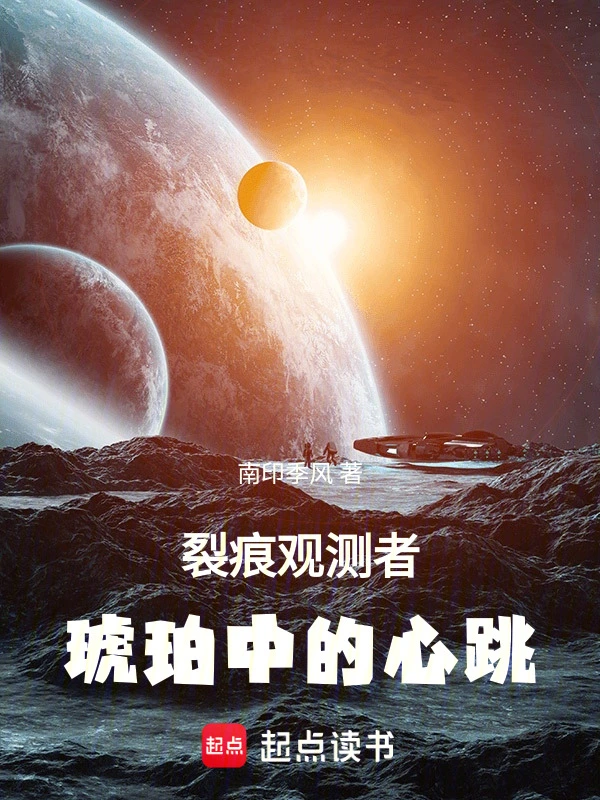
Crack Observer, Heartbeat in Amber
裂痕观测者,琥珀中的心跳
- Status
- Ongoing
- Length
- 199k Words
- Genre
- Sci-Fi
- Audience
- Male
- Subgenre
- Interstellar Civilization
- Updated
- 4mo ago
- Source
- Qidian
Stats
0Monthly votes
2Recommends
0Fans
35Chapters
Synopsis
Reader comments
Readers also read
 Psychic Worlds: the Paladin Forges His Body into a Numerical Monster
 Oh Yeah! I've Seen Fake People
 Doomsday Convoy: I Can Extract Unlimited Entries
 My Low-Dimensional Universe Model
 Criminal Investigation Notes 2: Buried Corpse in Songhu
 Age of Mythology: I Can Upgrade Everything
 Academic Tyrant: All My Teachers Are Subject Experts!
 Leader
 The Black Witch's Journey to Another World
 Night Without Borders
 How Can You Become an Immortal If You Don't Have Money?
 Green Hills
 Chronicles of the Ark: Flawed Seed
 Be Cautious: an Investor's Monologue
 Geocentric Encoding
 Polar B&B: My Tenant Is the Whole Universe
 Echoes of Steel: Algorithmic Wars in Normandy
 Energy Field Healing Center
 Canal Underground Palace Heart Lamp Record
 Twin Cities Luck Master
"The Rift Observer" Volume 1: Mapping the Abyss on the Precipice of Madness and Sanity
When science fiction reaches out to the ultimate truth of the universe, it often falls into a dilemma: either it becomes empty philosophical nonsense, or it becomes a cold technical manual. The first volume of "The Crack Observer, Heartbeat in Amber" builds a bridge over this abyss with an amazing narrative balance. Its building materials are the charred spectrogram of the father, the asphalt graffiti on the wall of the madman, the rigorous emails of the scientist, and the old machine that is still recording in the pocket of a mortal woman as she walks towards the sea of darkness. 1. World view: writing cosmic horror using scientific grammar The "cosmic maintenance" hypothesis is the cornerstone of the book, but it is presented in an anti-routine manner. It does not stop at occult metaphors, but constructs a set of creepy "engineering logic": reality is a system full of loopholes, higher-dimensional beings are indifferent maintenance workers, and human civilization is a colony that is accidentally observed in a petri dish. Chen Wen's murals are not only the art of a madman, but also a tragic "translation" of high-dimensional operations using low-dimensional symbols - the impact ripples collaged with broken glass, the stagnant grid superimposed with gold foil, and the "Gaia-main anchor" depicted with silver minerals, constitute an image system rare in science fiction literature that combines aesthetic impact and theoretical rigor. What is more subtle is the weaving of the "evidence chain". The 72 Hz frequency is like an auditory fingerprint throughout, from her father's recording in 1978, to the collective hallucinations in Taos Town, to the warnings received by Shen Jie's mobile phone, and finally became the "background sound of the world." Scientific instruments here are not tools to explain anomalies, but rulers to measure the abyss - when the atomic arrangement under the electron microscope violates the laws of crystallography, when the spectrometer records "negative absorption" at 72 Hz, madness is endorsed by experimental data, this is a deeper horror than any supernatural description. 2. Characters: The Pain and Dignity of the Knower The portrayal of Shen Jie breaks the cliché of "the chosen one". She is not a hero, just a recordkeeper chosen by fate. The transformation from an investigative reporter to a "key associate" is portrayed as a slow mental retardation: she needs to simultaneously resist external threats ("their" warnings), social disciplines (police cleanup, medical diagnosis), and inner desire for "normality" (the return channel provided by Levi). The final choice is not a passionate adventure, but the desperate struggle of the prisoner who digs at the wall with his fingernails after recognizing the prison. Chen Wen and Abdul form the two sides of the fate of the "perceiver". The former moves toward crazy magnificence amid overload, using murals to complete archeology across dimensions; the latter's silence tends to disintegrate under heavy pressure, leaving behind the last pulse of the earth with sand lines. The fragile network formed by the three people is the most primitive and tragic union based on the instinct of "recording and transmitting" when human beings face a transcendent crisis. 3. Narrative: The existential dilemma under double gaze The perspective of Observer No. 7 Is the real genius of this work. From absolutely rational observation, to generating "abnormal" sub-processes, to "fine-tuning" Xiaguang for Shen Jie and guiding equipment transactions, this non-human existence's subtle deviations in program logic reflect a deeper philosophical inquiry: When observers begin to treat samples differently, and when the recording behavior itself is permeated with "concern" that is difficult to quantify, is the absolute "non-intervention" principle disintegrating? This "observer's gaze" and "the observed's looking back" constitute an exquisite polyphonic structure in the narrative. And Shen Jie's "mortal gaze" is equally profound. The scientific instruments she carries are extended senses, but the ultimate detection tool is her own "contaminated" nerves. When she turns off the engine on the dark sea and uses her body to feel the "groan" of the spatial structure; when she is watched by the "eroding body", she experiences the horror of being dismantled - these passages transform epistemological terror into physiological tremors, creating a rare and embodied "sublime experience" in science fiction. 4. Imagery: a symbolic universe burning on the edge of darkness The work constructs a system of images with astonishing density: 72 Hz: is the background sound of the world, the fault code of the system, and the cursed frequency shared by all who know Cracks and patches: both a wound in the physical space and a trauma in the cognitive structure Match Metaphor: constantly changing in quotes from Chen Wen, Shen Jie, and Observer No. 7, From "lighting the match" to "burning out the match", outlining the last dignified posture of civilization before darkness Prisoners in Amber: The time and space where the father and the crew of the Albatross were frozen have become the cruelest metaphor for the existential dilemma These images self-reference and mirror each other in the narrative, forming a strong textual gravity field. 5. Blank Space: Echoes of the Abyss The end of the first volume is a master-level blank space. Shen Jie disappeared into the singularity of reality, but the silver-blue flash in the darkness hinted at the unfinished conversation; Observer 7 sealed the files, but the "abnormal" sub-process was still running; the global 72Hz noise permanently jumped, indicating that the collapse had entered a new stage. This "end rather than ending" treatment allows the story to continue to "whisper" in the reader's mind after the last line. Conclusion: Science Fiction as Cognitive Offense The most precious quality of "The Rift Observer, Heartbeat in Amber" is that it has fulfilled the essential mission of the science fiction genre: a serious and cruel offense against the boundaries of human cognition. It does not provide cheap hope, does not arrange deus ex machina, but calmly presents a possibility - what we think is a solid reality may be just an inferior product hastily patched by higher-dimensional existence; the meaning of civilization we cherish may be just an insignificant footnote in a surveillance report. But it retains warmth in despair: that temperature exists in Shen Jie's fingertips when pressing the record button, in the inscription "Someone must remember" in the corner of Chen Wen's mural, and in Abdul's granddaughter's trembling hands when taking photos of the sand line. Under the indifferent mechanism of the universe, these trivial "recording" behaviors have become the most stubborn evidence of the existence of human civilization. When Shen Jie's "Fuhai" drifts into darkness, she is not only sailing towards the end of the story, but also towards a deep harbor area that science fiction can reach - where rationality and madness, science and mystery, despair and dignity have reached a thrilling balance. We are waiting for the second volume, not for the answer, but for the next experience of being pierced by the bright light of truth.