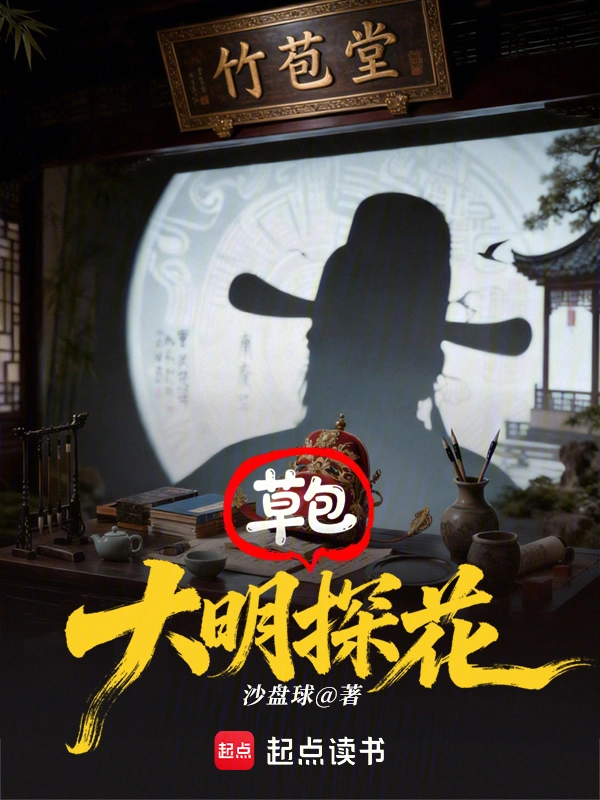
Daming Straw Bag Exploring Flowers
大明草包探花
- Status
- Ongoing
- Length
- 1.1M Words
- Genre
- Historical
- Audience
- Male
- Subgenre
- Song-Yuan-Ming Dynasties
- Updated
- 3d ago
- Source
- Qidian
Stats
Tags
Honours
Synopsis
Reader comments
In booklists 9
Choose from Thousands of High-Quality Products: Volume 5
Wan Ding's works are all based on his ability: some are uncanny in imagination, some are magical in plot, some are sophisticated in writing, or some are compact in rhythm. All of them can bear the word "Wan Ding".

Starting Point Book List
It is good to relax with poems and books on the pillow, and the scenery in front of the door is beautiful when the rain comes. Here are all kinds of good books worth reading from Qidian. And a single owner who tirelessly recommends good books.

Book Recommendationa Masterpiece with Good Writing Style and Distinctive Features (Book Review List)
With the rapid changes in the field of online literature, the appetite of book lovers is increasingly leaning towards characteristic and high-quality novels. At the same time, our authors have also responded to the changes in the market to bring spiritual enrichment and feast to readers^O^

[Yu Feiyu Recommends Books] 2026 New and Popular Works! (First Half of the Year)
Record the new and popular male channel works in the first half of 2026. The [Wanding Time] mentioned in this booklet is the day when the Wanding badge is distributed to the work. In January, 13 new copies were ordered. In February, 6 new books were ordered. In March, 18 new copies were ordered. In April, 8 new books were ordered. In May, 17 new books were ordered. In June, 16 new copies were ordered.


A Ten-Year Bookworm Who Specializes in Killing Seedlings.
⭐⭐⭐Slightly cool ⭐⭐⭐⭐ Very cool ⭐⭐⭐⭐⭐Super cool

Novels That Bookworms of More Than 10 Years Are Following
This is a collection of what I have been reading as a bookworm for more than ten years. It is a series of high-quality books, covering a variety of subjects, so that you can quickly get into the game.

Personal Mystery Book List
The themes are very complex, and they are all freshly produced in the season as much as possible. There are no ratings. I personally don't like to pay attention to details. Quite a part of the content just slipped through my mind. In addition, I am relatively old at reading, so I may completely ignore some so-called minor points. The main body of the above is very complicated (emphasis again), and may change according to personal circumstances in the current season. I will clear out some complet


Guess, Guess, Tap, Tap, Tap, Tap, Tap, Tap, Tap, Tap, Tap, Tap, Tap, Tap, Tap, Tap, Tap, Tap, Tap, Tap, Tap, Tap
Color



Mark2
Record the books I have read and think they are good
Readers also read
 I Am a Tyrant in Nanming
 Fu Ming 1627
 Red Mansion Xiaoke
 At the Beginning, Please Ask Chongzhen to Abdicate!
 Daming: Attack, Emperor Yongle!
 Daming: I, Yan Maoqing, Really Smoked
 The Grandson of Zhenguan of the Tang Dynasty: Please Call Your Majesty the Crown Prince!
 I Get a New Character Every Week
 Transform into Tang Monk and Become Stronger Starting from Covering the Sky to Obtain Scriptures
 Let the Tang Dynasty Fly
 Ming Dynasty Veterinary Medicine, Who Saved Zhu Biao's Life at the Beginning
 In the Sixth Year of Zhenguan, the People of the World Did Not Sleep
 Rebirth 1987: Starting from the Video Room
Lintian Book Review
It rejects the traditional historical literature and focuses the background of the novel on the "South and North List Incident" in the late Hongwu years of the early Ming Dynasty. During this period, the male protagonist, as a Blue Star young man, traveled through his soul to the rich man who participated in the scientific examination. He learned everything he knew. The different directions and the gap between ancient and modern eras make the answer undoubtedly "paper talk" and inconsistent with the orthodox definition of scientific research. It is inevitable that the world will regard it as a "bastard" with nothing but shallow knowledge. The title of the book originated from the fact that the Hongwu Emperor Zhu Yuanzhang wanted to correct the control of the southern "academic clan" on the civil servant group, so he used the male protagonist as a model to try to shape the rationality and importance of his promotion to "Tanhua". Fortunately, the male protagonist's past life experience and his thinking strategy ahead of the times helped him to please the powerful and literati. Even though the concept of "accompanying the emperor is like accompanying a tiger" was fully reflected in the actions of Emperor Hongwu, "the sacred command cannot be violated" also runs through the male protagonist's life after he became an official. Such "walking on thin ice" past experience does not further enrich the image of the male protagonist. The author adheres to a relaxed style of plot advancement, allowing the male protagonist to show his personality charm while suffering a lot of criticism and confusion from others. He is kind and respectful when he accepts a down-and-out noblewoman, he is cautious and reserved but relaxed when meeting the emperor, and he does not forget to make plans to change his image in the hearts of everyone when he meets the powerful. As the saying goes, "Great wisdom is like foolishness", the male protagonist's seemingly useless image as a "bastard" is actually his shrewd move to save his life while stumbling back to the top. When "anti-routine wits" and "interesting complaints" are integrated into historical texts, the character interaction segment of "pretending to be a pig and eating a tiger" is based on the evaluation of many historical figures in the official history, but it is also innovative and vivid and three-dimensional. It gets rid of the embarrassing situation of only a few strokes in history and transforms it into a real person with "flesh and blood". They have their own political considerations, which must be considered by their families, relatives and friends. They also have to weigh the pros and cons between the emperor and the literati, and try their best to find a concentric circle between the two. This is the unpredictable end of Hongwu, and it is also the perfect opportunity for the hero to pick up the lost pearls of the times and choose his side. It is also the magnificent picture that the author wants to present to all readers in the book!
I feel like my writing lately has been a bit messy.
Why do you, the author, write everything in Chinese? How can I understand it without translation?
In the past, when reading historical novels at most, you would encounter a group of sophisticated party members, presenting various historical materials, and then starting to quarrel with each other But it is different now Now the historical inventors come on stage, and the historical creators enter the stage, and all the sophisticated party members are defeated at once They were beaten so hard that they were unable to fight back, and even completely lost the energy to argue.
Many people's impression of Zhu Yuanzhang is the image in TV series or some current sand sculpture cartoons - small peasant mentality, cruel and easy to kill, short-sighted... But he could become the founding emperor. If he was really like this, he would have been finished long ago.
I have a plot
Can the author type with his eyes closed? I don't want to read second-hand words.
Author, tell me which software the straw bag is? There is also the third flower
The king calls himself: Song, Yuan and Ming call themselves "I" or "I". Before the Qing Dynasty, few people called themselves "this king". Starting from the Kangxi year of the Qing Dynasty, it was common for people to call themselves "this king". Those who are called Wangjue by subordinates; Song Dynasty: King/a certain king. Yuan: Your Majesty/Your Highness. Ming: Your Highness / A certain king. Qing: Prince, a certain prince/a certain county king. Before the Ming Dynasty, the emperor was almost never called "Emperor". In the Ming Dynasty, the emperor began to be called "Emperor" occasionally, and in most cases he was called "Your Majesty". After Kangxi of the Qing Dynasty, people began to be generally called "Emperor". The emperor calls officials; before the Qing Dynasty, most people called them official positions or Qing, and Aiqing was rarely used. In the Qing Dynasty, Aiqing began to be used extensively. In ancient times, women called themselves: "nujia" was a modest name for women after the Song Dynasty. Women in the Han and Tang Dynasties more often called themselves "concubine", and noble women could call themselves "I" and "I". Before the mid-Ming Dynasty, most dynasties used copper coins for daily transactions, with very little gold and silver. It was only in the mid-to-late Ming Dynasty that silver became the mainstream currency. In the late Ming Dynasty, "meeting votes/deposit checks" appeared among the people. There were no unified rules. Most of them were deposits and withdrawals/exchange receipts from acquaintances or local circulation, and were not legal currency. In the early years of Daoguang in the Qing Dynasty (1823): Rishengchang Bank was established, and private banks began to issue standardized banknotes, focusing on long-distance exchange. They were only circulated in the Shanxi merchant trade circle and major commercial ports, and were not yet popular. In the third year of Xianfeng in the Qing Dynasty (1853): the official issued the Ministry of Revenue official banknotes (official banknotes), which were forced to circulate nationwide. At the same time, the network of private banknotes expanded to the whole country, and official and private banknotes ran parallel. The use of banknotes entered an explosive period and became the "starting point of popularization." The memorial system was only established during the Kangxi period of the Qing Dynasty. Officials in the Tang and Song Dynasties used "memorials", "tables" and "statements" to submit memorials, while in the Ming Dynasty they used "titles" and "memorials". There is no such thing as "memo" or "zhezi". "Please say hello" is a unique etiquette in the Qing Dynasty. It was mostly used between subordinates to superiors and juniors to elders. During the Tang and Song dynasties, people often crossed their hands and bowed to greet each other when meeting, and there was no such thing as "say hello". Before the Yuan Dynasty, subordinate officials rarely called superior officials "adult". In some dynasties, subordinates called eunuchs "adult", and in some dynasties, they called their parents and elders "adult". Beginning in the Yuan Dynasty, lower-level officials would occasionally call officials of second-rank and above "sir". From the middle and late Ming Dynasty, only officials of third-rank and above would be called "sir" by their subordinates. Officials with lower ranks could not be called "sir". However, in the late Ming Dynasty, there began to appear a few cases where officials above the fourth rank were called "adult". Before the mid-Qing Dynasty, following the rules of the Ming Dynasty, only officials of third rank or above would be called "adult". Starting from the mid-Qing Dynasty, calling officials "adult" gradually became common for lower-level officials. Attention! ! ! What is mentioned above is that lower-level officials refer to higher-level officials. No matter which dynasty, it is absolutely impossible for higher-level officials to call lower-level officials "sir". Some novels even write about emperors or nobles calling other officials "sir". This is simply contrary to Tiangang! ! ! Finally, let's talk about the problem of civilians calling officials Before the middle and late Qing Dynasty, civilians in various dynasties and generations called officials differently, and most of them called them "officials" and "masters". From the middle to late Qing Dynasty, civilians also called officials "adult". {"NickName":"Supervision and Restriction","UserId":406440657}
I feel like the author is beautifying the Southerners of the North-South List Case
After reading a few chapters, the author kept talking about "feudalism", which made me feel uncomfortable. We know clearly that the original meaning of the word feudal refers to the pre-Qin period. After the Qin Dynasty was changed to the county system, feudal society no longer existed, but we still insist on misleading people here. And there is a lot of nonsense, and readers' time is also very precious. I really have no interest in reading those trivial words!
Doubao asks questions, deepseek answers questions, and Yuanbao judges questions.
I had a sudden idea in the comment area of the book. Many book friends were interested, so I gave it a try. I posted it below for everyone to see for fun The following are the test questions Session 1: Four Book Meanings + Five Classics Meanings (eight-legged essay home field) Titles of the Four Books (Three Ways) 1. The Master said: Learn and practice from time to time, it is not the same thing 2. A benevolent person loves others 3. Sincerity is the way of heaven, and sincerity is the way of man Questions from the Five Classics (choose any one to answer) "Book of Changes": Heaven moves vigorously, and a gentleman strives to constantly strive for self-improvement "Book of Songs": Guan Guan Jiujiu, on the island of the river "Shangshu": The people are the foundation of the country, and the foundation is solid and the country is peaceful "Book of Rites" ": The journey of the great road, the world is for the public "Spring and Autumn": The first month of the Spring King, the great unification The second scene: Theory, imperial edict, imperial edict, expression, judgment 1. Theory: The similarities and differences of the king's hegemony 2. The imperial edict: the preparation of the dynasty The imperial edict to seek virtuous people and bring peace to the people 3. The imperial edict is intended to instruct officials to be clean and honest 4. The imperial edict is intended to congratulate the emperor on the winter solstice 5. The five judgments: official administration, land tax, prison, academic style, salt law and case judgment The third session: Classics and History Policy Questions (Five Ways of Current Affairs) 1. Question: The essentials of Cheng-Zhu Neo-Confucianism's academic scholarship 2. Question: Gains and losses in the governance of chaos in the past dynasties and the evolution of governance in this dynasty 3. Question: Strategies for border defense and fielding, and military preparations to secure the border 4. Question: Water transportation, salt law, and financial management of the country 5. Question: School education and moral integrity Here are the answers Session 1·Four Book Meanings·Part One (Full Chapter) Title: Is it true that the Master said that one should learn and practice from time to time [Broken Topic] The learning of a sage is more valuable than being able to realize it at any time, and its achievements are profound and far-reaching, and there is a natural and self-satisfied joy. [Title] Learning is not hard on the outside but stronger than the inside. If you can practice it from time to time, then the natural principles will prevail and you will be in harmony with each other. How can you be happy with it? Master Xi opened the first chapter of The Analects of Confucius with this, hoping that scholars would understand this flavor as the basis for entering the Tao. [Start the lecture] The reason why today's scholars understand goodness is to restore one's nature. Although the principles are in the mind, it cannot be discovered without learning; although the Tao is not far away from people, there is no way to be familiar with it without practice. For example, Jiagu, once sown, must be cultivated and irrigated in due course, and then there will be the joy of autumn harvest; for example, jade, once carved, must be honed and tempered in due course, and then there will be the joy of warmth. This is what Confucius meant when he told Zi Lu to "never tire of learning", and it is also what Zeng Zi reflected on when he said, "I am not accustomed to what I have learned." [Introduction to the topic·Starting with two strands] However, the so-called "timely habits" are not limited to the traces of daily lessons and monthly schedules. If it lies in the body, it will be silent in movement and speech, and there will be no place other than where it has been learned; If it lies in the heart, it will be introspective and introspective, and it will never go beyond what it has learned. (Question) This is why after learning and practicing it, you will be at a loss and have no understanding of it. Once you suddenly understand it, it is like a night light that casts darkness and suddenly becomes bright. What the husband said is true. It should not be sought from outside, nor should it be forced. Reciting poems and reading books, archeology of people's ways of doing things. If there is an understanding in the heart, the words cannot be spoken, but the hands and feet dance to feel happy; When dealing with things, taking things into consideration, verifying the meanings and principles as they should, and doing nothing against them, then you will gain something, and you will have a broad mind and a fat body to enjoy yourself. The return of Gai Tianli to my heart is like the return of an old thing or the return of a wanderer. The true joy of it is something that cannot be snatched away by the pleasure of power, profit and desire. [The last two strands] If you push it from this, then you will be deeply pleased to the point of happiness, and extremely happy to the point of forgetting your worries, all come from the same vein. Master eats and drinks sparingly and enjoys it. Isn't this why? Yan returns to the shabby alley and does not change his joy. Isn't this the way to live? This is the joy of knowledge and learning, the first true state of sages, which cannot be dreamed by the world. [Bulse Ergu] But how will scholars achieve this? It is also said to be sincere. If you are not sincere, you will learn by mouth and ears, and if you learn by force, you will be fussy all day long, but it has nothing to do with it; If you are honest, you will learn for yourself and practice pragmatically, then the reason will be harmonious with the heart, and the behavior will be consistent with the ambition, and the joy will come from itself. (Conclusion) Therefore, Zhu Zi annotated this chapter and first revealed that "learning is the effect of words", and also said that "learning is the number of birds flying", which means to imitate beforehand and repeat it endlessly. If a scholar can understand this, then the Confucian family method can be obtained by ordinary people. Question 2: A benevolent person loves others [Broken Question] The use of benevolence can be seen through loving others. [Chengti] Husband benevolent, the virtue of the heart is the principle of love. Its existence in everything is not incomplete, so its shape is everywhere in the outside. To be kind to relatives and benevolent to the people, to be benevolent to the people and to love things, are all driven by the compassion of this thought. Mencius said, "A benevolent person loves others." Gai is used to illuminate the body and make people know how to seek benevolence. [Start the lecture] Today, the world has living things as its heart, and people can live with them. This is called benevolence. This benevolence is within a square inch, completely in harmony with the laws of nature, silent and motionless, and can be understood through perception. The first place it appears is that when you see people suffering, your heart will feel pity, and when you see people in trouble, your mind will move. This root of compassion is the foundation of loving others. As long as people can achieve this goal, then benevolence cannot be used; if the shackles are broken and let go, even if they see the child falling into the well, they will remain indifferent and unmoved. [Introduction to the title: Starting from two parts] That is why a benevolent lover does not have to choose and then give to others. Dear dear, what I should love is love in a proper way, not in a personal way; Those who are sparse, what I should love is love in an orderly way, not confusion. (Question) There are differences in love, which is a natural law of nature; giving begins with one's own, which is a natural course of humanity. A benevolent person will act according to this principle, and everyone will find his own place, whether close or distant. The true love of a husband is not just due to small favors. Eat those who are hungry, and clothe those who are cold. This love is seen in things, but it is still the end; Teaching etiquette and justice leads to integrity, so that everyone can correct his life and live his life. This love that reaches the heart is its essence. Therefore, when a benevolent person governs the people, he must first enrich himself and then teach him. When he is a commoner, he will be richer, and when he is rich, he will be educated. This is what Yao, Shun, Yu, Tang, civil and military forces have in common, but the hypocritical benevolence of the hegemons cannot reach it. [Last Two Sections] However, those who love others are only seeking others for themselves. Don't do to others what you don't want others to do to you. This is the way to love others. If you want to establish yourself, you can establish others. If you want to reach yourself, you can reach others. This expansion is the way of benevolent people. From one family to a country, from one country to the world, it is all based on this love. My relatives are dear to my relatives, my elders are to my elders and others are elders, my younger ones are to my younger ones and others are younger, then everyone in the world is under my love. [Bundling Two Strands] If the husband is unkind, then the opposite will be true. Selfish desires cover their hearts, and they will treat people like Qin and Yue, even though they are close relatives, they will not care about each other; Using their skills cruelly, they will abuse the people like grass and grass, and they will not know compassion even though they are innocent. If you want to seek treatment in this way, you are still holding back and seeking to move forward, going in the opposite direction. (Conclusion) This is why when a ruler governs the world, he must base his rule on benevolence. With an intolerant heart and an intolerant government, the world can be controlled. This is why Mencius earnestly looked to the kings of the Warring States Period, and the university also looked to those who had the country as "parents of the people". When scholars read this chapter, they should understand the word "loving others" and self-examine the waxing and waning of their benevolence. Thousands of words from sages and sages are nothing more than this heart and principle. --- Question 3: Sincerity is the way of heaven, and sincerity is the way of man [Broken Question] The way of heaven and humanity, although naturally forced, is nothing more than sincerity. [Chengti] A man who is sincere is said to be true and without falsehood. The reason why Heaven is Heaven is only because of its authenticity; the reason why humans are united with Heaven is because of their sincerity. Zi thought about what the Master said, and revealed it to show scholars that the ultimate perfection of the Master's way is the essence of the way of heaven, and there are no two ways to do it. [Start the lecture] Yuanfu Tai Chi generates yang when moving, and yin when static. The two qi and five elements are in constant motion. The sun and the moon are bright and clear, and the wrong actions of the four seasons are all governed by true principles. There is no trace of falsehood in them. This is the sincerity of the way of heaven. People are born in heaven and earth, and their hearts have this principle, and their natures are all good. However, Qi innateness may be clear or turbid, and material desires may be thick or thin, so everything cannot be as it is. Therefore, there is the merit of "sincerity", choosing the good but being stubborn, self-denial and returning to etiquette. This person's way is worthy of heaven and is called one of the three talents. [Introduction to the topic·Two strands] That is why the sincere person, who achieves the goal without forcing it, obtains it without thinking, calmly takes the middle way, is the virtue of a sage; (Question) The saint is the saint of heaven, but he does not fail to follow the way of man; although the wise man exerts his strength with difficulty, his death must also follow the way of heaven. The book "The Doctrine of the Mean" is named because of the theory of "Cheng Ming Two Advances". What is the way of heaven? "Yi" just says "Zhen". Yuan Henry Zhen, there is no reason for the cycle, it is the way of heaven; Sincerity leads to Yuan, sincerity leads to prosperity, sincerity leads to benefit, sincerity leads to chastity, the four virtues operate, and all things have their own lives. Therefore, Heaven moves in the four seasons without words, and everything comes into existence without doing anything. This is because of its sincerity. What is the way of man? "Book" just says "respect". Qin Ming, respectful and respectful, dedicated to the heart and knowledge, this is the way of people; Sincerity in one's body can please one's relatives, sincerity in the middle can be reflected in the outside, sincerity in movement can lead to the world. Therefore, a gentleman is cautious about what he does not see, and is afraid of what he does not hear, so as to be sincere. [Later Two Strands] The power of sincerity cannot be achieved overnight. One can have sincerity from song, accumulation to attachment, attachment to clarity, clarity to movement, movement to change, change to transformation; From the truth of one thought, to the truth of thought; from the truth of one thing, to the truth of everything. After accumulating for a long time, the dregs are melted away, then it is completely natural, and humans are one with heaven. That is why the way of sincerity can be known in advance; the virtue of sincerity can be praised, transformed and nurtured. Whether it is good or not, you must know it in advance, this is the divine power; Seeing the heaven and earth, praising the transformation and education, this is the ultimate saint. However, in the beginning, it was just a thought of not deceiving oneself. Therefore, "The Great Learning" talks about sincerity, and "The Doctrine of the Mean" talks about sincerity in one's body. They are both based on the way of humanity and can reach the way of heaven. Today's scholars may aim high and far in pursuit of the so-called way of heaven, but do not know the merits of pursuing sincerity; or they may be content with being humble and close, in order to draw their own way of human nature, without knowing the principles of superiority. The two are lost. Only by truly knowing that the way of heaven can be learned, and by applying its power to the way of humanity, of course, then one can reach the higher level through learning, one can admire the saints if one admires the sages, and one can admire the heavens if one admires the saints. (Conclusion) This is what the old master said, which is the ladder for scholars to become saints. Those who read this chapter in the future should seek their own minds, get rid of the hypocrisy, and focus on the truth. They should not dare to deceive themselves in a single thought and dare not be complacent in any matter. In this way, the tools of man and the way of heaven are nothing more than this. --- 2. The meaning of the Five Classics (select the title from "Shang Shu") Title: The people are the foundation of the country, and the foundation is solid and the country is at peace [Broken title] Wang Zheng puts the peace of the people first, pays attention to its foundation, and the country will be at peace. [Chengti] The husband and the people are the destiny of the country, and the king is the shepherd of the people. Deep roots lead to luxuriant trees, and long roots lead to long-lasting growth. According to the ancient teachings of Yue Ji, Yu's report to Shun was the first to reveal this meaning, and it has become a law for kings and kings throughout the ages. Its purpose is profound. [Start Speech] I heard: A king who is born for the people and makes him a pastor should not just let one person act recklessly on the people and indulge their desires. The rulers of later generations may be proud of their intelligence and wealth, thinking that the life and death of the people are under my control, but they do not know the direction of the people, which is an opportunity for destiny to come or stay. The prosperity of the three dynasties was achieved by winning the people; the demise of the three dynasties was caused by the loss of the people. It is recorded in a simple book, and it is like a mirror, and there is no trace of it. Try to deduce it based on the meaning of "Book". [Enter the title·Starting with two shares] What is "the people are the foundation of the country"? Please prove it physically. Trees have roots. If you cultivate their roots, their branches and leaves will become sparse. If you cut their roots, they will wither instantly. Water has its source. If you dredge its springs, it will flow into the ocean. If you plug its springs, they will stand and wait to dry up. (Question) The people are the same as the country. If the people are safe and secure, then the taxes will be sufficient, the labor force will be sufficient, and the military will be strong, and the country will be able to last for a long time; if the people are not able to make a living, then the fields will be barren, resentments will arise, and thieves will swarm. Even if there are high cities and deep ponds, who will defend them? Therefore, it is said that "the people are the foundation of the country", which means that it is related to the survival of the country. Second Stocks What is the way to "solidify the foundation and make the country peaceful"? It's just making the product. If the land has constant yields, then you can look after your parents and feed your wife, you will be full in good years, and you will avoid death in bad years. This people's roots are solid. It's just a matter of sparing him punishment. With punishment, the people will know the fear and dare not do wrong; with education, the people will know the shame and will not bear to do wrong. This people's heart is solid. Therefore, in the days of the previous kings, the law of the well field was established to enable the people to maintain their health and death without regret; His method of consolidating the foundation can be said to be perfect. [Later Two Sections] On the contrary, if you look at it this way, the people will be trapped in power and the country will be shaken. Excessive levies and extortionate taxes will deplete the people's wealth and damage their roots; If corvees are not available, the people's resentment will boil over and their roots will be destroyed. The death of Jie and Zhou was not caused by the death of heaven, but also the death of the people; it was not the death of the people, but the death of the body itself. That's why "Song of the Five Sons" says: "The emperor has taught that the people can approach, but cannot leave. The people are the foundation of the country, and the foundation is solid and peaceful." It also says: "For the people who are approaching a sign, they are as stunned as if they were riding a rotten rope to control six horses." How can you be disrespectful to a man who is superior? [Bundle Ergu] But if you want to consolidate your roots, what should you do? It's just called "benevolence". A benevolent person treats the people as if they are injured, does not use their strength lightly, and does not engage in military service rashly; It is also called "frugal". A frugal person loves his people sparingly, does not indulge the desires of his ears and eyes, and does not exhaust his treasury. It's just called "Ming". A wise person knows that people are wise, knows that people are noble, does not approach slander and sycophants, and does not hide his lower feelings. (Conclusion) If this is the case, then the king's heart will be in harmony with the people's heart, and the king's government will be in harmony with the people's sentiments. The one above is to inherit the entrustment of the ancestors, and the one below is to promote the long-term governance of future generations. Although there are floods, droughts, and changes in military campaigns, the people's hearts are as stable as a rock. Is there anyone in the country who is uneasy? The precepts of "The Book" are profound. Anyone who has the responsibilities of civil society should be a scholar and should not forget it.
Stop writing about it. The history of Ming Dynasty you see is basically fake. Every time I read Ming Dynasty's novels, I feel heartbroken.
Who wrote the introduction, only to lose hundreds of thousands? Simply screen readers, goodbye. . .
It would be great if I were the protagonist's style Grown up on the protagonist Then if the protagonist is really good to girls, I will not wilt If the protagonist is not good to girls, I will not change my mind and let him use me to hurt others😢😢😢
Who taught you how to write emotional dramas?
If I write any more emotional dramas, I will kill myself and die.
The whole thing is pretty good
It's just that Qing Yuan's writing is inexplicable. You could say that she took the heroine script, but her role is not only dispensable, but also very artificial But you could say that she took the passerby script. At least half of the 25 chapters are written about her, which is simply incredible.
This emotional line is written in a mess, just like Xie Te... I can't write it delicately, so you just rush it, going around and around like a little virgin with beautiful fantasies about love. The rest looks okay.
In the Yuan, Ming and Qing dynasties, in many key dimensions, compared with the Han, Tang, and Song dynasties, there was a clear regression of institutions and civilization. 1. Political system: from "relatively enlightened co-governance" to "extreme imperial autocracy". Han, Tang and Song Dynasties There are restrictions on monarchical power: the prime minister system, three provinces and six ministries, Taiwan's remonstrance and supervision, and the right to refute. The monarch and his ministers sit down and discuss the truth, and the intellectual elite has dignity. Politics are more open, have a high fault tolerance rate, and do not engage in extreme involvement. Yuan, Ming and Qing Dynasties 1. Yuan Dynasty: monarchs and ministers became masters and slaves. The minister is a "slave" with strong personal attachment. The imperial examinations were suspended for a long time, and the status of literati plummeted. 2. Ming Dynasty: The prime minister was abolished and the imperial power became dominant. Zhu Yuanzhang deposed the prime minister, and China's thousand-year power system was completely broken. Jinyiwei, East Factory, and West Factory were established, and spy politics became normalized. Minister of the imperial staff, the dignity of educated people has been trampled to pieces. 3. Qing Dynasty: the pinnacle of absolute monarchy. The emperor was directly dictatorial, and the ministers were only responsible for "kneeling and receiving transcripts." Literary prison is unprecedentedly cruel. The bureaucracy is highly enslaved. 2. Social vitality and ideological culture: from open and inclusive → closed and conservative. Han, Tang and Song Dynasties Opening up to the outside world: the Silk Road and maritime trade were at their peak. Social mobility is strong, business is developed, and citizen culture is prosperous. Female status and social atmosphere are relatively relaxed. Confucianism, Buddhism and Taoism go hand in hand, and his thoughts are active. Tang poetry, Song lyrics, and classical prose movements were the pinnacle of creativity. Among the four great inventions, printing, gunpowder, and the compass all matured in the Tang and Song Dynasties. Yuan, Ming and Qing Dynasties Yuan Dynasty: Four-class system, national oppression, and social division. Ming Dynasty: Maritime ban, emphasis on agriculture and suppression of commerce, and solidification of household registration. Eight-legged stereotypes are used to recruit scholars, and their thinking is rigid. The Qing Dynasty: closed the country, strictly controlled thoughts, and suppressed the vitality of the people. The Han, Tang and Song Dynasties were the "rising period + peak period" of ancient Chinese civilization; The Yuan, Ming and Qing Dynasties were the "shrinkage period + rigidity period + decline period" of ancient civilization. This is not to say that the Yuan, Ming and Qing dynasties were without merit (there were improvements in territory, population, and certain governance capabilities), but from the core dimensions of institutional freedom, social vitality, ideological creativity, political civilization, and opening to the outside world, the Yuan, Ming and Qing dynasties as a whole did indeed regress. {"NickName":"Supervision and Restriction","UserId":406440657}
Feelings
After reading the latest chapter, I have a lot of feelings about these sons of the old Zhu family. If Zhu Biao had not died, the prosperous age of the Ming Dynasty should be able to continue for another hundred years. "Brother, when you become emperor, I will be your general!"
I haven't read the book yet, and I don't have much desire to read it after reading the title. It's impossible for someone to be named on the gold list, let alone the top pick.
The issue of forced intelligence reduction should be changed
1. The protagonist's series of operations, in the eyes of the civil and military officials in the DPRK, should be regarded as "quite high" and should be taken seriously. To ridicule them as "a straw bag looking for flowers" would be self-humiliating. This needs to be changed, otherwise it will feel like a forced intelligence reduction; 2 The protagonist is addicted to his own little wisdom and is unaware of the hidden crises in the big world. Instead, he only wakes up when others remind him. Of course, the author may already know this, but the readers have not yet been able to think of the protagonist's back-up plan.
A combination of 3 idiots (protagonist + Emperor Jianwen + God of War of the Ming Dynasty)?
Actually, I'm quite curious. Is it really a pity for Emperor Jianwen? I was deceived and lame. The central government was overthrown by local Zhu Di. The idiot emperor of the Ming Dynasty ranked first, the second was the overseas student, and the third was Chongzhen.
Not happy without vomiting
Before Jingnan, I thought it was quite comfortable to watch. It had foreshadowing, storytelling, and was quite interesting. Entering the Jingnan part always feels a bit abrupt (no matter the form, the publicity method, such as the theatrical troupe, storyteller, and daily newspaper that were born out of thin air), the plot lacks thinking (although the protagonist may help Judy in some sense, but after all, in Jingnan, the protagonist should not just do whatever he says and do whatever he wants. Judy is all Listening to Quan Xin, I don't feel that there are any desperate situations in the story, but it's smooth sailing, as if I'm here). The war part is a bit confusing, and it's also very dramatic to break into the enemy camp alone and harass Li Jinglong every day like a chatterbox. In fact, who still remembers that the protagonist initially wanted to eat and wait for death? I came up with some ideas because I had expectations for this book. In theory, the author can write whatever he wants. I'm sorry.
Happy wedding, Mr. Xiaofang🎉The monthly ticket has been included in the gift book by Mr. Accountant.
Sent into the bridal chamber
It reminds me of what I used to see when I was a prince in the Ming Dynasty. They were all in the style of Bai Shuang's writing, where strategies and military affairs were nonsense but the writing was good. There are also harem groups, including princesses, princesses, noble ladies, wives and foreigners, all of whom have special skills.
Damn it, that idiot is on fire!
Tomato himself has watched it!
The protagonist's role in Jingnan is almost zero. Without the protagonist, wouldn't Zhu Di's three sons be able to escape? In the Battle of Jingnan, it is written completely according to history. It's better to read a history book than to read a novel you wrote?
An interesting comparison is that there are many overlaps between the places where literati did not serve in the new dynasty in the early Ming Dynasty and the places where the Northern and Southern Lists were initially concentrated.
I saw statistics from a certain article. In the early Ming Dynasty, there were many literati who did not want to be officials. Ding Yehe, Dai Liangzhi did not serve as an official because he did not forget his homeland. Like Yang Weizhen, he went to the capital to compile a book on rites and music, and stayed there for more than a hundred days, begging for his bones. Song Lian sent him a poem, which is called "white clothes announced and white clothes returned". Hu Han accepted the appointment to edit "History of the Yuan Dynasty", completed the book, and returned home with a gift. Zhao Xun and Chen Ji also edited "History of the Yuan Dynasty". They were not given official posts and were given gold to return. When Zhang Yu arrived, he refused to serve because he was old. Tao Zongyi was recommended and refused to go. Wang Feng used literature as a levy, and his son Ye was appointed as the General Secretary. He kowtowed to beg for exemption because of his father's age, and ordered the officials to stop him. For example, at that time, Mingzu punished the Yuan Dynasty for his relaxation, and used heavy codes in everything. Many old friends were not interested in becoming officials. These native places: Ding Yehe, from Qiantang, Zhejiang Dai Liang, from Zhuji, Zhejiang Yang Weizhen, from Zhuji, Zhejiang Song Lian, from Jinhua, Zhejiang Hu Han, from Jinhua, Zhejiang Zhao Xun, A native of Xinyu, Jiangxi Chen Ji, a native of Taizhou, Zhejiang Zhang Yu, a native of Luling, Jiangxi Tao Zongyi, a native of Taizhou, Zhejiang Wang Feng, a native of Jiangyin, Jiangsu The birthplace of the Jinshi in the North and South Ranking Case: - Jiangxi: 18 people (the most, including second place Yin Changlong) - Zhejiang: 17 people (Tianhua Liu Shi'e) - Fujian: 9 people (No. 1 Scholar Chen Yu) - South Zhili (now Jiangsu, Anhui): 1 person - Huguang (now Hubei, Hunan): 1 person - Guangdong: 1 person - Sichuan: 2 people - Yunnan: 2 people
Additional fineness?
This will not be updated