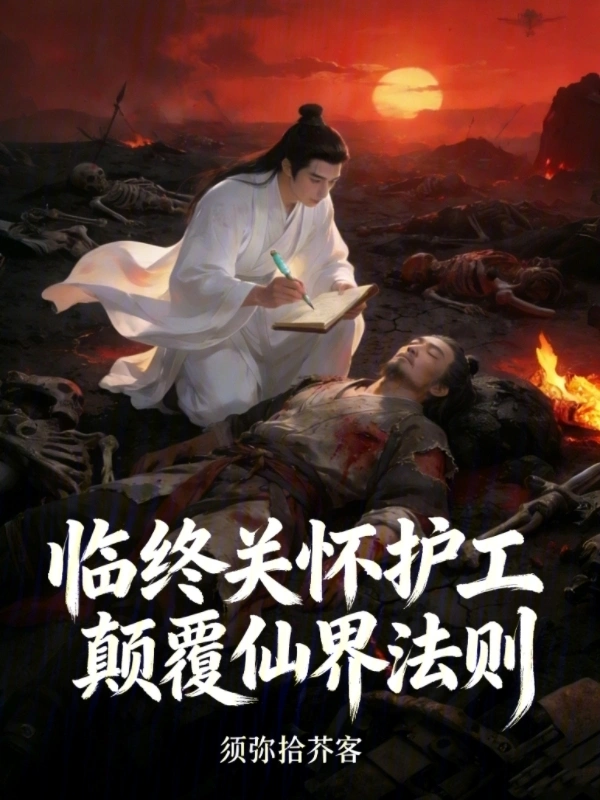
Hospice Caregivers Subvert the Rules of Fairyland
临终关怀护工颠覆仙界法则
- Status
- Ongoing
- Length
- 594k Words
- Genre
- Cultivation
- Audience
- Male
- Subgenre
- Cultivation Civilization
- Updated
- 3d ago
- Source
- Qidian
Stats
0Monthly votes
135Recommends
0Fans
148Chapters
Synopsis
Reader comments
Readers also read
 Mortals: as Mortals, the System Is Broken!
 Qingfeng Daojun
 Mortals: Start with the Heavenly Bones
 Become a Dragon King from West Lake
 Dayan Wusheng: Starting from Bajiquan
 Ziyang Emperor
 The Twin Daughters' Personal Bodyguards
 Things About the Two Song Dynasties
 Hogwarts: the Cat Wizard of the Moving Castle
 Jueding Danzun
 The Supreme Pinnacle of Rebirth in Another World
 Immortal Doctor's Hand
A work that "screens the soul"
If you have long been tired of the traditional cultivation of immortality of "killing people to seize treasures and proving the Tao through killing", and are disgusted with the industrial feeling of the protagonist being invincible at the beginning and being able to leapfrog and kill enemies by shouting throughout the game, then this novel will be a long-lost "cranial massage". If you happen to be "intelligent" and obsessed with watching the protagonist use logic and psychology to "escape" his opponents; if you sneer at the industrial saccharine-like emotional lines and only love the delicate portrayal of "two aliens redeeming each other in a desperate situation"; if you are curious about how modern professional concepts such as "hospice care" and "psychological healing" take root in a world of fairy tales where the jungle cannibalize the strong - then this book is a spiritual refuge tailor-made for you. It is a typical "slow-heat" masterpiece. The first few chapters lay out the world view and professional beliefs. If you are pursuing fast-paced and instant feedback adrenaline, you may find it tame. But as long as you are willing to calm down and follow the protagonist Fang Yuheng to "see" the pain that is deliberately ignored by the world, what it will give you back will be an emotional thickness and ideological depth that far exceeds that of traditional refreshing novels. 1. When the spiritual nurse mistakenly enters the Shura field The protagonist Fang Yuheng was originally a spiritual nurse in a modern hospice hospital. By chance, he traveled to the world of gods and delusions where millions of corpses were buried and the violence was soaring. In this fairy world where "the strong are respected and human life is regarded as nothing", he did not awaken the combat system, but was bound to a "life care large model system". His method of cultivation is not to kill people and seize treasures, but to "overcome the calamity of the heart." He transformed the "Top Ten Techniques of Soul Care" in modern nursing—peaceful gaze, attentive listening, and touching communication—into fairy magic. While other monks were harvesting heads on the battlefield, he was "siting for a while" with the dying enemy in the pile of corpses; while other sects were snatching treasures of heaven and earth, he was using a "non-analysis, non-judgment" mentality to resolve millenniums of resentment. The golden finger system setting of this novel is extremely unique. It has never been reduced to a "point-adding machine", but a technical plug-in for Fang Yuheng's "Care Flow" Taoist Heart. The functions of the "Soothing the World and Eliminating Tribulation", the Immaculate Heart Soothing Scarf, and the Soul Awakening Bell rewarded by the system are all to "resolve obsessions" rather than "physical destruction." This perfectly explains why an ordinary spiritual caregiver can gain a foothold in the fairy world - what he cultivates is "heart" and what he kills is "tribulation". 2. Unique pleasure: Cognitive dimensionality reduction The pleasure of this novel is extremely unique. It abandons "slap in the face" and "crushing" and instead relies on "cognitive dimensionality enhancement" and "emotional resonance". 1. Turn the intention to kill for your own use, and subdue others without fighting When the thousand-year-old demon ancestor and cult leader broke down and cried in front of Fang Yuheng, and found that his murderous heart was vulnerable in front of "Chat," the cognitive collapse of "I have practiced for thousands of years, but I am not as good as you sitting for a while", and the feeling of relief it brought was subversive. This is not a victory by force, but a defeat of the heart. 2. Use high-dimensional philosophy to violently break low-dimensional force Seeing the absolutely strong people (such as Emperor Xuanlu) who believe in "the weak and the strong" being forced to a logical halt by a set of "care logic" that he completely cannot understand, and even having their Taoist hearts damaged, this sense of intellectual superiority of "defeating magic with magic" is very strong. 3. Redefining "Power" Traditional immortality believes in the supremacy of strength, and the "care flow" proposed in this novel proposes that true strength is not to eliminate pain, but to coexist with pain and transform it. Fang Yuheng's strength does not lie in who he can kill, but in his ability to "be present" - to stay awake in chaos and provide presence in despair. 3. Death Education and Life Care: Realistic Echoes of Fu Shi Ce Chinese culture is taboo about talking about death, which makes us full of unknown fear of death. In the novel, Fang Yuheng's "Policy for Soothing the World" submitted to the Heavenly Court directly pointed out the source of the suffering of all living beings. "The great fear of death not only refers to the destruction of the physical body, but also the demise of existence, the severance of meaning, and the permanent loss of connection." Fu Shice pointed out that our worries about the sick, old and alone, our panic about losing loved ones and status, and our rejection of change and the unknown are essentially variants of "fear of death". Unable to bear this ultimate loss of control, sentient beings frantically seek false certainty by seizing power, accumulating wealth, building walls around their hearts, or resorting to violence. The subversive nature of Fu Shi Ce is that it advocates "no analysis, no judgment, no definition" of hospice care, gentle acceptance of this fear, and use of pure "seeing" and "accompanying" to dissolve the resistance to loss of control. Striping away the literary cloak is a precise response to the dilemma of modernity. Modern society tends to "tool" people - depending on your efficiency, output and value. Life care is just the opposite. It focuses on the value of human beings as "existence" itself. When you can no longer "do anything", you still deserve to be respected and accompanied. This kind of value is the most powerful criticism of utilitarianism. 4. Worldview: The Game and Balance of Two Orders The conflict constructed in the novel is extremely tense. The villain, Emperor Xuanlu, is not a traditional villain, but a hero with the bloodline of the ancient God of War, who once quelled wars and saved millions from disaster. He believes in the supremacy of force, "maintaining order with fear", and believes that chaos is the greatest evil; The protagonist Fang Yuheng represents "resolving conflicts with 'seeing'" and believes that every life needs to be seen and every life can be transformed. The fear of death is the root of all fear. This is not a simple confrontation between good and evil, but a collision between two philosophies of governing the world. From seeing each other, to the confrontation of ideas, to the final mutual integration and dynamic balance, the pattern of the story transcends personal grievances and rises to a philosophical discussion of "what it means to be human". 5. Deconstructing the Shadow: When "Darkness" Is No Longer the Enemy A profound aspect of this novel lies in its deconstruction and reshaping of the "shadow", which completely subverts the binary opposition logic of the traditional fairy tale. In traditional Xianxia, "darkness" is the enemy that needs to be purified. Evil spirits must be eradicated, inner demons must be extinguished, and shadows must be dispersed. This novel gives a completely different path - darkness is not the enemy, but the self that needs to be seen. This setting has great psychological depth. The novel borrows Fang Yuheng's "caring flow" to point out that the so-called conflict between good and evil is essentially a game between "unwillingness to face the shadow" and "integrated shadow". The anxiety, rage, and madness of sentient beings in the fairy world do not originate from external enemies, but from the fear that is suppressed in the abyss of unconsciousness—the fear of illness and old age, the fear of loss, and the fear of losing control. These shadows of denial do not disappear, but accumulate into destructive power. This novel deconstructs not only the darkness of the world of Xianxia, but also the shadow in the reader's heart. The protagonist welcomes the shadow back into the realm of life with the company of "no analysis, no judgment, no definition". The novel thus reveals: Real strength is not to expel the darkness, but to be able to walk in the darkness and make the shadows become part of one's strength. This destigmatization of the "shadow" is the most powerful cure for modern people's spiritual internal friction. It does not teach you to defeat the darkness, but teaches you to talk to the darkness and light up your own night sun in the darkness. 6. The Power of Lines: The Healing of Being Seen The lines of this novel are extremely recognizable. It sublimates the concept of modern hospice care into the "mantra" of the fairy world: "Don't analyze, don't judge, don't define" - hits the modern people's desire to be "allowed". "Compassion or Sacrifice?"—Interrogating those "good guys" who constantly overextend themselves in the workplace and at home, deconstructing the hypocrisy of "self-sacrifice". "The Sun of the Night" - redefines light as self-awareness and acceptance, not dispelling darkness, but shining in the darkness. "The Debate of Thunder Tribulation" - Thunder Tribulation is not a natural punishment, but "alchemy fire". The real way to overcome tribulation is to use the thunder of heaven to burn away the "impurities" in your heart. "The Awakening of the Shadow Clan" - "You are afraid of the dark and throw your fear into the abyss of lightlessness. But we are not afraid, we face it head-on and let it become a part of us... Therefore, we can walk where you can't see... What is truly scary is not the darkness, but what you are unwilling to face." This sentence is a wake-up call for all those who avoid psychological shadows. "Ruo Ci rejects Charming King" - "The 'favor' you give is 'you pamper me'. The 'respect' you give is 'you respect me'. The 'freedom' you give is 'you allow me to be free'. But what I want is I make the decision for my own destiny." 7. The tears are also very "anti-routine" The touching point of this novel does not lie in the deep sadomasochistic love, nor in the tragic death of the protagonist, but in three words - "being seen". The dead souls are seen and rest in peace; the demon clan is seen and healed; the shadow clan is seen and awakened; the succubus is seen and transformed; the pain in one's own heart is seen and released. This subversive sense of "hearing thunder in a silent place" and the cognitive refreshment of "it turns out that the powerful can be so gentle" bring long and deep emotional value. 8. Before opening the "Care Flow" of Xianxia, he started the idea of "Frequency Flow" This work does not cultivate killing, nor plundering, nor immortality. What you cultivate is frequency, which is "I see you, I am here, and I am with you." It created the "caring flow" in the subdivision field of Xianxia online writing, and inspired a new direction of mind cultivation - frequency flow. The core of the story is not the advancement of the plot, but the step-by-step jump in character frequency. From Chiyangtan to Jiuchongyuan, Fang Yuheng's path was not a geographical one, but a mental one. Each level has a frequency. Defeating your opponent does not rely on force, but on transforming your own cognition inward, so that the opponent's frequency resonates with yours. Conclusion This is a masterpiece that is "slowly warming but full of stamina". It does not cater to the market, but uses "care" to deconstruct "killing" and "reason" to fight "fist". In the current binary opposition between "rolling in" and "lying flat", it provides a third way: transformation through acceptance, and strength through companionship. It does not teach readers how to win, but how to reconcile with themselves. In an era where everyone is teaching you to "become stronger", it rarely teaches you how to "transform inward" and how to see the cognition behind the problem - and this power of "inward transformation" is precisely the most urgently needed antidote to the internal friction of the contemporary spirit.
A wonderful book on spiritual practice
I read this book in one sitting and thought it was a fantasy novel at first. The more I read, the more I realize that it is actually a wonderful book for spiritual practice, and it is also a guiding light that accompanies life to the inner world.
Great, the secret method of practicing real life 👍
Frequency Anchor Revelation
The title of this novel is easily misleading. It sounds like a "time travel novel", but it is a revelation about "frequency". Fang Yuheng is not a hero, he is a "frequency anchor" who "does not analyze, judge or define". This is a "same-frequency skill". Analysis means judgment, judgment means separation, separation means opposition. When he lets go of these, he will no longer be with us. Confrontation of any frequency. When the frequency band of fear comes, he does not suppress or escape, he just "is there". When the frequency band of hatred comes, he does not rebound or suppress, he just "allows" it. When the frequency band of desire comes, he does not feel ashamed or indulges in it, he just "sees" it. It's not that he has no emotions, he is a "container" of emotions. When the entire container does not resist, the energy of any frequency band will flow through him and be "calibrated" by his clear frequency. Xuan Lu is not a villain, but a child trapped in "Lone Frequency". The abyss is not a hell, but a "sedimentary pool of frequencies shared by all living beings." Death is just the transformation of frequency from one form to another. The moment of death is not the end point that needs to be erased, but the stage in the frequency transformation process that needs to be gently accepted.
A work that "screens the soul".
If you have long been tired of the traditional cultivation of immortality of "killing people to seize treasures and proving the Tao through killing", and are disgusted with the industrial feeling of the protagonist being invincible at the beginning and being able to leapfrog and kill enemies by roaring throughout the game, then this novel will be a long-lost "cranial massage". If you happen to be "intelligent" and obsessed with watching the protagonist use logic and psychology to "escape" his opponents; if you sneer at the industrial saccharine-like emotional lines and only love the delicate portrayal of "two aliens redeeming each other in a desperate situation"; if you are curious about how modern professional concepts such as "hospice care" and "psychological healing" take root in a world of fairy tales where the jungle cannibalize the strong - then this book is a spiritual refuge tailor-made for you. It is a typical "slow-heat" masterpiece. The first few chapters lay out the world view and professional beliefs. If you are pursuing fast-paced and instant feedback adrenaline, you may find it tame. But as long as you are willing to calm down and follow the protagonist Fang Yuheng to "see" the pain that is deliberately ignored by the world, what it will give you back will be an emotional thickness and ideological depth that far exceeds that of traditional refreshing novels. 1. When the spiritual nurse mistakenly enters the Shura field The protagonist Fang Yuheng was originally a spiritual nurse in a modern hospice hospital. By chance, he traveled to the world of gods and delusions where millions of corpses were buried and the violence was soaring. In this fairy world where "the strong are respected and human life is regarded as nothing", he did not awaken the combat system, but was bound to a "life care large model system". His method of cultivation is not to kill people and seize treasures, but to "overcome the calamity of the heart." He transformed the "Top Ten Techniques of Soul Care" in modern nursing—peaceful gaze, attentive listening, and touching communication—into fairy magic. While other monks were harvesting heads on the battlefield, he was "siting for a while" with the dying enemy in the pile of corpses; while other sects were snatching treasures of heaven and earth, he was using a "non-analysis, non-judgment" mentality to resolve millenniums of resentment. The golden finger system setting of this novel is extremely unique. It has never been reduced to a "point-adding machine", but a technical plug-in for Fang Yuheng's "Care Flow" Taoist Heart. The functions of the "Soothing the World and Eliminating Tribulation", the Immaculate Heart Soothing Scarf, and the Soul Awakening Bell rewarded by the system are all to "resolve obsessions" rather than "physical destruction." This perfectly explains why an ordinary spiritual caregiver can gain a foothold in the fairy world - what he cultivates is "heart" and what he kills is "tribulation".
Break boundaries with gentleness and cross hearts with empathy
The Hospice Care Worker Subverts the Laws of Immortality This novel is a breath of fresh air in the fairy tale genre. It breaks away from the solid logic of "prove the Tao through force" and uses the professional technology of hospice care to reconstruct the rules of immortality. The innovation is amazing. The novel does not deliberately sensationalize, but it has an emotional temperature that directly touches people's hearts. It allows readers to touch the simplest kindness in reality in the fantasy of Xianxia. The novel is full of enlightenment on the philosophy of life, and the characters are vividly and vividly depicted.
This chapter is so well written. It writes that practitioners have to go through more than just hardships and challenges. And the obsession with the opposite of everything. Marvelous!
I can no longer control Fang Yuheng
Originally I only planned to write 150,000 words. However, I can no longer control Fang Yuheng. He seems to be no longer a novel character designed by me, but a real living life. His fate is unfolding spontaneously, the plot is pouring out of my consciousness, and I can no longer control it. It seems that he is leading me... And I am just a conduit, unable to stop the pen in my hand. The word count has exceeded expectations, and it's not finished yet... I don't know when I can stop. There is no contract, no one is watching, but I can't stop.
A sincere work, although it is systematic, it is not a cool piece of writing.
This is a sincere work that explores life, death and spiritual issues. Although it is systematic, it is not a cool article.
Real "power"
The real "power" lies not in conquering foreign objects, but in conquering one's own troubles. The kind of power that can destroy a sect with just a wave of hands at the slightest disagreement may seem like it can destroy the world, but in fact it can't even hold back a trace of restlessness in one's own heart.
Wonderful! The calamity is not the calamity 👍
What's the situation, a real person doesn't have