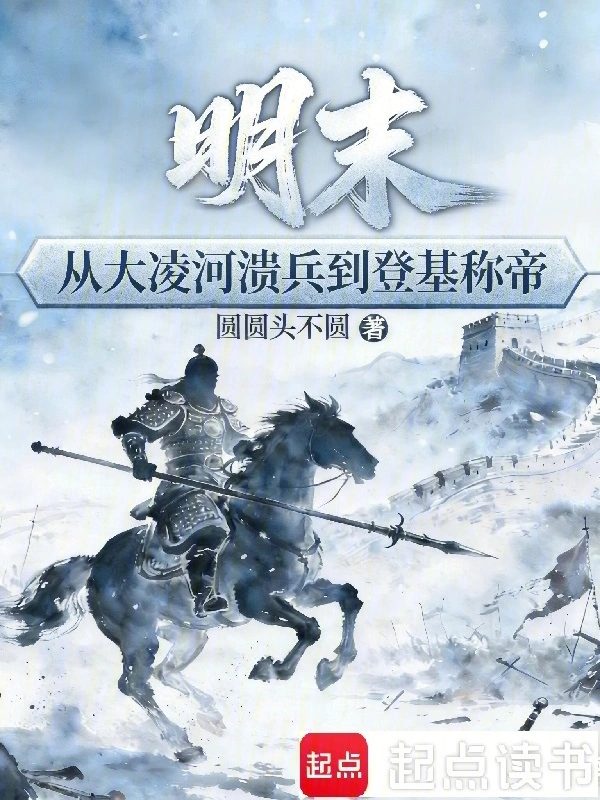
Late Ming Dynasty: from the Defeat at Daling River to the Ascension to the Throne as Emperor
明末:从大凌河溃兵到登基称帝
- Status
- Ongoing
- Length
- 923k Words
- Genre
- Historical
- Audience
- Male
- Subgenre
- Song-Yuan-Ming Dynasties
- Updated
- 14d ago
- Source
- Qidian
Stats
38Monthly votes
11.4kRecommends
26.8kFans
331Chapters
Tags
Synopsis
Reader comments
Readers also read
 Red Mansion: Start Escaping and Farming from the Equipment Bar
 Northern Qi, Sage Khan
 After Lying in Bed for Three Years, He Was Forced to Help the Han Dynasty
 Fu Ming 1627
 On My First Day at the Police Station, I Ate Imported Candy from a Police Beauty.
 Anti-Qing: Start with a Piece of Stone!
 Late Jin Dynasty: from Two-Legged Sheep to Human Emperor
 What Should I Do If I Ascend to the Wrong World?
 My Girlfriend Cheated on Her and Got Pregnant, and I Ran Away Nine Months Later
 Taiping Heavenly Kingdom 1854
 The Resurgence of the Song Dynasty Began by Pretending to Be the Emperor
 The Wind Rises 1898: Becoming a Warlord from Nanyang
Quick update
Faster Faster Faster Faster Faster Faster Faster Faster Faster Faster Faster Faster Faster Faster Faster Faster Faster Faster Faster Faster Faster Faster Faster Faster Faster Faster Faster Faster Faster Faster Faster Faster Faster Faster Faster Faster Faster Faster Faster Faster Faster Faster
Congratulations on finding the treasure
Congratulations on discovering a treasure. This book has no system or cheats. It relies solely on the wisdom and calmness of the protagonist. It feels like watching a favorite TV series when I was a child. It is worth calming down and reading slowly. You will definitely fall in love with this book.
What mistakes are easy to make in historical novels❓
Before the Ming Dynasty, the emperor was not called "Emperor". In the Song Dynasty, he was mostly called "Guanjia", and in other dynasties, he was often called "Your Majesty". In the Ming Dynasty, the emperor was occasionally called "Emperor", and in most cases he was called "Your Majesty". After Kangxi of the Qing Dynasty, people began to be generally called "Emperor". Princes and princes call themselves: Princes in the pre-Qin and Han Dynasties can be called "Gu", and a few can be called "Ignores". After the Wei, Jin, Southern and Northern Dynasties, the title of "Ignores" gradually became exclusive to the emperor, and princes, princes and princes can only be called "Gu" or "I". Song, Yuan and Ming called themselves "I" or "I". Before the Qing Dynasty, princes and princes rarely called themselves "this king". Starting from the Kangxi year of the Qing Dynasty, princes generally called themselves "this king". In ancient times, women called themselves: "nujia" was a modest name for women after the Song Dynasty. Women in the Han and Tang Dynasties more often called themselves "concubine", and noble women could call themselves "I" and "I". Before the mid-Ming Dynasty, most dynasties used copper coins for daily transactions, with very little gold and silver. It was only in the mid-to-late Ming Dynasty that silver became the mainstream currency. -In the late Ming Dynasty, "meeting votes/deposit checks" appeared among the people. There were no unified rules. Most of them were deposits and withdrawals/exchange receipts from acquaintances or local circulation, and were not legal currency. In the early years of Daoguang in the Qing Dynasty (1823): Rishengchang Bank was established, and private banks began to issue standardized banknotes, focusing on cross-regional exchange. They were only circulated in Shanxi merchant trade circles and major commercial ports, and were not yet popular. In the third year of Xianfeng in the Qing Dynasty (1853): the official issued the Ministry of Revenue official banknotes (official banknotes), which were forced to circulate nationwide. At the same time, the network of private banknotes expanded to the whole country, and official and private banknotes ran parallel. The use of banknotes entered an explosive period and became the "starting point of popularization." High-leg tables and chairs only completely replaced the low tables for sitting on the floor in the Song Dynasty. During the Han and Tang dynasties, people knelt and sat on the tables to eat and discuss matters. The furniture was mainly low tables and couches. The memorial system was only established during the Kangxi period of the Qing Dynasty. Officials in the Tang and Song Dynasties used "memorials", "tables" and "statements" when submitting memorials, while in the Ming Dynasty they used "memorials" and "memorials". There is no such thing as "memo" or "zhezi". In ancient formal occasions, the hand-over gesture was performed with the left hand outside and the right hand inside. The right hand outside was a special "unlucky gift" for funerals. "Better greetings" is a unique etiquette of the Qing Dynasty. It was mostly used by subordinates to superiors and juniors to elders. During the Tang and Song dynasties, people often performed cross-hand salutes and bows to greet greetings when they met, and there was no such thing as "sending greetings". Before the Yuan Dynasty, subordinate officials rarely called superior officials "adult". In some dynasties, subordinates called eunuchs "adult", and in some dynasties, they called their parents and elders "adult". Beginning in the Yuan Dynasty, lower-level officials would occasionally call officials of second-rank and above "sir". From the middle and late Ming Dynasty, only officials of third-rank and above would be called "sir" by their subordinates. Officials with lower ranks could not be called "sir". However, in the late Ming Dynasty, there began to appear a few cases where officials above the fourth rank were called "adult". Before the mid-Qing Dynasty, following the rules of the Ming Dynasty, only officials of third rank or above would be called "adult". Starting from the mid-Qing Dynasty, calling officials "adult" gradually became common for lower-level officials. Attention! ! ! What is mentioned above is that lower-level officials refer to higher-level officials. No matter which dynasty, it is absolutely impossible for higher-level officials to call lower-level officials "sir". Some novels even write about emperors or nobles calling other officials "sir". This is simply contrary to Tiangang! ! ! Finally, let's talk about the problem of civilians calling officials Before the middle and late Qing Dynasty, civilians in various dynasties and generations called officials differently, and most of them called them "officials" and "masters". From the middle to late Qing Dynasty, civilians also called officials "adult". {"NickName":"Restriction and Supervision","UserId":417773267}
No cheat code?
Thank you for your insensitivity to this abusive mainstream, 88
This kind of historical novel is difficult to write. The protagonist only has so many lifespans and development is too slow. It is difficult for agriculture to develop and grow. If agriculture does not develop and grow, the country will reach its peak development. The population can exceed 100 million at most, industry cannot develop even more, and industrial pollution alone cannot be dealt with. Mining alone requires batches of people to die. Due to communication problems, it is impossible for the country to develop too big.
The author's thoughts
First of all, I wish you all a Happy New Year! Thank you all for clicking into my book. The author is really new and working part-time, and it took less than a month to write the book. I just hope that everyone will comment more and interact more. If there is something bad written, feel free to criticize it. I will definitely not be disrespectful. I just hope that everyone will stop quarreling in the book review section. History is an established fact, and novels are just the author's fantasy. There is no need to get angry over an illusory thing. If you have any dissatisfaction, just come to the author! I wish all readers a happy life, happiness and good health.
The author has a certain level, but not much. He seriously belittles Hou Jin's combat effectiveness and makes the author's protagonist too idealistic.
No cheat code? I can only write blindly✍🏻It's an embarrassing conversation, everyone in the "Siheyuan" knows that you need a golden finger to play, and you will be killed and offline in a matter of minutes!
Idea
This book is probably going to be out of date, and there will be even fewer readers. The author feels that few people are following it. In the end, it turned into a vicious circle. To be honest, I have ordered a lot of this book. It's probably going to be wasted.
The design at the beginning is not arresting at all. It can obviously be designed to be worn as a teammate or other small officer. It makes sense to bring the memory and a dozen or so confidants to gather the defeated troops. It has to be made without memory. It is nonsense to think of going home alone.
Does the emperor only have one female protagonist? You have to get married. Everything is capital and assistance. Find capital in the early stage, and someone will invest in you in the later stage. The best way is to get married.
1 Don't regard Xu Guangqi and Tang Ruowang as positive characters!
Author, you can't write like this. You need to speed up the pace, return to the Ming Dynasty earlier, and return to the court to serve as an official. Only in this way can you have power and a stable team. Don't write too much about the details. Returning to the court is the main business.
This novel focuses on the tough line of war and hegemony. Its biggest feature is that it is "systemless", which means that the protagonist's growth and expansion of power do not rely on the data-based assistance systems common in modern online novels, but focus more on the characters' own strategies, decisions and struggles to survive in troubled times. The author emphasizes "not brainless", implying that the work will strive to be logically reasonable in plot design and character behavior, and avoid overly childish or illogical plots.
The feudal model is something even more backward and regressive than the tribal council/alliance + enfeoffment. Nothing can save the feudal model.
Ancient Egypt, Sumer, ancient Persia, Byzantium, the late Roman Empire, Qin to the Qing Dynasty, several civilizations each have thousands of years of history and have repeatedly proved it Among them, those who insist on the feudal model will either play themselves extinct - the brown-skinned ancient Egyptians, the real ancient Persians, and the Sumerians. Or he almost made himself extinct many times - Qin to Qing.
Forage
It is well written and can be read even if you are not familiar with the history of the late Ming Dynasty. And it was a bit jerky at first, but it became more and more fluent later on. The future is bright, come on!
Author, I saw some people saying that you can't do it, but I don't accept it. The protagonist is now an official of the Ming Dynasty. When you return to the court this time, you can suggest that the court let you attach yourself to Dongjiang. Of course, you, a newcomer, will not be able to gain a foothold in Dongjiang. You can suggest that you harass Hou Jin behind his back. At this time, the court needs to save face and will most likely agree. As long as you do not fight for money and you marry the Dongjiang military leader, the old Dongjiang military leader will also cooperate with you. At least you will not be short of ships. The court cannot give you much money, but it can give you the name and materials. You can set up a large stronghold in Hokkaido, so that you can advance, attack, retreat or defend. In the early stage, you can ask North Korea to give you money and people. You can also ask the court to send edicts to the Tokugawa family, and exchange them with tribute trade, so that the Tokugawa family can also provide you with supplies. You can do it in Japan Recruiting troops doesn't cost much. A large number of idle samurai are a threat to the Tokugawa family, so they will definitely cooperate with you. Many Japanese nobles, especially noble families that have failed in internal fighting, will definitely actively participate. At least most noble families will send some people to follow. Your protagonist will soon have soldiers. As long as your protagonist wants to, two or three hundred thousand is nothing at all. You don't need too much in the early stage, just ten or twenty thousand. Where does the money come from? The imperial court and North Korea gave you start-up funds. Your protagonist can carry out trade in furs and timber, smuggle, and mine gold. Hokkaido is very rich in resources. It is more than enough to support you as a small warlord. You have no shortage of copper, iron, sulfur, and gunpowder. After the protagonist has established a foothold, he can set up a stronghold in the north for trade and continuously mobilize various tribes to fight against Hou Jin, preventing Hou Jin from replenishing his troops and forcing the Mongolian and Han flags to be reused, paving the way for the subsequent plot. If the plot develops further, the protagonist can take in a large number of concubines from Dongjiang military leaders and the daughters of Korean and Japanese nobles, which will in turn affect North Korea and Japan. With these two places as supplementary points, the protagonist will have a basic base.
The protagonist's name is too modern, he looks like an urban soldier king type
Quickly find a place to develop. Recruit troops and buy horses. There are no soldiers or food under your command.
The plot of this book advances too slowly, and not even the Ding family has been dealt with yet.
Overall, it's above average.
For me personally, the writing is okay. There are too few updates, but they are not on the shelves. It's understandable, but the plot progress is a bit slow. At this pace, I doubt whether I will be able to see the Jiaozhou New Army fighting the Tatars before two hundred chapters.
I would like to ask where the author went to study so many plots? A person who takes office in the Xiahe Qianhu Office can write so many chapters, as well as the four major families and pirates. Are these plots made up by the web writers themselves, or are they really based on historical facts? From the chapters where I took up the post of Qianhu Institute, I admire the author very much. I don't think he could have written that many chapters, so I just skipped it using Spring and Autumn Writing. Thumbs up to the authors who have paid more attention to the plot than 90% of the authors. However, I suggest that the author should not expand too much on some chapters and get to the point quickly. After all, there is a long way to go to restore China. If you write it like this, you probably won't be able to finish 800 chapters.
What kind of bullshit is the Landlord plot? If you don't want to write it, just become a eunuch.
Where has the protagonist gone so far? Are you independent? When will you become emperor? Take advantage of the limited offer
Did you copy this from other novels? I have seen your content before and it feels the same. It has basically not been changed.
Does it look like the author is preparing to stand on his own feet?
What's going on? Updates have been suspended for two days.
Just a few nonsense military opinions
I feel that the protagonist can learn Qi Jiguang's 14-volume Ji Xiao New Book well, and he can play it casually in the late Ming Dynasty. For example, if musketeers are equipped with two-handed long knives (Japanese knives) to fight against cavalry, Qi Jiguang believes that long spears are easy to break against cavalry. It is not as good as long knives that can cut horses. Bayonet is not necessary. Bayonet is not actually a very good melee weapon, and modern Western armies rarely fight. Bayonet combat is mainly bayonet impact (bayonet impact and bayonet combat are two different things. Bayonet can be equipped in large quantities mainly because it is cheap. If the craftsmanship problem of bayonet is not solved, long knife will be enough.) In addition, the car camp is too bulky and out of date in the late Ming Dynasty. However, various small artillery rockets can still be used to harass the cavalry, as long as there are a large number of reliable muskets. There is really no need for spearmen. During the Thirty Years' War, many infantry regiments in Europe had very few spearmen. As long as there are a large number of muskets and they are not placed randomly, the cavalry actually does not dare to attack the infantry. The organization of the Ming army was really bad. Qi Jiguang complained about lagging behind in the march. If you can train the army's mobility and marching for a long time, and be able to defeat the small part with more troops, it will be very easy to defeat the majority of the army. During the Opium War, the mobility of the British army was several blocks away from the Qing army. They were obviously fighting in the Qing mainland. The British army could often surround the Qing army with more enemies and fewer enemies... This is enough to illustrate the importance of intelligence work...
It's well written and exciting. I hope the author can continue writing! Come on!
The writing is very good. I read the latest in one go. Good luck to the author.