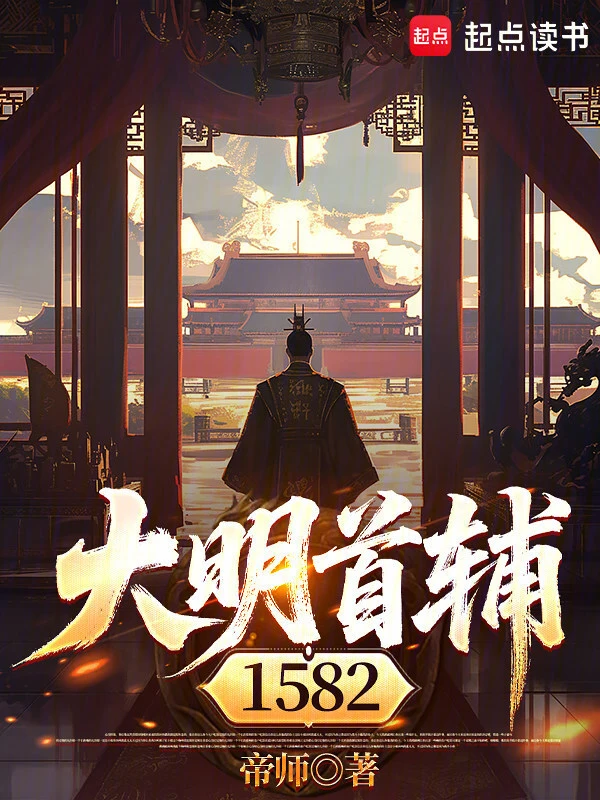
The First Assistant of the Ming Dynasty 1582
大明首辅1582
- Status
- Ongoing
- Length
- 190k Words
- Genre
- Historical
- Audience
- Male
- Subgenre
- Song-Yuan-Ming Dynasties
- Updated
- 5mo ago
- Source
- Qidian
Stats
0Monthly votes
1.3kRecommends
28Fans
55Chapters
Tags
Synopsis
Reader comments
Readers also read
 Fu Ming 1627
 At the Beginning, Please Ask Chongzhen to Abdicate!
 I Am a Tyrant in Nanming
 Red Mansion Xiaoke
 Daming: Attack, Emperor Yongle!
 I Served as Zhang Juzheng's Second Assistant in the Cabinet.
 Jiajing Mingjun
 I Get a New Character Every Week
 Transform into Tang Monk and Become Stronger Starting from Covering the Sky to Obtain Scriptures
 I Am Song Shizu
 Seizing the Direct Descendant in the Prosperous Tang Dynasty
 I Am Lord Xinling
Worth reading
Yes, it can be entered or substituted. From the perspective of newcomers and new books, it is very stable and has a level of 70 or 80. If it is an internal investment, it should be enough to sign. However, the big question for newcomers is whether they can continue writing. It would be better if there is an outline. Judging from your posts, I have accumulated enough writing skills. There is still great prospect for writing longer. Maintaining standards and quality resources are expected to have a higher impact. Looking after you.
Miscellaneous Talk·Jichou Month and Guimao Day in Yisi Year (2026.1.29)
[1. Why is it the first assistant of the Ming Dynasty in 1582] [2. Why is it the 26th year of Jiajing? [3. Why is it Chen Yiqin] [4. Why is it said that Zhang Juzheng is "close to Yi Yin in reality, but not named as Yi Yin"] 1. Why is it the first assistant of the Ming Dynasty in 1582 (1) Why is it the Ming Dynasty Answer: Because he is popular. 1. This is not to say that other dynasties are not popular. After finishing this book carefully (it will probably be more than 4 million words at present), I will also write about other dynasties later, but I will choose hot topics at the beginning. 2. The author himself has always wanted to travel through all the past dynasties like the boss of the new series in July (I am also anxious to write, but my hand is disabled, and I am so anxious every time I type, I beg for the hand speed of an eagle, please let me be reborn). 3. So if you have your own Bai Yueguang dynasty, emperors, ministers, concubines and beauties, don't worry. If you want to see which dynasty I write about, you can leave a message in the comment area later. I currently have preparations from Qi, Chu, Qin, Han, Tang, and Song for later use. 4. I am a bit nagging, so I will say a little more here. The author also likes the monarchs who worked hard in the middle and late dynasties, such as Chenghua and his son of the Ming Dynasty, Xuanzong Li Chen, known as the "Little Taizong" of the Tang Dynasty, and Xianzong Li Chun, who founded Yuan and Zhongxing. They are not as omnipotent as the founding monarchs, nor are they as pitiful and helpless as the subjugated monarchs. They each have their own shortcomings. They do not have the vigor of the early dynasty, nor the twilight energy of the late dynasty, but they have a unique spirit of saving the world. In the author's words, it is a stage where "everything seems to come in time, but time just seems not enough", so it leaves us enough room for imagination. However, the premise for such emperors to take root is to increase the popularity of the entire dynasty, so as to attract more readers and history enthusiasts to focus on these relatively less popular monarchs. (2) Why is it the first assistant. Answer: It was determined based on the special circumstances of the first assistant in the Jialongwan period and the author's personal writing preference. (I had an imperial city PK in my mind, imperial power VS prime minister power) 1. The chief assistant is a product between imperial power and prime minister power. What is mentioned here especially refers to the chief ministers of the Jiajing (late period), Longqing, and Wanli dynasties in this book. ① Although the old Taoist priests lived in seclusion and were very powerful, one of the consequences was that they indulged in the bad habit of forming a party for personal gain, and even brought this trend to the forefront, seriously damaging the political ecology and the prestige of the court, and setting a precedent for the later Donglin Party, so that there was a situation where the local government respected the emperor and kissed the chief minister. ② Emperor Longqing let himself go, and his not-strong character met the strong chief minister, and he showed the world the appearance of a weak leader and a strong minister. The release of this signal directly over-raised the prestige of the chief minister in the court and the local area, causing Emperor Wanli to face many difficulties as soon as he ascended the throne. Of course, due to the premature death of Long Qing, the imperial power did not have time to complete the transition. ③All the above created an embarrassing situation. During this period, the power in the hands of the chief minister had gradually transcended the scope of the so-called prime minister and had deviated far from the original intention of Lao Zhu to abolish the prime minister and Zhu Di to establish a cabinet. This was a serious backlash from the prime minister's power and an out-of-control crisis for the imperial power. ④ By the time of Zhang Juzheng, the power of the chief ministers and assistants of the three dynasties had actually been accumulated to near the peak. However, there were still constraints from the Empress Dowager Li and the internal minister Feng Bao who divided the imperial power at the same time, which contributed to the political pattern in which the imperial power was "divided into three and the three pillars stood out". 2. Gao Xiaofeng said: "Secretary, the ministers of the Ming Dynasty are all very powerful." Courtesy, or scholar-bureaucrats represented by the chief minister. They are the hub for uploading and distributing, the flesh and blood of the political framework, and the implementers of the highest decisions. The larger the state and political structure, the stronger this interest group will be. In the political environment of the Ming Dynasty, scholar-bureaucrats will fight among themselves, but if the imperial power wants to reduce the interests of their group, or let them think that the emperor is going to attack them, they will undoubtedly attack in groups. The author wrote a sentence about his one-sided evaluation of scholar-bureaucrats. "The government agencies are all trying to quarrel with each other, and the officials who deceive the superiors and deceive the subordinates are often criticized." "Historical records rarely grant marquis affairs, but the common people say before and after life." The monopoly of the right to interpret and judge, this privilege of controlling communication channels up and down, makes it impossible for the country's highest power and the broadest mass base to establish an effective feedback mechanism. The quality of national policies is based on the memorials passed down from local officials, and the living conditions of the people are entirely determined by officials themselves. With the monopoly of knowledge and public opinion, we cannot classify them as a vulnerable group. In front of them, the emperor and the common people, the former is the artifact they hold hostage, and the latter is the stored grain they draw blood from. (3) Why is it 1582? Answer: Zhang Juzheng died in 1582. This book takes the death of Zhang Juzheng as a node. The protagonist was born in 1543 and took over as chief assistant in 1582 (39 years old at this time). Before 1582, the main focus was on accumulating strength, and the southwest region where the protagonist was located was the basic plot. It involved plots such as chieftains, imperial wood harvesting, military affairs, and entering the capital to serve as King Yu's servant. I won't spoil it too much here. After 1582, he mainly presided over the New Deal and made systematic adjustments to the Wanli New Deal, which would involve plots such as sea territories, switches, Chinese cultural circles, and the vassal system. I will not go into details as above. [2. Why is it the 26th year of Jiajing? Answer: To prosper a country, it must have virtuous people. Ding Weike's Dragon and Tiger List, 301 Jinshi, are the mainstay throughout Jiajing, Longqing, and Wanli of the Ming Dynasty. They are not only the protagonist's help, but also the flesh and blood that truly fills the framework of the Ming Dynasty. The subsequent series of plots are all related to the Jinshi in this imperial examination, so this is the beginning. [3. Why Chen Yiqin] Answer: He has the intelligence, the ability to protect the protagonist, the qualifications, and the means to pave the way for the protagonist. ① Deeply cultivated in the Hanlin Academy Chen Yiqin was a Jinshi in the 20th year of Jiajing. In the 26th year of Jiajing at the beginning of the plot, during the seven years he entered the Hanlin Academy, he was respectful and humble. It cannot be said that they are all friends, but there are no enemies. The protagonist's four elementary school masters were created by a combination of factors such as Chen Yiqin, a "good old man", the protagonist's own talent and his sincerity to learn. The four of them accounted for more than half of the disciples in Ming Dynasty's official circles, and the intricate network they formed gave Chen Yuting the confidence to "have the right words and connections". ②Posthumous title "Wenduan": Observe etiquette and uphold justice, and have pure conduct. "Jane is in the heart of the emperor, knows how to advance and retreat, is not greedy for power, and does not rely on his status as an emperor's master. It has left the new emperor with the impression of being a die-hard one of his own." Throughout the Jiajing Dynasty, the feudal dynasty is an integration of family and country, and this old Taoist priest is an integration of public and private affairs. The private good of writing Qingci can impress He, but he also likes someone who can stabilize his power, someone who will not have any wrong ideas, someone who can act as a check and balance as long as he exists. Therefore, Li Chunfang and Chen Yiqin appeared. They have similarities and differences. The similarity is the nature of "reconciliation". The difference is that the former is both public and private, Qing Ci is well-written and respectful enough, while the latter Chen Yiqin is even more unwilling to participate in the fight, but his power skills are not bad at all, so we can see that only Yuan Li can escape intact and make his son become a cabinet minister. The father and son Chen Yiqin and Chen Yubi in history are such a person. You can hardly imagine that he was an emperor's teacher, and he was able to stand up and support the emperor's heir when Yan Song and Yan Shifan framed King Yu. So much so that Emperor Longqing personally wrote the word "loyalty" and said that he "inspired Hongduo". ③I personally appreciate "important third characters" like Chen Yiqin. He can be the mediator of the conflict between the protagonist and the supporting characters, preventing the situation from getting too out of control and going to extremes, and controlling the situation at the level where the conflict needs to be resolved. At the same time, what is more important is self-knowledge, the ability to weigh one's own weight, find one's own position, know the time to enter the game, control the speed of promotion, and the open-mindedness to voluntarily withdraw from the game. These all make me deeply sigh for his wisdom in protecting himself. Such a character is the most suitable protector for an ambitious protagonist who needs to wear sheep's clothing in the early stage. [Why is it said that Zhang Juzheng is "close to Yi Yin in reality, but not named after Yi Yin"] 1. Gu Lin's "one word becomes a prophecy" "The ancients said that great talents came late, this is a Chinese talent, and you are not a Chinese talent. It is my fault that I delayed you for three years. May you have great ambitions, be Yi Yin, be Yan Yuan, and don't be a young scholar who becomes famous." ————"The Acts of Grand Master Zhang Wenzhonggong" ① This is a short story interspersed with Zhang Juzheng's road to the imperial examination. Gu Lin (1476-1545), whose courtesy name was Huayu and whose name was Dongqiao Jushi, was from Shangyuan. He lived in today's Nanjing, Jiangsu Province, and his ancestral home was Wuxian County, Suzhou. A Jinshi, official, and writer in the ninth year of Hongzhi's reign, he reached the rank of Shangshu of the Ministry of Punishment in Nanjing. He is known as "Mr. Dongqiao" in the literary world. He can be said to be Zhang Juzheng's bole and mentor. This Mr. Dongqiao misunderstood Zhang Juzheng at first, thinking that Zhang Juzheng was a middle-level talent, a young scholar, so he spent three more years on the road to the imperial examination. His last words became a prophecy, comparing Zhang Juzheng to Yi Yin. Zhang Juzheng and Yi Yin, the different times have caused the fate of the two to be different. Yi Yin can depose and establish a new king, but Zhang Juzheng cannot. Is it because he does not have enough power? There is a reason for this, but more importantly, he is "unnamed". In the Yin and Shang era where Yi Yin lived, the political concept of "the destiny of heaven is constant, but virtue is the basis" is an ideology that has been established since Tang Dynasty. The concept of virtue originated from the way of heaven and can affect the material realm from the spiritual realm. When your behavior occupies the high ground of virtue, then the power to depose and establish a new king is naturally a right given by the previous king, and it is also the will of God. (These are all brief discussions, just to introduce ideas, everyone is welcome to chat)
Why is it that the status remains unchanged despite the contract being signed?
Why does it still show that I have not signed a contract?
Isn't it difficult to write about the Jiajing Dynasty?
As a newcomer, you start to engage in political intrigues, and you are also a Taoist emperor. If you don't write well, you will really get criticized.
Update
What about updates? Remember to update 4,000 words every day, and new book issues cannot be interrupted.
Good looking 😍 is now on the shelves. Please place an initial order.
Haven't signed a contract yet? I can't cast a monthly vote. I followed the author on Douyin.
The big problem of the Ming Dynasty is that you can't clean up the system of landlords and powerful civil servants. If you need to govern the world, you have to rely on civil servants. Civil servants spontaneously seize political power. For the sake of power, they collude with foreign enemies.
In the second year of Jiayou's reign, he was the first in the Dragon and Tiger list.
Ming Dynasty political battles
If you like political fighting, you can check it out, it's a relatively good one. But for me, no matter what kind of political fighting literature, the essence is to dance in shackles, locked in the imperial bureaucracy of the Ming Dynasty for a lifetime, with little to see.
Let's follow it first, mainly to see how to write a long article
Officials who are not confident are not qualified to become chief assistants.
Author
Do all the novels you open have multiple female protagonists?
Although I invested in this book, I was not optimistic about it at the beginning. The protagonist is a four-year-old child prodigy, and he is not only Jiajing and Yan Song, but also Xia Yan and Zhang Juzheng. I admit that I checked a lot of the author's information, but he couldn't tell the most basic story well. By the end of the writing, he didn't even know how a four-year-old child could go through more than ten years of experience. After that, there were so many useless plots that had nothing to do with the protagonist that he couldn't write anymore except to drop his book bag.
The starting point is too high and it is difficult to write. If you are an ordinary scholar, you can write dozens of chapters just by starting a business in your hometown and making money. You can study dozens of chapters in the social science test, enter the officialdom and work step by step to get promoted, and then work as a local magistrate in the capital for another hundred chapters. Then step by step, you can enter the political center, where the party fights for power to carry out reforms, and then invents and opens up channels. The starting point of this book is the political center from the beginning. The protagonist wants to get involved in everything, but he is too young to interfere. There is no clear outline for writing step by step, and the plot cannot be advanced at all. You can fast forward if you get a name like a child prodigy in the early stage, and then enter the imperial examination and become an official, solve marriage problems by the way, marry a teacher's daughter or other things, become an official, an official, or a local official. It's a pity that this book has been discontinued now.
Stopped updating? You won't be able to enter, will you? 😭
Author
Can you answer the previous question?
Give me a reason why you don't want to write it. It's not appropriate to die before you even finished writing the edict.
If you don't want to write anymore, I'd better post it and tell readers about it. What's most annoying is that it suddenly ends without saying anything!
Drag it away and bury it
The author has entered the palace on a cliff
The biggest problem of the Ming Dynasty is that you, the vassal king, have to start with the biggest ones, otherwise you will start with the smaller ones and not the big ones. If you still want to reform