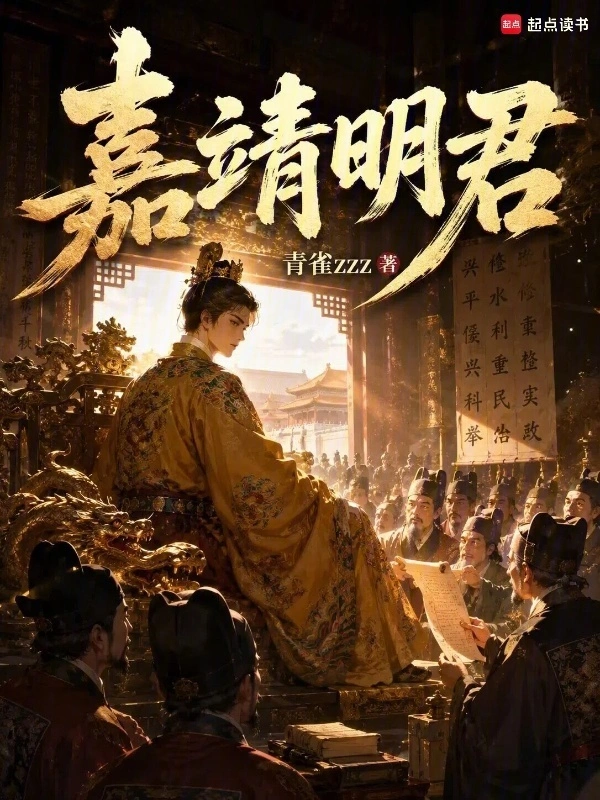
Jiajing Mingjun
嘉靖明君
- Status
- Ongoing
- Length
- 154k Words
- Genre
- Historical
- Audience
- Male
- Subgenre
- Song-Yuan-Ming Dynasties
- Updated
- 3d ago
- Source
- Qidian
Stats
116Monthly votes
1.2kRecommends
11Fans
66Chapters
Tags
Synopsis
Reader comments
Readers also read
 At the Beginning, Please Ask Chongzhen to Abdicate!
 I Am a Tyrant in Nanming
 Red Mansion Xiaoke
 Fu Ming 1627
 Daming: Attack, Emperor Yongle!
 Damn It, I Will Become the Ling Emperor of the Han Dynasty
 I Am Song Shizu
 I Get a New Character Every Week
 Transform into Tang Monk and Become Stronger Starting from Covering the Sky to Obtain Scriptures
 I Want to Revive the Tang Dynasty!
 Daming: Emperor Chenghua Is Here to Ascend the Throne First!
 The New Tang Dynasty Began with the Anshi Rebellion
Is Zhang Juzheng really loyal? Can he really not see that Ming Dynasty has no money? Forget about paying money in the south of the Yangtze River. At least the manufacturing industry in the south of the Yangtze River is developed and smuggling is prosperous. But why should the north also pay the money? Is it possible that they really don't know that the people will be scratched by profiteers? As a minister, you oppress the monarch and ask the monarch to be frugal. What about you? Also, the person Long Qing said bullied him, was it Li, Feng Bao and Zhang Juzheng? As soon as the emperor died, the Iron Triangle formed an alliance of interests and forced Gao Gong to return to his hometown for retirement 😂
Made me laugh so hard
The author's post on Tieba, the title of the book blocks loneliness
Recently I've been watching Zhu Yuanzhang's burial system and I'm getting more and more angry. It's so cruel. He kills people indiscriminately. Zhu Di also kills people indiscriminately.
If I don't read Qingquezzz's book for a day, I will feel uncomfortable all over.
If I don't read Qingque zzz's book for a day, I will feel uncomfortable all over. If I don't read Qingque zzz's book for one day, I will feel uncomfortable all over. If I don't read Qingque zzz's book for one day, I will feel uncomfortable all over.
Jiajing is very difficult to write about
It's very difficult to write. He basically reached his limit in the first half of his life, and it would be impossible to change the time traveler. What you wrote is so fake
Newcomers should not touch Ming Dynasty textual research, it is very difficult to write, because without experience you cannot write about the depth of the officialdom of the Ming Dynasty, and the biggest feature of the Ming Dynasty is the human nature of the officialdom. It can be said that the human nature of ancient and modern times is vividly described. Unless you write some imaginative Ming Dynasty prose. When newcomers write textual research on historical texts, they first write about the eras where popular celebrities lived. For example, in the Tang and Song dynasties, when textbook celebrities burst out, it will be much easier to write secondary works based on celebrities. For example, this book about Shao and Song dynasties is a passionate second-generation fan fiction. As I continue to accumulate writing skills and book fans, I will be able to write hard-core essays about the emperors of the Ming Dynasty. Otherwise, it is easy to dampen the enthusiasm for writing. The openness of the Tang Dynasty, the elegant Song Dynasty, the officialdom of the Ming Dynasty, the princes of the Qing Dynasty, the Three Kingdoms, the Five Hus, the Five Dynasties and the late Ming Dynasty are the bases for warlord writing. As for other subjects, they are all unpopular. The more unpopular you are, the more you need to write about the character, because this character does not exist in public perception and cannot be imagined. You can only base it on historical data. Creative creation of characters requires extremely high demands on the author. According to public perception, your Jiajing era is unpopular. This is still a trend of the Ming Dynasty 1566. Otherwise, who knows what is interesting about this period. According to history, who would like such an emperor who is not doing his job properly, except for the stingy guy who is just trying to make fun of others.
Zhang Cong (1475-1539), whose courtesy name was Bingyong and whose nickname was Luo Feng, was later given the name "Fujing" and whose courtesy name was Maogong because he avoided the taboo of Emperor Shizong of the Ming Dynasty. He was a native of Yongjia County, Wenzhou Prefecture, Zhejiang Province (now Longwan District, Wenzhou City, Zhejiang Province). He was an important minister, an outstanding politician and reformer in the mid-Ming Dynasty. He served as the chief minister of the cabinet three times. 1. Early experience and entry into politics Zhang Cong has been eager to learn since childhood and has a profound knowledge of the "Three Rites" ("Zhou Rites", "Rituals", and "Book of Rites"). However, his road to the imperial examination was quite bumpy. After passing the imperial examination in the eleventh year of Hongzhi (1498), he failed in seven examinations. It was not until the 16th year of Zhengde (1521) that at the age of 47, he went to Beijing for the eighth time to take the exam. He finally passed the Jinshi exam and entered the Ministry of Rites to observe politics, officially entering his official career. 2. The "Dali Conference" incident and the mutual understanding between the monarch and his ministers The important turning point in Zhang Cong's political career was the "Dali Conference" incident. After the death of Emperor Wuzong of the Ming Dynasty, Emperor Shizong of the Ming Dynasty (Emperor Jiajing) succeeded to the throne as a vassal king and wanted to honor his biological father, King Xingxian, as the emperor. At that time, many courtiers headed by Yang Tinghe held opposing opinions. Zhang Cong fought against all opinions and supported Shizong's idea of "succession without heir", which catered to the emperor's will. Although this move was met with fierce opposition and even life threats from his old ministers, Zhang Cong was courageous and did not shy away from resentment. He eventually gained the extreme trust and respect of Emperor Shizong of the Ming Dynasty and moved to the center of the political stage. 3. Implementing the "Jiajing Reform" As the instigator and chief architect of the "Jiajing Reform", Zhang Cong implemented a series of drastic reform measures during his administration, aiming to eliminate the long-standing abuses of the Ming Dynasty: Clean up the village fields: Resolutely survey and clean up the village fields of the ancestors in the capital, and return a large amount of occupied land to the owners, effectively inhibiting land annexation and easing social conflicts. Suppress eunuch power: In a low-key and step-by-step manner, the large-scale elimination of guarding eunuchs in various places weakened the power of eunuchs and effectively suppressed the emergence of eunuch autocratic power. Rectify the administration of officials: Promote anti-corruption and establish "strict prohibitions" to severely combat corruption, so that "the road to bribery and acceptance is cut off"; at the same time, strict supervision and assessment of local officials are carried out. Reforming employment: Implementing the "Three Ways of Advancement Method" in employment, emphasizing that in addition to Jinshi, Juren and Suigong students should also be promoted and used, which expanded the basis of rule and facilitated the mobility of social classes. 4. Historical evaluation and later years Zhang Cong was an honest and self-responsible official. Although he held a high position, he did not have the slightest selfishness. The history of the Ming Dynasty spoke highly of him, saying that he was "bright and courageous, and did not avoid resentment." "He was extremely honest and hated corrupt officials." Later historians believed that his achievements ranked first in the Jiajing Dynasty. In recent years, academic circles have called him "the first minister of reform in the Ming Dynasty". In the 14th year of Jiajing (1535), Zhang Cong's illness worsened and he repeatedly asked to be appointed to the official position. Emperor Shizong of the Ming Dynasty even personally prepared medicine for him, but in the end he was allowed to retire and return to his hometown. In the 18th year of Jiajing (1539), Zhang Cong died of illness and was awarded the posthumous title "Wenzhong" as a grand master.
4/38. Food and grass. There are source notes and good reviews. The protagonist considers himself a latecomer, the successor of Hua. Take your time and take a look. Look at how hot it is.
Are recommendation votes useful?
I've given you the daily recommendation votes, but I don't know if they're useful. Very well written
Can I use dim sum as a title? You don't know how to use it except for adults, right? When you call your leader, do you also call him "Sir x"?
It would also be good to prevent Zhu Houcong from ascending to power. Zhu Houcong is too rubbish.
Another big etiquette? Time travelers still waste energy on big etiquette? How is that different from the original Jiajing? Real trash.
Just criticize Zhengde. Nothing to say. I wonder if you, the author, have checked some historical materials. Why do you criticize Zhengde so much?
Looks a bit familiar
Why does this introduction feel so familiar? Was it cut up and republished in a previous book?
Move the capital to Nanjing and seize the southeast.
No, what do you think when you open the same book when you already have a million-ordered novel?
43/43. Grain and grass. The main problem lies in "the tone was too high at the beginning, but then the subsequent performance was very lack of practice." Successors and successors are not so easy to be. To learn, you need to review the past. To slay the dragon, you must practice diligently. However, the notes at the end of each chapter are quite good. It should look like three rivers. Looking forward to seeing you again.
That's ridiculous. Not even three months after ascending to the throne, he was cleaning up the management of the nobles. . My butt is not yet hot from sitting. When everyone didn't recognize them, they made personnel changes. Are you sure you have been a civil servant? You also clean up the Zhang brothers, and you are not afraid of others saying that you, the emperor, are crossing rivers and burning bridges. If it weren't for Empress Dowager Zhang, you would be able to sit on the throne of God.
It's been a long time since I've seen a non-commercial book written with care by the author.
Qingque... Does it mean black egg?
Is it true that Zhu Houcong gave it to the palace maid to use the menstrual moon to make elixirs?