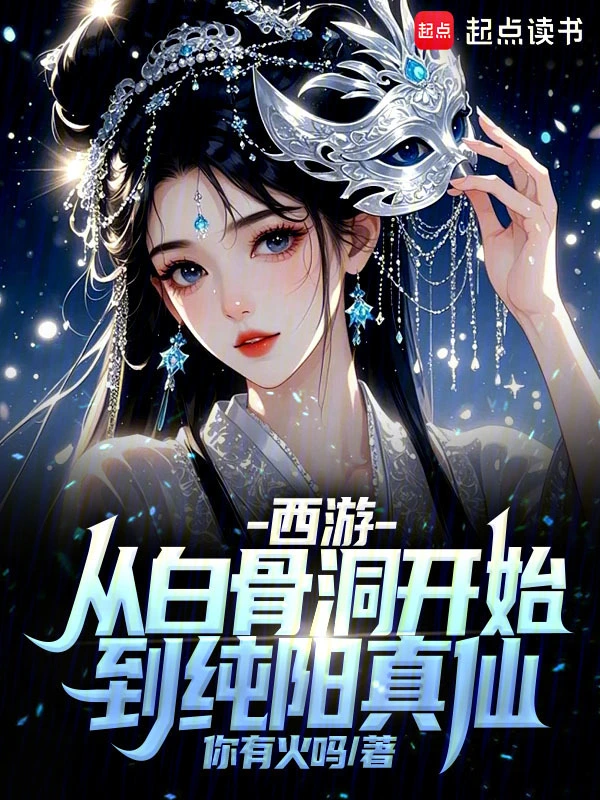
Journey to the West: from the Bone Cave to the True Immortal Chunyang
西游:从白骨洞开始到纯阳真仙
- Status
- Completed
- Length
- 598k Words
- Genre
- Cultivation
- Audience
- Male
- Subgenre
- Classical Xianxia
- Updated
- 6mo ago
- Source
- Qidian
Stats
0Monthly votes
17.9kRecommends
40.8kFans
194Chapters
Tags
Synopsis
Reader comments
In booklists 1
Readers also read
 Xuanjun
 Immortal Travel
 Your Magic Weapon Version Is Too Low!
 Guixuxuanji
 Never Walk Alone!
 Journey to the West: from the Five Thunder Methods to the True Lord of Leibu
 Journey to the West: from Centipede Spirit to Hundred-Eyed Lord
 Daming: Have I Become Wanli's Portable Grandfather?
 I Am Drawing a Hot-Blooded Episode in the Zhiyu Episode!
 Prehistoric: Reborn as a Qi Immortal, Practice Steadily
 Conferring Gods: Starting from the Princes of the Princes
 Gou Achieved Immortality on His Journey to the West
 People Are Conferring Gods. at the Beginning, Two Peaches Kill Three Soldiers.
 Prehistoric: Willow God's Template, He Became a Disciple and Was Expelled
 Journey to the West, Little Witch, I Have the Demon Summoning Sutra
 Conferred God: Zhang Kui Guards the Pass and Invites the Saint to Die!
 Honghuang: I Build a Vertical and Horizontal Road and Drive the Saint Crazy!
I am tired of reading novels where the strong bullies the weak, and the superiority and inferiority of fellow Taoist ants are discussed. The sudden emergence of literature on seeking Taoism and cultivation is quite new. Whether one becomes a god or not depends entirely on the author's experience and diligence in researching information.
I'm so speechless. The title of the chapter is "Shocked, Shocked, Silly... Can't you think of anything else besides these words?"
Please comment, this is not a traditional monster-killing and upgrading article, but a moral article. This kind of novel is not long, and I feel that I will get into trouble in the later stages.
Chapter 7 Death from Poison
"The black bear's level of elixir refining is extremely high"... Isn't it a wolf demon who can refining elixirs?
Borrowing the world of Journey to the West to write fantasy and cultivating immortality
It is a fantasy novel about cultivating immortals under the pure brand name of Journey to the West. The author just borrowed the name Journey to the West to adapt the novel about cultivating immortals. If you don't mind, you can read it. The author's writing is pretty good. I don't like this style. If you don't mind, don't come.
The author is too high-spirited in his studies, and his Confucianism, Buddhism and Taoism are shocking at every turn. . .
They're not just talking heads, they're just talking nonsense? Why do you feel like you are reading an ancient online article? It seemed strange before, but now it's almost interesting. But you did a good job in this cycle. You didn't go astray and you were very steady. Your results shouldn't be bad.
What's the difference between this and those pretentious stories behind the scenes of spiritual energy recovery? One moment I'm shocked by this, the other moment I'm shocked by that╮(╯_╰)╭
Xu Gongzi Shengzhi, an early online fugue author, has a similar writing method, but his writing is better and more true than this book. And who is the most powerful theoretical master in Journey to the West? It is Jin Chanzi, a disciple of Tathagata. The protagonist is praised by Tathagata as a theoretical Buddha. In the end, he still looks down on the only spiritually ignorant (ordinary) monk in Journey to the West. It really feels like the second brother is talking about the elder brother. Simply instilling principles is not as interesting as watching the old version of The Legend of Jigong. As of now, the story has been lost, and the theory has been rambled on.
To be honest, I can't even remember what the traditional journey to the west is. Now I can't tell the difference between prehistoric times, gods, and journey to the west.
There are too many explanations, and the lengthy articles sometimes consume too much reading patience.
Thoughts after watching the first chapter
I don't know how the protagonist can decipher the hexagrams without having the time to build the sun, the hour, or the time, or whether he is using divination and prediction to write a novel. Assuming that we use the six lines to look at it, regardless of the year, month, day and time, the DiLei Fu hexagram (Kun Palace), wife, wealth, children, grandchildren, water, hold the world, and the Ying Yao brothers are ugly, earth, and should restrain the world. Although it is a Liuhe hexagram, the sons and the ugly are combined to restrain, but after all, it is others who restrain me, and it is not beautiful in the end.
All he could think about was what Kui Mulang would think if he saw Bai Jingjing. He was married to a reincarnation, so he could probably guess that he didn't love him. This was the corpse-turned-spirit.
A fan of the author Wang Mingyang, who has never studied Marx
Has the UC editor adapted the novel?
Shocked at every turn, shocked by this and that
Why are you still writing about the King of Tang Dynasty? To be honest, I kept skipping pages to read this plot. What are you writing about? Everyone is here to watch Journey to the West, not to watch your exam. What are you writing about that is not related to Journey to the West?
Read Chapter 7 and write a short review of the drug test
First of all, it looks okay so far, but the details are not handled well, and some contradictions in the plot are not clearly explained. For example, the protagonist recommended that the White Bone Demon kill his little demon to eliminate his karma. The White Bone Demon actually did it and it was eliminated. This isn't quite right, is it? It's not clear whether these little monsters are the old subordinates of the former Mountain King White Tiger Spirit or the new recruits of the White Bone Spirit himself after he took office. If it is the former, it would be fine. In the latter case, the principal can eliminate the disaster for himself by killing all the accomplices? Let's not talk about cause and effect Later, the author assumes that the White Bone Demon was transformed from the corpse of the fairy from Pixiang Palace. The protagonist directly regards this as known information. Isn't this right? From the reader's perspective, the protagonist has just read Journey to the West just like us. The protagonist can speculate in this way, and you can also expand the original work yourself. But it's inappropriate to just use it as known information In the early stage, it was said that the White-bone Demon has low cognition and does not know the heavens. He thinks that cause and effect is nonsense. However, later the White-bone Demon gave the protagonist popular science that monsters will have a natural disaster every five hundred years. The greater the karma, the stronger the natural disaster. Isn't this contradictory? The author's portrayal of her in the first few chapters is "ignorance" rather than "unafraid". If it is the latter, it can be written like this, but if she has the concept of karma and catastrophe and is afraid, how can she have this behavior pattern? In addition, there are many typos. Didn't the author read it himself before sending it out?
The cold and icy Bone Lady, how can I look at and feel uncomfortable? How can these two words be used to describe people?
Since Tang Monk is a monk with a strong heart towards Buddha, why don't you ask Tang Monk for a piece of Tang Monk's meat?
He directly found Tang Monk and knelt down and begged him to cut off a small piece of meat for him to eat without hurting his roots. Of course, the prerequisite is not to be beaten to death by Sun Wukong and the others when they meet. In this case, go directly to Tang Monk, beg him, and promise to live forever as long as you get Tang Monk's meat and eat it. I will definitely do more good deeds to pray for Elder Tang in the future.
The most important thing in the study of mind is the unity of knowledge and action. Just thinking is useless!
The practice of Journey to the West is all about the patrons and the background.
Do you understand Journey to the West?
Well written. I have a question, author, do you really understand Journey to the West? . Journey to the West is actually a satire, satirizing Emperor Jiajing and his court.
Awkward. First of all, the theory of Neo-Confucianism and Psychology is fine when applied to personal cultivation, but it is nonsense when extended to all things in the world Secondly, the classical immortals do not use the thoughts of Zhuangzi and Liezi, and it is really speechless to engage in the thoughts of King Cheng and Zhu.
In fact, it was okay, but Yang Jian was made to be unintelligent and stubborn. Don't confuse Marshal Tianpeng of the Navy with Marshal Tianpeng, the leader of the Four Saints of the Arctic. Even Emperor Zhenwu once worked under him, but he ended up treating him like Zhu Bajie, which was a bit too much.
I don't know how powerful the author is when I read it. I'm afraid it's because the writing was very uncomfortable.
This is the first time I have read a novel in so many years that it is difficult to comment on it. It may be because my appreciation is limited or I am too impetuous. It's not that the novel is bad, it's probably my problem.
You are not writing a novel, but are instead writing an argumentative essay?
Borrowing a building to promote a book, Cyber×Western Fantasy, the title of the book is "The Magician of Eternal Night: From the Alchemical Slug to the Seat of Truth" Thanks for renting the building
I borrowed the building to promote the book, Cyber×Western Fantasy. The title of the book is "The Magician of Eternal Night: From the Alchemical Warhead to the Seat of Truth" Thanks for borrowing the building
Not the author, too many exclamation points 😥
I haven't seen this kind of fairy grass for a long time. Come on, author!