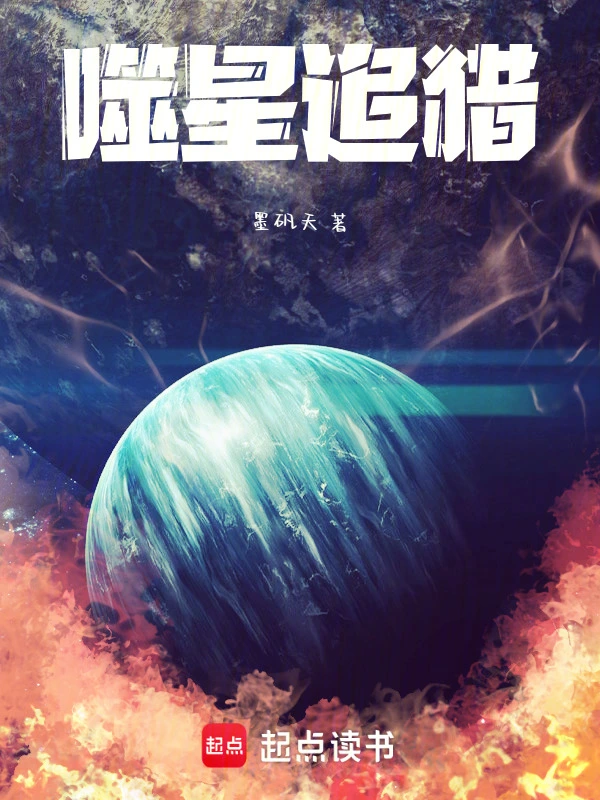
Star Eater Hunt
噬星追猎
- Status
- Ongoing
- Length
- 193k Words
- Genre
- Sci-Fi
- Audience
- Male
- Subgenre
- Interstellar Civilization
- Updated
- 10mo ago
- Source
- Qidian
Stats
0Monthly votes
1Recommends
0Fans
85Chapters
Synopsis
Reader comments
Readers also read
 Psychic Worlds: the Paladin Forges His Body into a Numerical Monster
 My Low-Dimensional Universe Model
 Doomsday Convoy: I Can Extract Unlimited Entries
 Oh Yeah! I've Seen Fake People
 Siheyuan: Start by Picking up Attributes
 Night Without Borders
 How Can You Become an Immortal If You Don't Have Money?
 Beastmaster: I Can See the Evolutionary Path
 Immortal Who Seizes the Body
 Green Hills
 Xuanjian Immortal Clan
 Become a God from Water Monkey
 Star Skeleton Sword Master
 Red Dome Flames
"Star Hunter": Passion and regret under the narrative of Guardian of the Galaxy
1. The eye-catching point: "Inheritance" and "Group Image" are written thoroughly in the interstellar framework 1. The setting of the world has a sense of depth, and the theme of "Guardian" is solidly implemented. The "Silver Core Creation-Star Devouring Creatures-Three Generations of Guardians" system constructed in the novel is very complete: the ancient guardians created the silver core to seal the out-of-control experimental body, the outpost spent 20 years waiting for support, the hunting group took on the mission to complete the redemption, and even the alliance changed from "hidden conspiracy" to "joint guardianship", making "Galaxy Guardian" not an empty slogan. In particular, the details of the creation of the silver core (from the sphere in the dead abyss to the disc compass in the dark star belt) and the origin of the star-devouring creatures (ancient energy carriers are out of control) not only serve the battle plot, but also coincide with the deep thinking of "technology and awe", which is thicker than the common "interstellar monster fighting". 2. The group portraits are vividly created, and everyone has an "irreplaceable function" The protagonist group does not have "tool men": Lin Ye has a clear growth line (from warrior to decision-maker, and ultimately willing to use up all his energy for the seal), Akai's "survivor narrative" (diary, team card, persistence in fantasy) fills the emotional void of the outpost, and even the supporting characters have records Reminiscence points - Lu Ming's "mechanical maniac" details (coating engines with crystal chips, changing star sand bombs), Xia Xiaoyu's sensitivity of "keeping the sensor in hand", and Dr. Zhou's professionalism behind "anti-venom and emergency injections", make the teamwork battles (such as the dark sand channel to dismantle the crystal cluster, the shattered galaxy to strengthen the star-eating body) appear real and believable, rather than simply "protagonist halo advancement". 3. The plot is relaxed and relaxed, with a good balance between "hot blood" and "warmth" The intense battle scenes (Lu Ming risking his life to repair the cannon during the Lords' decisive battle, the dark matter impact during the purification of the silver core) can capture the rhythm, while the warm details (the burial of team cards at the outpost funeral, Akai touching a photo when they reunite, Lao Gu handing over a communication badge) can also make the emotions ground. For example, in Akai's diary, "On the 65th day, I heard the cry for help from the silver core creation", which not only foreshadows the subsequent plot, but also makes "the outpost is not a symbol, but a living person". This kind of "bloody and tearful" treatment gives the interstellar adventure more humanistic warmth. 2. What can be optimized: details and rhythm still have shortcomings of "routineization" 1. Some plots are slightly cliche, and the pattern of "key items" to solve crises is repeated From the star core key, Akai's diary, silver crystals to the outpost team card, almost every crisis is resolved by "finding a certain item/interpreting a certain record": cracking the silver core relies on keys + crystals, rescuing Akai relies on diary passwords, and the ultimate seal relies on "three inheritance tokens". Although the logic is self-consistent, repeated use of "props-driven" easily makes readers predict the plot. For example, when Broken Galaxy fought against Dr. Chen, the "purification mode one-click solution to strengthen the astral phagocytos" process was less frustrating than the "multiple rounds of cooperation" in the Lord's decisive battle. 2. The depth of supporting roles is insufficient, and some characters are reduced to "functional symbols" The roles of Su Wan (captain) and Dr. Zhou are too "instrumental": Su Wan is responsible for "sailing the ship + main gun support" throughout the whole process, but has almost no personal background (for example, why did he join the hunting group? Do you have any past experience?); Dr. Zhou is always "delivering anti-venom + rescuing the wounded", lacking details such as Lu Ming's "growth behind mechanical talent" and Xia Xiaoyu's "cost of perceptual ability". Even the "ambition" of the villain Dr. Chen seems thin, driven only by "wanting to rule the galaxy" without paving the way for the source of his obsession with silver core energy, allowing the "alliance conspiracy line" to end hastily as soon as it begins. 3. The resolution of the ultimate conflict is a little hasty, and the sense of oppression of the "dark matter threat" is not full The "initial astral consciousness" in the dark star belt is the biggest crisis in the book, but the process from "discovering the manipulation of dark matter" to "initiating the ultimate purification" is too fast: the remnant soul of the ancient guardian appears, and Lin Ye chooses to "protect rather than restart" , the silver core light beam purifies dark matter, almost in one go, without the "desperate struggle" in the middle - for example, the "black palm" condensed by the dark matter cloud disintegrated after being struck by the light blade, and the consciousness of the initial astral phagocytosis did not show the "specific harm of swallowing the galaxy", making the tension of "Ultimate Seal" weaker than the previous "Lord Showdown". 3. Summary: A "qualified interstellar novel" with highlights and potential The most successful aspect of "Star Eater" is to combine the "big galaxy" and "little people" - it does not indulge in the grand interstellar war, but focuses on "the 20-year wait at the outpost", "the side-by-side trust of the hunting group" and "the mission of ancient times and the present", so that "guardianship" ultimately falls on "people". If the "prop-driven" routines can be reduced in the subsequent polishing, more backgrounds can be given to the supporting characters, and the resolution of the final conflict can be more layered, this novel will change from a "good-looking interstellar novel" to a "memorable interstellar story." Overall, it is a work that can make people feel "passionate and warm", especially suitable for readers who like "team adventure + inheritance theme". Among similar interstellar themes, it can be regarded as a masterpiece with its own unique style.