


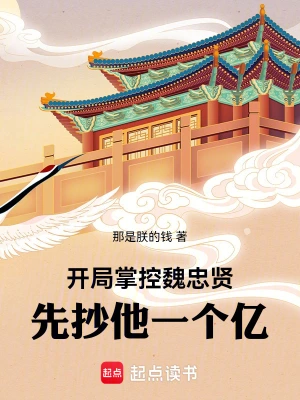
From the Start, I Control Wei Zhongxian, Then Seize a Hundred Million!
开局掌控魏忠贤,先抄他一个亿!
- Status
- Completed
- Length
- 3.7M Words
- Genre
- Historical
- Subgenre
- Song-Yuan-Ming Dynasties
- Updated
- 2mo ago
- Source
- Qidian
Stats
872Chapters
40Votes
51.2kRecs
265.3kFans
Tags
Synopsis
In booklists 1
Readers also read
 Seizing the Direct Descendant in the Red Mansion
 Germany: 1914
 Great Ming: His Father Is Useless, So He Must Summon the Founding Emperor
 A Literary Master in Ancient Greece
 Simultaneous Transmigration: Is Everyone Starting Out in Prison?
 Great Ming: I Asked You to Die in Protest, So Why Did You Really Die?
 Ming Dynasty Veterinarian: From the Start, I Save Zhu Biao's Life
 A Great Industrial Nation, Starting with a Fake Student Abroad
 A Dual Status Panel Descends into the Abyss, and the Assassin's Potion Is Right at the Entrance
 No One Understands How to Save the Ming Dynasty Better Than I Do
 Great Ming: I, Yan Maoqing, Really Am Blessed
 The Ming Dynasty's First Brother-in-Law
Reader comments 52
Google Translate
And the Western missionaries, science and technology all came from the West, right? At the end of the Ming Dynasty, technology was weaker than in the West, right? Thousands of years of civilization, with a large number of people and a production-oriented civilization. No matter how we use moral articles to evaluate officials, how can we not have our own science and technology? Practical science and technology can help production (peasants, craftsmen, merchants), and non-practical science and technology research can also "edify sentiments" (mostly scholar-officials who do not support production) What was there in the West at that time? Was it that the West valued production more than China? (Pirate civilization emphasizes plundering but not production). Are Western aristocrats and priests more enlightened than Chinese literati and prefer to "cultivate their sentiments" through the study of science and technology? Too many authors of historical novels strive to be Western mouthpieces emphasizing the "bringing of science and technology to the West"; too many novels of the late Ming Dynasty praise the enlightenment of traitors and Western missionaries like Xu Guangqi
Just read this book without thinking too much.
There is a big problem
At the beginning, there was no power, but Wei Zhongxian was nakedly exploited and everything was settled. Aren't you afraid that he would die of drowning the next day and then change the emperor or something? Do you think that relying on the title of emperor to suppress people like Wei Zhongxian is natural?
There are too many problems in the Ming Dynasty, including those Zong children. Wei Zhongxian's words are actually a knife, but this knife needs to be sharpened.
The setting is relatively novel, which is the type of setting I prefer... But there is a power loophole. Why should others listen to you and then implement it once you become the emperor? Doesn't that mean that anyone can be secretary or governor as long as you dare to appoint someone... Have you ever been the lowest team leader in the company? You want them to deliver results and hold meetings every day, but it just doesn't work!
Seeing that the eight major locust dealers confiscated more than three million taels of property, the protagonist was shaken and wanted to laugh after hearing this! Is this more than just hiding the silver winter melon and feeding the dog to a random family who looks down on anyone?
The emperor of the Ming Dynasty was so soluble in water that he almost became an identification tool for the blind.
As for the statement that "the emperors of the Ming Dynasty are easily soluble in water", it is essentially an internet meme and ridicule, not a serious historical inference. Its core content - implying that the emperor was assassinated by a group of civil servants - is a conspiracy theory that lacks reliable historical data support and can be regarded as "rumor making" or at least "over-interpretation and joking". ** We can analyze it from the following aspects: ### 1. The origin and essence of the "easily soluble in water" meme This meme mainly originated from the accidental drowning of two young emperors in the Ming Dynasty: * **Ming Wuzong Zhu Houzhao (Emperor Zhengde)**: In the fifteenth year of Zhengde (1520), he fell into the water while boating and fishing in Qingjiangpu. He was not accustomed to water. After being rescued, he was frightened and his health deteriorated rapidly. He died of illness a few months later at the age of 31. * **Ming Xizong Zhu Youxiao (Emperor Tianqi)**: In the seventh year of Tianqi (1627), while taking a boat trip in Xiyuan, he fell into the water due to a "boat capsize". After returning to the palace, her condition worsened and she died soon after at the age of 23. Both these two emperors accidentally fell into the water while playing and died soon after. The coincidence of the timing of "falling into the water" and "died young", as well as the "zhao" (next to the word for fire) and "xiao" (next to the word for wood, wood in the five elements) in their names were jokingly linked to the periodic table of chemical elements by netizens, thus deriving Internet buzzwords such as "easily soluble in water" and "afraid of fire". **This is purely a humorous association made by later generations based on coincidence and name. The purpose is to ridicule and is not a historical conclusion. ** ### 2. Is the inference of "assassinated by a civilian group" reasonable? Attributing the emperor's accidental or illness death to the assassination of the civil servant group is very unreasonable, lacks historical basis, and is a typical conspiracy theory. ** * **Motives are not proportional to risks**: As analyzed in the data [2], a civil servant who can plan and execute the assassination of the emperor must be a very humane minister (such as the chief minister of the cabinet). They are already at the top of the power pyramid, and the risk of assassinating the emperor is the annihilation of the "Yi Tribe". After the new emperor ascends the throne, "one emperor and one courtier", they cannot guarantee their status and safety at all, but are very likely to be liquidated by the new emperor. It is crazy and irrational for any mature politician to gamble his life and the life of his entire family for an uncertain future. * **Technically extremely difficult**: The emperor of the Ming Dynasty had a strict security system around him, especially the factory guard (Dongchang, Jinyiwei) system directly controlled by the emperor. One of its responsibilities was to monitor officials and protect the palace. It would be difficult for a civil service group to infiltrate the emperor's bodyguards and eunuchs to carry out assassinations without being detected. The information [2] also clearly points out that "the factory security system of the Ming Dynasty ensured that there was no possibility of civilian intervention in the inner court." * **Specific case analysis is untenable**: * **Zhu Houzhao**: The cause of his death, historical records are clear, was complications such as pneumonia after falling into the water and being frightened. He himself lived a debauched and overindulgent life, and his body had long been hollowed out. Falling into the water was just the straw that broke the camel's back. Although some conspiracy theorists (as mentioned in the information [1]) believe that he wanted to take back military power and offend civilian officials, this is purely conjecture without any evidence. Information [4] also pointed out that the powerful official Yang Tinghe was Zhu Houzhao's teacher at that time, and his power completely relied on the emperor's trust. He wished that the emperor would live a long life. * **Zhu Youxiao**: The cause of his death had nothing to do with civil servants. He had been taking "elixirs" (such as "Linglu Drink") donated by the eunuch Wei Zhongxian for a long time, which resulted in heavy metal poisoning and made his body extremely weak. The drowning incident only hastened his death. The information[4] clearly pointed out that Zhu Youxiao's death was of no benefit to Wei Zhongxian, who was in power at the time. Wei Zhongxian was the person who wanted him alive the most. ### 3. The true relationship between the emperor and the civil servant group The relationship between the emperor of the Ming Dynasty and the civil servant group was indeed complex and full of tension, but this was mainly reflected in political struggles, policy games and power checks and balances, rather than life-and-death physical elimination. * The emperor checked and balanced the civil servant group by establishing a cabinet and reusing eunuchs (such as Wang Zhen, Liu Jin, and Wei Zhongxian). * The civil servant group influenced and restricted the imperial power by advising officials, court discussions, and even "death remonstrances". * This kind of struggle is institutional and open, and is part of the operation of the political system of the Ming Dynasty. Although when the struggle was fierce, officials could be imprisoned, imprisoned, or even executed, the emperor was directly assassinated by civilian officials, which was unimaginable in the political logic and practical operations of the Ming Dynasty. **Conclusion:** "The emperor of the Ming Dynasty is easily soluble in water" is a humorous meme based on historical coincidence and Internet culture. You can make fun of it easily, but don't take it seriously. The conspiracy theory that extends it to "a civilian group assassinating the emperor" is completely untenable, lacking any reliable historical evidence, and cannot withstand scrutiny in terms of motives, risks, and operational feasibility. This statement is more of modern people's joking and imagining of history. It is more accurate to regard it as "rumor making" or "nonsense". Historical research should be based on rigorous historical data and logical analysis, rather than catchy Internet jokes.
Have you ever been Chongzhen? Take it for granted.
Brain storage, I have no brain!
Without thinking about historical issues, I read the whole article and just want to say, where is the update? Writing so slowly? Let Dongchang, Xichang, and Jinyiwei come to talk to you, okay? In the Shaanxi chapter, whether it is an imperial edict to accuse oneself or a letter to the Ming Dynasty's subjects, I think there is nothing wrong with it from the perspective of the upper and lower levels. At least I had an intracranial climax when I watched it. Maybe it was because I was too violent. Kill, kill and create a bright world!
At first I thought it was just a refreshing article, a little astringent, but as I read it it became smoother and smoother. This book does not have the sense of a brainless clown who wields a blunt knife but fails to hit the weak point and hits a critical blow, nor does it have the powerlessness to lay out intricate emotional relationships to create a sense of entanglement but cannot scratch the exciting point of history. But it moves precisely like a scalpel, and the smoother the unbuttoning is, the smoother the plot will be. When everything is connected in series, I am even more surprised by the seemingly ordinary dissection skills of the first knife, which has already opened up the best intraoperative vision. Then the buttons are unbuttoned, and readers can watch the beauty reveal herself on the viewing platform with the best view.