


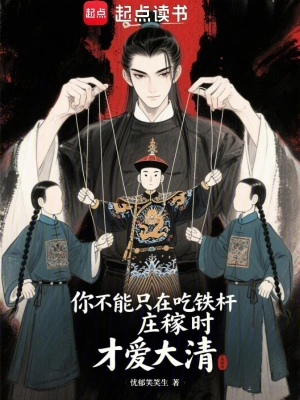
You Can't Love the Great Qing Only When You Have an Iron Rice Bowl
你不能只在吃铁杆庄稼时才爱大清
- Status
- Completed
- Length
- 954k Words
- Genre
- Historical
- Subgenre
- Qing & Republican Era
- Updated
- 5mo ago
- Source
- Qidian
Stats
Tags
Synopsis
More by this author
In booklists 10




Treasure Hunt Reading List 📚
A collection of books I’ve enjoyed, found worth reading, or wanted to gripe about.
[Lanji Reviews: In-Depth Critiques]
Dedicated to solving the web-novel reading slump.

A Bookworm’s Smorgasbord
A laid-back list maker who updates whenever the mood strikes. I'll gradually add new books and revise my comments on existing ones. Feel free to drop by often. I'm an older reader with eclectic tastes. I read male- and female-oriented fiction, cultivation, fantasy, historical romance, magic, family intrigue, sci-fi, farming stories, anime-inspired fiction... pretty much anything. Rather than following new books as they come out, I prefer the satisfaction of reading a whole story in one go. So

[Ongoing Hidden Gems 🌱]
【Ongoing hidden gems 🌱】 Recommending high-quality ongoing reads and promising books Hope you'll find something good here Feel free to leave book titles in the comments, too Thanks for your support
My Reading List
Some books I read from time to time


A Treasure Trove for VIP Readers ①
A collection of interesting, worthwhile books I have read again.
Eclectic Recommendations, No Dropped Titles (1)
A mixed bag of good reads: books I'm still following in 2025
Records of the Grand Historian
Explore the relationship between Heaven and humanity, understand the changes from past to present, and create your own school of thought!
Historical Fiction Recommendations
For my own use. These are all books I'm currently reading or planning to read. Feel free to upvote or downvote, everyone, and thanks for helping me sort through them.
Feel-Good, Smart, and Showbiz Stories
I only recommend books that I have been able to follow through to completion. I have grown tired of simplistic novels, and the era of brainless stories is over. I now focus on intelligent novels with well-planned plots. Most involve transmigrate, reborn protagonists, the military, sports, or entertainment. Recently, though, I have also been reading other genres, so there will be more variety in the future.
Readers also read
 An Important Town in the Residual Tang Dynasty
 The Corpse Plague of 1916
 In the Ming Dynasty, the Days When the Cows and Horses Turned Over
 Chronicles of the Red Mansion
 Simultaneous Transmigration: Becoming a Legend Before the Story Begins
 Return to the Prosperous Tang and Become the King of Sui
 The Empire Will Keep Winning
 Starting with Saving Manchester United
 Myriad Worlds: Starting with Darkest Dungeon
 A Dream of the Beiyang Fleet
 Great Ming: I, Yan Maoqing, Really Am Blessed
 I Became the Founding Father of America
 The Man in Charge of the Great Qing
Reader comments 50
Google Translate
The comment section seems to underestimate the class brotherhood between emperors.
It's hard to imagine that in the 21st century in New China, there would still be people quarreling over two feudal pigs
Have you ever been a member of the Eight Banners of the Han Army? Some things are written randomly, and I take it for granted.
I love the Qing Dynasty too. My ancestors were serious elites of the Sauron tribe. . I want to say that it is a pity that those bannermen in Beijing were not killed. Have a good life. My ancestors were out hunting
It's too dangerous. When the Qing Dynasty was first established, a tribe occupied a country. It was extremely barbaric. You jumped up and down, and even if you were slashed by someone, not a single blister came out!
Shunzhi in history can be said to be a typical powder keg of unstable emotions in the face of military defeats. Zheng Chenggong won a great victory in Guazhou and beheaded three thousand bannermen in the first battle. Anyway, more than a dozen prefectures and counties in Jiangsu and Zhejiang directly marched to Nanjing, which was weak in military strength. Fulin was so passionate that he wanted to directly lead tens of thousands of bannermen under his command to conquer in person. When faced with Li Dingguo's defeat as king, his defeatist mood led him to think about ceding territory and negotiating peace. According to the book, he was promoted to the king of three countries and swept across four provinces. Without the antihypertensive medicine of Hong Chengchou to cool him down, and faced with the collapse of the two yellow flags' core combat strength of 5,000 people (the death of 5,000 from the two yellow flags is as uncomfortable as the death of 10,000 from other flags), this guy may have become emotionally unstable a long time ago, going crazy in the palace every day. (Refer to the history of World War II when he personally micro-managed the maintenance of hundreds of thousands of people in Yazima and sent away hundreds of thousands of people. After the German troops arrived in Moscow, Stalin, who briefly broke down, locked himself in the room and gnawed on the carpet.) In fact, the biggest crux of the Manchu Qing Dynasty at that time was the insufficient core population. After years of war and various factors such as internal factional strife and smallpox, this in the book This was the time when the Manchurian military strength was at its weakest (not the Manchu Qing military strength). The whole of Manchuria was comparable to the War Banners of the Saarhu period, and their combat power was also very doubtful. During the Battle of Xiamen, the Manchurian Banners who successfully landed on the beach were blocked on the beach and were beaten. It was because the navy achieved its strategic goal, but was held back by the land war, so that the navy could only be used to wipe the butts of these useless Manchurian Banners. It can be said that a series of Manchu military arrangements at that time were in a situation where the core combat strength was insufficient. Facing various internal Han armed forces, they both wanted to use them to serve their lives and wanted to prevent a single Han general from becoming big (although they did not prevent Wu Sangui and his animal friends after all). In fact, Wu Sangui was guarded against in the end, but his men wanted to make progress too much. Looking at the history of the Qing Dynasty from Shunzhi to the early years of Kangxi, you will find that the more the Ming army's surrendered generals experienced the battle against the Qing during the Huangtaiji period, the more they had a strong ideological impression of the power of the Manchus. This was the case with the first generation of the three vassals. On the contrary, the new generation of Han troops and the southwest Ming army's surrendered generals who had only experienced a series of fierce battles in the southwest would think "that's it?" When they treat the Eight Banners of Manchuria The question in the book Chiang can actually be in this seemingly dangerous time and space (it is difficult for the Ming armies to form a joint force, and Sun Kewang will probably hinder his good brothers soon. In fact, the crisis level of the Manchu Qing Dynasty in the book does not exceed the San Francisco Rebellion), and the crazy PUA and emotionally unstable Shunzhi can obtain the prime ministerial power to train the new army, which is theoretically under the direct control of the emperor. I have already thought of the place, and it is at the Tianjin station.
Historical records record that the old slave was beaten in bed and summoned famous doctors from all over the world to treat his illness.
A miracle doctor said that the old slave's gunshot wound could only be cured by applying the essence of his close relatives. The old slave called his sons to the bedside and told them to come and see him tomorrow. Whoever contributed more would be appointed as his heir. The next day, several sons gathered in front of the bed. Every one of them felt listless and weak, but the most they could only eat was half a bowl. Only Huang Taiji was in high spirits, but he had a big face in front of him. The old slave was very surprised and asked him how he did it. Huang Taiji took off his pants and showed Huang Taiji his vitals on the back. He proudly said that there were more places where he came in. So Nurhachi established Huang Taiji as his successor.
I guess, carrying the Qing Dynasty to fight against the Qing Dynasty, inciting the bannermen to fight the bannermen, this is a sacred book
The latest wild history in the Qing history circle is too wild.
Kangxi was actually a descendant of Hong Chengchou, and he was actually made up to look like him. . . . 🤭
Some people are sensitive to the Qing Dynasty. When they saw that it was about being an official in the Qing Dynasty, they thought that the protagonist would be a slave. In fact, if you look back, you will find that the protagonist is not only not a slave, but also very bold. The author is also very bold.
The great usurper of the throne is Xiao Jiang
If the Manchu Qing Dynasty was the master of feudal monarchy, then our young Chiang Kai-shek can be called the master of usurping the throne and seizing power.