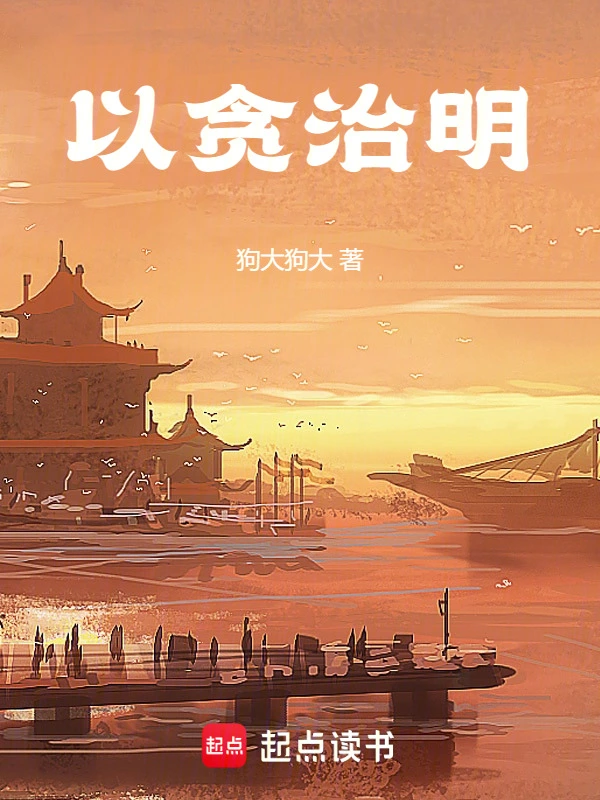
Use Greed to Rule the Wise
以贪治明
- Status
- Completed
- Length
- 1.0M Words
- Genre
- Historical
- Audience
- Male
- Subgenre
- Song-Yuan-Ming Dynasties
- Updated
- 2mo ago
- Source
- Qidian
Stats
0Monthly votes
14.4kRecommends
38kFans
453Chapters
Tags
Synopsis
Reader comments
In booklists 2

Readers also read
 Talker in the Song Dynasty
 In the Red Mansion: Escort Daiyu to Beijing at the Beginning
 1914 Begins with the Rejection of the Schlieffen Plan
 Please Call Me Your Majesty the Tsar
 Never Walk Alone!
 Master, Gao Zai
 Qingyao
 Daming: Have I Become Wanli's Portable Grandfather?
 I Am Drawing a Hot-Blooded Episode in the Zhiyu Episode!
 Why Were the Civil Servants in the Northern Song Dynasty so Bad?
 Daming: the First Assistant of a Poor Family!
 Let the Tang Dynasty Fly
Rarely seen good writing, exquisite appearance
The writing is clean and smooth, and it touches on the officialdom and worldly affairs, Jianghu and temples, with a hint of drama in the rough. Even if you don't have any professional knowledge of economics, you can still understand the plot. The combination of modern thinking and ancient economic background makes it not boring and difficult to understand, which shows the author's hard work. In addition, the protagonist's background, personality and mentality have been carefully polished, and the characters stand up. In addition, this kind of plot with daily transitions is very good, and I support the author to write according to his own ideas! This is not a fast-paced novel. From an economic point of view, it is a relatively niche novel among the world-shaking novels in the Qidian historical literature. It has not yet been found as a meal replacement, and it looks very fresh.
Idealistic protagonist
Such a protagonist may have existed, but he will never live long. Don't ask why, it depends on how much you know about human nature...
Recommend
The writing is really good. There is no foot-wrapped plot like other historical novels of this type. The protagonist is greedy on the surface, but in fact secretly promotes the economic reform of the Ming Dynasty. It is a contrasting setting of corrupt officials doing good deeds. There is no golden finger, the intrigues are exciting, the historical details are true, and you can feel the author's research on the history of the Ming Dynasty."
The most recent example of running a country with corruption is Little Days Next Door
Tanaka Kakuei, nicknamed Kintaiko 🤭, did a pretty good job, at least better than those abstract things that came later. During his tenure, he used the corrupt funds as his own private treasury and distributed them to lubricate the administration. He turned the corrupt interest network into his own power network and controlled a certain amount of financial power and political power in disguise. Now Ishiba Shigeru regards himself as Tanaka's successor😅
Just reading your introduction, I feel that in the end the protagonist can either start a capitalist society and turn the emperor into a constitutional monarch like Great Britain, or he will be ready to float on the sea. Otherwise, even if you are alive and fine, your whole family will die when you die. Offending the corrupt scholars and offending the censor can still do you a favor. Especially after you really succeed in your career, it will definitely take the whole Qing Dynasty and the public to do it. Even if the current emperor can tolerate it, the next emperor can also tolerate it, but your whole family will still be punished when you die.
In the feudal period, the financial circle was just a pig.
If it were impossible to govern the country through corruption in the Ming Dynasty, the premise of governing the country through corruption is that everyone must know how to stop. But if someone above you is greedy for one tael of silver, each person below will get 100 taels for each point. The common people cannot bear such expropriation. Even if you launch an industrial revolution to increase productivity, it will still be too late. Once the snowball of corruption in governing the country starts rolling, it will only get bigger and bigger. You can't govern even if you want to, because you are the biggest corrupt official. If we catch corruption, we'll arrest you first. If we don't catch corruption, the country will be at a loss.
If the protagonist does not become the emperor, then the protagonist must carry out comprehensive changes that limit the emperor's rights. It is useless if the protagonist just copies the technology of later generations and adds a few reforms. If a country wants to produce a large number of original inventions and creations, it must carry out systematic changes in ideological foundation, political structure, legal system, social forces and other aspects. The reason why Britain was the first to enter the Industrial Revolution is that after experiencing the ideological changes of the European Renaissance, coupled with the British Glorious Revolution of 1688, the king's rights were further restricted. Britain established the framework of parliamentary sovereignty and the rule of law, and the bourgeoisie, the new aristocracy, and the king formed a check and balance, which allowed British civilians to gain unprecedented freedom. At this time, the degree of freedom of scholars, craftsmen, and farmers in Britain was higher than that of other European countries at the same time, and it was far more liberal than the civilians of China's Ming and Qing dynasties. The high degree of freedom of all British civilians fully inspired everyone's strength. The power of the Chinese emperor was not greatly restricted, and all officials, gentry and landlords were dependent on the imperial power. The freedom of civilians, who account for the vast majority of the country's population, is too low. This system inhibits innovation and hinders social development. China's Zhou Dynasty was a feudal system, and the central government could not control much of the local princes' affairs. The princes competed with each other. During this period, Chinese civilization truly allowed a hundred flowers to bloom. Most of the essence of Chinese civilization came from this period. During the Spring and Autumn Period and the Warring States Period, the "Mo Jing" recorded the principles of optics and mechanics, and the germination of geometry had emerged; the "Gan Shi Xing Jing" recorded astronomical observation data. But from the Qin Dynasty to the Qing Dynasty, there was almost no progress! The institutional innovation of the Spring and Autumn and Warring States periods stagnated after the Qin and Han Dynasties, lacking the ability to dynamically adjust. Since the Qin Dynasty, especially since the Han Dynasty deposed all schools of thought and only respected Confucianism, Chinese civilization has almost stood still and entered a dead end. The Zhou Dynasty and the Spring and Autumn Period and the Warring States Period were similar to the ancient systems of most European countries. They were all feudal systems. Even in successive years of war, less than 10% of the country's total population died directly or indirectly as a result of the war. But from the Qin Dynasty to the Qing Dynasty, every dynasty would kill half or more of the country's population due to war! What is even more tragic is that every time there is a change of dynasty, there is almost no progress in the system and culture! {"NickName":"Supervision and Restriction","UserId":406440657}
In ancient times, the biggest problem in finance was to prevent capital from entering the land. While the Dutch East India Company became the most successful investment product in Europe because of its annual dividends of more than ten points, Chinese landowners' annual profit margins through land rent and lending could reach several times that of the East India Company. Faced with such a high profit rate, it is inevitable for capital to enter the land.
The most troublesome thing in ancient times was burning wood for fire
The mountains and fields must be bare. There is no way. Trees grow slowly. Even now, we can't live without them.
The Ming Dynasty really needs to be saved. Most of the emperors of the Ming Dynasty were good people, much better than the emperors of several other dynasties, but they were kidnapped by civil servants. The emperor was a good man and was not very good at it. Without the means to fight for power, as long as he failed in the later stage
Finally, the financial circle has also crossed over.
In the middle of the Ming Dynasty, people came by boat from Japan to rob the southeast coast. . Good niche vocabulary. We have waves a few meters high. Swallowing ships in the East China Sea. How developed should Japan's shipbuilding industry be? ? ? Where did Little Japan go to steal so much wood? . . . I can only say one thing. Those who wrote history books have never seen the waves of the East China Sea. . . Still thought you could just open it with your eyes closed?
No wonder the Ming Dynasty had many literary works with the emperor starting the game, otherwise it would be frustrating.
Family planning is not something that sticks at all. This thing is short-sighted and affects the whole body. People will self-regulate. They can control concubines at most and limit conflicts between upper and lower parties.
The Ming Dynasty in the history books is very likely to be evaded and ignored, using the evil of the Manchu Tatars to cover up the bigger, more ferocious and crazy evil.
Have you ever thought that the end of the Ming Dynasty was actually much worse than what is written in history books? There is a group of traitorous literati who must shamelessly glorify what they do. There are 100,000 Tatars in the Qing Dynasty, and all the people are armed and barbaric people with no experience in governing the country. If they want to rule the Ming Dynasty, they must rely on a huge base of traitorous literati. Will this group of people be honest? What did they do before the Ming Dynasty fell? What did you do after the death of Ming Dynasty? In the history of the Ming Dynasty, it was obvious that there were smuggled goods who blamed the emperor, but he claimed to be a loyal minister, but the emperor was stigmatized? The emperor of the Ming Dynasty was very self-aware. If he didn't go to court and did nothing, wouldn't this be an early constitutional monarchy? How can we still allow the country to decline? It's like France is going black. The white nation in France will lose its dominant status in twenty or thirty years, and its eventual barbarism is inevitable. Can you say that the disappearance of this nation in the long river of history is the fault of black people? Come on, what's the difference between them and the savages? Do you blame the Markworm? Or is it the fault of the last president? The enemies of this nation are so deeply hidden, so frantic, ferocious, and crazy about putting a country to death, but we, as onlookers, can't even see clearly. Seeing clearly means there is no rule of law, no one studies it, and it is inevitable. Just like the Creator has set a long life for this country, the appearance of this group of people appears to be a man-made disaster, but in fact it is a rule of heaven.
Let's change the name to Da Ming: the path of reform for finance students
The writing is good, but in the current situation, if the protagonist wants to be a loyal minister or a powerful minister of the Ming Dynasty, he will become more and more frustrated. Even if he wants to deepen reforms, it will be difficult and extremely labor-intensive. Moreover, there is a Taoist Emperor who is a powerful creature causing trouble, and even if it goes well, it will cost a lot of money. After 20 or 30 years of reform, even if a group of people have been cultivated, the Taoist emperor will do whatever he says, and it suddenly becomes the death of the people and the government. Moreover, this Taoist emperor is more difficult to deal with. He is smarter. Although it is said that he will not be used in the right place, it will be very uncomfortable to be his subordinate. , But if there is a chance to go out and rebel, it will be difficult at the beginning, but if the protagonist does not die, it will take several years to develop to thousands of people, and the protagonist will become more and more smooth, At least he will not become more and more aggrieved under the emperor, and be a chicken. At the very least, it will be frustrating at the beginning, but it will also be interesting. It will become smoother and smoother at the end. After all, it is easy to draw on a blank piece of paper. At the end, there is pure oppression of the system. As long as the protagonist does not die unexpectedly, it is worth spending twenty or thirty years. Compared with being an official under the Taoist emperor
In the feudal dynasty, playing finance? Really or not, can invisible hands really withstand visible swords and cannons? Emperor and officials: "The pig has grown fat on its own!!!"
At present, it seems that the author is not very good at writing about political struggles. He should just go back to writing about technocrats.
There is a reason for the imperial system. Officials are too imbecile. After listening to the Ming Dynasty officials, they can make too much money when natural disasters occur. You feel that these people really have no conscience. To put it roughly, a few big heads can be greedy for central taxation, land can be annexed for two, and three people can be bought and sold into slaves. Fourth, fundraising can lead to greed, and fifth, disaster relief money and food can lead to greed. There are many other ways. You will know why the officials of the Ming Dynasty were so determined to plead for the people. They were all doing business to make the government's money their own, and the common people could also make money.
Rather than bowing down to the people, I actually want to see the protagonist occupy the ecological niche of a corrupt official and use the corrupt money to save the people. The clear soup man who slanders Uncle Guo, I really feel that I have seen too much and it is not attractive. Corruption in the last years of the dynasty is a system. The protagonist becomes the end product of the corruption system, swallowing black money and using it to save the people.
Use Manchu tactics to defeat Zhu Ming's wealthy gentry?
It's rare to find a good book in the early stage. It's a pity that I don't have the number of investments. I lost money so much. I'm sad. 😭😭😭 I believe that my investment will not be a loss.
The situation is not good, and it is going to end badly.
Epitaph (as of Chapter 149): The food and grass are on the low side, the highs are high and the lows are low, and it is an official story that has become unfinished.
The protagonist travels through the Jiajing and Ming Dynasties, relying on his past life experience to get involved in officialdom. Escaped the struggle between Da Li (Emperor) and Qing Liu (Civil Officials). First-hand experience in officialdom, second-hand economic construction ability, plus a mind that understands history. In the early stage, it was almost half of Long Aotian But the contradiction emerged. The protagonist is very capable and knows that neither Jiajing nor Qingliu is a good person, so he often attacks with an aloof image. In ancient officialdom, the protagonist actually complicates things to a certain extent. In fact, the protagonist has become the kind of person he hates the most. He talks about benevolence and morality and looks down on others, but he is very honest in body The author is also aware of this, so in the following plot, the protagonist is asked to understand the public sentiment and fight against the corrupt powerful, and even uses too much force. It seems that the protagonist is about to explode like Jiajing But when it comes to developing the economy and gaining political achievements, the protagonist thinks about managing relationships again, and the contrast between before and after is huge. It even got mixed up. It was supposed to develop well and gain political achievements, but as the author wrote it, it turned into a story about the protagonist urging people to stop gambling As of the main plot of chapter 149, I don't even know the protagonist's political leanings + how to deal with etiquette. Be an honest/corrupt official? Economic development/moral governance? In summary, the food and grass have gone bad, and I want to write about a lonely time traveler, but officialdom writing is full of left- and right-brain struggles. Actively and passively collude with others, and then have to break out with corrupt officials the next moment.
If you haven't updated yet, give me back six recommendation votes, give me back six recommendation votes, give me back six recommendation votes, 😰
Every time I subscribed and finished reading, I found that I was among the top 100 readers who had finished reading. I couldn't help but feel worried about this book.
Today is my first time to reward this book, and it is also my first time to reward this book. Although it is the minimum amount, it is still a token of my gratitude, because I admire the author for being able to persevere like this. The book is very satisfying and I want to read it until the end. However, the power generated by love cannot last forever. If the dog is in serious trouble, I think it is not a bad idea to write an outline and escape at a certain stage. After all, it still needs to be right.
Why is it not popular if it is well written?
Have you seen the abandoned pits and commented on it? Why don't you pursue it? I have read about half of it so far, and the writing is very smooth. It should be considered a high-quality article.
This is a thinking of Ming history
When the Ming Dynasty was established in 1368, years of wars had led to desolation of the land, a sharp decline in population, and a serious lack of social productivity. Recuperation and recuperation were a must-have national policy. In 1371, Ming Taizu issued the "Sea Ban", which prohibited all Chinese ships from going to sea and severely punished private traders and ship owners. In 1374, the Baobao Promotion Department was established, and the Ming Dynasty Baobao was officially issued the following year. It was initially put on the market through financial channels such as salary and military pay, and the paper currency standard was forcibly implemented, severely cracking down on privately minted copper coins, and prohibiting the circulation of gold and silver. (Since the imperial court banned the circulation of gold and silver, then the gold and silver circulating among the people Where did it come from? It is obvious that precious metals such as gold and silver have not needed national power to give them credit value since ancient times. Through border smuggling and the trade development of the land and sea Silk Road in the past dynasties, bureaucratic capital and private tycoon families have accumulated a large amount of hard currency gold, silver and copper. Since the Song Dynasty, A large amount of precious metals in society are no longer in the hands of the court, and the newly established Ming Dynasty court has almost no gold and silver reserves. In order to maintain the operation of the country, it needs to continue to make financial expenditures. If precious metals are directly used as the national currency, it is tantamount to the country voluntarily giving up its monetary sovereignty, and the court will only have one. It is an empty shelf and exists in name only. For example, if banknotes are forced to be used as national currency without reserves, the country will still be subjugated if the country's credit is completely overdrafted) In 1381, Ming Taizu further strengthened the sea ban policy and issued the "Da Ming Huidian", which required all merchant ships to go to sea with government approval. (While prohibiting private overseas trade, the tribute trade system was used to establish maritime trade monopolized by the central royal power. Earning overseas gold and silver provided credit support for the Ming Dynasty treasure banknotes. Hedging bureaucratic capital and private capital used hoarded precious metals to seize the country's monetary sovereignty. All foreign trade was settled with treasure banknotes. The Ming Dynasty purchased precious wood and spices. , Foreign luxury goods, foreign trade silk, porcelain, iron pots, prices were all set by the Ming Dynasty) In 1402, Emperor Yongle ascended the throne. In addition to continuing to maintain Zhu Yuanzhang's national policy, he also sent Zheng He on seven voyages to the West from 1405 to 1433 (expanding trade routes, destroying pirates and escorting merchant ships, and monitoring private smuggling). Zhu Yuanzhang established the rules of living for the people when he founded the country, and set the tax rate at a very low level. Emperor Yongle was able to move the capital to Beijing, build the Forbidden City, build the Ming Tombs, conduct five expeditions to Mobei, conduct an expedition to Vietnam, repair the Great Wall, and dredge the North-South Grand Canal. Compiling the Yongle Canon, any of the above items would be enough for the whole court and the public (such as Emperor Yang of the Sui Dynasty and Emperor Wu of the Han Dynasty), but if the Yongle Dynasty did all these things, then he must have the money to do these things, and where does this money come from? It can only be the Western trade. It is easy to earn, otherwise there is no way to explain the national finances (all the vassal states at that time accepted the Ming Dynasty treasure banknotes. Zheng He used such depreciating banknotes to exchange for a large amount of gold, silver and various physical objects. The Ming Dynasty treasure banknotes can be printed as much as they want, and the Ming Dynasty does not need to worry Regarding the issue of inflation, Zheng He sold high and bought low. Ming historians estimate that Zheng He made seven voyages to the West and earned 720,000 taels of gold and 12.76 Million taels of silver. This is the total income. At the same time, he spent a total of 6 million taels of silver on the seven voyages. The total cost was that when Ming Xianzong Zhu Jianshen became emperor, there were still 2.4 Million taels of silver in the treasury) In 1435, Ming Xuanzong died at the age of 37, and Ming Yingzong, who was only 8 years old, succeeded to the throne. Amid the cry of "wasting people, hurting money, and not beneficial to the national economy", all data and information related to the maritime trade in the Western Sea and the maritime fleet were basically sealed or destroyed, causing the central finance of the Ming Dynasty to shrink significantly. Even with the support of the wealth accumulated in previous maritime trade, the national credit of the Ming Dynasty treasure banknotes began to gradually decline and depreciate. (From the epitaph of Guo Yan, we can learn that he was ordered to supervise the construction of 120 "Xiaban sea ships" in the eighth year of Zhengtong (1443) of Emperor Yingzong of the Ming Dynasty, and was appointed as the "general coordinator of the eight prefectures". Due to his good supervision, "the military and the people benefited from it". After the completion, "tens of thousands of military and civilian officials from the eight prefectures came to the mansion to express their thanks." This confirms Emperor Yingzong of the Ming Dynasty was preparing to restart the national plan for the Western Ocean trade. After the ship was built, it was first put on hold due to the civil uprising, and then the Tumubao Incident occurred in 1449. In 1457, just a few months after the restoration of the Emperor Yingzong of the Ming Dynasty, he wanted to start the Western Ocean trade plan again. Zhang Zhao objected on the grounds of needing disaster relief. In order to provide relief to the former. Let him clean up the mess and sail to the West. By the Chenghua period in 1464, Emperor Xianzong of the Ming Dynasty Zhu Jianshen ordered the Ministry of War to search for archives of Zheng He's voyages to the West, but found that the relevant documents (including charts) were missing, and Liu Daxia, an official of the Ministry of War at the time, was accused of hiding or destroying them. Archives, since then the imperial court has completely lost the ability to return to the Western Ocean) In 1567, Longqing Emperor Zhu Zaijing was forced to shut down the business due to the increasing national financial deficit. Bureaucratic capital and private capital began to encroach on the maritime trade that was originally a monopoly of state-owned enterprises in the Ming Dynasty. With the massive inflow of wealth and silver, most of the tax revenue went into the hands of bureaucratic capital and private capital, except for the imperial court. The amount of silver in private circulation also increased massively, and the monetary sovereignty of the Ming Dynasty was gradually being eroded. Longqing Emperor Zhu Zaijing was an adult and knew the stakes. Silver must not be allowed to become the legal currency of the Ming Dynasty. However, this was the last step for bureaucratic capital and private capital plutocrats to steal the monetary sovereignty of the Ming Dynasty. From the death of Ming Xuanzong at the age of 37 to the ascension of Emperor Longqing to the throne, it was 1 In 31 years, it was 132 years before Emperor Longqing switched on and off. How could the century-old plan of bureaucratic capital and private capital plutocrats stop progressing and fall short? Therefore, Emperor Longqing had to die in 1572, five years after the switch, in pursuit of beauty and lust, in order to ensure that Emperor Wanli, who was only 10 years old, ascended the throne. In 1581, Zhang Juzheng promoted a whip law to abolish treasure banknotes and use silver as the national currency. As a result, the country lost its monetary sovereignty, and its economic lifeline gradually fell into the hands of bureaucratic interest groups, Jiangnan gentry and maritime merchants who controlled large amounts of gold and silver. They emptied the country's wealth and got rid of the control of the central royal power. After Zhang Juzheng's death, Emperor Wanli liquidated him on charges of "authoritarianism and chaos in government", deprived him of his title and ransacked his home. Wanli once ordered "dissection of coffins and slaughter of corpses", intending to dig graves and whip corpses to vent his anger. However, due to the strong persuasion of officials such as Chief Assistant Shen Shixing, this was not actually implemented. In the Chongzhen period, there were no eunuchs to check and balance, and Chongzhen could only borrow money from ministers to pay the army, until the Manchu Qing Dynasty, the collaborator selected by the capital tycoons, entered the customs in 1644 (I just want to be the wife of the county magistrate, I don't care who is the county magistrate, this is the fundamental reason why the Song and Ming Dynasties fell from the world twice). By 1662, the Southern Ming Dynasty fell, and the Manchu Qing Dynasty began a 295-year dark rule.