


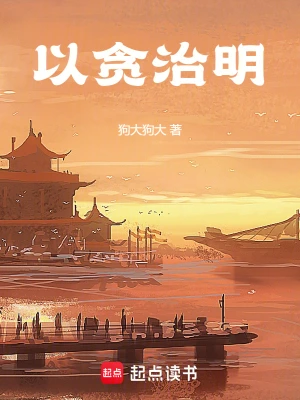
Ruling the Ming Dynasty Through Corruption
以贪治明
- Status
- Completed
- Length
- 1.0M Words
- Genre
- Historical
- Subgenre
- Song-Yuan-Ming Dynasties
- Updated
- 3mo ago
- Source
- Qidian
Stats
453Chapters
0Votes
7.3kRecs
37.9kFans
Tags
Synopsis
In booklists 2

Readers also read
 My Only Method: I Will Add More Points to Become Stronger at the End of Ming Dynasty
 A Guide to Building Civilization in a Primitive Tribe
 Daming: Asking for the Throne at the Beginning, Lao Zhule Went Crazy
 My Father Is Wen Tianxiang, and We Win the Battle of Yashan from the Start
 A Record of a Mortal's Journey to Immortality: I Earn Immortality by Grinding Achievements for Rewards
 How Grand Is the Adviser!
 Great Ming: I, Yan Maoqing, Really Am Blessed
 Lord Evolution
 A Record of a Mortal's Journey to Immortality: Choosing Hextech in the Chaotic Star Sea
 Why Are Northern Song Civil Officials So Awful?
 Cleansing the Demons
 My Portable Ming Dynasty Court
Reader comments 33
Google Translate
The most recent example of running a country with corruption is Little Days Next Door
Tanaka Kakuei, nicknamed Kintaiko 🤭, did a pretty good job, at least better than those abstract things that came later. During his tenure, he used the corrupt funds as his own private treasury and distributed them to lubricate the administration. He turned the corrupt interest network into his own power network and controlled a certain amount of financial power and political power in disguise. Now Ishiba Shigeru regards himself as Tanaka's successor😅
Just reading your introduction, I feel that in the end the protagonist can either start a capitalist society and turn the emperor into a constitutional monarch like Great Britain, or he will be ready to float on the sea. Otherwise, even if you are alive and fine, your whole family will die when you die. Offending the corrupt scholars and offending the censor can still do you a favor. Especially after you really succeed in your career, it will definitely take the whole Qing Dynasty and the public to do it. Even if the current emperor can tolerate it, the next emperor can also tolerate it, but your whole family will still be punished when you die.
In the feudal period, the financial circle was just a pig.
If it were impossible to govern the country through corruption in the Ming Dynasty, the premise of governing the country through corruption is that everyone must know how to stop. But if someone above you is greedy for one tael of silver, each person below will get 100 taels for each point. The common people cannot bear such expropriation. Even if you launch an industrial revolution to increase productivity, it will still be too late. Once the snowball of corruption in governing the country starts rolling, it will only get bigger and bigger. You can't govern even if you want to, because you are the biggest corrupt official. If we catch corruption, we'll arrest you first. If we don't catch corruption, the country will be at a loss.
If the protagonist does not become the emperor, then the protagonist must carry out comprehensive changes that limit the emperor's rights. It is useless if the protagonist just copies the technology of later generations and adds a few reforms. If a country wants to produce a large number of original inventions and creations, it must carry out systematic changes in ideological foundation, political structure, legal system, social forces and other aspects. The reason why Britain was the first to enter the Industrial Revolution is that after experiencing the ideological changes of the European Renaissance, coupled with the British Glorious Revolution of 1688, the king's rights were further restricted. Britain established the framework of parliamentary sovereignty and the rule of law, and the bourgeoisie, the new aristocracy, and the king formed a check and balance, which allowed British civilians to gain unprecedented freedom. At this time, the degree of freedom of scholars, craftsmen, and farmers in Britain was higher than that of other European countries at the same time, and it was far more liberal than the civilians of China's Ming and Qing dynasties. The high degree of freedom of all British civilians fully inspired everyone's strength. The power of the Chinese emperor was not greatly restricted, and all officials, gentry and landlords were dependent on the imperial power. The freedom of civilians, who account for the vast majority of the country's population, is too low. This system inhibits innovation and hinders social development. China's Zhou Dynasty was a feudal system, and the central government could not control much of the local princes' affairs. The princes competed with each other. During this period, Chinese civilization truly allowed a hundred flowers to bloom. Most of the essence of Chinese civilization came from this period. During the Spring and Autumn Period and the Warring States Period, the "Mo Jing" recorded the principles of optics and mechanics, and the germination of geometry had emerged; the "Gan Shi Xing Jing" recorded astronomical observation data. But from the Qin Dynasty to the Qing Dynasty, there was almost no progress! The institutional innovation of the Spring and Autumn and Warring States periods stagnated after the Qin and Han Dynasties, lacking the ability to dynamically adjust. Since the Qin Dynasty, especially since the Han Dynasty deposed all schools of thought and only respected Confucianism, Chinese civilization has almost stood still and entered a dead end. The Zhou Dynasty and the Spring and Autumn Period and the Warring States Period were similar to the ancient systems of most European countries. They were all feudal systems. Even in successive years of war, less than 10% of the country's total population died directly or indirectly as a result of the war. But from the Qin Dynasty to the Qing Dynasty, every dynasty would kill half or more of the country's population due to war! What is even more tragic is that every time there is a change of dynasty, there is almost no progress in the system and culture! {"NickName":"Supervision and Restriction","UserId":406440657}
In ancient times, the biggest problem in finance was to prevent capital from entering the land. While the Dutch East India Company became the most successful investment product in Europe because of its annual dividends of more than ten points, Chinese landowners' annual profit margins through land rent and lending could reach several times that of the East India Company. Faced with such a high profit rate, it is inevitable for capital to enter the land.
The most troublesome thing in ancient times was burning wood for fire
The mountains and fields must be bare. There is no way. Trees grow slowly. Even now, we can't live without them.
The Ming Dynasty really needs to be saved. Most of the emperors of the Ming Dynasty were good people, much better than the emperors of several other dynasties, but they were kidnapped by civil servants. The emperor was a good man and was not very good at it. Without the means to fight for power, as long as he failed in the later stage
Finally, the financial circle has also crossed over.
In the middle of the Ming Dynasty, people came by boat from Japan to rob the southeast coast. . Good niche vocabulary. We have waves a few meters high. Swallowing ships in the East China Sea. How developed should Japan's shipbuilding industry be? ? ? Where did Little Japan go to steal so much wood? . . . I can only say one thing. Those who wrote history books have never seen the waves of the East China Sea. . . Still thought you could just open it with your eyes closed?