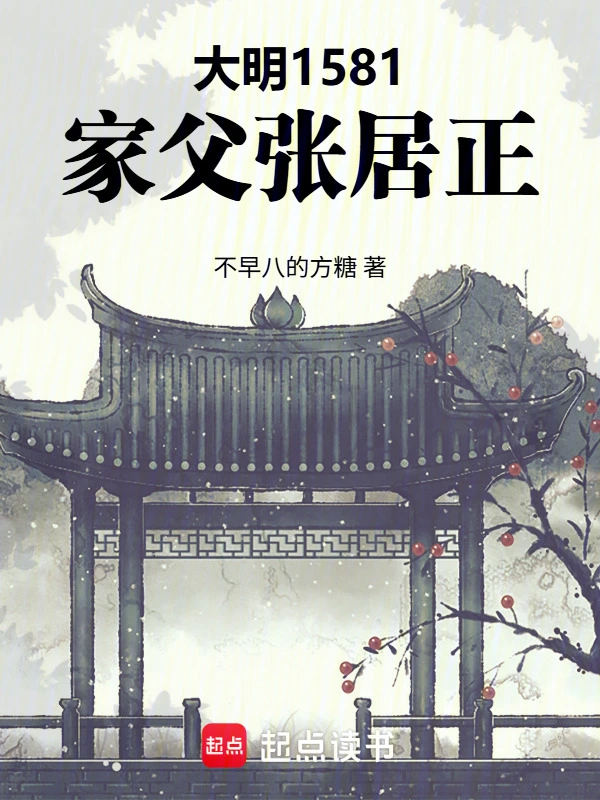
Ming Dynasty 1581, My Father Zhang Juzheng!
大明1581,家父张居正!
- Status
- Completed
- Length
- 2.0M Words
- Genre
- Historical
- Audience
- Male
- Subgenre
- Song-Yuan-Ming Dynasties
- Updated
- 4mo ago
- Source
- Qidian
Stats
0Monthly votes
45.7kRecommends
126.1kFans
534Chapters
Tags
Synopsis
Reader comments
Readers also read
 Talker in the Song Dynasty
 Please Call Me Your Majesty the Tsar
 In the Red Mansion: Escort Daiyu to Beijing at the Beginning
 1914 Begins with the Rejection of the Schlieffen Plan
 Never Walk Alone!
 Ming Dynasty Veterinary Medicine, Who Saved Zhu Biao's Life at the Beginning
 Northern Song Dynasty: Spoiler of the Future, Zhao Kuangyin Collapsed
 Daming: Have I Become Wanli's Portable Grandfather?
 I Am Drawing a Hot-Blooded Episode in the Zhiyu Episode!
 Datang: How to Become the Chief Planner of Xuanwu Sect
 The Fierce Ministers of the Song Dynasty
 Travel Through the Ming Dynasty and Train Lao Zhu to Become a Sailing Emperor
 One Piece: Daddy Garp, Kicked Kizaru Angrily at the Beginning
 Reborn Bao Guowei, I Really Didn't Want to Be a Great Writer!
I feel like I wrote about the emperor too well, and the problems all belong to the gentry, but in fact the essence is the problem of the centralization of power in the ancient feudal government. In order to ensure eternal stability, the emperor will inevitably centralize power. Centralization will bring excessive power to the bureaucratic network, because the bureaucracy is the emperor's hand in maintaining his rule. In other words, feudalism If the power of the bureaucracy is weakened relative to the common people, the status of the emperor is actually unstable, and power and money are interconnected. If the power is too great, the money and land representing interests will gradually be concentrated in the bureaucracy through various means. The power of the bureaucracy and the emperor are not antagonistic, but actually derived.
If the protagonist does not become the emperor, then the protagonist must carry out comprehensive changes that limit the emperor's rights. It is useless if the protagonist just copies the technology of later generations and adds a few reforms. If a country wants to produce a large number of original inventions and creations, it must carry out systematic changes in ideological foundation, political structure, legal system, social forces and other aspects. The reason why Britain was the first to enter the Industrial Revolution is that after experiencing the ideological changes of the European Renaissance, coupled with the British Glorious Revolution of 1688, the king's rights were further restricted. Britain established the framework of parliamentary sovereignty and the rule of law, and the bourgeoisie, the new aristocracy, and the king formed a check and balance, which allowed British civilians to gain unprecedented freedom. At this time, the degree of freedom of scholars, craftsmen, and farmers in Britain was higher than that of other European countries at the same time, and it was far more liberal than the civilians of China's Ming and Qing dynasties. The high degree of freedom of all British civilians fully inspired everyone's strength. The power of the Chinese emperor was not greatly restricted, and all officials, gentry and landlords were dependent on the imperial power. The freedom of civilians, who account for the vast majority of the country's population, is too low. This system inhibits innovation and hinders social development. China's Zhou Dynasty was a feudal system, and the central government could not control much of the local princes' affairs. The princes competed with each other. During this period, Chinese civilization truly allowed a hundred flowers to bloom. Most of the essence of Chinese civilization came from this period. During the Spring and Autumn Period and the Warring States Period, the "Mo Jing" recorded the principles of optics and mechanics, and the germination of geometry had emerged; the "Gan Shi Xing Jing" recorded astronomical observation data. But from the Qin Dynasty to the Qing Dynasty, there was almost no progress! The institutional innovation of the Spring and Autumn and Warring States periods stagnated after the Qin and Han Dynasties, lacking the ability to dynamically adjust. Since the Qin Dynasty, especially since the Han Dynasty deposed all schools of thought and only respected Confucianism, Chinese civilization has almost stood still and entered a dead end. The Zhou Dynasty and the Spring and Autumn Period and the Warring States Period were similar to the ancient systems of most European countries. They were all feudal systems. Even in successive years of war, less than 10% of the country's total population died directly or indirectly as a result of the war. But from the Qin Dynasty to the Qing Dynasty, every dynasty would kill half or more of the country's population due to war! What is even more tragic is that every time there is a change of dynasty, there is almost no progress in the system and culture! {"NickName":"Supervision and Restriction","UserId":406440657}
Everyone has mentioned the advantages, but I will talk about the shortcomings that I personally think of: the protagonist is too arrogant and has no respect for the elders, and is more ruffian than calm, and the above.
Zhang Juzheng showed that even a capable and ideal official could not save the Ming Dynasty. He would only get himself involved and could only usurp the throne or create a republic.
The author should fix it
The writing is readable, but the framework is a bit lacking. The writing of the plague section is too slow. If you want to develop modern medicine, you don't need to go through such a long period of plague. Moreover, it has never made the readers happy. Killing two censors is anticlimactic and not fun at all. The mastermind behind the scenes is even more incapable of controlling the same. It makes people feel frustrated while reading. Also, Zhang Juzheng's writing is too incompetent, the villain is too fierce, and he remonstrates every day. At least when Zhang Juzheng was in power, he could be labeled as slandering the emperor and deceiving his reputation. Also, the officials are ignorant. Even the common people at the bottom know that plague therapy is effective. It is impossible for officials not to know. A contemporary section chief knows that he cannot confuse right and wrong in the Headwind Bureau.
I am Shennong. To be honest, it is a pity that this novel has no traffic and has been buried.
Rating: Five stars The content is exciting yet soothing. The only drawback is that it updates once a day, which is too slow. There is no common sense error, and it may be the reason that is consistent with the actual situation? (Is it too cumbersome to check the information, which leads to fewer updates?) It ranks among the first-class articles in the history department. I really admire Zhang Juzheng's writing with flesh and blood.
Excellent grain products! Worth reading
It is not easy for the author to embellish the desolate twilight of the dynasty and create a lively atmosphere around the protagonist 😃😃. In ancient times, the confinement of feudal ethics was too heavy, and most people who read novels do not want to be so old-fashioned and dull. The author's ability to write with childlike interest and vitality without the oppression of feudal ethics at the beginning shows the merit of his writing skills 🌹🌹. Although the writing is not as stable and solid as that of the old author, the charm of the young author is the freedom to be open-minded, joyful and witty! 😁😁😁
The problem of the Ming Dynasty was that the land could not support so many people. The Manchu Qing Dynasty relied on enslaving the people. The only solution is to open borders and close the country
This is what you call heavy taxation. Is it called paying money in the south? When the Qing Dynasty came, they paid less than one-tenth of what they paid to the Ming Dynasty. Basically, the north was responsible for what they could do. Why is the south so powerful?
This is nonsense, and misses the point. This is not how we save people.
Don't beautify Zhang Juzheng. Zhang Juzheng partly collaborated with the Jiangnan landlord class, especially Xu Jie, who was his teacher, and he inherited part of Xu Jie's political legacy. In addition, among the chief ministers of the Ming Dynasty, the first one I hate is Xu Jie, the second one is Zhang Siwei.
The pace is too slow. He opened a hospital and was tricked, and then he fought back to solve the case. After writing 50-60 chapters, the real murderer was not caught in the end. 1️⃣There are still 140 chapters left. The protagonist, who runs a hospital, has little military power. How can you coerce the ministers in the court to rebel after making hundreds of thousands of taels? 2️⃣Are you confused about prices? Tomorrow, a doctor will charge 1,000-8,000 taels
The development of handicraft industry in the Ming Dynasty in that era was actually much more advanced than that in Europe at that time. By the way, industrialization would not be fully launched in Europe until the 19th century. The era in which the Ming Dynasty lived was already the most industrialized era.
The Ming Dynasty relied on Zhang Juzheng's great ability to continue a wave of blood. Without Zhang Juzheng's performance, Emperor Wanli would not have the confidence to achieve any of the three major conquests. But it is not without reason that Wanli hates Zhang Juzheng. Zhang Juzheng has made great contributions to the country and the people, but he is really not a good teacher. The biggest problem is the consistent double standards and hypocrisy of Confucianism. He is stricter on benefiting others than lenient on himself. He uses the standards of saints to require the young emperor to be diligent and frugal. He often reprimands Weihe and even threatens to dethrone him. Zhang Juzheng's private life is extravagant and lustful. Wanli has watched it since he was a child, but he can't hate it?
The more I look at history recently, the more I feel that what you did is right, and it is of no use at all. Political factions are different, no matter what you do is right, you will still die. The political relationship between Zhang Juzheng and Wanli can also be said to be unending.
This is a thinking of Ming history
When the Ming Dynasty was established in 1368, years of wars had led to desolation of the land, a sharp decline in population, and a serious lack of social productivity. Recuperation and recuperation were a must-have national policy. In 1371, Emperor Taizu of the Ming Dynasty issued the "Sea Ban", which "forbids people living near the sea to go to sea privately." Any merchants and shipowners who go to sea without permission to conduct smuggling trade will face severe punishment. In 1374, the Baobao Promotion Department was established, and the Ming Dynasty Baobao was officially issued the following year. It was initially put on the market through financial channels such as salary and military pay, and the paper currency standard was enforced. Private minting of copper coins was severely cracked down, and the circulation of gold and silver was banned. (Since the imperial court banned the circulation of gold and silver, where was the gold and silver circulating among the people? Where did it come from? It is obvious that precious metals like gold and silver have not needed the power of the state to give them credit value since ancient times. The currency may not be gold and silver, but gold and silver are naturally currencies. After the border smuggling of the past dynasties and the trade development of the land and sea Silk Road, the rich and powerful have naturally hoarded precious metals. Since the Song Dynasty, society At the meeting, a large amount of precious metals were no longer in the hands of the court, and the newly established Ming Dynasty had almost no gold and silver reserves. In order to maintain the operation of the country, continuous financial expenditures were needed. If precious metals were directly used as national currency, it would mean that the country voluntarily gave up its monetary sovereignty. Without monetary sovereignty, there would be no food sovereignty. This court was left with only an empty frame, existing in name only. For example, if paper money was forced to be used as the national currency without reserves, and the country's credit overdraft was clean, the country would still be destroyed.) In 1381, Ming Taizu further strengthened the sea ban policy and the control of maritime trade, and reiterated: "It is forbidden for people on the coast to communicate privately with overseas countries." (While banning private overseas trade, the tribute trade system was used to establish maritime trade monopolized by the central royal power, and overseas gold and silver were earned to provide credit support for the Ming Dynasty treasure banknotes. Hedging bureaucratic capital and private capital used hoarded precious metals to seize the country's monetary sovereignty. All foreign trade was settled with treasure banknotes. The Ming Dynasty purchased precious wood, spices, and foreign luxury goods. The prices of foreign trade silk, porcelain, and iron pots were all set by the Ming Dynasty) In 1402, Emperor Yongle ascended the throne. In addition to continuing to maintain Zhu Yuanzhang's national policies, he also sent Zheng He on seven voyages to the West from 1405 to 1433, expanding trade routes, destroying pirates, escorting merchant ships, and monitoring civilian smuggling. For specific records, please refer to the monument "The Legend of Tianfei Lingying". Zhu Yuanzhang established the rules of living for the people when he founded the country, and set the tax rate at a very low level. Emperor Yongle was able to move the capital to Beijing, build the Forbidden City, build the Ming Tombs, conduct five expeditions to Mobei, conduct an expedition to Vietnam, repair the Great Wall, and dredge the North-South Grand Canal. Compiling the Yongle Canon, any of the above items would be enough for the whole court and the public (such as Emperor Yang of the Sui Dynasty and Emperor Wu of the Han Dynasty), but if the Yongle Dynasty did all these things, then he must have the money to do these things, and where does this money come from? It can only be the Western trade. It is easy to earn, otherwise there is no way to explain the national finances (all the vassal states at that time accepted the Ming Dynasty treasure banknotes. Zheng He used such depreciating banknotes to exchange for a large amount of gold, silver and various physical objects. The Ming Dynasty treasure banknotes can be printed as much as they want, and the Ming Dynasty does not need to worry Regarding the issue of inflation, Zheng He sold high and bought low. Ming historians estimate that Zheng He made seven voyages to the West and earned 720,000 taels of gold and 12.76 Million taels of silver. This is the total income. At the same time, he spent a total of 6 million taels of silver on the seven voyages. The total cost was that when Ming Xianzong Zhu Jianshen became emperor, there were still 2.4 Million taels of silver in the treasury) In 1435, Ming Xuanzong died at the age of 37, and Ming Yingzong, who was only 8 years old, succeeded to the throne. Amid the cry of "wasting people, hurting money, and not beneficial to the national economy", all data and information related to the maritime trade in the Western Sea and the maritime fleet were basically sealed or destroyed, causing the central finance of the Ming Dynasty to shrink significantly. Even with the support of the wealth accumulated in previous maritime trade, the national credit of the Ming Dynasty treasure banknotes began to gradually decline and depreciate. (From Guo Yan's epitaph, we can learn that in the eighth year of Zhengtong (1443) of Emperor Yingzong of the Ming Dynasty, he was ordered to supervise the construction of 120 "sea-going ships" and served as the "general coordinator of the eight prefectures". Because of his good supervision, "the military and the people benefited from it". After the completion, "the military and civilian officials of the eight prefectures came to the mansion to express their gratitude". This confirms the national plan of Emperor Yingzong of the Ming Dynasty to restart the Western Ocean trade, and the sea-going ships were built. It was first shelved due to the civil uprising, and then the Tumubao Incident occurred in 1457. A few months after the restoration of Emperor Yingzong of the Ming Dynasty, he wanted to launch the voyage to the West. Zhang Zhao objected on the grounds of needing disaster relief. In order to clean up the mess of his predecessor, he stopped the voyage. By the Chenghua period of 1464, there was no record of the 120 ships built. Zhu Jianshen, Emperor Xianzong of the Ming Dynasty, ordered the Ministry of War to search for archives of Zheng He's voyages to the West, but found that the relevant documents (including sea charts) were missing, and Liu Daxia, an official of the Ministry of War at the time, was accused of hiding or destroying these files. Since then, the imperial court has completely lost the ability to return to the West. ) In 1567, the Longqing Emperor Zhu Zaicheng was increasingly short of national finances. Forced by the government, bureaucratic capital and private capital began to encroach on the maritime trade that was originally a monopoly of state-owned enterprises in the Ming Dynasty. Except for the court's share of the tax revenue, most of it went into the hands of bureaucratic capital and private capital. The amount of silver in private circulation also began to increase massively, and the monetary sovereignty of the Ming Dynasty was gradually being eroded. Longqing Emperor Zhu Zaijing was an adult and knew the stakes. Silver must not be allowed to become the legal currency of the Ming Dynasty. However, this was the last step for bureaucratic capital and private capital plutocrats to steal the monetary sovereignty of the Ming Dynasty. From the death of Ming Xuanzong at the age of 37 to the ascension of Emperor Longqing to the throne, it was 1 In 31 years, it was 132 years before Emperor Longqing switched on and off. How could the century-old plan of bureaucratic capital and private capital plutocrats stop progressing and fall short? Therefore, Emperor Longqing had to die in 1572, five years after the switch, in pursuit of beauty and lust, in order to ensure that Emperor Wanli, who was only 10 years old, ascended the throne. In 1581, Zhang Juzheng promoted a whip law to abolish treasure banknotes and use silver as the national currency. Taxes were also paid in silver instead of in kind. As a result, the country lost its monetary sovereignty. The economic lifeline gradually fell into the hands of bureaucratic interest groups, Jiangnan gentry and maritime merchants who controlled large amounts of gold and silver. Capital plutocrats could control market inflation or deflation at will, draining the country's wealth while getting rid of the control of the central royal power. After Zhang Juzheng's death, Emperor Wanli liquidated him on charges of "authoritarianism and chaos in government", deprived him of his title and ransacked his home. Wanli once ordered "dissection of coffins and slaughter of corpses", intending to dig graves and whip corpses to vent his anger. However, due to the strong persuasion of officials such as Chief Assistant Shen Shixing, this was not actually implemented. (In the 16th century, Spanish and Portuguese colonists discovered huge silver deposits in Peru and Mexico in the Americas. Europe has always had a huge trade demand for China. In 1581, Zhang Juzheng reformed the use of silver as the national currency. European colonists began to use the silver stolen from the Americas to trade with China. Chinese society has always been based on a self-sufficient small-scale peasant economy, with men farming and women weaving. The way of life makes the Chinese have little need for foreign goods. Foreigners consume a lot of Chinese tea, raw silk, and porcelain, resulting in China importing less and exporting more. Foreign merchant ships always come loaded with silver, and then leave loaded with Chinese goods. A large amount of silver flows into China.) Farmers mainly produce in kind, and after paying taxes on silver, the price fluctuations caused by the manipulation of the market by the bourgeoisie have increased the burden. In the Chongzhen period, without the eunuchs to check and balance, the state's rights were completely lost, and Chongzhen could only borrow money from ministers to pay the army. (From a historical perspective, the Xia and Shang Dynasties: before the authoritative central force was formed, the Xia Dynasty was an era of equality and republic, and the development of each tribe did not affect each other. The Shang Dynasty used military conquests and human sacrifices to intimidate each tribe to surrender. West Zhou Dynasty: With the turn of Shang and Zhou Dynasties as the turning point, the Zhou royal family established a political model of co-governance with the princes based on the enfeoffment of land. The Zhou rites were the cultural product of this period. Pre-Qin Period: After the collapse of the central prestige of the Western Zhou Dynasty, the feudal princes began to fight until the Qin Dynasty unified the Qin Dynasty and the early Han Dynasty: the unification of the Qin Dynasty laid the foundation for the collapse of the princes. From the Western Han Dynasty to the Sui Dynasty, the gentry and the aristocrats occupied a dominant position in society and merged with the new power of the gentry group in the troubled times of the Jin and Southern and Northern Dynasties. From the Sui Dynasty to the Song Dynasty, the gentry group was completely destroyed by the Huang Chao uprising in the internal struggle. The landlords succeeded the former and became a new social force. In the Song, Yuan, Ming and Qing dynasties: since the gentry landlords did not have the capital to directly confront the government, they constantly had to find and support agent regimes that could maintain their interests until they reached satisfactory cooperation with the Manchu regime.) By 1662, when the Southern Ming Dynasty fell, the Manchu Qing Dynasty began a 268-year dark rule.
So what if my father is Zhang Juzheng? When I go to court, I have to stick my butt out and shout long live. What I want is to rebel and become the emperor.
How long will the author continue to sell Zhang Juzheng's hook🙂
I am not the prime minister! It's a photo shoot. The people who come after you say this will definitely be dead.
Emperor of ming dynasty
The emperor of the Ming Dynasty could no longer control the Jiangnan Group, and the Northwest Group would also rebel during the Chongzhen Period. This shows that the foundation of the dynasty was completely gone by the time of Wanli. The army was basically unfilial and loyal to the emperor and could not command. Don't think that Wanli has much power. He only has one power. If he disagrees with it, he will be killed in a minute if he wants to fight for power.
Interesting, more to come
It's fun, I like it. As long as the style and story rhythm remain unchanged, I will continue to watch it.
How to put it, in my humble opinion, Lao Zhang is not considered to have extended his life and sent away the sinners of the Ming Dynasty. Those Jiangnan xx collusion and training are not nonsense. His silver standard completely turned the Ming Dynasty's treasure banknotes into waste paper. The currency issuance power was gone, and silver replaced the treasure banknotes (we don't have many silver mines) Equal rights and currency issuance rights are the foundation of Guo Jia. The Tumubao Incident eliminated the balance of power, and the treasure banknotes gradually disappeared. Half of the silver and treasure banknotes were halved. Lao Zhang took over and directly implemented the silver standard, and the currency issuance power was gone. Don't talk about over-expansion or anything like that. As long as there is still something, there will always be someone to pay for it and we can slowly change it later. Without the right to issue currency, it means that the economic lifeline is being manipulated, and the country's demise is not far away. Next door, Laomei has made a fool of Zhu Yuanzhang's Ming Dynasty treasure banknotes. The Fed said what a good experience template. It is only issued for one day, and someone will pay for it. I can still be awesome. $Without the distribution rights, do you think Laomei will be finished?😁😁😁 One whale falls and all things are born, and the cultural gap has been two or three hundred years. Anyway, the more we recover, no matter how history is tampered with and distorted, it will be corrected, and the intensity will only become stronger and stronger.
More and less
Haokan
A shadow of a man who went up the mountain to hunt tigers. If I hadn't read your previous book, I would have thought it was his trumpet.
Does anyone still read this book?
There are no comments at all for several chapters.
The author is Yang Wei, so I squeezed in one chapter in a few days. No, eunuch, right?
This book is popular
The writing is sophisticated and contains a lot of useful information. It is not a piece of cake.
Very well written. Lots of fun. Interesting. Update soon.
The cross talk section is too abstract. Just mention it.
Just after catching up on the latest chapter from the first chapter, it suddenly became free 😭