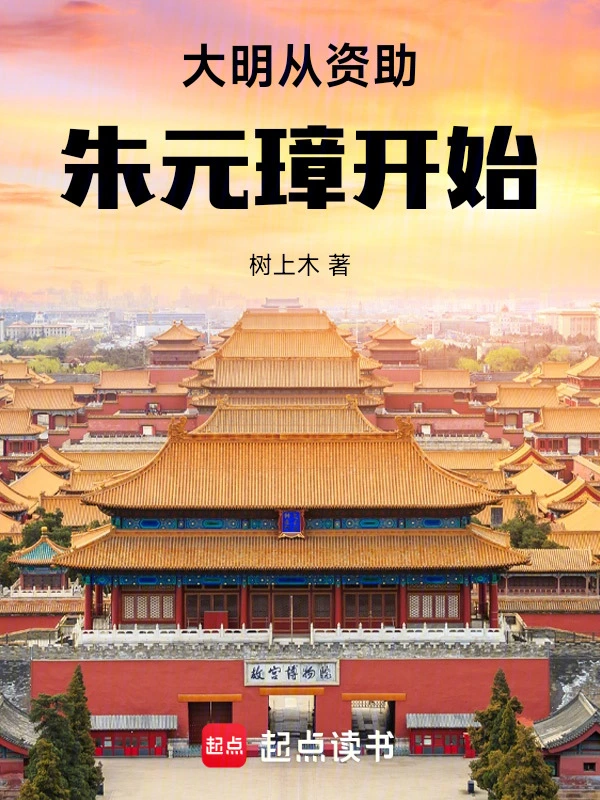
Ming Dynasty Started by Funding Zhu Yuanzhang
大明从资助朱元璋开始
- Status
- Completed
- Length
- 1.7M Words
- Genre
- Historical
- Audience
- Male
- Subgenre
- Song-Yuan-Ming Dynasties
- Updated
- 8mo ago
- Source
- Qidian
Stats
0Monthly votes
16.8kRecommends
62.1kFans
818Chapters
Tags
Synopsis
Reader comments
Readers also read
 1914 Begins with the Rejection of the Schlieffen Plan
 In the Red Mansion: Escort Daiyu to Beijing at the Beginning
 Talker in the Song Dynasty
 Please Call Me Your Majesty the Tsar
 Never Walk Alone!
 The Ming Dynasty Started with Taking Zhu Yuanzhang to Visit the Forbidden City.
 Ming Dynasty: in the Beginning, He Complained That Zhu Di Was Not the Right One to Succeed to the Throne.
 Daming: Have I Become Wanli's Portable Grandfather?
 I Am Drawing a Hot-Blooded Episode in the Zhiyu Episode!
 Travel Through the Ming Dynasty and Train Lao Zhu to Become a Sailing Emperor
 Ming Dynasty Veterinary Medicine, Who Saved Zhu Biao's Life at the Beginning
 Northern Song Dynasty: Spoiler of the Future, Zhao Kuangyin Collapsed
 Brother Li Shimin
 Ming Dynasty: Huddled in Beiping and Became Magistrate
 Late Ming Dynasty: It's Over, My Adoptive Father Is King Chuang
 My Fourth Uncle Is Zhu Chongba
After reading your introduction, I feel like asking the author a question, why doesn't the male protagonist do it himself? ?
With Zhu Yuanzhang's character, no matter how awesome you are, no matter how benefactor you are, he will kill you. Even if you save his parents, even if you save his queen's life, he will still suppress you later, and he will never be soft.
If the protagonist is not dead! Waiting for the day when Zhu succeeds, it's time for the protagonist Ling Chi and the nine tribes to disappear. It's hard to die under Zhu's hands. Peeling daylilies is the most basic.
Aren't you looking for death?
Looking for death. Zhu Yuanzhang is the emperor who hates the rich the most. He also finances the world. Why don't you force Zhu Yuanzhang to kill you after he conquers the world? The so-called superior merits overshadow the master.
Looking at the introduction, are you planning to become a dog? You can kill it and eat it when you are hungry. Who is Zhu Yuanzhang? As a time traveler, I don't know
The biggest reason why Zhu Yuanzhang was hacked was that it violated the interests of the gentry in various places (for example: the empty seal case, the local gentry imagined that the local tax farming system was implemented in the Yuan Dynasty, and tested the empty seal case that Zhu Yuanzhang only came up with). Historically, those who were hacked were tyrants and basically violated the fundamental interests of the local gentry. When it comes to brutality, you will find that not many people talk about Chiang Kai-shek. Why? Most of the damn people are dead. Who will remember it? Guess who holds the pen of founding the country?
The content of this book is about how to be a dog for Zhu Yuanzhang, and it is also an extremely loyal dog. Zhu Yuanzhang and other civil servants and military generals are written very intellectually. The protagonist is very awesome and powerful, but he still acts like a dog to Zhu Yuanzhang.
As for the things mentioned in the introduction, the protagonist can recruit a group of people to do it by himself, and he doesn't need to do it for Zhu Yuanzhang
This author is another person who has read about the events of the Ming Dynasty without seriously studying the actual records of the Ming Dynasty. He has only a partial understanding of the historical situation in the early Ming Dynasty, so he comes to instill his worship of Zhu Yuanzhang. If you don't look at who Zhu Yuanzhang is, Whoever you are, if you want to say that Zhu Yuanzhang was good to the people and bad to the officials, then it was in the early Ming Dynasty when Zhu Yuanzhang had not yet unified the world. After Zhu Yuanzhang initially unified the north and the south, Zhu Yuanzhang had completely different attitudes towards the people. It can be said that ordinary people are not regarded as human beings.
The rabbit dies, the fox is sad, the lackey cooks, there is a threat, Lao Zhu will take you with him before he dies, it is better to go to Nanyang, or Australia, anyway, there is money, and it is still a troubled time, there is no shortage of population, large-scale construction, just capture hundreds of thousands of Nanyang natives, directly immigrate one or two million from the Central Plains, I do not approve of investing in Lao Zhu, you want to become bigger and stronger, Lao Zhu has seized the country, his death is not far away
Ming Dynasty? It is not a Han dynasty, it is even worse than the Qing dynasty. It is a dynasty that has turned back the wheel of history. The average quality of the emperor is at the bottom among the unified dynasties.
I list in detail the comprehensive regression of the Ming Dynasty compared to the Song Dynasty: 1) It started the ugly behavior of human sacrifice, which directly lowered the moral standard of ancient China and returned Chinese civilization to the ignorant period of the Shang and Zhou Dynasties. In ancient China, burials were abolished from the Warring States Period. More than 2,000 terracotta warriors and horses were unearthed from the tomb of Qin Shihuang. These cheap handicrafts such as pottery warriors were used instead of living people for burial, which reflected the great progress of social civilization. In the Ming Dynasty, Zhu Baba resumed the practice of living and dying, and once again regressed Chinese civilization to the Spring and Autumn Period. It is worth mentioning that in the 276-year history of the Ming Dynasty, the burial system was never abolished at all. What Zhu Qizhen, Emperor Yingzong of the Ming Dynasty, abolished was only the burial of concubines, while ordinary people continued to be forced to bury fat pigs named Zhu. According to Professor Ma Weiyuan, an expert on Ming Dynasty history, New China excavated Dingling and discovered a large number of bones, all of which were the remains of people who were buried in the palace. 2) Created the dross system of recruiting scholars with stereotyped writing, which imprisoned the thoughts of literati and poisoned Chinese civilization for 600 years. 3) The implementation of the "no board allowed into the sea" maritime ban policy resulted in more than 200 years of complete stagnation and regression, causing China to miss the most critical era of great navigation. China, which had been leading the world in ancient times, began to fall behind during the Ming Dynasty and began to be colonized and invaded by the West. 4) Implement the most generous clan support system in history, and raise the pig family with all the flesh and blood in the world. Since the Han and Tang Dynasties, clan favors have been implemented for five generations. In the Song Dynasty, it was further civilized and became three generations. But Zhu Mingjia Tianxia completely reversed history. Not only did it formulate the most generous clan treatment in history, but it also stipulated that the salary should be reduced to Lieutenant Fengguo. This means that every descendant of Zhu Baba is an iron hat king. The salary of Lieutenant Fengguo is 200 shi, which means that he can receive at least a salary equivalent to a fourth-grade official and be replaced hereditary. Step backwards into primitive society. This bizarre clan support system made the common people of the Ming Dynasty miserable. "Wanli Accounting Records" records that during the Wanli period, the number of fat pigs surnamed Zhu reached 180,000. Zhu Ming's annual income was only 18 million taels of silver, and the salary paid to the clan reached 5.5 Million taels, accounting for 30%. During the same period, the cost for disaster relief was only tens of thousands taels, accounting for only 0.43%. The number of eunuchs and maids in the Ming Dynasty was the largest in history. According to literature, there were 100,000 eunuchs. As for eunuchs, the feudal dynasty mutilated the bodies of ordinary people and turned them into slaves. 5) The most serious land annexation in history, the Zhu Ming royal family was the absolute main force in grabbing people's land. "Records of Emperor Shizong of the Ming Dynasty" records that in the 8th year of Jiajing, the total land in the Ming Dynasty was 850 million acres, of which 426 million acres were reduced to non-taxable land. There is no doubt that these lands were seized by powerful people represented by the Zhu Ming royal family. The Zhu Ming royal family only had a population of hundreds of thousands, but they plundered half of the country's land. The remaining half of the land is still being annexed by officials, gentry and landlords at all levels. In the Ming Dynasty, most of the common people were tenant serfs, and there were few homesteaders. According to Gu Yanwu's description, 90% of the people in the Jiangnan area are tenant farmers. 6) In the 276th year of the Ming Dynasty, the territory was abandoned and the land was abandoned for 276 years The Ming Dynasty not only refused to open any territory, but also continued to abandon the territories developed by the Yuan Dynasty. In the Ming Dynasty, Liaodong, Daning, Kaiping, Dongsheng, Hetao, Hami, Annan, and Myanmar were abandoned successively. The territory inherited from the Yuan Dynasty was more than 5 million square kilometers during the founding of the early Ming Dynasty. By the end of the Ming Dynasty, only two capitals and 13 provinces, covering 3.5 Million square kilometers, were left. 7) Unprecedented spy politics monitors the Han people and prevents Han people from rebelling The Ming Dynasty only had a population of 51 million, but the Jinyiwei, Dong and Xichang spy agencies numbered tens of thousands. The Ming Dynasty also had 100,000 eunuchs. These spies monitored every move of the Han people as never before, and acted as thugs for the Ming emperor to oppress and exploit the common people, such as mine supervisors and tax supervisors. 8) The caste oppression system turns ordinary people into slaves who provide food The Ming Dynasty was the only dynasty in Chinese history that blatantly implemented the caste oppression system. "Ming Huidian" formulated the clan support system, the craftsman registration system, and the low-level household system. They blatantly divide the people of the country into three, six or nine classes and carry out discrimination and oppression. Zhu Baba demoted Zhang Shicheng, Fang Guozhen, and Chen Youliang's subordinates to untouchable households, and Zhu Di demoted the family members of Jianwen's old ministers to untouchable households, engaging in blatant discrimination and humiliation. These caste systems were implemented openly for 276 years. In the end, these anti-human systems were abolished by the Qing troops who entered the customs. The road guide system of the Ming Dynasty stipulated that ordinary people could not travel more than a hundred miles away from home, which nakedly locked the people to the land, serving as tenant serfs to the Zhu Ming royal family and becoming slaves providing food. 9) Unprecedented massacre of Han civilians Killed millions of soldiers in Jiangnan, and the sword on his waist was still bloody. During the founding of the Ming Dynasty, in order to retaliate against the people of Hunan for supporting Chen Youliang, Zhu Baba slaughtered the people of Hunan to "ten houses and nine empty houses". Today, "Hongwu Tu Xiang" is recorded in the family trees of many people in Hunan. When Zhu Di was fighting for the throne, he massacred all the northern areas of Hebei in revenge for the people in Hebei supporting Zhu Yunwen. Later, in order to fill the population vacuum in Hebei, a large number of people migrated from Shanxi. So far, the genealogy of most people in Hebei Province has records of "under the big locust tree in Hongtong, Shanxi". 10) The appalling Literary Prison Let's put aside the four major Hongwu cases that massacred hundreds of thousands of people, and let's talk about the literati who lost their heads because of a mismatch in one word at the hands of Ming Taizu Zhu Baba. Judging from the contents of these literary prisons, it is inexplicable for Zhu Baba to kill people. He is actually a psychopath. In the early days of the founding of the Ming Dynasty, the three major cases massacred nearly 100,000 officials and their families, and the massacre of people in two counties under Yingtian Prefecture, estimated to be around hundreds of thousands. Zhu Di established the Jianwen rebellion and massacred tens of thousands of old officials of the Jianwen Dynasty and their families. Since Zhu Baba, the Ming Dynasty has launched a literary inquisition and started this evil system, which has harmed China for 600 years. Zhu Ming also implemented an extremely perverted imperial staff system, and would kill ministers who were lax in their remarks at every turn.
Zhu Yuanzhang deserves to die the most. If this kind of thing wins China, it is because China is unlucky. The caste system is being promoted and people are still practicing it.
According to Li Xinfeng's research, "Huaixi Honors" is too general
Regarding the founding group of the early Ming Dynasty, Wu Han went beyond the simplistic understanding of "heroes and generals" and understood the struggle between kings and prime ministers, the dispute between Huaixi and Zhejiang, and the Hu Lan Party case from the factional perspective of the "Huaixi Group". However, the interpretive efficacy of "Huaixi" has been questioned by all parties. It is a general characteristic of the high-level ruling group, not a factional factor that affects the political status, tendency and destiny of ministers. After the founding of the Ming Dynasty, the interpersonal relationships between nobles and nobles were increasingly affected by marriage, new military achievements, and institutions. However, at the beginning of the founding of the People's Republic of China, the status and interpersonal relationships of nobles and even military attachés and soldiers at all levels still depended to a large extent on origin factors such as military exploits, place of origin, origin, early experience in the military, and the relationship between superiors and subordinates. In this regard, Zhu Hong attached great importance to the "original background of honorable ministers" and pointed out the core position of those who were born in Haozhou in Huaixi and among all nobles; Zhang Hua outlined a stricter "Huaixi" group based on the generals' place of origin and the order in which they joined the Red Army; Zhao Yi examined the personal relationship between Zhu Yuanzhang and the Xungui Group and believed that the ruling group in the early Ming Dynasty lacked strong interpersonal relationships within the first group, resulting in Zhu Yuanzhang's inability to truly trust the Xungui Group. The sooner or later you join the Red Army camp, the difference between "joining the army" and "submitting", and even whether your native place is in Haozhou and other factors will affect the honorary awards. But in the final analysis, the sooner or later the master-slave relationship is established with Zhu Yuanzhang is the main indicator that determines the ranking of nobles. Among the "old people crossing the river", those who "joined the army" formed the first circle with the closest relationship with Zhu Yuanzhang. They may be collectively referred to as those who joined the army in Haozhou, including Chang Yuchun, who joined the army with his personal connections and outstanding military exploits. Among the "old people crossing the river", those who "submit" are generally not from Haosi, and their personal affiliation with Zhu Yuanzhang is not obvious. They were suppressed when they were awarded rewards in the third year of Hongwu (1370), forming a second circle, which can be called "subjects to Jiangbei". The generals who surrendered after crossing the river could occupy a place among the nobles of the early Ming Dynasty, either by virtue of their military exploits or by leading a large group of troops to surrender. They were classified as "submitters" and had a weak personal relationship with Zhu Yuanzhang. They constituted the third circle, which can be called "submitters after crossing the river". The Haozhou soldiers constituted all the dukes and the first half of the marquises, occupying an absolutely dominant position. At the end of the third year of Hongwu, the Ming Dynasty made great achievements. The rankings of the twenty-eight feudal lords are arranged in groups according to the order in which they joined the Red Army. The first fourteen were all from the Haozhou Red Army. They were all natives of Haozhou and Dingyuan who joined the Red Army before the Sino-Japanese War. The last fourteen were the four generals who defected to the Red Army in the north of the Yangtze River in the Yiwei year (1355) and the ten generals who joined the Red Army one after another after crossing the river. The old generals from Haozhou and those who defected to Jiangbei were both "old people who crossed the river", but their origins were different. The former joined the Red Army as a Red Army or an anti-Yuan self-reliant person, and was officially called a "conscript" or "a defector." According to this, the chief officers or direct superiors of the Eight Guards of Longxiang, Fengxiang, Wude, Xuanwu, Zhenwu, Shenwu, Xiongwu and Guangwu are "affiliated". Regarding the proportion of "joining the army" and "submitting", the chief officer of the guard in the Jiachen year (1364) and the marquis in the third year of the Hongwu period (1370) both accounted for half. It can be seen that this distinction in status and faction does exist. There is an obvious difference in the relationship between the generals of the inner eight guards and Zhu Yuanzhang. The chief officers of the Tiance Guard and the Xiaoqi Guard were Zhu Yuanzhang's hometown confidants. Although Chang Yuchun, who was in charge of the Wu De Guard, was a "subordinate" and a junior who joined the Red Army just before crossing the river, he quickly became the most popular and famous general with high achievements and prestige. Wude, Tiance, and Xiaoqi, the three guards who are not named after beasts of prey, must be troops that have a particularly close relationship with Zhu Yuanzhang and should be comparable to the imperial guards. The three chief guards, Bao Tao, Ying Yang, and Fei Xiong, were either from Dingyuan or were members of the established Red Army who were not originally subordinate to Zhu Yuanzhang. Although they belonged to the "military" camp in Haozhou, their relationship was slightly distant. The chief officers Longxiang and Fengxiang both belonged to the Chaohu Navy who had "submitted" to each other, and their relationship was even more distant. The eight guards listed in Yu Ben's quotation above are arranged in this order from the least to the most intimate. Among the eight outer guards, only Yingwu Guards and Xingwu Guards came from the Haozhou Red Army. Their chief officer status was similar to that of Baotao, Yingyang, and Feixiong. If Zhenwuwei and Weiwuwei have the color of the old Haozhou tribe that is not directly related to Zhu Yuanzhang in the early period, their status will be comparable to Yingwu and Xingwu at most, but they are probably related to the Chaohu navy and those who surrendered after crossing the river. Xuanwuwei came from the Chaohu Navy. Xiongwu, Guangwu, and Shenwu were the last to join and had the most distant relationship with Zhu Yuanzhang.
There are a lot of conspiracy theories in the comment area. Ming Hei is famous for his low IQ. He has never learned logic. When he gets old, he will sell health products accurately. People like you are the favorites of electronic scammers.
Zhu Yuanzhang is not considered a high-quality stock. Invest in Lao Zhu, be careful that someone will eventually kill you, the hero. (Lao Zhu in history was a master of killing heroes. Haha😃)
Lao Zhu is a typical landowner and a wealthy man. The entire Ming Dynasty is his family! Why aren't there any novels about Zhang Shicheng and Chen Youliang's ascension to the throne? For a change 😁
Ministers are just long-term workers of Lao Zhu's family. In terms of officialdom environment, it is not as good as that of the Qing Dynasty.
It's not good who you invest in. Are you investing in Hongwu? I don't hate Hongwu. But, brother, no one would be willing to work under him 🙂
The author is so unreasonable to invest in Zhu Yuanzhang?? Hahaha
The rhythm is unbearable! What the hell? Daydreaming? ? ? Think of something unrealistic! Who is this person who was reborn or traveled through time? ? ? Knows everything! If you don't look at the information in modern times, you may not be able to figure it out! Bring a computer with you!
What the hell are you writing! Do you have a system? Are you hung up? Just think about modern things! You are an expert and know everything! Do you want to create the rhythm of cars, airplanes, cannons, and trains? Do you have that technology? The rhythm gets worse the more you write?
Wool needs to be deodorized and grease-free, and the protagonist needs to solve this problem.
There were no sweaters in ancient China because wool was too smelly and oily. In ancient Europe, urine was mixed with plant ash to remove grease. Who would wear it if it doesn't remove the smell, smell and oil?
After watching Wang Shanshui's video, Zhu Yuanzhang's palace is extremely deep. When he conquered the world, he was equivalent to Li Shimin, and when he ruled the world, he was like Liu Bang.
In fact, the basic foundation of the Ming Dynasty was military households. If military households collapsed, they would be doomed. This is highly stable with the military households designed in this book.
In fact, the basic foundation of the Ming Dynasty was the military household. If the military household collapsed, it would be over. It did not collapse until the middle and late period of Chongzhen. Xu Da's Duke of Wei and Mu Sheng's Duke of Qian were passed on until the end of the Ming Dynasty. There were also a large number of middle and lower-level officers who were awarded hereditary positions such as Hundred Households and Thousand Households. Sun Chuanting's family was from a hereditary family, and this position was passed down from Hongwu to the late Ming Dynasty. Qi Jiguang hereditarily commanded the Qianshi of the Dengzhou Guard. His ancestor Weixiang accompanied Ming Taizu in the southern and northern wars, and the Dengzhou Guard commanded the Qianshi. This position was hereditary until the end of the Ming Dynasty. There are also Li Chengliang, Qin Liangyu, Mao Wenlong and others, whose hereditary positions are more iron-clad than their iron rice bowls. Did Zhu Yuanzhang achieve sharing wealth? In the Ming Dynasty, not only the imperial examinations for military households, but also active-duty soldiers and officers participated in the imperial examinations. There were also official health schools to teach the children of active-duty military households, and they also took the imperial examinations for immigrants. The "Jinshi" rate for military households is 1/4. One out of every four Jinshi is from a military household, and 50% from civilian households At the end of the Ming Dynasty, guardsmen could also be sent out to fight. It was mainly a point-to-point financial system, and the soldiers from the Jiading camp were basically selected from the young men in the guards. There are clear records when opening the records. The Ming Dynasty had a point-to-point financial system, and the sources of military pay were complicated. The court's arrears in military pay did not mean that Jiubian had no food to eat, it was just a discount. Military pay includes "monthly rations", "line rations" and "rations". The arrears of pay began in the 27th year of Wanli, and there is no way to calculate them. The most cruel thing seems to be that he has not been paid for 13 years and can still direct wars. This system is really strong. Among so many dynasties, no one can compare to the control of the army. Military households were mainly owed the portion of insufficient military pay reported by various localities (transportation to Beijing). Beijing would then plan to transport silver to the army based on the reports. In practice, transportation in ancient times would not be that fast. Local military and political chiefs would first trick the soldiers into dragging them, and then wait for the silver to be shipped. The Ming army's unit that leads the pay is the grain warehouse of the guard station. The officer who distributes grain is occasionally missing in the guard station, but it can still feed the belly (monthly food). He can move to the inland to fight. In addition to suppression, Hong Chengchou, Sun Chuanting and Lu Xiangsheng tried to find ways to produce food wherever they went. In addition to planning military operations, they also inspected the land of military settlements. After obtaining the land, they immediately gave it to military households to cultivate and keep enough for themselves. The rest was surplus military expenditure. They could not rely entirely on the Beijing Transport Salaries issued by Chongzhen (military expenditures came from military settlements, civilian settlements, merchant settlements and Beijing Transport).
Lao Zhu doesn't care whether he is virtuous or not. There are records in people's ancestral teachings that the sage should be thrown into prison immediately and hacked to death rather than repeat the old story of Wang Mang and Sima Yi. Before these two usurped the throne, they were both virtuous people praised by everyone. . . . .
Eliminate Confucius and Confucianism
This is not simple! Cut off the Confucian family. Now that colleges have been built and libraries have been built, there are many talents, so what else is needed for Confucianism? It is necessary to develop in an all-round way, build water conservancy projects, develop agricultural modernization and make the country strong through science and technology. Therefore, it is enough to destroy the Confucius family, and to respect Confucius, it is enough to respect Confucius alone.
Zhu Yuanzhang was indeed capable of commanding troops. He planned the Northern Expedition and had a miraculous plan.
The failure was because of not listening to Zhu Yuanzhang's plan
7/{"NickName":"Book Friends 160810083435261","UserId":220953537}
What you wrote is getting worse and worse! I'm convinced
Why is there no update on the 31st and no explanation?