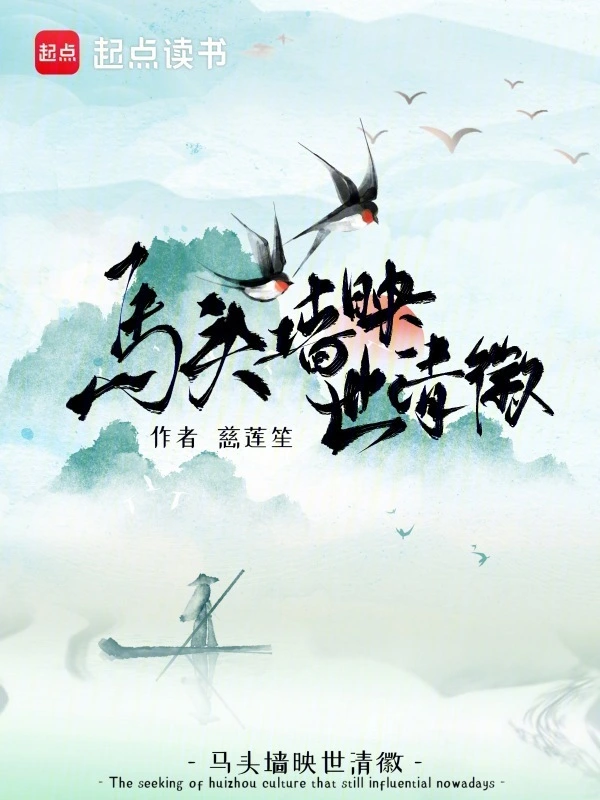
The Horse Head Wall Reflects the Qing Emblem
马头墙映世清徽
- Status
- Completed
- Length
- 371k Words
- Genre
- Ancient Romance
- Audience
- Female
- Subgenre
- Transmigration Romance
- Updated
- 9mo ago
- Source
- Qidian
Stats
0Monthly votes
9.8kRecommends
36.8kFans
116Chapters
Tags
Synopsis
Reader comments
In booklists 1
Readers also read
 Return to Yanmen
 Beautiful Little Maid
 The Splendid Farmhouse in Time Travel
 Become Famous
 Order Game
 Lu Fengshi
 Wasteland: the Three-Star Pile of Full-Level Cubs Is Super Fierce
 Cultivation of Immortality with Useless Materials, Starting with a Contract with an Ancestral Dragon
 A Man Who Started a Flash Marriage and Was Reborn in the 1980S to Get Rich.
 Midas Touch
 On the Tenth Year of the Natural Disaster, I Went to Farm with Me
 The Icing on the Cake
 Born Like a Star: Peak
 Prosperous Times Cast Youth
 Yunjuanqi Comfortable
 The Youth Returns After All the Glitz
 Haiyanheqing Four Seasons
 Qingluo Jinghe
 The Clouds Are Clear, the Rain Is Shining Brightly in the District
 Heroine Drama Script
Ma Tou Wall Comment Activity
Huizhou culture, in addition to the four carvings of Huizhou: stone carving, brick carving, wood carving and bamboo carving. The Four Treasures of Huizhou: Hui ink, She inkstone, rice paper, and Hui pen. The Huizhou architecture with blue bricks, small tiles, horse-head walls, and hanging lattice windows in the cloister is a self-contained whole. The Huizhou architecture with blue tiles and white walls is elegant and unified. Even people who don't understand architecture will be impressed by the row upon row of Huizhou buildings. Ma Tou Wall, also known as wind and fire wall, fire wall, fire sealing wall, is an important feature of Gan style architecture and Hui style architecture, and plays an important role in Jiangyou folk residences. Horse-head wall refers specifically to the wall that is higher than the two gabled roofs, that is, the top part of the gable wall. Because its shape resembles a horse's head, it is called "horse-head wall". The "horse head" on the horse head wall is usually in the "gold seal style" or "Chao Hut style", which shows the owner's pursuit of the ideal of "study and becoming an official". The horse, among many animals, can be called a mascot. In ancient China, "one horse takes the lead, succeeds, and makes great contributions." As the so-called white walls, black tiles, horse head walls, cornices and lattice windows with raised corners.
Huangshan Story
In the early morning, I set foot on the stone steps of Huangshan Mountain. The mist is lingering, the pine shadows are whirling, and the distant peaks are looming. As we climbed all the way, our clothes were soaked with sweat, but the coolness in the mountains was refreshing. At noon, we took a short rest at Guangmingding, ate the dry food we brought with us, and looked at the rolling sea of clouds. In the afternoon, I walked down the steep trail and occasionally passed by porters. They carried heavy loads on their shoulders and walked steadily. In the evening, I returned to the foot of the mountain. My legs were sore, but my heart was full of satisfaction. The beauty of Huangshan lies in its authenticity and magnificence, without any modification.
Destroy the Son of God Again
Destroy another Son of God
[Long Review of Ma Tou Wall]
This novel tells the story of the male and female protagonists Cheng Heng and Guan Yin traveling through time at the same time, but my favorite character in the story is Liu Jiaoan, who is labeled as the "female supporting role". Guan Yin traveled through time and became a man with a "wife", a small town "drama writer" who disguised himself as a man. There are many details on the relationship between Guan Yin and Liu Jiao'an. The author uses extremely elegant and calm writing to describe the daily life of the "father-in-law" and the "wife". Liu Jiao'an seemed to have known Guan Yin's true gender from the beginning to the end. She was considerate in selling embroidery to support the family, taking care of her sick and frail husband, and became the listener for Guan Yin to confide his thoughts about time travel in "Zhuang Zhou's Dream". Looking forward to seeing more stories about this pair😊
Huangshan Story
When the university first started, we were assigned a man from Anhui in our dormitory, now named Mr. Chen [Deyi]. When he introduced himself, he said that he was from Huangshan, specifically from She County. I was confused at that time. I didn't know how to pronounce the character "", so I stammered and asked him to explain. "It's '' county, pronounced 'shè', not 'xi'!" I thought to myself that this is probably one of the most difficult characters I have ever seen. The most famous ink in She County is Hui ink. Hui ink is one of the four famous inks in China. It is a specialty of She County and its history can be traced back to the Tang Dynasty. Mr. Chen has always said that he would give Hui ink to his roommates, but everyone rejected it because none of us know calligraphy. On the other hand, Huangshan sesame cakes are very delicious. The slightly spicy sesame cakes with dried prunes are not enough every time. The ones bought online are not as delicious as those bought in local shops.
[Sharing of Huangshan Customs]
Hui Opera is a traditional opera form in Huizhou area (now Huangshan City and surrounding areas of Anhui Province), with a long history and unique artistic style. As an important part of Huizhou culture, Hui opera shows strong local characteristics in terms of singing, performance, and repertoire. --- 1. Historical origins Hui Opera originated in the Ming Dynasty and flourished in the Qing Dynasty. It is a product of the combination of folk art and literati culture in the Huizhou region. Huizhou merchants (Hui merchants) spread all over the country during the Ming and Qing Dynasties, and Hui opera also spread to various places with the footprints of Hui merchants, affecting the development of other forms of opera. For example, the formation of Peking Opera is closely related to Hui opera. 2. Artistic features (1) Singing Diverse singing: Hui opera has rich and diverse singing styles, mainly including Gaoqiang, Kunqiang, Bangziqiang, Erhuangqiang, etc. Among them, Gao Qiang is one of the most representative singing tunes of Anhui Opera, with high-pitched and passionate tones that are full of appeal. Local characteristics: The singing tune of Huizhou opera incorporates elements of Huizhou dialect and folk music, and has a strong local color. (2) Performance forms Stylized performance: Anhui opera's performances focus on stylization, and the movements are standardized and symbolic, such as gestures, footwork, eyes, etc. There is a complete performance system. Both civil and martial arts: Anhui opera includes both literary opera (mainly singing) and martial opera (mainly fighting). The performances are diverse and can satisfy the preferences of different audiences. Facial makeup and costumes: The facial makeup of Huizhou opera is brightly colored, symbolizing the character's personality; the costumes are gorgeous and pay attention to details, reflecting the delicacy and elegance of Huizhou culture. (3) Instrumental accompaniment -Traditional musical instruments: The accompaniment instruments of Huizhou opera are mainly Huihu, flute, gongs and drums. The music style is unique and can not only express passionate battle scenes, but also interpret delicate emotions. 3. Classic repertoire The repertoire of Anhui opera has a wide range of themes, including historical stories and folklore. Representative repertoires include: "Seven Armies Flooded": Based on the story of the Three Kingdoms, it shows the heroic image of Guan Yu. "The Legend of White Snake": adapted from folk legend, telling the love story of White Snake and Xu Xian. "The Palace of Eternal Life": Taking the love story of Tang Minghuang and Yang Guifei as the theme, the singing is beautiful and the emotions are delicate. "Mu Guiying Takes Command": Shows the bravery and wisdom of the heroine Mu Guiying. Summary Hui opera, as a treasure of Huizhou culture, demonstrates the charm of traditional Chinese opera with its unique singing, exquisite performances and rich repertoire. It is not only an art form, but also a vivid embodiment of Huizhou history and culture. In contemporary times, protecting and inheriting Hui opera is of great significance to carrying forward China's excellent traditional culture.
[Long Review of Ma Tou Wall]
The whole novel has a special concept. It is set that the male and female protagonists have a relationship in Huizhou and travel across time. This is not a simple love story. The male protagonist Chen Heng and the female supervisor Yin travel through different time and space and can only meet each other in dreams. The "work/career" of the two people after time travel happens to be interchangeable with that in real life. On the contrary, it caused the two people to collide with each other in their views on history, values, and especially their career ideals. This book is worth reading slowly. The author is not in a hurry and will update it slowly!
[Long Review of Ma Tou Wall]
The Ma Tou Wall is of great significance to me. The first time I got to know the Ma Tou Wall was when I was writing a graduation thesis for my wife. As a science student, I looked up a lot of information when I was writing this type of paper, and for the first time I realized the structure and significance of Huizhou architecture. ,, In ancient times, the horse head wall was also a material symbol of family members' longing for home. The black and white horse head wall would also give people a sense of clarity, elegance and distinct rhythmic beauty.
Sharing of Dragon Boat Festival Customs
Dragon Boat Festival is my favorite time to watch dragon boats. The river bank is full of mountains and plains, with crowds of people and loud cheers.
[Craftsman meets Huangshan]
Craftsman encounters Huangshan: Huizhou craftsmanship passed down for thousands of years At the foot of Huangshan Mountain, Huizhou traditional residential construction skills, as a shining pearl of traditional Chinese architectural art, have accumulated over hundreds of years. This technology covers the complete system of architectural design, material selection, and engineering construction. It uses exquisite wooden frames as the main structure and cleverly integrates mechanics and aesthetics. What is even more commendable is that it takes the "Three Huizhou Carvings" of wood carving, stone carving, and brick carving to the extreme, and outlines the unique style of black tiles, white walls, and horse heads in one moment. Each Huizhou style building is a solidified poem and painting, carrying a profound historical and cultural heritage. In addition to the amazing architectural skills, the Huangshan area also contains rich intangible cultural heritage treasures: among the national-level intangible cultural heritage, Huizhou ink making skills inherit the charm of ink for thousands of years, Huizhou brush making has become a masterpiece with exquisite craftsmanship; among provincial-level intangible cultural heritage, Huizhou bamboo weaving uses bamboo strips as pens Weaving the beauty of nature, the Anhui-style mounting and repairing techniques bring ancient calligraphy and paintings back to life; the municipal intangible cultural heritage focuses on Huizhou on the tip of the tongue, from the unique flavor of Huizhou stinky mandarin fish to the simple and mellow aroma of Huizhou tarts, every skill tells the story of the fireworks and craftsmanship of this land. .
[Sharing of Dragon Boat Festival Customs]
Dragon Boat Festival customs: a cultural code inherited for thousands of years The Dragon Boat Festival, as a traditional festival of the Chinese nation, carries a profound historical and cultural heritage, and many customs still have unique charm today. Eating rice dumplings is one of the most representative customs of the Dragon Boat Festival. As early as the Spring and Autumn Period, Zongzi appeared. It carries the deep memory of the patriotic poet Qu Yuan. After Qu Yuan threw himself into the Miluo River, people threw bamboo tubes filled with glutinous rice into the river to protect his body from fish and shrimp, which gradually evolved into today's zongzi. People wrap glutinous rice in rice dumpling leaves, with fillings such as red dates, bean paste, fresh meat, and egg yolks, and wrap it into triangles, squares, and other shapes. After cooking, it becomes soft, glutinous, and sweet. Different regions also derive different salty and sweet flavors. Putting mugwort and hanging calamus are also important customs during the Dragon Boat Festival. People hang mugwort and calamus on doorways or windows. Mugwort emits a special aroma, and calamus is shaped like a sharp sword. Folks believe that they can drive away evil spirits, avoid disasters, and protect peace. From a scientific point of view, the Dragon Boat Festival falls in the summer, when diseases and plagues are easy to spread, and snakes and insects breed. Mugwort and calamus have medicinal value. They can repel mosquitoes and flies, purify the air, and protect the health of your family. Dragon boat racing is a carnival event during the Dragon Boat Festival. Before the competition, each team made careful preparations and wiped the dragon boat as bright as new. The bow and stern of the boat were decorated with colorful ribbons and bright flowers, symbolizing auspicious victory. The players wore uniform uniforms and trained in advance. During the competition, the drums beat like thunder, and the contestants rowed hard to follow the drum beats. The dragon boats flew across the water like arrows, chasing each other. The spectators on the shore cheered and cheered, and the colorful flags flew. This is not only a sports competition, but also a vivid inheritance of traditional culture, demonstrating the spirit of unity and hard work, allowing the Dragon Boat Festival culture to bloom with new brilliance in the new era.
Reminder
Great author! Your words are like magic. Every time you update, I stay up late and can't stop reading! I still remember that last time the plot got stuck at the most tense point, and it stopped abruptly just as the protagonist was about to reveal a shocking secret. For the past half month, my mind has been filled with follow-up developments, and I have even been thinking of countermeasures for them in my dreams! The stories you write are wonderful, and your people are so warm and kind - you must be a good person who is willing to help others and full of justice if you can portray the characters vividly! Seeing as you are such a doting fan, can you understand our eagerness to see through it? Now when I open the reading software every day, it's like waiting for a miracle to happen! Your fingertips are the best gift to the readers ~ the new chapter will definitely set off another craze! Cool, please update soon! We have moved the small bench and prepared milk tea, waiting for your God to unfold!
Dog Days
Dog Days: A Map of Oriental Survival Wisdom Engraved in Time and Space Dog Days is by no means a simple seasonal scale, but the crystallization of wisdom tempered by Chinese civilization in the long river of time. From the climate records in oracle bone inscriptions of the Yin and Shang Dynasties to the systematic records in "Historical Records and Almanacs", it connects the ancestors' profound insights into the laws of nature. The theory of yin and yang and the five elements infuses it with a philosophical foundation, integrating the hot seasons with the numerology concept of gold treasures, and building a cognitive system of the unity of nature and man. In the soil of farming civilization, the three days of fermentation have become the "weather code" to guide production - the farmer's proverb "the first fermentation of radish and the second fermentation of vegetables" accurately anchors the sowing node. The experience of "furrowing the field deeply is better than watering the garden" is passed down from generation to generation, allowing the land to accumulate the power of the next year's harvest in the high temperature. This special season also gave birth to a rich folk ecology. The custom of "sunbing mold" in the water towns of the south of the Yangtze River turns damp mildew spots into a living ritual in the sun; the northern practice of "fuming dumplings with one head and two noodles" uses the warmth of noodles to dispel the cold, dampness and coldness of summer; and Chinese medicine takes advantage of the strong yang energy of the three days to carry out the "winter disease and summer treatment" therapy of moxibustion and sticking, transforming the corresponding wisdom of heaven and man into practical health care methods. These life wisdom passed down for thousands of years are still vital in the era of air-conditioned rooms and electronic calendars. From the ancient rules of observing the stars to modern sophisticated climate models, the Dog Days have always been the resonance point between traditional culture and modern life. It is not only a living fossil of farming civilization, witnessing the survival wisdom of "relying on the sky"; it is also a flowing cultural gene. In the collision of cold drinks and traditional fu tea, it interprets the tolerance of Chinese civilization that keeps pace with the times. This short period of forty days of heat carries the Chinese nation's awe of nature, love of life, and eternal philosophy of symbiosis with heaven and earth.
Huizhou back then
In 2016, I went on a school study tour to Huizhou, and I realized that ink painting in Jiangnan is also Jiangnan. The writing back then was childish and clumsy, but looking back, the emotions are quite different from today. Later, I visited Huangshan City again because of several regrets... Later, I asked about Huizhou in history for the sake of the script. Finally I have this book "The Horse Head Wall Reflects the Qing Hui in the World"
[Ma Tou Wall April Interaction] Personal Statistics Post
Diligence can make up for the shortcomings, and one step can make a thousand miles.
Ma Tou Wall Comment Activity
As expected of a big boss, Golden Alliance's new book is really great. After reading it, I feel that the author has a strong cultural heritage, a very broad range of knowledge, and a very in-depth understanding and research of various intangible cultures and Huizhou culture. I was really shocked when I saw the titles of each chapter. The titles of each chapter are very beautiful, neatly contrasted, and rhyme, just like ancient poems. The key point is not just written casually, it is a high-level summary and concentration of the content of this chapter, and it also creates a special artistic conception. It feels like reading the titles of each chapter in conjunction, it is a long ancient poem with a far-reaching artistic conception, fragrant and fresh fragrance, so awesome! And the author's ability to control words is also quite strong. In the main text, he always describes a complete picture with just a few strokes, making many sentences very beautiful and moving, which is rare in online novels. This shows that the author put a lot of thought into polishing it to achieve this effect. I didn't even find a single typo in the entire text. When reading this book, there is always an immersive feeling. The author really knows all kinds of life and culture in ancient times very well, just like an ancient person who has traveled through time and told us slowly.
Ma Tou Wall Comment Activity
"The Horse Head Wall Reflects the Qing Emblem of the World" is another masterpiece by Cilian Shengda. "The Horse Head Wall Reflects the Qing Hui" is based on Huizhou culture. It tells the story of the modern female supervisor Yin and the male protagonist Cheng Heng who accidentally traveled to ancient times and became the female husband and teacher. They helped each other and had a cultural exchange with ancient times using modern thinking. The novel tells a gripping story through delicate writing and also displays strong cultural elements, making readers feel as if they are among the mountains and rivers of Huizhou. The background of the novel is set in Huizhou, a place full of cultural heritage and historical inheritance. The various elements of Huizhou make people immerse themselves in the same period. Huizhou is famous for its unique natural scenery and rich cultural heritage, such as Huizhou opera, Huizhou carvings, rice paper production and other intangible cultural heritages. Through the display of these cultural heritages, readers can gain an in-depth understanding of the profound heritage of Huizhou culture during the reading process, especially Huizhou's customs, intangible cultural heritage, admiration for learning, opera and cultural exchanges, etc. Are vividly displayed.
The 98th anniversary of the founding of the Chinese People's Liberation Army
𝟮𝟬𝟮𝟱.𝟖.𝟎𝟏|Army Day. The mountains and rivers are safe and sound. I am grateful to have you.
[Huiyun enters Beijing]
The Hui Troupe came to Beijing. What is the "Hui Troupe"? As the name suggests, it is a theater troupe of Hui people. The four major Anhui troupes are collectively known as the four famous Anhui troupes that were active in Beijing theater circles during the Qianlong period of the Qing Dynasty: Sanqing, Sixi, Hechun and Chuntai. "Axis" means that the Sanqing troupe is good at performing the whole drama from beginning to end. "Ququ" refers to Kun Opera, which means that Sixi Troupe is good at performing Kun Opera repertoire. "Children" refers to child actors, which means that the actors in the spring stage troupe are mainly young people and are full of vitality. "Ba Zi" refers to martial arts, which means that the martial arts in Hechun Troupe is popular and the most popular. The earliest Anhui troupe was established by Cao Wenqian, a native of Xiongcun, Shexian County and former minister of the Qing Dynasty, in the 42nd year of Qianlong's reign (1777) in the Qing Dynasty. He established the "Hua Lian Troupe" in order to entertain his mother. At first, it mainly trained child actors and sang Kun opera. Later, it recruited famous actors, mainly singing Anhui opera. On the 80th birthday of Emperor Qianlong in the fifty-fifth year of the Qianlong reign of the Qing Dynasty (1790), the court held a celebration. Cao Wenqi changed the name of "Hualian Class" to "Qingshengban" (which means celebrating peace). He led a troupe to Beijing to perform in the palace for two days and two nights. The repertoire included "Seven Flooded Armies", "Odd Double Club", "Havoc in the Heavenly Palace", "Phoenix Mountain", "Water Overflowing the Golden Mountain", "Run the City", etc. He was highly praised for his superb acting skills. Emperor Qianlong and his concubines watched from the attic and rewarded the actors. Since then, the reputation of Hui opera has become so great that it has attracted the "four major Anhui opera troupes" to come to Beijing one after another. In the fifty-fifth year of the Qianlong reign of the Qing Dynasty (1790), in order to celebrate the birthday of Emperor Gaozong Hongli, the "Three Celebrations" Hui Troupe with the famous opera artist Gao Langting as the mainstay was recruited from Yangzhou to Beijing, which became the beginning of the Hui Troupe's entry into Beijing. Since then, Anhui troupes such as Sixi, Qixiu, Nicui, Hechun, and Chuntai have come to Beijing one after another. During the performance, the six classes gradually merged into the four famous Anhui classes of Sanqing, Sixi, Chuntai and Hechun. At that time, it was a period when local operas were booming and fine arts were competing for success. Some emerging local operas, such as Gaoqiang (then called Beijing Opera) and Qinqiang, had already flowed into Beijing. On the basis of its original ability to sing a variety of operas, Hui Troupe has also integrated Beijing and Qin operas, especially absorbing the essence of Qin opera in all aspects of repertoire, vocals and performances to enrich itself. At the same time, adapting to the diverse needs of the Beijing audience and giving full play to the strengths of the actors in each class, the four major Huizhou troupes gradually formed their own different artistic styles, which are as follows: "The axis of Sanqing (referring to the Sanqing troupe's reputation for performing the entire drama in succession); The tunes of Sixi (referring to the Sixi troupe's reputation for singing Kunqu opera); The tricks of Hechun (referring to winning by being good at performing martial arts); The children of Chuntai (referring to the outstanding child actors)". The situation emerged that "the four Hui classes are each good at winning" (according to "Menghua Suobu"). During the Jiaqing and Daoguang years, Han Tiao (also known as Chu Tiao) artists came to Beijing to participate in Hui Troupe performances. The Hui Troupe also learned from Chu tunes, laying the foundation for the integration of Erhuang, Xipi, Kun and Qin tunes into Peking Opera. Therefore, the arrival of the "four major Anhui troupes" in Beijing is regarded as the prelude to the birth of Peking Opera and is of great significance in the history of Peking Opera development. In the second year of Xuantong in the late Qing Dynasty (1910), the "four major Anhui classes" had been scattered one after another
Reminder
May ends and pigeons fly to June, traveling around every three days. Although update notices have been released, the implementation rate is extremely low. Damn, the pigeon spirit is reincarnated? If you don't update this month, you'll need more, I'm telling you!
[New Era of Huifeng]
Huizhou culture is the shining pearl of traditional Chinese culture. The "honesty-based" business approach of Huizhou merchants, the creative wisdom of "harmony between man and nature" of Huizhou architecture, and the profound philosophy of Xin'an Neo-Confucianism have built a unique cultural system. In selecting the site, Huizhou architecture pays attention to being close to mountains and rivers and conforming to the natural terrain. Villages are often built between mountains and rivers, and the houses complement each other with natural elements such as mountains, rivers, and fields to form a harmonious whole. The entire village of Ruhongcun is centered on the half-moon-shaped South Lake and the bow-shaped Moon Marsh, surrounded by surrounding houses, complementing the green mountains and waters in the distance, like a natural landscape painting. The layout pays attention to symmetry and regularity. The patio can not only provide lighting and ventilation, but also show the ingenuity of nature and the prayer for wealth with the appearance of "four waters returning to the hall". The building materials are mostly made of local wood, stone and bricks, which are integrated with the environment. The depiction of flowers and birds in the wood carvings, stone carvings and brick carvings integrates the beauty of nature into the architectural texture At present, problems such as the difficulty of inheriting traditional skills and the high pressure to protect ancient buildings have become prominent, but digital technology and the integration of culture and tourism have also brought about changes. Through the innovative inheritance of intangible cultural heritage workshops, digital protection of ancient buildings, and the development of Huizhou culture-themed cultural creation and tourism, Huizhou culture can be integrated into modern life in a more vivid manner, and the millennium Huizhou charm can be reborn through inheritance and innovation.
While working in Xin'an
In the long history, Huizhou is like a bright pearl, shining with unique light. There are not only beautiful mountains and rivers here, but also profound cultural heritage, especially the amazing wisdom of labor, which is like a clear spring, nourishing generations of people on this land. Huizhou's sculpture art shows the wisdom of the working people. Brick carving, wood carving, stone carving, every knife and stroke embodies the hard work of the craftsmen. They carved exquisite patterns on ordinary bricks, stones and wood, including auspicious flowers, birds, fish and insects, and stories about characters reflecting life scenes. These carvings not only beautify the architecture and living environment, but also inherit Huizhou's culture and values. With their hard-working hands and rich imagination, the craftsmen gave life to the hard stone and wood, allowing future generations to appreciate the profoundness of Huizhou culture.
[The beginning of summer brings youth]
, A great man once said, "Young people are full of vitality, like the sun at eight or nine o'clock in the morning. Hope rests on you." We are in the best of times, with opportunities and challenges coexisting. It should be like the grass and trees in the beginning of summer, not afraid of the scorching sun, not afraid of wind and rain, taking root to absorb nutrients and stretching upward. For us, the times have given us missions and the country has placed its expectations. In the name of youth, we should have great ambitions. In this warm age like the beginning of summer, we should hold on to the reins of time and rush to the other side of our dreams. We should engrave the mark of youth and play the song of youth in the journey of national rejuvenation.
While working in Xin'an
A smart and reasonable irrigation system for agricultural water conservancy: For example, Jixi's "Six-Guangzhou Round Irrigation System" embodies the spirit of fairness, order, and cooperation, ensures the reasonable dispatch of farmland water during drought, and maintains the stability of agricultural production. Complete drainage system: The drainage system of the ancient village makes clever use of natural slopes to allow rainwater to flow in criss-crossing ditches. The width and depth of the ditches are carefully calculated, and culverts, wells and other facilities are installed to ensure smooth drainage, while also focusing on integration with the overall environment.
[I guessed the author's idea]
I have read almost every one of Asheng's books, and I am very interested in the intangible cultural heritage described in the book. It's just that you can't be like the author, who can go to the great rivers and mountains to experience it personally, and learn and communicate with the inheritors of intangible cultural heritage. After reading for thousands of years, I specially bought books related to Hangluo, and then I realized that the intangible cultural heritage in Jiangsu and Zhejiang is as bright as a galaxy. After reading the live broadcast of intangible cultural heritage, I realized that the basic necessities, food, housing, transportation, getting along day and night, and everything in the past are all intangible cultural heritage. After reading Haiyan Heqing's Four Seasons and Heavens, I realized that the twenty-four solar terms can be interpreted in this way. Following the author's book, it seems that I have also taken a trip to Huangshan, Sanqingshan, Jiangnan, and traveled through history. In this new book, I will also take a guess. The fragrant things should be related to fragrance. Sandalwood and agarwood may be related to incense, spices, fragrant beads, and incense fans. The metaphysical culture of southern Fujian should be related to Mazu, the Holy Grail, the Wandering God, etc., But I really don't know much about this aspect. In short, June is coming soon, and I am looking forward to the author's new book!
While working in Xin'an
The labor wisdom of Huizhou culture is one of the crystallizations of the wisdom of the ancient people and still has important enlightenment significance for modern society. The working people of Huizhou reclaimed fertile fields among the lofty mountains, and relied on their wisdom to build exquisite Hui-style buildings. Just like the horse-head wall with graceful shape and smooth lines, it has the characteristics of well-proportioned, static and dynamic coexistence. The wall head has various designs, including magpie tail style, seal bucket style, sitting kiss style and Chaohu style. It shows extraordinary creativity. Huizhou craftsmen use their exquisite skills to carry forward traditional crafts such as wood carving, stone carving, and brick carving. Each work embodies their pursuit of beauty and ultimate control of details.
[New Era of Huifeng]
Walking through the alleys paved with bluestone slabs, the moon marsh in Hongcun reflects the outline of the horse head wall, as if time has frozen here. In this ancient Huizhou village, every brick carving and every flower window tells the story of the craftsman's ingenuity. I met an old craftsman who was repairing the beams of the ancestral hall. The carving knife in his hand wandered on the wood grain. "The craftsmanship of our ancestors cannot be discontinued in our generation." ' He said. Huizhou culture is not only the scenery, but also the persistence in the blood. If inheritance has a shape, it is probably the interweaving of the old and the new under the white walls and black tiles.
Reminder
This activity is really good. To be honest, Asheng, if you had spent all Shui Qun's time writing Ma Tou Wall, you would have finished the book long ago. You can't afford procrastination. As an author, you can only satisfy the readers by writing every word. Haha.
After reading Chapter 11, the male and female protagonists are still dawdling around every day without knowing anything. How many online novels have modern people read before time travel? It feels like the writing is so sticky and messy. It doesn't feel like writing a book but like writing a script. There are a lot of dialogues, inner dramas and descriptions of scenes mixed together, which makes people feel upset. The author may want to write that kind of immersive feeling, but this kind of writing is okay. If it is too much, it will make people irritated. I haven't read Chapter 2 yet. What he did in a day was clearly written down. Guan Yinming knew that his life experience was strange, and he had lost his memory and was short of money. He didn't want to plan for the future, but began to worry about the course of history. To be honest, ordinary people have to survive first before they can think about anything else. The author's two protagonists are too divorced from reality, like idealists in a utopia. If you travel to ancient times, you should at least find out what era it is. If you really want to revolutionize and change the humiliating history, you should also know who you should rely on in the early stage. When Guan Yin and Liu Anjiao stay together, it is obvious that two people are dependent on each other. Guan Yin's disguise is also full of loopholes. It is obvious that he can directly clarify the matter and grasp the original person's matter as soon as possible, but he keeps covering it up. That Cheng Heng was still a post-00s generation and blatantly taught "banned books" to children, even if it was to change their minds for child brides. Can't he teach the moral character of a gentleman in the Four Books and Five Classics? Sometimes I feel that this script is too scripted. It feels a bit like showing off the words and I don't know what I want to express.