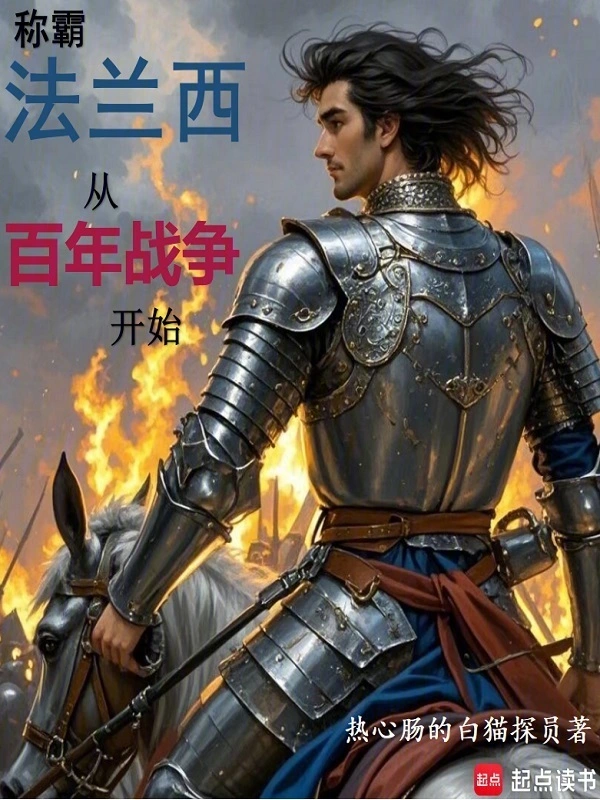
Dominating France Begins with the Hundred Years War
称霸法兰西从百年战争开始
- Status
- Ongoing
- Length
- 755k Words
- Genre
- Historical
- Audience
- Male
- Subgenre
- Foreign History
- Updated
- 1y ago
- Source
- Qidian
Stats
0Monthly votes
2.5kRecommends
4.4kFans
233Chapters
Tags
Synopsis
Reader comments
Readers also read
 Fu Ming 1627
 Red Mansion: Start Escaping and Farming from the Equipment Bar
 Northern Qi, Sage Khan
 After Lying in Bed for Three Years, He Was Forced to Help the Han Dynasty
 If You Are Already an Adventurer, Who Should Work Hard on Your Own?
 Start in the Middle Ages, on the Crusades
 Japan's Warring States Period: the Rise of the Wakasa Tiger
 The Artist Begins in Prison
 Traveling at the Same Time: Great Love to the Heavens
 Japan's Warring States Period: from Cannon Fodder to People of the World
 British Overlord
 Greece Recasts Rome
I hope it can break the stereotype of the French army.
After a brief look at the comment section, I basically still have a stereotype of the French army in the Hundred Years War. First, the French army was not always suppressed by the British army. The Hundred Years War did not really last for a hundred years, but was divided into four stages because of the time interval. The French army was suppressed by the English army in the first and third stages, and the second and fourth stages both counterattacked the British army. Second, the French army is not really good at it. Some people in the comment area said that the chivalry system was backward. Please, I think anyone who knows a little bit about the history of England should know that England also had a chivalry system at this time. Even England was engaged in cavalry operations in France. The French army was defeated in the first stage because Valois had just succeeded Capet, and the royal power was weak and the military system was chaotic. There was even King Carlos II of Navarre serving as the guide for the English, so they suffered a disastrous defeat. In the second stage, after Charles V reorganized his internal affairs, he led the French army to counterattack Edward and his son with a French army that had not fundamentally changed the military system. He basically drove them into the sea, leaving only a few broken ones in the French territory. The third stage was due to the fact that King Charles VI of France was suffering from physiological madness. Before he went mad, he had fought a beautiful battle in Flanders with a small number and defeated a large number. Even the English were worried that the French would come to kill them. The reason why Henry V won a great victory was because at this time the Burgundians and the Armagnacs were in a civil war, and France did not fully resist England. Third, in essence, Chinese netizens formed this stereotype because the world's right to speak is now in the hands of the British and American countries. They are naturally disgusted with France, so they crazily publicized clips from the Hundred Years War. I feel that since netizens hate the so-called "Angsa", they should at least not only know about Henry V, who almost became King of France, but not about Louis VIII, who actually went to London and was crowned King of England. Otherwise, he would just be living in Ansa's cultural hegemony. Hopefully the author can break this stereotype.
I hope that the protagonist can reverse the tragic situation in which France has been passively beaten during the Hundred Years War. There are few wars in human history in which social development is roughly equal, both sides are on the rise, but the war is one-sided. There were a total of three battles between the two kings, and the French army lost all of them. Not only did they lose, but they lost as much as they had money. This determined the fate of most of France's rich and beautiful lands and also established people's general impression of the French army in the Hundred Years War. The 116-year Hundred Years War was actually a style of "the British army is less than a thousand, and a thousand is invincible". France only gained the upper hand for about 10 years, and the rest suffered pain and humiliation. This is mainly because the British army only needs one or two battles to wipe out the elites of the French court, leaving France leaderless and divided, and then let them kill indiscriminately for more than ten years or even decades In the naval battle of Sluys in 1340, the French army 10,000 soldiers were lost, including at least 500 French nobles of knighthood and above. In 1346, the British army swept across the west coast of France and defeated the French army. They captured and killed nearly 1,000 French nobles of knighthood and above. There were more than 300 high-level prisoners of war transported back to England and imprisoned in England. Among them were 250 middle- and high-level aristocratic command members, including the commander of the French army who was killed in one regiment. In 1346, the British and French kings fought another decisive battle at Crecy. The French army lost 10,000 people, including 1,542 French nobles above knight level. France lost at least four counts, and also lost Duke Rudolf, the leader of the Duchy of Lorraine, and also lost King John of the Czech Republic who accompanied France in the battle. Fortunately, John's son escaped quickly and later became the Emperor of Holy Rome. In less than 5 years, France lost 3,000 military nobles, including a large number of castle owners, local governors and country squires. In the Battle of Poitiers in 1356, the French army once again had a clear advantage in numbers, and lessons were learned. The King of France even imitated the British professional army for military training, and installed stronger breastplates on the horses and knights, so that the knights no longer dared to rush. But in the stalemate stage, when the British army moved tactically, the French noble knights could not resist the temptation and rushed in without authorization, allowing their opponents to seize the opportunity. This time, the French king, prince, and marshal were all trapped and became prisoners of the British. 2,000 Nobles from the army commander-in-chief Gauthier to the Duke of Bourbon and above were killed in the battle. More than 2,000 nobles from knights and above were captured. Among the prisoners were 14 counts. The "golden flame" royal flag that symbolized the dignity of the king was also cut down. Six years after the Battle of Poitiers, the British Parliament passed a law to terminate the status of French as the national language in England. English became the official language again, and schools allowed British students to re-use the language of their motherland. 200 Years have passed since the Norman Conquest, and the English have finally regained their status as nationals and are no longer conquered. A large part of it lies in Norman--England has gained confidence and developed a common national identity. But France, which had been immersed in turmoil and pain for decades, finally reunited, avoided large-scale battles, and focused on fighting small and medium-sized British troops, consuming the British court's financial resources, regaining most of its lost territory, and ending the first phase of the Hundred Years' War. It can be said that from 1337 to 1380, the war between England and France was actually basically over. The restored central power of France put the British army, which had no advantage in population and resources, at a disadvantage again. The Hundred Years War should not have existed in history. The reason why the war burned in vain on the land of France for another forty years was purely due to the backwardness of the French army. After the death of Charles V, a mad king emerged in France, and the political arena was divided into a faction dominated by the Duke of Burgundy and another faction dominated by the nobles of Orleans. A civil war broke out, and the British army took advantage of the situation. Even so, the war could not last long, because under the centralized power of France, the strength gathered was stronger than that of the British army. The British army only had 10,000 people. At that time, the French army was not only large in number, but also united and had high morale. However, Britain has a more advanced and self-reforming army, while France is conservative and backward, and its military is stuck in its ways. Therefore, the command is still clumsy and rigid, and the knights are brave and foolhardy, once again fighting a one-sided massacre In this battle, France will lose the ability to fight back for at least the next twenty years. About 5,000 ordinary gentlemen and landowners were killed, 1,500 knights and first-class nobles were killed, nearly 100 barons and first-class nobles (at least 13 others were captured), 98 nobles above "Knights of the Square Banner", 8 counts, 3 dukes and even an archbishop (Archbishop of Sens). All the castle owners and rural landowners and knights in and around Agincourt were wiped out. Including the lords and their sons in the Agincourt area where the battlefield was located, there were a total of more than a dozen lords, large and small. Not only that, at least 12 of the 21 governors of other provinces were killed, including the governors of important regions such as Amiens, Rouen, Caen, Evreux, Macon, Mo, Senlis, Sens, and Mermandois. Among them, some consuls brought their sons and troops recruited from the areas under their jurisdiction to serve the royal court loyally and rushed to the battlefield. As a result, the regiment was wiped out and no one survived. In addition, the famous families in Artois, Picardy, Normandy, Pontio and other places were also wiped out. French Gendarmerie Commander Galois, French Navy Minister Jacques, and Crossbow Corps David were all killed. Most of the royal officials of the French court died in the war. Charles VI also lost 7 royal blood relatives. The French Chancellor and the Archbishop of Reims lost three brothers. The owner of Alvi Beville, who later hosted the Winter Olympics, lost 4 sons and a bunch of relatives, and his daughter became the sole heir of the family property. The French army also captured 2 dukes and 3 counts, including the leader of the Orleans faction, Duke Charles of Orleans, and Duke Jean of another wealthy Bourbon family. In addition, the French commander of this battle, Marshal Boucicaut, who was regarded as the perfect idol by the French noble knights, was also captured and later died in humiliation in a British cell. Such an unbearable loss only resulted in the death of a great nobleman, Edward, Duke of York, by the British army. The British army captured Paris in one fell swoop. You must know that the British army captured the French king and the prince in the first stage, but they had never achieved such results. The ransom extorted by the British and the endless wealth obtained from the advantageous situation made the British society rich even if Britain ultimately lost the Hundred Years War. A large number of churches, castles, and schools built on loot and ransom money sprung up in England. It can be said that since then, until today, no matter how many times France has defeated Britain, it has never been able to let Britain taste such a bitter pill.
Flanders map
Map
I haven't started reading it yet, but after reading the introduction, I can't even begin to figure out how a commoner in the Middle Ages could become the king of France. It is possible to become a duke in Italy by joining a mercenary group. Isn't France the most legalistic country? Civilian? One generation to be king? Europe is not in favor of "princes, generals, ministers, etc."
Please read it! Please recommend! Please kill me first!
Family members, if you don't chase me, I won't chase you! Where can I read new books? Come and read it, don't let this good book be buried, let's add new content to European history together! The battle begins right after time travel. The setting of multiple scenes and multiple characters makes it easy to dissuade readers. But I really wanted to write a more realistic story. Therefore, Carlo joined the war at the beginning. After all, whether it is a prince or a commoner, if you want to be recognized by everyone, going through the war and blooming with brilliance may be the fastest way! Now I have written about the process of farming! Readers who like farming can take advantage of it!
Long suite building
If you want to give an image to the character in your mind, you can write it here, and I will add it as appropriate. If it is a Western name, otherwise it would be too inconsistent. Someone can have a story, a nickname, a motto or something. Try not to be too perfect. Perfect people are rare after all. Please give me more.
What element do you most want to see?
Lord? War? I can read everyone's comments and decide what to write in detail in the second volume. In fact, I reviewed it carefully myself. I didn't write well from the canonization part to the love part of Mrs. Qiong. Maybe it's because of my own influence. Some people say that you have so little mental activity and that your action descriptions are too rough. Something made me a little confused, so I wasted too much writing energy on some meaningless details. I also studied how to use the force to swing the sword, but I didn't do much research to understand that it would not look good if I didn't explain it. So the plot is slow. There are many plots in the follow-up part of Mrs. Joan. I personally feel that the writing is okay emotionally. Then it's hard for me to comment on it myself. It involves excommunication and religion in Flanders, and uses a lot of words, which may make readers feel verbose. After that, it's the second volume. I feel that my second volume has started to be polished differently, and from my perspective, I have begun to compete for hegemony.
There is no system. At the beginning, you are just a little person involved in the war.
The history of the Hundred Years' War is truly magnificent, and its excitement is beyond words. If readers are interested in the subject matter I write about, feel free to read it. Since I am determined to create a work without a "systematic" setting, I will inevitably start from a true and reliable historical background and dig deep into various historical materials and related information. I will go all out to carefully carve out every plot and every character, and strive to present this period of history to readers in the most authentic way, so that everyone can deeply feel the unique charm contained in the history of the Hundred Years' War, as if traveling through time and space, and being in an era where wars were raging and heroes emerged in large numbers.
If the protagonist really wants to be a king...
Sorry, I'm just giving a few suggestions, I don't dare to advise the author. First of all, if the protagonist really wants to be the king, he can replicate Hugo Capet's Frankish king selection system. Don't get into the trap of marrying a princess to inherit, otherwise the French army will become a clown. After all, female line inheritance really exists. Secondly, it is better not to call him "Carlo". Although "Carlo" and "Charlie" are the same word, French translations generally do not translate it into "Carlo", but Italians prefer to translate it this way.
Young Carlo on the battlefield
Carlo
New book? !
It's coming, update soon 😃
Fan
Come, come, white cat, I'm going to read your new book. I'm optimistic about you.
White Cat I came from another book of yours. Your pace seems a bit slow. Can you start farming and development quickly? I've read more than ten chapters and I'm still fighting 😭
Some thoughts on the ending
In fact, I personally think that if the protagonist can, he may still have a chance to establish the land of Charlemagne's period, click on the decision to rebuild the Frankish Empire 😎
It's been a month. When will the author resume updating?
How is your friend's health doing?