


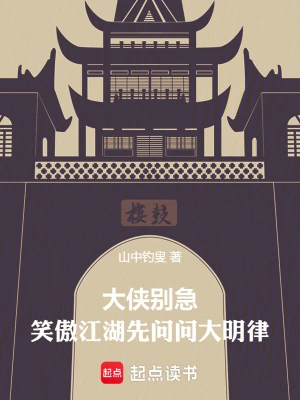
Hero, Don’t Rush. Let’s See What the Great Ming Law Says About The Smiling, Proud Wanderer
大侠别急,笑傲江湖先问问大明律
- Status
- Ongoing
- Length
- 1.4M Words
- Genre
- Martial Arts
- Subgenre
- Wuxia Fan Fiction
- Updated
- 1y ago
- Source
- Qidian
Stats
412Chapters
13Votes
14.3kRecs
56.6kFans
Tags
Honours
Synopsis
More by this author
In booklists 2
A Happy Shut-In's Reading List
Selection criteria: enjoyable novels with enough satisfying moments and a strong update pace; slice-of-life novels with steadily progressing plots and a warm atmosphere; and traditional novels that focus on telling a complete and coherent story. The standard for inclusion and evaluation is simple: I like them!
64Books36Follows1yUpdated

Sci-Fi Fan Fiction, Mystery and Detective Fiction, Cultivation, and Sandbox Worldbuilding
I only recommend ongoing books that seem pretty good.
34Books140Follows1yUpdated
Readers also read
 Martial Arts Adventures Begin with The Heaven Sword and Dragon Saber
 Hardship Realm: One Trait a Year
 I Made My Name Across the Heavens by Stealing Li Mochou’s Chance
 My Million Ways to Die in the Wuxia World
 Simultaneous Transmigration: Is Everyone Starting Out in Prison?
 My Master Is Guo Jing
 How Can You Be a Traitor Without Money?
 A Great Industrial Nation, Starting with a Fake Student Abroad
 A Dual Status Panel Descends into the Abyss, and the Assassin's Potion Is Right at the Entrance
 The Fierce Minister of the Great Song
 How Grand Is the Adviser!
 Qiao Feng Transmigrates into Linghu Chong from The Smiling, Proud Wanderer
 Mr. Kongming Goes to Exorcise Demons
Reader comments 26
Google Translate
Based on history, Chief Yu single-handedly singled out Shaolin. The Qi Family Army formed a military formation. To put it bluntly, the Wudang Shaolin Demon Sect is a mess of sects. If you face a thousand Qi Family Army, one or two Qi Family Army should be exhausted to death. Qi Jiajun can kill thousands of enemies and suffer single-digit losses in his battle against Japanese rogue samurai.
Four different feelings You can say that he pays attention to the real history. People in the Ming Dynasty used to say "adult" one by one. It really makes me want to laugh when I hear it. In fact, this title only began to be abused in the middle of the Qing Dynasty. Officials as big as sesame seeds and mung beans can be called "adults". Prior to this, shouting was not allowed, either when it was an occasion of extreme humility, such as when the leader of a defeated army knelt down and begged for surrender, you could use the title of the opponent's commander in the letter of surrender; or someone who was highly respected and had great achievements could be addressed as "Sir"; even if you were really shy and flattering the superior officer, according to the practice of the Ming Dynasty, you would just call him "Sir, Sir" and this must be at least an official of the level of Jiuqing. If you really call someone "Sir" when you see an official, it's like you enter a government building and you catch someone and call him the chief. If you dare to call him, do you think he has the nerve to agree to you? You can say that he is imaginary. He often mixes in some historical records of the Ming Dynasty, trying to rely on historical texts, and trying to "sew" the characters in Xiaoao into the background of the Ming Dynasty. However, the original work of the martial arts novel deliberately blurred the existence of the ruling class in the feudal dynasty. Otherwise, the plot will not progress at all, and there will be many bugs in this stitching Overall, it looks a bit nondescript, tasteless and a pity to throw away.
The setting is good, but the foreshadowing is too long-winded. It's just long-winded. The author has decided whether to write a fan martial arts novel or a historical novel. You can randomly pop up a new character here, and randomly pop up a new character. The look and feel is very fragmented.
An author who amuses himself. It's a very good new routine about officials governing the world. It would definitely look better if it were written in a more humorous and refreshing way. I can't stand it if I have to write an article like Zou Zou's lecture on popular science.
Martial arts and officialdom have always been two paths. Even if there is an intersection in some novels, such as Tian Long Ba Bu, the connection is very weak. The officialdom is just the background, because the martial arts in the novels are fake, but the history is true. Unless it is imaginary, there will be too many logical and common sense problems, because if there is true internal martial arts, the most powerful should not be the sect, but the ruler.
If these points offend you, I sincerely advise you to withdraw.
1. When officials in the past dynasties lost their official seals, they generally chose not to make it public and find ways to find it privately. If you say that those who steal the seal will be severely punished, then what if you can't even protect the official seal yourself? 2. In Three Heroes and Five Righteousness or Bao Gong's case, Bai Yutang steals the Three Treasures. In the adapted TV series, Bai Yutang steals the seal of Kaifeng Mansion. So if Bao Zheng doesn't punish him, is it because he is not selfless enough? 3. When facing Lin Pingzhi before, and now facing Yue Lingshan, the protagonist intervenes in an official way, not for punishment. If you think it's such a double standard: I suggest you don't read any further. If you think that because you have given this title to your book, you should be killed and imprisoned, I suggest you not read further. If you think so, I just think the protagonist should fight his way through. Sorry, this book is not your type either. If you say that this history is not historical and martial arts is not martial arts, I suggest you find Qidian to complain, or complain to Qidian. If not, please be kinder and more tolerant. I sincerely advise you to quit, and it is good for both you and the author.
I feel like the author wrote the book for himself.
I saw someone discussing the fight between martial arts people and the military. However, martial arts people do not need to fight the army to fight against the imperial court. They only need to fight logistical wars and public security wars. And some people mentioned a million-armored army... Nurhaci only had 18 pieces of armor when he started, and dispatched 10,000 armored soldiers to capture martial arts masters for a long time. Not to mention whether they could catch martial arts masters, the logistics alone would have to drag down the local finance. Everyone overestimated the economic level, logistics capabilities, and mobilization capabilities of the feudal country. There is no need to assassinate the emperor. If a martial arts master like Ouyang Feng has been killing county magistrates for a long time, how will the court send troops to protect these low-level officials? Even if there are experts in the field, can each county magistrate be assigned at least one? In this long-term logistics and security war, a Wujue level leader with several deputies can defeat the basic administrative power of the feudal dynasty without the interference of other masters of the same level. You don't even need to kill the county magistrate, you just need to purposefully set fire to the granaries in various places, intercept and kill the local postmen delivering messages to the central government, and destroy the autumn harvest, which can cause a lot of trouble to the court. As for kidnapping and assassinating the family members of senior officials, coercing senior officials to do things for themselves or not to serve the court wholeheartedly are more troublesome methods. As for the terrorist actions, anti-national actions, and actions that undermine the private economy, such as releasing large quantities of corpses into water sources to cause a plague to break out in a certain place, harassing, attacking and intercepting teams transporting food and wages for the border army, and controlling green forest bandits and water bandits to plunder the waterways and land routes of various merchants, there is no need to mention these actions. Huang Yaoshi in the Condor Shooting can do the above. He has a group of apprentices who are at least second-rate or third-rate. Among his apprentices are Lu Chengfeng, the general manager of the 18th Green Forest Road, and Mei Chaofeng, who has close contacts with the enemy's high-level officials. If there are no masters of similar level like Hong Qigong and Zhou Botong to restrain him, it would be too easy to cause huge damage to the Song Dynasty.
It feels a bit pity, but the core of the story is still very interesting, and it has a certain degree of research on history and the original novel. However, the writing style is a bit too jerky and cumbersome, and the writing style does not fall where it should. It seems to be the same "blank space" as in traditional martial arts novels, but it also hides too crucial information and makes it incoherent, leaving readers to infer. Perhaps, this ingenious way of writing makes a short novella a masterpiece, but I don't think it is suitable for such a long online article - it is too tiring to read. It's not very friendly to readers who didn't follow it from the beginning. Moreover, the story itself lacks a breaking point. In the middle period, it feels like the majestic Five Mountains and the vast rivers and lakes, playing house with the protagonist here, and listening to the protagonist's far-fetched nonsense here. Perhaps, this is indeed one side of Jianghu, but the other side of "pleasure and grudges" is even more eye-catching.
What's wrong with copying Jin Baoyi's book? He can beautify his traitorous ancestors into patriotic heroes. In the early years, he also worked as a dog for the British and took advantage of the United Front.