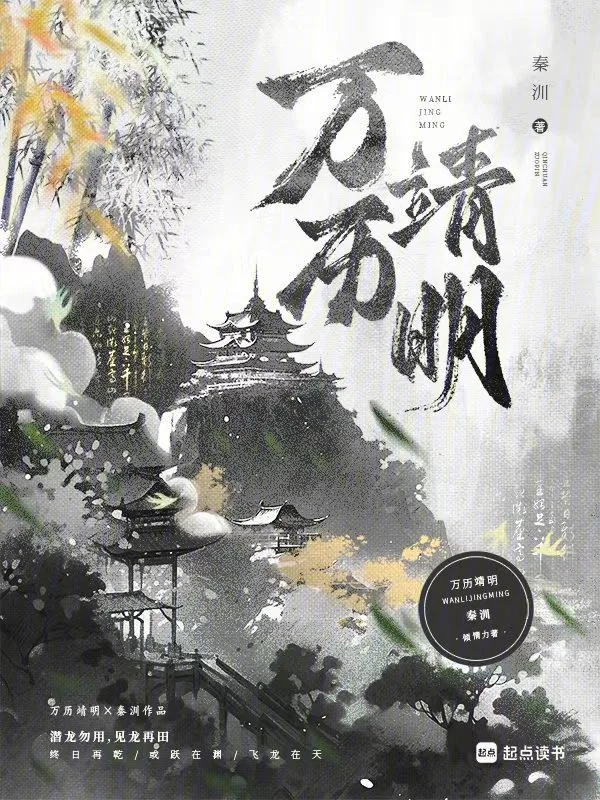
Wanli Jingming
万历靖明
- Status
- Ongoing
- Length
- 659k Words
- Genre
- Historical
- Audience
- Male
- Subgenre
- Song-Yuan-Ming Dynasties
- Updated
- 7d ago
- Source
- Qidian
Stats
48Monthly votes
2.3kRecommends
3.9kFans
228Chapters
Tags
Synopsis
Reader comments
In booklists 1
Readers also read
 After Lying in Bed for Three Years, He Was Forced to Help the Han Dynasty
 Fu Ming 1627
 Red Mansion: Start Escaping and Farming from the Equipment Bar
 Northern Qi, Sage Khan
 Siheyuan: Start by Picking up Attributes
 Taichang Daming
 Daming: I, Zhengde, Am the Taoist Emperor!
 Immortal Who Seizes the Body
 Devouring the Starry Sky: Infinite Opportunities to Hoard Treasures at the Beginning
 Jiajing Mingjun
 I Want to Revive the Tang Dynasty!
 I Am Song Shizu
The author fulfilled my dream of becoming an emperor😏
In addition to natural and man-made disasters, the biggest problem in the late Ming Dynasty was internal and external difficulties, and these actually interacted with each other. One of the natural disasters was the Little Ice Age. The long-term drought not only greatly devastated the agricultural production activities in the hinterland of the Central Plains, but also hardened and flattened the land in the Northeast Plain, which was originally covered with swampy mudlands, allowing the formation of large-scale pastures. The Jurchens began to transform from a fishing and hunting nation to a half-fishing and half-herding horseback riding nation, and finally formed the freak of the Manchu Qing Dynasty. Man-made disasters are party disputes. Qi, Chu, Zhejiang, Kunming, Xuan and other parties were originally just small fights with different political opinions. However, under Jiajing's deliberate indulgence, they gradually evolved into bloody fights between the same parties and against different parties, which greatly consumed the national power. Internal difficulties, because of the excellent national defense policy of the Ming Dynasty, most areas in the mainland were protected from military disasters. Coupled with the development of the commodity economy, the degree of social atomization in the late Ming Dynasty was extremely high, and it was difficult to carry out large-scale social mobilization like the early Ming Dynasty. (The Weisuo system was actually still operating well until Wanli's later years, and there was a steady stream of people. The Ming Empire provided excellent mid-level and high-level generals) External difficulties, many people know about the above, and they are just the same old tune, but external difficulties, I think many people don't understand, or can't imagine, it is the impact of the Age of Discovery. As the most important trading body in the Age of Discovery, China has never actively participated, but it has always been deeply affected. A very important plan for Zhang Juzheng's reform was to change the original physical tax to a silver currency tax. China has been a silver-poor country since ancient times. The huge demand for silver monetization cannot be met by China's own production of silver alone. The discovery of the new world and the rise of Eastern trade allowed China, as the terminal of the Eastern Sea Route, to obtain huge amounts of silver from the Americas. This was the economic basis for Zhang Juzheng's reform. At the end of the 16th century, the Anglo-Spanish War broke out, the Eastern sea route was cut off, and it was difficult for American silver to enter China. The silver shortage began. The most direct result was the difficulty in collecting taxes and the sharp decline in central fiscal revenue. (Many people like to attribute the financial difficulties in the late Ming Dynasty to the tax evasion and resistance of the gentry and landlords and the corruption of officials. It is undeniable that these reasons are true, but the more important reason is that there is really no silver, and it is difficult to pay taxes even if you have money and food)
Questions about finances
The Ming Dynasty established the silver standard in the hands of Zhang Juzheng, and the silver in the Ming Dynasty was all in the hands of the gentry. People had to exchange things for silver to pay taxes, so this was a policy for the poor. If you want the people not to live too miserably and revolt everywhere, you must not let Zhang Juzheng implement this policy. You can pay taxes in kind or in copper coins. The Ming Dynasty died in Wanli, thanks to Zhang Juzheng. So if you want the Ming Dynasty to be strong, you must abolish the silver standard. Or find ways to increase the amount of silver in circulation. Think about the Chongzhen period, when Li Zicheng copied tens of millions of silver from officials and eunuchs, and think about whose hands the silver was.
Why the change? As for the system of the Ming Dynasty, it was basically sufficient for the operation of the feudal dynasty. The real problems were nothing more than annexation, the corruption of the salt administration, shipping, and the clan. The solution was nothing more than official governance. Reform was too difficult. As long as the original system was implemented, it was enough to defeat everyone around it.
Encourage authors
The author is a newcomer to L1. Among some newcomers, it is already very good to write like this, especially a traditional historical article without a system. It is encouraging, keep up the good work! Take your time, every famous author gets through it step by step!
Wanli Mingjun's crimes were so heinous that the rest of them were tasteless after reading them, forcing readers to write the articles themselves.
Don't just change this or that right away. Reform is a long process.
Has the potential to keep fire🔥
The story is very graphic, the characters are clearly drawn, and it can be explosive.
In the sixth year of Longqing's reign, there were basically no Japanese plagues, but the southwest became lively. Burma directly dominated Yunnan for ten years and seemed to be in an uninhabited land. It was not until Jiangling's death that he was defeated by the Ming army in southern Sichuan and returned home.
Is it necessary to have dark and high arches? Can you check the history? The novel is not nonsense Gao Gong is not a corrupt official. Gao Gong served as the chief minister of the cabinet during the Longqing period of the Ming Dynasty. He was committed to rectifying officialdom and fighting corruption. In the first year after he took office, he handled an average of nearly three major corruption cases every month, and brought 169 officials to justice. Gao Gong has also taken a series of measures to prevent and punish corruption: -Establishing official files: Officials with grades below the third level across the country are required to establish a "book", which records in detail the official's quality, political achievements, hometown address and folk reputation, etc., And is updated monthly. This not only provides accurate navigation for anti-corruption, but also forms effective supervision of officials, because the register also arranges "substitute officials" for officials in critical positions. Once the "main officials" have problems, the "substitute officials" can immediately take over, thereby warning officials not to act recklessly. - Implement recommendation and continuous sitting: It is stipulated that recommended officials must be held accountable. If the recommended person is incompetent after taking office, the recommender will sit together. This measure effectively curbed the unhealthy trend of abuse in official circles. - Strict pursuit of stolen goods: He changed the previous rule that the worst form of corruption for officials was to cut off their posts for the people and not to immove their property, and implemented "the corrupt still ask questions to recover the stolen goods." Under his governance, the corruption trend that had become increasingly fierce since the Jiajing period of the Ming Dynasty was effectively curbed in the last three years of the Longqing period, and a good situation of "a temporary cleanup of officialdom" emerged. To sum up, Gao Gong is an official who vigorously combats corruption and purges officialdom, not a corrupt official.
Zhang Juzheng
I hope that the supporting role of Zhang Juzheng can be written in a more three-dimensional way. As the first prime minister of the Ming Dynasty, his character is very complicated. But it is undeniable that he is a young genius reformer. What he really wants to save the Ming Dynasty is not just for power. He regards the emperor as his political heir, and hopes to write more about the master-apprentice relationship with the emperor, so that master and apprentice can work together. I always feel that he is the best choice at this time and hope to give him a good result.
The point you chose is too far forward. I started writing about Wanli from Longqing, so I think there is a greater possibility of being cheated.
The supporting characters of this era are also outstanding. Zhang Juzheng is not known as the first prime minister of the Ming Dynasty for a reason. I hope to write this character in a more three-dimensional way, and also write about the relationship between the male protagonist and his master and apprentice. I always feel that as a reformer and a young genius, there should be a good result. After all, he is also an idealistic reformer. He who really wants to extend his life for the Ming Dynasty, and gathers power in order to do things. I hope the author can show this person in all aspects.
Seeking pursuit of reading, nourishing books to support one's death
Please read every Tuesday! Now I only look at follow-up reading, and if you follow-up, you will get recommendations. If you don't follow-up, you can only code on a single computer. People who code on a single computer do it purely for love, and it is difficult to stick to it! The latest chapter, just read it and stay for 30 seconds. Everyone should read it and keep reading! Thank you everyone
Alas, I'm a little tired of watching it. Wanli is basically acting, and the mother is kind and the son is filial. If you don't understand and she's not my mother, why don't you just rebel against Tiangang? Win at the lowest cost?
The author's writing skills are very strong, and the pictures are very immersive. I wish I could write more.
Idiom Solitaire Game
Is there no one playing Idiom Solitaire in this book? Did any of you participate? I'll throw it around first, then I'll be able to move freely
The author writes about officialdom games very well! Comparing the scene in "The Late Ming Dynasty" when Wei Zhongxian was frightened when he picked up the "History of the Ming Dynasty", the sense of historical dislocation exploded.
In fact, the Ming Dynasty did not produce silver, but Zhang Juzheng introduced the "silver standard". This was very embarrassing because the right to mint coins was not in his hands. But it doesn't matter much. The minting power of the Ming Dynasty has long been destroyed by several generations of emperors after the founding of the People's Republic of China. Officials and ordinary people do not believe in the Ming Dynasty treasure banknotes.
Are all Wanli books like this? !
The author is really a good slave, but the author is a pure fan?
Update quickly! I voted! ! ! ! !
Good thing, the updates for readers are too slow, so I wrote my own book
Wanli Mingjun is a good example. If it is well written, the readers of that book can largely become the basic readers of this book In addition, I hope the author can also refer to it, Xinshun 1730😁
Why are you discontinuing the update now? Brother, even though the ads are out, why don't you start writing!
Is it a eunuch? I won't watch it if I haven't watched the eunuch yet.
The beginning is pretty good
The beginning is pretty good. The old man is not dead yet, and there is still some time to establish prestige and take over the old man's legacy. Not so tight on time.
Eunuch
I haven't started watching it yet. If it's eunuch, we won't watch it.