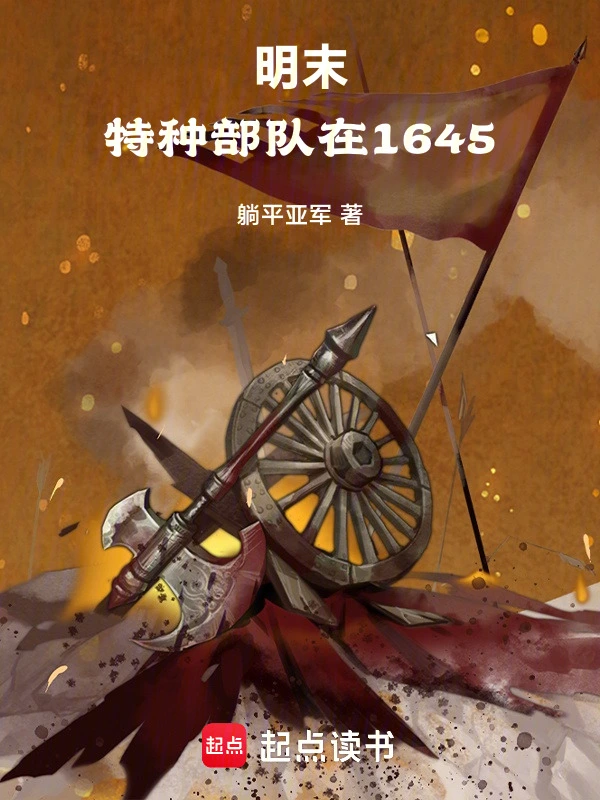
Late Ming Dynasty: Special Forces in 1645
明末:特种部队在1645
- Status
- Ongoing
- Length
- 831k Words
- Genre
- Historical
- Audience
- Male
- Subgenre
- Qing & Republican Era
- Updated
- 4mo ago
- Source
- Qidian
Stats
0Monthly votes
6kRecommends
14.9kFans
357Chapters
Tags
Synopsis
Reader comments
Readers also read
 Red Mansion: Start Escaping and Farming from the Equipment Bar
 After Lying in Bed for Three Years, He Was Forced to Help the Han Dynasty
 Northern Qi, Sage Khan
 Fu Ming 1627
 Northern Song Dynasty: Spoiler of the Future, Zhao Kuangyin Collapsed
 Traveling Through the Ming Dynasty: I Can Receive Modern Supplies
 The Wind Rises in North America 1625
 Anti-Japanese War: Rebuilding the Mountains and Rivers
 Farmhouse Letong Passed Through Ancient Times and Received Liu Guanzhang at the Beginning
 Traveling Through 1570: the Rise of South America
 Destroy the Qing Dynasty
 Giant Ship Heng Song: My Supplies Come from the Motherland
They are all self-trained armies. They can just use modern squads, platoons, companies, battalions, regiments, brigades and divisions. They are not recruiting old officers. They need to consider adapting to the old officers. They are all officers trained by themselves. The trained officers are also rookies. They do not need to be influenced by the old army at all. Even if they are recruiting old officers from the old army, they must be retrained, disrupted and reorganized, and they cannot use the titles of old officers.
Without advanced firearms, chariot camps would have to be built to deal with the Qing army. A simple phalanx of spears could not withstand the Qing cavalry.
Try to make good use of thermal weapons
Establish and train cold weapon troops, and when facing the enemy, try to use hot weapons to kill the opponent's generals. The enemy will be confused and morale will drop, and then the cold weapon troops will be enough. The bullets of such thermal weapons may last for a long time.
After seeing dozens of chapters, let me say a few words.
The author should believe in the inviolability of private property. In Chapter 40, the protagonist made it clear that land reform should be based on redemption, which is what Chiang Kai-shek did in TW. In fact, there are many methods, and these landlords are particularly dirty. Chiang directly used the national development stocks issued by the government as payment to force the purchase. The payment method used by the protagonist is not mentioned, nor is it said about the issuance of banknotes. The default is gold and silver and other precious metals (this will definitely not be enough money). This is gentler than Chiang. The foundation of the agricultural economy has not changed at all. It can be seen from this that the author should unite the gentry forces, build an enhanced version of Tsarist Russia, and happily suck blood from the poor tenants 🙂. In the following chapters, the plot kills several big businessmen who are looking for s. Will those big businessmen who are honest and not against the protagonist not be killed?
Those who traveled through the past were not the special forces, but the chatter brigade. He chattered a lot of nonsense during the battle. Did time stop while he was talking?
Eight modern people traveled together 🤫 This is like Columbus discovering the New World. As long as you have a little historical knowledge, you can thrive in this era 🪖 Don't underestimate human nature. Even soldiers with strong team spirit cannot resist the fatal temptation. 😎In the end, they fought against each other for their own interests and fell apart; a cohesive team has its own plans when it comes to individuals, 🤓I don't believe that these eight soldiers can work together as one ❤️Always maintain the original intention until the end in the face of complicated interest entanglements. 😏According to the darkness of human nature, I dare to assert that these eight people will eventually plot against each other in the face of various temptations and interests 🔪🔪🔪
There were 350 major uprisings during the Hongwu period. According to statistics from scholars, there were as many as 411 uprisings in the 60 years since the founding of the Ming Dynasty, with the number of uprisings during the Hongwu period being particularly frequent. There are already many stories about the protagonists rebelling in the early Qing Dynasty, including the Kangxi Dynasty and the Yongzheng Dynasty. It would be interesting to write a book in which the protagonist rebelled during the Hongwu Year of the Ming Dynasty or the Kublai Khan to Yuan Dynasty of the Yuan Dynasty.
The military system is copied mechanically. This is in line with the development of weapons. Even skirmishing formations have not been developed. The protagonist's army is still a cold weapon and uses modern military systems. The author should read more military knowledge to understand why the modern army has a three-three system.
The last time I saw a book like this was almost twenty years ago. Time travel had just become popular, and a battalion brought a captured weapons production line.
Just snipe and kill the opponent's generals every time you fight.
After reading Lingao Qiming, I feel childish when reading any time-travel novel. I won't talk about the ancient dialects, but just say that the protagonist and his group go to Li Zicheng to ask for soldiers. How to ensure that among the people they want, there are no informants planted by Li Zicheng? If they obey you on the surface, they may poison or attack you after you relax your vigilance. This is a potential risk. The best way is to recruit people from the rescued village, and use the village as a base to spread ideas and enlightenment, so that you will have a steady stream of new ideas and people who will firmly support you.
I have subscribed to most of them, but I haven't read the latest 20 or 30 chapters. How can I put it, it's good to watch, but it feels like it's all about military warfare. It doesn't feel like there is much content about people's livelihood, economy, and internal affairs from a personal perspective.
The big boys in Hong Kong movies all fought in the Vietnam War😅😅😅 Eight brothers all want to be emperors
Too wordy
Where does the mercy come from on the battlefield? There is only victory on the battlefield, and there are only friends and foes on the battlefield. There is no victory on the battlefield, there is nothing, and there is no mercy.
The author is great
There is something wrong. Do not attack the local tyrants to divide their fields: the scholars are all big landowners. There must be millions in the late Ming Dynasty: there are not 100 million people in the late Ming Dynasty: those who know how to read are all big landowners: don't write too tightly and march too fast: a province can be conquered in half a month: write slowly: write in the early stage of the Ming Dynasty, enter Sichuan to close the door and divide the land to the local tyrants. In actual control of the province, if there is grain and steel industry in a few years, two or three provinces can be conquered:
The King of Soldiers?
Ordinary soldiers are enough, if it's too high, you can't control it.
I haven't read it yet, but I'm curious as to what national route the army will take after the army breaks through. Is it a feudal monarchy? Constitutional monarchy? Capitalist democratic republic? Socialism?
Why are updates becoming less and less effective?
Did Shennong taste the herbs? Poisonous or not?
If you can't write anymore, just become a eunuch. 🥵
I'm not telling you, the update speed can't be any slower.
Everyone is here to help the author write the ending. I will start by giving some ideas.
It has not been updated for more than a month. Let me write an ending. The protagonist suddenly obtains a nuclear missile system, boom boom boom, destroys all opponents, and then loses them all.
There are a few places that are not very good
The first one is to let Emperor Longwu of Nanming gain strength. This is wrong. He must either get it into his hands or assassinate him. He cannot raise him. The second one should accept surrender properly. He cannot just kill people after killing them. War years are definitely unavoidable.