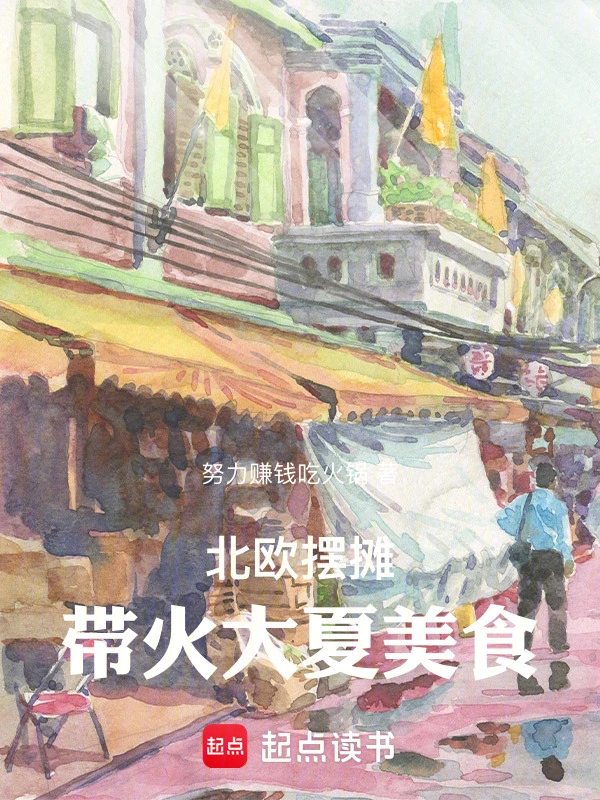
Nordic Stalls, Bringing Hot Summer Food
北欧摆摊,带火大夏美食
- Status
- Completed
- Length
- 1.7M Words
- Genre
- Urban
- Audience
- Male
- Subgenre
- Urban Life
- Updated
- 1y ago
- Source
- Qidian
Stats
0Monthly votes
14.5kRecommends
37.1kFans
566Chapters
Tags
Synopsis
Reader comments
Readers also read
 Is There Any Limit to This Engineer's Military Research and Development?
 1979 Once Upon a Time in the Northwest
 Peninsula: the Insomniac Artist Is Connected
 What Do You Mean I Am a Warmonger!
 Never Walk Alone!
 What? Huaiyang Cuisine Is Gone?
 Live Broadcast: I Am an Upright Chinese Medicine Practitioner, and All My Patients Died Online
 Daming: Have I Become Wanli's Portable Grandfather?
 I Am Drawing a Hot-Blooded Episode in the Zhiyu Episode!
 Who Asked Him to Be a Cook?
 Wilderness Survival: Starting from the Awakening Druid System
 Datang: Fishing in the Imperial Dining Room Was Exposed by Si Zi
 Food: Randomly Contracted, the Diners Were Driven Crazy by Me
 The American Chef God Started Living Alone in the Wilderness
 North America 1980, Starting from Inheriting a Small Restaurant
A place of water and soil supports a person.
The soil and water support the people, and the Jincheng saying goes to the people of Jincheng. People are strong... Sorry, I got offended. As far as I know, foreigners in Europe and America don't like Chinese food. Americans like sweet things, but I don't know about Europeans' taste. Japan and Korea will make changes when they introduce our food. A place where water and soil support a person is not an empty talk. There is no Chinese restaurant that has survived abroad without making changes. Making the food more suitable for local tastes is a necessary process. Aren't we also not used to eating foreign food? Why do you think foreigners will definitely like to eat authentic Chinese food? Do you rely on lust? There are eight major cuisines in China! The taste of food will be different in each place. Take the Changsha stinky tofu as an example. Wasn't there a popular video before? Some people said that the boss's stinky tofu was not authentic, so they bought the boss's stinky tofu and traveled to Changsha to feed the locals to eat it. However, it was also said to be unauthentic. Why can the stinky tofu seller survive in their local area? Is it authentic? No, Changsha stinky tofu is sold in various places, and the taste of each place is different. The land of China is like this, let alone the world?
Fortunately, I have been to Europe, otherwise I would have been brought in by you.
Nowadays, the delicacies in Europe and the United States are all tasteless, and you are..., You are also drunk😵💫
There is no end to the nonsense. If you have such skills, you would already have opened your own restaurant, and you still work as a sous chef? Wouldn't it be nice to be your own boss? The end of working abroad is to open your own shop and become your own boss.
After reading the previous ten chapters, I went to Baidu to look at the status of Chinese food in the world. Basically, it has been localized to suit local tastes. Popular tastes include sweet and sour, as well as salty food. I find it strange that so many people love eating Roujiamo from the beginning, because I don't have a unique feeling about Roujiamo. Living in Beijing, my taste is a bit mixed. I have been out several times. I have been to Shanxi to eat noodles with vinegar, to Shandong, Yunnan, and Hubei. I really feel that each place has its own taste. It is recommended to add some magic modifications to make the system more immersive.
Putting aside the facts, you can watch
The writing is so ideal. The author brought the environment to China. I suggest you check more information.
Anyone who has been abroad knows that the dishes cooked by many famous Chinese restaurants in foreign countries are not authentic. Why not authentic? Because authentic Chinese food is not popular, more than 95% of Chinese restaurants abroad are modified according to the taste of foreigners. They are not what you imagine at all.
A bunch of people who have never been abroad say that foreigners don't like Chinese food
My undergraduate and postgraduate studies were in Sydney (Australia) and Toronto (Canada). Less than 7 years in total. Let me talk about my observations: 1. General: The vast majority of foreigners like Chinese food. 2. Comment 1: When they first came into contact with Chinese food, they didn't quite understand the big dishes, such as sea cucumbers roasted with green onions and nine-turn large intestines. This requires long-term adaptation and cultural accumulation. 3, Comment 2: But they understand that there is no threshold for snacks and home-cooked meals. For example, sesame seed cakes, garlic scallops, bombed squid, Cantonese morning tea, pork slices, ground delicacies, etc. 4, Branch 3: Due to limitations in raw materials and differences in taste, restaurants opened by the previous generation will be improved. 5. Comment 4: But the new generation of Chinese restaurants are not much different from those in China. Even the spicy Hunan cuisine is eaten by many foreigners. 6. Summary: There is only the difference between delicious and not delicious. Imagine that there are pizza, Vietnamese pho, Middle Eastern barbecue, Chinese restaurants, and Japanese noodle shops on the street. As long as it tastes good, people will come to eat it. But why do you think Chinese restaurants can't compete? I just read the description in the book. There are too many details, which reflects two points: on the one hand, he does not understand the habits of foreigners, and on the other hand, the author has never opened a restaurant. Of course, these two points I mentioned are also false propositions. This book would be very boring if it were about the real behavior of foreigners. If you write about the daily life of real foreign restaurants, it will directly become a business novel. So, the correct way to eat is to only look at how the food is cooked, and the rest is purely fictional and necessary for the plot. I won't be surprised if one day customers start flying after finishing their food.
These comments all sound sick If a Chinese food novel doesn't write about how foreigners like Chinese food, why should it write about Chinese chefs who died of poverty in foreign countries because no one could eat the food they cooked?
I remember that I came across a foreign blogger a while ago. He said that by posting delicious Chinese food and Chinese beef batches, he would get traffic and then make money.
In the profile, you don't even have the title of head chef? Are you happy if someone else gives you the sous chef?
You can't even dream of being that low, how can others see it? It feels like an ordinary chef originally worked in an ordinary restaurant, but then a golden finger was promoted to a chef and went to set up a stall. Then the protagonist's identity is revealed, and the restaurant's head chef offers to give you the sous chef, and then the protagonist happily works there. . . No sense of substitution. Don't talk about opening a restaurant alone, continue to set up stalls. . . Even if you go back, the head chef won't give it?
Even domestic Sichuan cuisine has to be adjusted according to the different tastes of different places. Do you really think that Chinese food will not be adjusted when it goes abroad? The author is so naive!
? ? ? Don't you know that if you work a second job part-time in Europe, you have to pay more than 50% in taxes? Setting up a stall is a second job. If you earn 10,000, you have to give 6,000 to 7,000 to the local government. How can you really do this 6
If you want to set up a stall in Northern Europe, are you sure the police won't come after you?
I saw chapter 260 and couldn't stand it any longer. These ten or so chapters are a bit outrageous, and the author is also an outrageous thing. What did he write? How many foreigners shared a single room for nine people just to eat fried dough stick rice balls? What are you talking about? Anyway, the hotel facilities are okay. Have a party and enjoy it. Then you turn to the front desk and say that it can only be used by one person. What do you want to express? An issue about hotel room prices is spread out in two or three chapters, and I guess I won't be able to continue reading it later. The novels I have been looking for recently are all seedlings, and there is nothing to read at the moment. You can still read the front of this book and pick it up when it is on the shelf. There are more than 200 chapters that you can skip directly at the hotel, but the writing there is messy.
I don't know what the taste is in Europe and the United States. Anyway, Chinese restaurants in Japan are quite expensive (not the improved ones). Japan is said to have a clean mouth, but it turns out that Northeastern cuisine is also quite good (Northeastern cuisine is heavy in oil and salt, and the boss is from Jilin). I can only say that everyone in the comment area should not blindly emphasize that the other country will not like it. The other country still has diners with different tastes... Of course, sweetness is definitely there, at least Japanese sweet foods are generally not rejected by Japanese people. I have read that the author has been working in Europe for several years, so he must know more about Europe than me. I don't need any guidance from someone who has never been there. I hope I can practice my writing skills well. This is important.
It's so funny. Foreigners can't get used to Chinese food, unless they are foreigners who have lived in China all year round.
Whether foreigners like Chinese food or not is a false proposition!
In fact, I find it funny that these people are discussing whether foreigners like to eat Chinese food. First of all, Chinese food itself is not a single category. There are eight famous and inherited cuisines, not to mention the endless supply of self-derived fast food snacks in the streets and alleys. I believe if you search carefully, you will definitely be able to find something with similar food tastes to other countries! Like Xinjiang hand-picked rice, Northeast stew, large sausages, braised pork and so on! Not to mention those who pay attention to beautiful presentation! It can be said that there are thousands of dishes that are always in line with the tastes of so-called foreigners! Secondly, the term foreigner itself is not rigorous. Are Japan, South Korea, Vietnam, Singapore and other Chinese cultural radiation areas considered foreigners? In a narrow sense, European and American white people are themselves a multi-national and multi-ethnic group, and their internal tastes vary greatly, not to mention the immigrant and fusion tastes of Americans! Even if the popular tastes in different countries are divided into sweet, spicy, sour, carnivorous, vegetarian, light, etc., Are there no equivalents for the major Chinese cuisines? It can only be said that foreigners coming to China temporarily, or Chinese people opening restaurants abroad for the first time, may not necessarily be able to find dishes that suit the tastes of diners right away! Just like when you live in a certain place for a long time, you will always find food that suits your taste! Except for certain food deserts of course! Ha ha!
It feels like the protagonist made a piece of shit and posted a Chinese meal, and a bunch of people came to eat it and shouted that it was delicious and asked for another one.
This kind of delicious food is the most boring. Anyway, it's full and you have to queue up. Basically, it's like this.
Does the author like Japanese people?
Isn't this author Chinese? Why do I feel that he likes Japanese people very much? He always says that Japanese people are polite and have a craftsmanship spirit.
17 Votes are given, happy new year
This is the first time I've seen so many big zodiac animals gathering in a book review area.
I would like to give a suggestion to the author. When writing about traveling around Europe in the future, it is best not to bring a girl with you. There are too many plots of this kind of dining car novels with girls, and I am already tired of reading them. It is better to refer to Late Night Canteen or similar works, hire temporary workers at each place, and have some short stories and interactions with different employees or certain customers, which are more interesting than women. Then you can also introduce the cultural features of each place through popular science, adding a little flavor to the main line of catering. ps. You can also consider adding some animal elements. For example, birds of prey and peregrine falcons are birds that can fly very far to find their territory. They can receive such special 'guests' during their travels. They don't need to be reared at the end. They can just treat them as a special travel partner they met during the trip. After the protagonist returns to the hotel, the birds can visit him once or twice a year, which is a good story.
Just for fun, just for fun
What people in every place identify with the most is basically the food of the place where they were born! There is no way, I have been growing up since I was a snack! Habits are really hard to change! Moreover, in Europe and the United States, Chinese restaurants are all mid-to-high-end restaurants. It is okay for ordinary people to eat once in a while. It is unrealistic for them to eat every day. They are ordinary people and do not have such a rich family background! Just like us ordinary people, when we eat Western food once in a while, we will complain that Western food is expensive and tastes just like that! Europeans and Americans are addicted to sweetness, and the Chinese food they like is basically improved, with sweet and sour flavors that are more suitable for European and American tastes. They may find your whole Mapo Tofu very strange and will try it. However, it is a bit difficult to make them like Mapo Tofu. If you replace it with sweet and sour pork loin, they may like it better! So, when we read novels, don't take it too seriously, just have fun.
Can this be refined?
There is a flaw. You have such cooking skills, but you don't just make money at home, but you go abroad to work as an unknown person.
Not as outrageous as the nonsense in the comment section below
Fully subscribed. At least for now, I have read 336 chapters. It may be a bit weird in the early stage, but I only enjoy Tu Yile when reading novels. There are no principled errors or private things and I can read it. Lucas and some regular readers write it well. At least I can remember who is who by looking at the names, so everything is okay. Don't talk nonsense about how it's impossible for foreigners to eat Chinese food, or what you can't accept. . I've read novels, so I don't want to forcefully substitute the reality of my own worldview to make myself unhappy. I just have to read it for fun. How can there be so much nonsense? . . .
In Europe, I remember that when I went to England, I ate a lot of fast food. If I couldn't find something delicious, even if there were Chinese restaurants, they were not big. The type of rice was Vietnamese rice. It was long and the whole thing tasted super strange... But potatoes, I ate a lot of potatoes. It turned out that I was King Arthur. What about my stupid hair... 😵😵😵😵😵
I suggest the author to read Ramen King as a reference. This way it will at least be more realistic... Although it is a ramen comic, it can be used in other restaurants 🙂