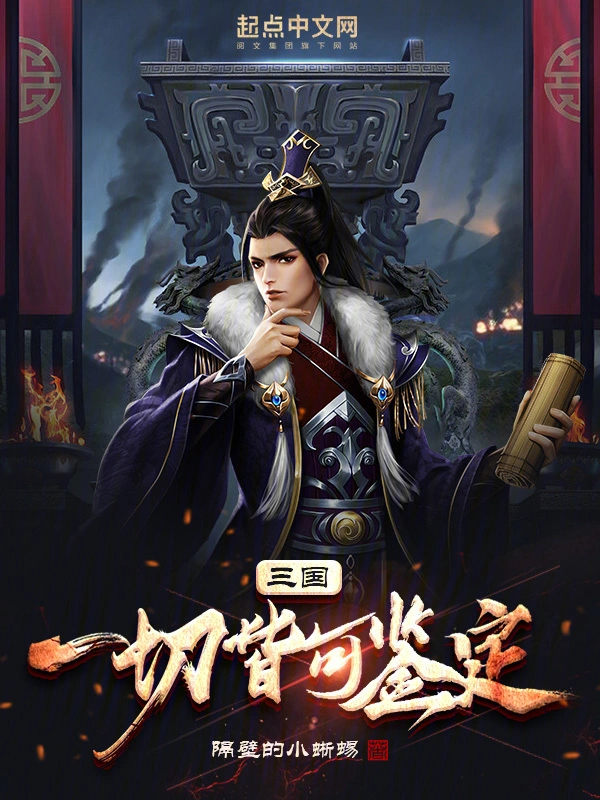
Three Kingdoms: Everything Can Be Identified
三国:一切皆可鉴定
- Status
- Completed
- Length
- 908k Words
- Genre
- Historical
- Audience
- Male
- Subgenre
- Qin-Han & Three Kingdoms
- Updated
- 1y ago
- Source
- Qidian
Stats
0Monthly votes
4.4kRecommends
10.8kFans
382Chapters
Tags
Synopsis
Reader comments
Readers also read
 Talker in the Song Dynasty
 1914 Begins with the Rejection of the Schlieffen Plan
 Please Call Me Your Majesty the Tsar
 In the Red Mansion: Escort Daiyu to Beijing at the Beginning
 Never Walk Alone!
 Three Kingdoms Keepers of Households
 Recasting the Three Kingdoms: the Headwind Situation Is What Makes It Interesting
 Daming: Have I Become Wanli's Portable Grandfather?
 I Am Drawing a Hot-Blooded Episode in the Zhiyu Episode!
 Conquer All Worlds Starting from the Mythical Three Kingdoms
 Lords of the Three Kingdoms of Darkness
 Emperor Zhaolie at the End of Han Dynasty: Starting from Western Liaoning
 The Yellow Turban Marshal of the Three Kingdoms
 Portable Magic Tower of the Three Kingdoms
 Kill Monsters in the Three Kingdoms and Upgrade to Become the God of War
 How Are Knights Made?
 The Rise of Gangwen Chaogong Resulted in the Invasion of Other Worlds
 Cao Cao's Chef
 Sun Ce's Ambition
 Where Is the Paradise in the Wasteland?
Appraisal✘ Consecration✔
Goldfinger's presence is too strong, but it doesn't have much effect. It's still known everywhere, which is too wasteful.
A little humble opinion
I think it's better not to upgrade the number of appraisals. It's fixed once a day. The main thing is to straighten out the plot and write it more reasonably Then the items to be appraised are mainly to improve yourself According to the current plot, magical items like drums and golden sore medicine, you can't use them if you write them out. If others know about it, it will have a magical effect. In the end, someone who is better than you will come to buy it from you. If you don't sell it, they won't come to rob you. Once or twice is okay. If you continue to write like this, it will inevitably feel like you are smarting Following the main line of identification at the beginning, it is good to mainly identify pills to improve yourself. This book is definitely better if I write about working alone. I think it might be better if I write about less appraisal equipment and more people. It is better to identify more Dali Pills and Guyang Pills to attract people than to give equipment. Writing the history of the Three Kingdoms can only make small mistakes The suggestion is that the book can produce results. After all, it is not easy to keep writing with the writing skills
Alas, I feel that the number of appraisals has increased, and the consecrated items have been spread out. After everyone knows about it, I feel bad. It is better for the protagonist to use it alone. In a historical novel like this, it is too extraordinary and feels bad. Although the writing is indeed okay, the golden finger is indeed not designed well. For example, some things will never be damaged. I think it can be strengthened. There are also fairy tales such as the Qiankun Bag, which are also exaggerated. In short, the golden finger is interesting but not well written.
The biggest failure is that I didn't write down the timeline clearly, which makes me confused. No matter what kind of book you write, the first sentence in the opening chapter is to clearly state the time and place. This is something that elementary school students know when writing essays! !
Ask
Is it possible to recruit all the strategists and generals? —— I have published some discussions on the plot before, and I feel that there is no problem after the changes. I wish the author's new book a hit🌹
I felt bad when I saw the introduction. Zhishen is a Buddhist name, not a nickname.
The name makes no sense! Do you think the Lu family will name their eldest son Da?
Must support🌹🌹🌹🌹🌹🌹🌹🌹🌹🌹🌹🌹🌹🌹🌹🌹🌹🌹🌹🌹🌹🌹 🌹🌹🌹🌹🌹🌹🌹🌹🌹🌹🌹🌹🌹🌹🌹🌹🌹🌹🌹🌹🌹🌹🌹🌹🌹🌹 🌹🌹🌹🌹🌹🌹🌹🌹🌹🌹🌹🌹🌹🌹🌹🌹🌹🌹🌹🌹🌹🌹🌹🌹🌹🌹 🌹🌹🌹🌹🌹🌹🌹🌹🌹🌹🌹🌹🌹🌹🌹🌹🌹🌹🌹🌹🌹🌹🌹🌹🌹🌹🌹
The identification system is very creative.
It was really refreshing to watch, it felt very good, and the plot was very reasonable.
A brief history of the changes in administrative divisions in ancient China
1. Abstract This dynasty basically followed the three-level division rules formed since the late Han Dynasty and the Three Kingdoms, but the administrative divisions continued to sink. At the township level, the actual control reached the village level (this dynasty had administrative villages, but in ancient times there were only natural villages). Throughout the past dynasties, China has basically implemented the system of prefectures and counties finally established by Qin Shihuang. The only question is whether there are higher-level divisions above prefectures and counties. As for downwards, only this dynasty has successfully moved administrative management beyond the county level. 2. Qin, Han, Three Kingdoms, Two Jin, Southern and Northern Dynasties During the Qin and Han Dynasties, there were roughly two levels of counties and counties. During the Qin Dynasty, counties had governors and counties had county magistrates or magistrates. During the reign of Emperor Jing of the Han Dynasty, the county governor was changed to the prefect. During the period of Emperor Wu of the Han Dynasty, the country was divided into thirteen states and states began to be established. But the state at this time was a virtual one. It was just a supervisory area with only one governor and no actual chief executive. When Wang Mang usurped the Han Dynasty, he once established the state pastoral system. At that time, there were really three levels of "state-prefecture-county". After the fall of Wang Mang's new dynasty, the Eastern Han Dynasty returned to the "prefecture-county" level. By the way, the governor here is just a local substitute for the censor in the imperial court. It is just a supervisor of the prime minister system and is a supplement to the original supervisory system led by the censor. The governor is a very small official position, and his power and status are much smaller and lower than those of the county governor and prefect, let alone those of the state pastor. Give an example. There was no later official rank in the Han Dynasty (it was only started in the Wei and Jin Dynasties and took shape in the Northern Wei Dynasty). The level of officials was reflected by the amount of "rank" (salary). The governor is only 600 shi, the magistrate of a large county is 600 to 1,000 shi, the magistrate of a small county is 300 to 500 shi, and the prefect is 2,000 shi. As for the classification of counties, county magistrates, and county magistrates in the Han Dynasty, as well as the changes in the titles of county officials in later generations, please refer to the article "The Titles and Grades of County Officials in the Past Dynasties" published earlier by this official account. No further details will be given here or below. By the end of the Eastern Han Dynasty, the governors stationed in various states by the imperial court were trying to expand their powers and turned themselves into the state pastors that Wang Mang had done during the Wang Mang period. The states began to actually become first-level administrative divisions again, so that they were three levels of "state-prefecture-county". The power of the state pastoralists is very great, and it is easy to make the local area weak and form a separatist force. During the Northern and Southern Dynasties, in order to strengthen control, the central court began to establish more states and made each state smaller. Later, the states and counties were almost the same size. By the late Southern and Northern Dynasties, although there were three levels of "state-prefecture-county" in name, in fact it had slowly transitioned to two levels of "state, county-county". 3. Sui, Tang and Song Dynasties In the Sui Dynasty, during the reign of Emperor Wen of the Sui Dynasty, counties were abolished. Except for Yongzhou Mu, all state officials were governors. During the reign of Emperor Yang of the Sui Dynasty, the prefecture was changed to a county, and the governor was changed to a prefect. The Sui Dynasty abolished the states and only retained the counties. After the establishment of the Tang Dynasty, the counties were renamed states, and the prefects were renamed governors. When Xuanzong arrived, the prefecture was changed to a county, and the governor was changed to a prefect. During the reign of Emperor Suzong of the Tang Dynasty, the old system of the early Tang Dynasty was restored. In short, during the Sui and Tang Dynasties, the states and counties were the same, as were the governors and prefects. They were all political officials actually responsible for administrative affairs at the state and county level. In the Song Dynasty, some of the more important states were changed to prefectures, but they were still on the same level as the states. In the Song Dynasty, when court officials went out to prefecture (or magistrate) affairs, they held the positions of prefect and governor in the Sui and Tang Dynasties, and the latter were often used to refer to their positions. For example, when Ouyang wrote "Fengle Pavilion", he called himself the governor, and when he wrote "The Drunken Old Pavilion", he called himself the prefect, because there was no difference between the governor and the prefect. During the Sui, Tang and Song Dynasties, roads and roads began to gradually become the highest first-level administrative divisions, and China's administrative divisions entered the period of the road (road) system. "Dao" began to appear in the Qin Dynasty. At first, it was at the same level as a county and was used exclusively in remote areas where ethnic minorities lived together. The geography of "Hanshu" explains that "there are barbarians who call Dao" or "the head of the county is called barbarian Dao". In the Sui and Tang dynasties, military expeditions were often named according to the direction and direction, which was called "such-and-such road", and the military commander in that area was called "the marching general of such-and-such road". Later, the Tang Dynasty also used this term in internal and civil affairs. At the beginning of the merger of counties and counties (or states and counties), when there were few first-level administrative districts, they were only used as supervisory and geographical units. After the number of states and counties later increased, it gradually became a substantive first-level administrative region, evolving from a two-level system of "state, county-county" to a three-level system of "dao-state, county-county". After the middle of the Tang Dynasty, that is, after the Jiedushi system took control of local real power, "Dao" gradually evolved into the name of a Jiedu jurisdiction. "Dao" actually existed in name only, and its meaning was different from that in the early and prosperous Tang Dynasty. Although the areas under the jurisdiction of many Jiedu envoys were praised as Taoists, the administrative divisions of Taoism were in chaos. In the Song Dynasty, the highest administrative division was changed to "road". The road was slightly similar to the Tao of the Tang Dynasty and was modeled after the Tao system of the Tang Dynasty. "Tao" and "Road" were initially of the nature of supervisory districts, and then transformed into administrative districts. 4. Yuan, Ming and Qing Dynasties During the Yuan Dynasty, provinces became the highest first-level administrative divisions, and were later followed by the Ming and Qing Dynasties. The province is the abbreviation of the province in Xingzhongshu, and the folk abbreviation of "province". It is a first-level administrative region directly under the jurisdiction of the central government. According to scholar Qian Mu, "Xingzhongshusheng" means "Zhongshusheng in action", that is, the all-powerful agency set up by the central government in local administration to maintain its rule. At the same time, as an administrative region name, Lu was also retained by the Yuan Dynasty. However, the status of roads in the Song Dynasty was equivalent to the provinces of the Ming and Qing Dynasties, while the roads in the Yuan Dynasty were only equivalent to the prefectures of the Ming and Qing Dynasties. The Yuan Dynasty also added Zhili Prefecture and Zhili Prefecture, which were directly subordinate to the provinces and roads. The rest are called Sanfu and Sanzhou. Various prefectures and prefectures, big prefectures and small prefectures. During the Ming Dynasty, the Zhili Prefecture was abolished and the prefecture became a first-level institution higher than the state. However, some important states are still under direct control and are called Zhili states. Zhili Prefecture and Sanzhou both govern counties. In the Qing Dynasty, they found that this was too chaotic, so they stipulated that only Zhili Prefecture could manage counties. Scattered prefectures were equivalent to large counties and could no longer manage counties. In this way, the Qing Dynasty was: province-prefecture-county or province-Zhili prefecture-county or province-prefecture-sanzhou. 5. Special Administrative Divisions By the way, there are some special local administrative divisions and official settings in the Song, Yuan, Ming and Qing dynasties. 1. Song Dynasty In the Song Dynasty, roads were at one level, prefectures, prefectures, military and prisons were at one level, and counties were at one level. The government is an area with a more respected system, such as the capital, the capital, etc.; The army is generally a military town or strategic point; the supervision is located in some major industrial, mining, animal husbandry, salt and other important asset areas. 2. Yuan Dynasty The Yuan Dynasty also had armies, some of which were directly under the jurisdiction of the provinces, and some of which were under the jurisdiction of the return route. The Yuan Dynasty also set up pacification departments in the ethnic minority areas of Sichuan and Huguang. Similarly, in the Ming and Qing dynasties, there was a pacifying envoy department. The appeasement department of the Yuan Dynasty was directly under Yulu. In addition, the Yuan government also established the Xuanzheng Yuan (originally the General Zhiyuan), which in addition to being in charge of Buddhist affairs across the country, was also responsible for governing military and political affairs in the Qinghai-Tibet Plateau (today's Tibet). 3. Ming Dynasty The Ming Dynasty implemented the three-si system, but gradually formed a governor system. In the Ming Dynasty, in order to express the difference from the Yuan Dynasty, the provinces were deliberately called Chengzhengshisi, which were referred to as "Guzhengshisi", "Chief Secretary", and "Fansi" instead of "provinces". In official documents, avoid using the word "province" of the Yuan Dynasty, so add "etc." Under the place name. In addition, each province also has a capital command department, which is in charge of the military household guards of the province and the Han armies, and takes orders from the Ministry of War and the Fifth Army Governor's Office. In addition, there is the Department of Punishment and Prosecution, which is responsible for supervising the judiciary, obeys the orders of the Ministry of Punishment, and is in charge of judicial power. The Ming Dynasty implemented a system in which a province was divided into three divisions: capital, cloth, and administrative divisions. It was originally intended to prevent the concentration of local power, but it caused certain inconveniences in actual use. Therefore, after Xuande, ministers from the Ministry (Six Ministries) and the Yuan (Duchayuan) began to be assigned to supervise local administration in the name of the governor-general and governor. After the Jingtai Dynasty, the governor-general and governor basically became the permanent system of each province, overriding the "three divisions" and becoming the highest officials of a province or even across provinces. There are also cases where he serves as governor and governor at the same time, and he is called a governor. In addition, there are also supervisory censors who serve as supervisors. 4. Qing Dynasty The Qing Dynasty followed the Ming Dynasty system and retained the administrative envoys' respective departments. However, the areas under the administrative envoys' jurisdiction were directly referred to as "provinces", and fixed governors and governors were set up above the chief envoys of each province to take charge of military and civilian affairs in the province, which became a standard organizational system. The chief envoy becomes the subordinate officer of the governor and governor. In the Qing Dynasty, the administrative division units at all levels below the provincial level basically followed the Ming system, with the following differences: ① The administrative division unit - department was added. This is a divisional unit established in the newly developed areas in the Qing Dynasty. It can be divided into Zhili Hall and scattered halls. Zhili Hall is parallel to the prefecture and Zhili Prefecture, directly under the province, and most of them do not have counties; scattered halls are subordinate to the prefecture, parallel to scattered prefectures and counties, and become the most basic administrative division unit. ②In the Yuan and Ming dynasties, whether they were Zhili prefectures or scattered prefectures, they generally had counties. In the Qing Dynasty, only Zhili prefectures under provincial jurisdiction had counties, while prefectures under provincial government did not have counties. That is: the province has jurisdiction over prefectures and Zhili prefectures, and the prefectures have jurisdiction over scattered prefectures and counties. ③ In the border areas of Northeast China, Outer Mongolia, Xinjiang, Khovd, Tibet, and Qinghai, there are five general jurisdictions, the counselor's jurisdiction, the Tibet Minister's and Dalai Lama's jurisdiction, and the Xining Minister's jurisdiction. In remote jurisdictions and provinces, in addition to setting up prefectures, prefectures, and counties in some agricultural areas, administrative divisions of leagues and banners were established in Inner Mongolia, Outer Mongolia, Xinjiang, Qinghai, and the Northeast. Southern Xinjiang (Huibu) was divided into seven cities. The league is equivalent to the prefecture in the mainland, the banner is equivalent to the county in the mainland, and a camp is set up in Tibet. VI. Appendix 1. Brief table of administrative division level changes in the past dynasties Qin Dynasty: County--County Han Dynasty: (state)-- County--County (state is a fictitious one) From the end of Han Dynasty to the beginning of Sui Dynasty: state--prefecture--county Sui Dynasty: county (state)--county Tang Dynasty: Dao--zhou (county)--county Song Dynasty: Lu - Fu, Prefecture, Jun (over the county), Jian (over the county) - County, Jun (not under the jurisdiction of the county), Jian (over the county) To govern counties), military, and appeasement departments--county Ming Dynasty: Accepted the Provincial Envoys and other offices (equivalent to provinces)--prefecture, Zhili Prefecture--Sanzhou (can govern counties)--county Inland of Qing Dynasty: Province--Dao (virtual)--prefecture, Zhili Prefecture (Counties under jurisdiction), Zhili Department (a few counties under jurisdiction) - Sanzhou (not under the jurisdiction of counties), San Ting (not under the jurisdiction of counties), counties Borderlands of the Qing Dynasty: General jurisdiction - League - Banner Republic of China: provinces, municipalities under the jurisdiction of the Yuan, localities, administrative districts - counties, City This dynasty: provinces, municipalities, autonomous regions, special administrative regions - regions, prefecture-level cities, autonomous prefectures, leagues - counties, county-level cities, autonomous counties, flags, autonomous banners, municipal districts, special zones, forest areas - townships, towns, ethnic townships, sub-district offices 2. Statistical table of administrative division level changes in the past dynasties Qin Dynasty: Level 2 Han Dynasty: Level 2 Late Han Dynasty to early Sui Dynasty: Level 3 Sui Dynasty: Level 2 > Tang Dynasty: Level 3 Song Dynasty: Level 3 Yuan Dynasty: Level 3 or 4 Ming Dynasty: Level 3 or 4 Qing Dynasty: Level 3 Republic of China: Level 2 This Dynasty: Level 4
Suddenly, an idea arises. The protagonist can draw a world map or carve a globe, and then identify it.
Lu Da's nickname is not Zhishen. Lu Da, a military man, does not have a nickname. Zhishen is the Dharma name given to him in Mount Wutai.
After reading the author's 3 works, they became more and more dull, and I lost interest in reading them. I hope the author can work harder.
My writing is good, but my grades are not good. What's the explanation?
After reading the beginning, I actually feel that the author's historical knowledge reserve is at least average among the authors in the Three Kingdoms direction. The poor results may be because the description is too realistic. There are only trade-offs between elite bureaucrats, and there are not many interesting points of traditional Three Kingdoms fan fiction. For example, because the timeline is early, most of the characters are not the big IPs of the traditional Wei, Shu, and Wu. Except for the young Lu Su, they are all relatively unpopular characters such as Chen Gui, Sun Jian in his early years, and the Three Heroes of the Late Han Dynasty.
Too bland
There is still some creativity, but the plot is too bland and there are very few reviews. By the way, the title of the book is "Everything Is Identifiable", and the last thing is "Identifying the World"?