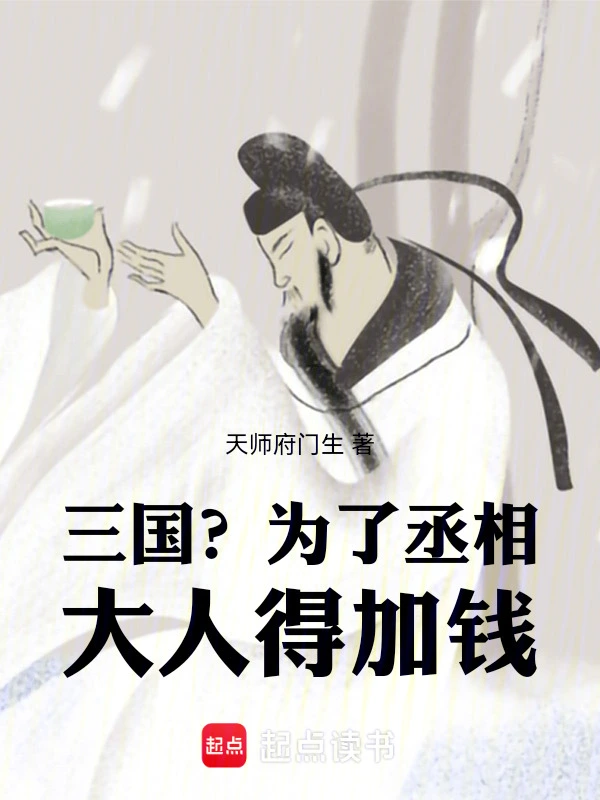
Three Kingdoms? I Have to Pay More for the Sake of the Prime Minister.
三国?为了丞相大人得加钱
- Status
- Completed
- Length
- 310k Words
- Genre
- Historical
- Audience
- Male
- Subgenre
- Qin-Han & Three Kingdoms
- Updated
- 2y ago
- Source
- Qidian
Stats
0Monthly votes
311Recommends
10Fans
145Chapters
Tags
Synopsis
Reader comments
Readers also read
 Talker in the Song Dynasty
 In the Red Mansion: Escort Daiyu to Beijing at the Beginning
 Please Call Me Your Majesty the Tsar
 1914 Begins with the Rejection of the Schlieffen Plan
 Three Kingdoms: Ji Han Liu Zhang
 Three Kingdoms: Huang Tian Should Stand, and the World Will Be Prosperous!
 Three Kingdoms: I, Liu Chen, Will Not Surrender to Wei Until He Dies!
 I Originally Wanted to Vote for the Wei Dynasty, but Why Did I Return to the Han Dynasty?
 Three Kingdoms: Starting from Believing in Science and Conquering the World
 Three Kingdoms: Angrily Denounced the Theory of Hatred for the Country, Saying That Jiang Wei Was an Amateur
 Recasting the Three Kingdoms: the Headwind Situation Is What Makes It Interesting
 The Ashes of the Southern Ming Dynasty
Death of Guan Yu
After Mi Fang Kaicheng surrendered, Lu Meng was very happy. He held a large ceremony on the sand dunes to celebrate the capture of Nanjun. At this time, Yu Fan whispered a few words to him, "Aren't you happy a little too early? The reason why we were able to capture Jiangling City was because Mi Fang wanted to surrender alone. Others may not be of the same mind as us!" You should enter the city early and take Gangneung into your own hands. Lu Meng was also the one who listened to the advice. He immediately led his troops into the city and placed his own people in dangerous places in the city. Originally, there were indeed many people in the city who did not want to surrender. They also had some forces in their hands and wanted to set up an ambush to attack Lü Meng. However, Lü Meng took the lead and did not occupy a favorable terrain for the attack. The ambush plan was ruined. Jiangling City is the core place where Guan Yu governs Jingzhou. Almost all the generals of the Shu army in Jingzhou have their families in Jiangling. Lu Meng gave these family members generous treatment and issued an order not to harass the people in the city and not to remove things from the city without authorization. There was a soldier under Lu Meng who was a fellow villager with Lu Meng. One day it rained and he was afraid that his armor would get wet, so he took a bamboo hat from a farmer's house to cover it. As a result, this matter was reported to Lu Meng. After Lu Meng analyzed it, although the fellow had good intentions and wanted to protect the public armor, he still violated his own laws by taking the people's bamboo hats without authorization, so he gritted his teeth and beheaded the fellow with tears. From then on, no one dared to disobey Lu Meng's general orders. In addition to strictly managing the army, Lu Meng also extended kindness to the people in the city. He often sent people to visit the elderly and take care of their lives. He also sent timely supplies to those who lacked food and clothing. If someone was sick, he sent them medicine. Regarding the treasures in Guan Yu's treasury, Lu Meng did not touch any of them and sealed them all. This gives everyone a feeling that with a person like Lu Meng governing Jingzhou, life will only get better and better. At this time, Guan Yu's siege of Fancheng had just been broken by Xu Huang. Now he heard that Jingzhou had been lost and Jiangling had fallen into the hands of Sun Quan. Guan Yu was worried. His brothers' families were all in Jiangling. He didn't know what happened to them. The army could not speed up, so he sent envoys several times to ask them to rush to Jiangling to contact Lu Meng, just to inquire about the situation of his own people in Jiangling City. To be honest, Lu Meng was really good at it. Every time Guan Yu's envoys arrived, he warmly entertained them, then personally took them around Jiangling City, and even asked him to visit the homes of Shu army officers and soldiers to express condolences. These people had received Lü Meng's favor, so they would naturally talk about Lü Meng's benefits. Some even wrote personal letters to their relatives ahead of them, explaining in detail the situation of themselves and their relatives and friends. After the messenger returned to Guan Yu's army, he told everyone the truth one by one. Especially those who received the personal letter felt more at ease. After so many times, many people felt troubled in their hearts. Since their families were living so well, they had no intention of fighting Wu Jun. With Lu Meng thinking about Guan Yu's soldiers, Sun Quan was not idle either. He also made plans for Guan Yu. As early as when Lu Meng crossed the river in white clothes, he ordered Lu Xun to advance at the same time. After capturing Nanjun, he also captured Yiling, Zigui and other places, and set up defenders along the way, which cut off Guan Yu's escape back to Yizhou. This time it is troublesome. As soon as the army withdraws from Xiangyang, the initiative is in the hands of the opponent. If it goes back, it will be beaten by Cao Jun. Jingzhou is occupied by Lu Meng and cannot go back. The road to Yizhou is blocked and cannot go back. The key men have no fighting spirit and there is not much food and grass. How can we fight this battle! Guan Yu had no choice but to go west and temporarily stationed in Maicheng. In December of this year, Guan Yu led a small number of cavalry to break out of Maicheng and fled west to Zhang Township. The other men who stayed in Maicheng surrendered to Sun Quan. Guan Yu's purpose this time is very clear. He will run to Yizhou at the risk of his life. As long as he breaks out of the encirclement, he will meet his own people. Guan Yu is indeed brave. With just a dozen men and horses, they broke through numerous sieges along the way and arrived at a place called Linju. It was only ten or twenty miles away from Yizhou, and they were about to embark on a road to survival. What a pity, right here, Dongwu Pan Zhang's troops were ambushing here. Pan Zhang's general Ma Zhong rushed out with his men, and Guan Yu and his son Guan Ping were captured alive. Maybe it was Lu Meng's explanation before leaving, or maybe it was Pan Zhang and Ma Zhong's own idea. They killed Guan Yu and Guan Ping on the spot, and a generation of famous generals fell!
Cao Wei summary
Emperor Ming Cao Rui, also known as Cao Rui, named Yuan Zhong, was a native of Qiao County, Peiguo (now Bozhou City, Anhui Province). He was the second emperor, politician and writer of Cao Wei during the Three Kingdoms period. The son of Wei Emperor Wen Cao Pi and Empress Wen Zhao Zhen. Cao Rui was loved by his grandfather Cao Cao since he was a child, and was named Marquis of Wude at the age of fifteen. In the first year of Huangchu (220 years), Cao Pi was proclaimed emperor by Zen and established the Cao Wei Dynasty. In the second year of Huangchu (221), Cao Rui was granted the title of Duke of Qi, and later the title of King of Pingyuan. He did not establish an heir because his mother was executed. In May of the seventh year of Huangchu (226), Cao Pi was seriously ill and made Cao Rui the crown prince. After Cao Pi died, Cao Rui became emperor. During his reign, he commanded Cao Zhen and Sima Yi to successfully defend against the attacks of Soochow and Shu Han, pacify Xianbei, and attack Gongsun Yuan, which was quite accomplished. However, in the later period of the reign, there was a lot of construction work, extravagance and lewdness, and a wide range of women, which left a negative impact. On Dinghai day of the first month of the third year of Jingchu period (January 22, 239), Cao Rui died of illness in Luoyang. His posthumous title was Emperor Ming, and his temple name was Liezu. Because of his improper entrustment of an orphan at the end of his life, it led to political turmoil in the future, and eventually the power fell to the Sima family. Cao Rui is not only called the "Three Patriarchs" by later generations in terms of politics, father and ancestor, but also in the history of literature is regarded as one of the "Three Patriarchs of Cao Wei" who created a generation of poetry. Cao Rui has more than ten existing poems, all of which are Yuefu poems. Jixing, a native of Peiguoqiao (now Bo County, Anhui Province), was the son of Cao Jie. Eunuch of the Eastern Han Dynasty. In the first year of Yongning (120 years), when Emperor Shun became the crown prince, Empress Dowager Deng saw that Cao Teng was young and cautious and kind, so she sent him to serve the crown prince to study, and thus gained Emperor Shun's favor. After Emperor Shun came to the throne (126 years), Cao Teng served as Xiaohuangmen, and was later promoted to Zhongchang Shi. Because of his meritorious service in planning to welcome Emperor Huan, he moved to Changqiu, where he was named Feitinghou and given the title of Special Advancement. Cao Teng served in the palace for more than thirty years without any obvious fault, and he was able to recommend wise men. He was impeached by Zhong Hao, but he called Zhong Hao a capable official, so he was praised by people. Cao Teng is one of the six figures in the Cao Wei Dynasty who holds the title of emperor. In Chinese history, he is the only eunuch to be officially awarded the title of orthodox emperor. Cao Song (? ~ 193), Courtesy name Jugao, was born in Qiao County, Peijun (now Bozhou City, Anhui Province). A minister in the Eastern Han Dynasty, the adopted son of Cao Teng in Dachangqiu, and the father of Cao Cao, Emperor Wu of Wei. Cao Song entered the official position with his family's shadow, and successively served as Sili Xiaowei, Honglu Qing, and Da Sinong. He was ranked among the ninth ministers and held a high position of power. In the fourth year of Zhongping (187), he bribed Zhongguan and donated money to Xiyuan to serve as Taiwei, ranking among the three Dukes. In the fifth year of Zhongping (188), the Yellow Turban Uprising broke out. As a Taiwei, Cao Song took the blame and was dismissed. Later, Cao Song defected to his son Cao Cao in Yanzhou and was killed in Xuzhou. In the first year of Yankang (220), he pursued the Taiwang of Wei. After the founding of Cao Wei, he was honored as Tai Huang. Cao Cao (155-March 15, 220), whose courtesy name was Mengde, whose first name was Geely, and whose nickname was Ahao, whose surname was Xiahou, was from Qiao County, Peiguo (now Bozhou City, Anhui Province). An outstanding politician, military strategist, writer, and calligrapher in ancient China, a powerful official in the late Eastern Han Dynasty of China, and the founder of the Cao Wei regime. The son of Taiwei Cao Song. Cao Cao served as a knight and a debaucher in his youth. When he was twenty years old, he promoted Xiaolian to be a prince and was awarded the title of Lieutenant of the North of Luoyang. Later, he served as the Cavalry Commander, participated in the suppression of the Yellow Turban Army, and was appointed Prime Minister of Jinan. When Dong Zhuo was good at governing, he dispersed his family wealth and raised troops to attack Dong Zhuo. In the third year of Chuping (192), according to Yanzhou, more than 300,000 Yellow Turban troops were divided and surrendered, and the elite were selected to form the Qingzhou Army. In the first year of Jian'an (196), Emperor Xian of the Han Dynasty was welcomed to Xu County. From then on, he issued orders and took charge of the government in the name of Emperor Xian. After that, Yuan Shu, Tao Qian, Lu Bu and other forces were defeated one after another. In the fifth year of Jian'an (200), he defeated Yuan Shao, who was separatist in Hebei, in the Battle of Guandu. He then defeated Yuan Shang and Yuan Tan, attacked Wuhuan in the north, and unified the north. In the 13th year of Jian'an (208 years), he became prime minister. In the same year, he led his army to march south and conquered Jingzhou, but was defeated by the coalition forces of Sun and Liu in the Battle of Chibi. In the 20th year of Jian'an (215), he took Hanzhong, and the following year (216) he was promoted to the Duke of Wei from the Duke of Wei. In the twenty-fifth year of Jian'an (220 years), Cao Cao died of illness in Luoyang at the age of sixty-six. After the establishment of Cao Wei, he was honored as Taizu, posthumously named Emperor Wu, and was buried in Gaoling. Cao Cao employed people based on their talents, restrained powerful forces, and strengthened centralization of power; he cultivated fields in the north and built water conservancy projects. His various measures enabled the social and economic recovery and development of the ruled areas to a certain extent. Regarding Cao Cao's achievements and his character, later generations have had so many comments and so many disagreements, which is rare in the world. In addition, he knows the art of war, is good at calligraphy, and is good at poetry. Most of his poems express political ambitions and reflect the suffering life of the people in the late Han Dynasty. They are majestic, generous and desolate, and pioneered the style of Jian'an literature. The author of "Collection of Emperor Wu of Wei" has been lost. Today's collection of works is compiled by Cao Cao.
With the style of a veteran, who are you? I saw your work in the group.
Pick a fairy
I've read so many chapters and I can't keep up.
To be honest, the setting is good, but the writing could be improved.
The setting is good and eye-catching. But the writing style really doesn't suit me. So I skipped a few chapters according to the title. For example Guan Yinping's demeanor and language seemed to be commenting on others rather than worrying about his father. Sometimes, if the words do not convey the meaning, it is better to express it in vernacular, such as "It is pitiful even if you think about it." Here, you should express the worry and urgency of being a daughter, and then eagerly ask the protagonist for a rescue strategy, instead of sighing silently. There were other mutterings, but after all, I felt that this was not something a daughter should do. The author may be more suitable to write Dream of Red Mansions.
During the Three Kingdoms period, Shu's fundamentals were too weak. The key was that Cao Wei replaced the Ming Dynasty. Sun Quan of Eastern Wu was too young. Continuous attacks could only be a war of attrition. He could only imitate Qin in the Spring and Autumn Period. If he couldn't defeat Jin, he would change directions and attack Yunnan. This is what Zhuge Liang did later, but he did not continue. If he continued to attack until he reached Indonesia, it would be enough to establish a great nation.
Run away