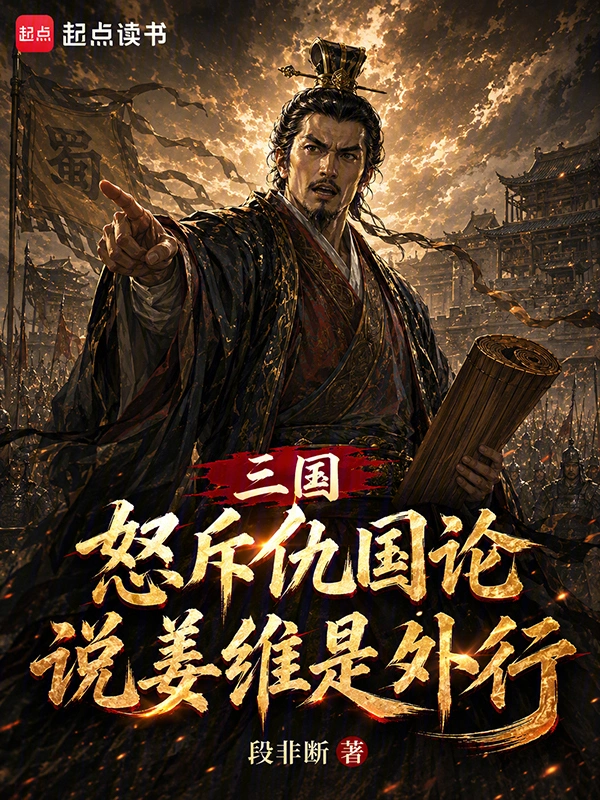
Three Kingdoms: Angrily Denounced the Theory of Hatred for the Country, Saying That Jiang Wei Was an Amateur
三国:怒斥仇国论,说姜维是外行
- Status
- Ongoing
- Length
- 796k Words
- Genre
- Historical
- Audience
- Male
- Subgenre
- Qin-Han & Three Kingdoms
- Updated
- 3d ago
- Source
- Qidian
Stats
232Monthly votes
4.1kRecommends
10.6kFans
273Chapters
Tags
Synopsis
Reader comments
Readers also read
 Northern Qi, Sage Khan
 After Lying in Bed for Three Years, He Was Forced to Help the Han Dynasty
 Red Mansion: Start Escaping and Farming from the Equipment Bar
 Fu Ming 1627
 Criminal Investigation Notes 2: Buried Corpse in Songhu
 Three Kingdoms: Starting from Believing in Science and Conquering the World
 Three Kingdoms: Starting from Changbanpo to Help the Han Dynasty
 The Black Witch's Journey to Another World
 Martial Arts!
 Three Kingdoms: Eighty-Year-Old Deng, Assisting Liu Bei in the Beginning
 It Can Be of Great Use If You Are Under Xima Su
 Three Kingdoms: Ji Han, the Great Physiognomist
 Jiajing Traveled Through Emperor Qing and Started Cultivating Immortality from the First Year of Qing Dynasty
In order to deceive Liu Chan into surrendering, the "preservation" promises Qiao Zhou made with great confidence turned out to be empty promises in hindsight. Judging from the historical facts, these promises of his were not only unfulfilled, but even full of hypocrisy and deception: 1. Promise to "preserve the clan", but the Shu Han royal family was brutally humiliated When Qiao Zhou initially persuaded him to surrender, he swore that Cao Wei would treat Liu Shan well and preserve the Shu Han clan. However, after Liu Chan surrendered, the Wei State not only rewarded the palace servants of Shu Han to the Wei generals who had no wives, but even Liu Chan's favorite concubine Li Zhaoyi was treated in this way. Li Zhaoyi could not bear the humiliation and finally chose to commit suicide. Faced with this tragedy that trampled on the dignity of the royal family, Qiao Zhou, who had patted his chest to vouch for it, didn't even fart. 2. He promised to "go to the capital in person and fight hard", but ended up being a coward When Qiao Zhou persuaded him to surrender, he said righteously and solemnly: "If your Majesty surrenders to Wei, and Wei does not break the soil to seal your majesty, Zhou please go to Kyoto and fight for it in ancient justice." This means that if Wei treats Liu Chan badly, he is willing to go to Luoyang in person to argue. But the fact is that Liu Chan later moved east to Luoyang and was ridiculed all the way. He was followed by only a few loyal ministers such as Que Zheng and Zhang Tong. Not only did Qiao Zhou not go to Luoyang to "fight" for Liu Chan, but he had been hiding in his hometown to be his rich man, completely forgetting his original rhetoric. 3. He promised to "protect his subjects", but his loyal ministers died tragically and he watched with cold eyes As we just mentioned, after the Zhonghui Rebellion broke out, the Wei army rebelled and massacred in Chengdu. A large number of loyal ministers such as the Shu Han princes Liu Xuan and Jiang Wei were brutally killed, and Guan Yu's descendants were also exterminated. At the most critical moment when the Shu Han monarchs and ministers were facing life and death and the people were struggling under the sword, Qiao Zhou, as the "chief minister", not only did not go to the powerful Wei Guan to speak up and stop the rebellion, but instead shrank his head and kept silent to protect the interests of himself and his family. Summary When Qiao Zhou tried to persuade him to surrender, he talked about "for the sake of the overall situation", "protecting the common people" and "for the sake of His Majesty", but this was just a political rhetoric he used to undermine the Shu Han's will to resist. When Liu Chan really handed over the jade seal and the Shu Han was completely destroyed, he immediately revealed his true face as a refined egoist. Those impassioned promises back then were just lies to gain Liu Chan's trust.
The core of Shuhan is romance, but if you want to succeed, you must calculate economic and political accounts How many acres of cultivated land does Shuhan have? How many stones of grain can be produced in a year How much grain can the common people eat? How many acres of land should be occupied by the powerful?
I read a lot of middle and late Shu Han texts
Some started from turning the tide after the Battle of Yiling, some started from preventing the defeat of Ma Su Jieting, some started from Zhuge Liang's death and put down the Yang Yi rebellion in Wei Yan, some started shortly after the Shu Han surrendered to Deng Ai, and some started from the Western Jin Dynasty after the Shu Han was completely destroyed. Thanks to Liu Bei's legendary life experience, the ecology of Shu-Han literature is also extremely rich. No matter in the early, middle or later periods, whether it is Youzhou, Xuzhou, Yuzhou, or Jingzhou and Yizhou, there are people who started writing wherever they were. 😄
The theory of Qiu Guo is right. He failed to seize the opportunity in the two battles of Huainan. Even with a better record than Zhuge Liang, he failed to seize the opportunity to win Longyou. Instead, Deng Ai kept suppressing Jiang Wei, and Shu Han was waiting for the country to perish. And Zhuge Zhan will join forces with Huang Hao to seize Jiang Wei's military power in a few years.
The words may not sound nice, but they are all the truth
So far in this book, the author has begun to feel obscene. Except for his various daily routines, the rest of his logical chain is completely untenable. Qiao Zhou is a representative of the local gentry in Yizhou. His core demand is to end the war and preserve the local interests of Yizhou. Jiang Wei's Northern Expedition in consecutive years has wasted people and money, increased taxes and corvee in Shu, and the local wealthy families have long complained. His "persuasion theory" is not simply a fear of death, but a collective choice of the gentry group. Personal persuasion cannot change the collective class position. Moreover, Qiao Zhou was a great Confucian and academic leader of the Shu Han Dynasty, and his disciples and former officials were all over the government and the local government. The fourth generation of the Yuan family and the three Dukes, after Dong Zhuo's rebellion, Yuan Shao launched an army to attack Dong. Most of the state pastors and county guards in the world were Yuan family's old tribes or disciples. There were very few voices opposing Yuan Shao in the court. Even if some people questioned his strategy and selfishness, they did not dare to refute it publicly. Firstly, they were afraid of offending the entire Yuan family group. Secondly, all public opinion in Shilin was biased towards the Yuan family. You Qiaozhou is the leader of Confucianism in the middle of Shu, and his disciples are all over Yizhou county officials, Taixue, and scholars. The Yuan family is the top family in the country. The logic of the two is the same. Their connections are intricate and intricate. Opponents can't stand alone, and debates and political opinions are bound to lose. I am still talking about Sunshine's opposition, that is, if you stand up and refute you, there will be many, many people who will reason with you. Those who secretly come to assassinate you directly are countless. Whether you can survive to unify the world is another matter. No, this one is not quite like the Yuan family, this one is more like the Luodang of the Northern Song Dynasty. Er Cheng pioneered Neo-Confucianism and had great influence among the scholar-bureaucrats in the Northern Song Dynasty. His disciples spread throughout the central and local academic and civil service groups, forming the Luo Party. Many people may not know this. Let me quote you a Baidu entry: In addition to the old and new party struggles in the Northern Song Dynasty, the Shu Party, Shuo Party and Luo Party were in constant confrontation. In court debates, discussions on classics and doctrines, and policy disputes, as long as issues related to ideology, education, and people's livelihood are involved, Ercheng's officials will speak out collectively. Even if the opponent has sufficient arguments, he will not be able to withstand the opponent's large number of people and strong public opinion, making it difficult to win in public arguments. There are many ways that the Shu Kingdom wants to shut up the protagonist like you. There is no need to read this book anymore. All the rest are about the author's obscenity. As for the one who married a widow to invest, Han law: Widows can take charge of their husband's inheritance, but they cannot dispose of it at will, especially the land and houses. If there is no son, the property will eventually belong to the clan/husband's family; if there is a son, it will only be managed until the son reaches adulthood. The dowry is considered private property, but the land and house cannot be taken away or inherited. As we all know, the late Han Dynasty was a troubled time, and the law could not be realized in reality. In reality, powerful clans directly robbed the property. Once the husband died, the clan gave priority to taking over the property, and widows were often "swept out." In troubled times, powerful men (such as Cui Yan) openly occupied widows' fields and houses, and the government did not dare to intervene. This is the second point of obscenity. There are many more mistakes that you may not have noticed yourself, so I won't list them all.
Did Ji Han call himself Ji Han?
For real development, we need to focus on various details. The first is technological innovation, the second is the division of factional interests, and the third is the rectification of officialdom.
You are a Yizhou native, and you are so full that you oppose the theory of hatred against the country.
Sun Hao was indeed cruel and unscrupulous, but when he faced Sima Yan in Luoyang, he dared to say, "I have also set up a seat for you in the south." He also publicly mocked Jia Chong for his regicide. Even though he was tough-talking, he still retained a bit of the backbone of a subjugated king. And what about Liu Chan? Not to mention his integrity, he can't even show a trace of attachment to his motherland. This kind of insensitivity is forcibly interpreted as "hiding one's strength and biding one's time", which is simply mistaking shamelessness for wisdom.
Don't marry a widow
Dorgon didn't have any fun with the child, so you're just looking for death. Even being a concubine is too much trouble.
The other direction is also rational analysis, welcome to discuss
In my understanding, the Shu Han Dynasty was basically waiting for death when they reached the Jiang Wei era. The terrain of Bashu is a natural insurance for self-protection. From another angle, it is a cage that traps oneself. There are only a few mountain roads in and out of the Central Plains, and the cost of transporting food is extremely high. Most of the food and fodder used by the army is consumed on the road, so it is naturally unable to carry out a long-term large-scale expedition. The cultivated land in Shuzhong is concentrated in the Chengdu Plain, with a small hinterland and a population base far smaller than that of the Central Plains of Cao and Wei. The products cannot support the consumption of successive years of outward expansion. During Zhuge Liang's lifetime, he could barely make ends meet by relying on the harvest of Nanzhong and the trade of Shu brocade. This dividend was slowly exhausted by the Jiang Wei period. Look at internal personnel changes. The old ministers of Jingxiang gradually withered away, and the local gentry in Yizhou gradually took control of local finance and taxation. Zhuge Liang's rules of severely punishing powerful people and checking hidden fields gradually became loose. Large households hid their people and fields. The court's tax revenue was unable to increase, and the surplus of the national treasury became tighter year by year. When Jiang Wan and Fei Yi were in power, they called for a truce to support the people. Their intention was to build up strength, but it also gradually caused the government and the public to become war-weary. The local wealthy people were originally opposed to the Northern Expedition and the consumption of their own resources. After taking power, they restricted war supplies everywhere. After Fei Yi passed away, although Jiang Wei took control of the military, he never had access to internal affairs and financial power. The court was hampered by local civil servants and Huang Hao's forces, and soldiers, food and grass were often not allocated in full. He wanted to replicate Wu Hou's strategy of encroaching on Longyou. He neither had the authority to rectify internal affairs and increase national strength, nor lacked the full cooperation of the court, so he could only rely on limited troops to attack on a small scale. Cao Wei's side is also steadily strengthening. The defense system on the western front has been improved year by year. The Yongliang farms have been established and the cities and fortresses are densely covered. The defense line is no longer empty in the early years. The Wei State no longer gave the Shu Han the opportunity to easily break through the city and plunder the people. It was difficult for Jiang Wei to send troops to capture enough population and food to replenish the country. The more wars he fought, the heavier the burden on the Shu Han's local people's livelihood, and the internal and external resistance piled up. With various factors piled up, Shu Han only had the capital to defend based on danger. It's hard, it's really hard to make a comeback.
What can we do if we don't surrender? Isn't it like a company in the later period of Shuhan? The boss doesn't care about things, and the top management are all flattering villains. Why do middle- and lower-level workers have to work hard for you? Can't I just switch jobs to other companies? If I don't reward people, I will suppress them. Talent, you also need talent and loyalty, what the heck, Zhuge Liang is in charge and everyone believes that he is fair, you are nothing in the late Shu Han Dynasty, you still want everyone to be loyal, why should you put yourself in a company, give you the most tiring job without good treatment, who will work for you?
When did the theory of feuding against the country become an heroic essay on surrender?
He was clearly advising General Jiang not to resort to violence, but to develop with peace of mind, and wait for the civil strife in Cao Wei. Finally, he would imitate Shang Tang and destroy Jie, and King Wu would defeat Zhou. He couldn't just blindly imitate Gaozu and destroy Chu, so he became a surrender faction? Nalongzhong was also waiting for the world to change, and Zhuge Liang also became a surrender faction when he woke up 😅 Isn't the problem with Jiang Wei? In the end, Deng Ai was not defeated once, and he was defeated by Bo Da in Duangu. Can the Shu Han country not resist the war?
If Guan Yu loses Jingzhou, Shu Han will have no chance. In the latter Three Kingdoms, the Sima family, father and son, were too supermodels at the same time.
The author suggests removing the emotional scenes, which are useless, unnecessary and redundant.
Huang Wei is a layman😁
Huang Wei is a layman🤓
I would like to say that the chief executive is pleased to see you 😡
Confront Trump. Trump denounced. If you go, come on. So I became the President of the United States😁
In fact, it's not like we can't win.
Most Shu Han travelers always think about how to strategize, how to recruit talents, and how to plan military strategies. You know, they are very tired, and they are already exhausted. If you want to break the situation, you can only rely on technology! Counterweight trebuchets (Mongolian return artillery) were used to attack the city, and the city walls at that time were difficult to block. If confidentiality can be ensured, explosives can be used. Economically, the Shu Han relied on the export of Shu Brocade. Okay, then continue to develop the textile industry, build the Flying Shuttle and Spinning Jenny, directly dump it, and bankrupt the textile industries of the other two countries! Ironmaking was also improved, using blast furnaces to make iron, and the armor style was changed to Song Dynasty Burenjia (iron pagoda). In the late Shu Han Dynasty, the talents withered and the national power was weakened. It was impossible to rely on power and tactics to save the country. Only science and technology can save the country! ! ! 😡
To be honest, I can accept participating in the hegemony of the Three Kingdoms at the end of the Eastern Han Dynasty, but I can't accept it at all during the Shu Han Dynasty, because you look at it from a civilian perspective and let the people bear the consequences for your own sake. The unification of Cao Wei and Wei is the general trend. It is the mainstream to end the war quickly and let the people recuperate.
The unification of Cao and Wei is the general trend, Liu Bei is just a traitor to the Han Dynasty, and the Shu Kingdom is divided, resulting in continuous wars, the people cannot live and work in peace and contentment, and countless people died in the battle, which is a heinous crime.
It is suggested that the title of the book should be changed to Jiang Wei is an amateur
Author, just patch it up and pretend that the main character has married a wife and has children, and that's it. Otherwise, we will conquer Guanzhong later and find someone else to marry. How else would you, the protagonist of a historical novel, still use it to fall in love? Otherwise, the little widow with her daughter should be taken in. You let this little widow climb a high branch. Finally, she became the wife of the prime minister of the Han Dynasty.
Awesome! Big cheers for the author!
After reading the three golden chapters, the writing style still has room for improvement.
The whole army has been defeated by Longyou. Liangzhou is just around the corner. Will there be a turning point in Huainan?
How to transport food and grass on the difficult and dangerous roads of Shu?
Governor Yongliang! 🤓
Liangzhou is basically fine. If Huainan can be defended, they will basically be in chaos after Sima kills you.