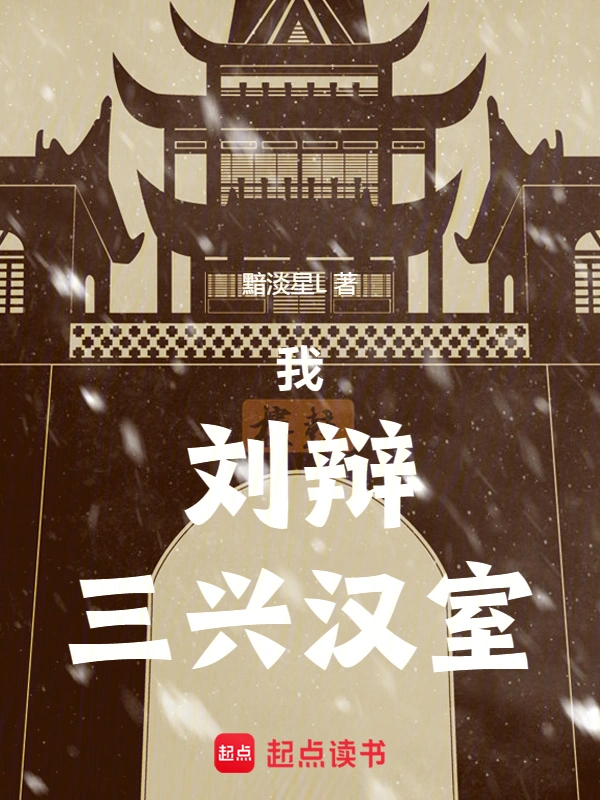
I, Liu Bian, Sanxing Han Dynasty
我,刘辩,三兴汉室
- Status
- Completed
- Length
- 1.5M Words
- Genre
- Historical
- Audience
- Male
- Subgenre
- Qin-Han & Three Kingdoms
- Updated
- 1y ago
- Source
- Qidian
Stats
Tags
Synopsis
Reader comments
In booklists 4

Focusing on Lesser-Known Historical Periods
This book list mainly recommends stories from lesser-known historical periods such as the Spring and Autumn Period and the Warring States Period, the Qin and Han Dynasties, the Jin and Southern and Northern Dynasties, the Five Dynasties and Ten Kingdoms, the turn of the Yuan and Ming dynasties, and foreign history. The single author will select the books with good writing skills and exciting stories to recommend to everyone. Books with novel stories and well-written stories will be highly recomm




🔥Book Relief Station🔥only Collects Ambitious Novels🔥
I read all kinds of subject matter, and I take in everything. Basically, I only accept novels that are large in volume and full in scope.
Long History
5000 Years of culture has too many regrets

Recommend New Books, Unknown Good Books, Come Soon If You Are in a Book Shortage! !
A good book worth spending time on for more than just food! ! Pay more attention!
Readers also read
 Please Call Me Your Majesty the Tsar
 1914 Begins with the Rejection of the Schlieffen Plan
 Talker in the Song Dynasty
 In the Red Mansion: Escort Daiyu to Beijing at the Beginning
 Three Kingdoms: Ji Han Liu Zhang
 Northern Qi: My Father, Emperor Wenxuan
 Recasting the Three Kingdoms: the Headwind Situation Is What Makes It Interesting
 The Han Thieves Are Not at Odds with Each Other, and the King's Industry Is Not on One Side.
 The Tang Dynasty Began with the Heian Shi Rebellion
 Taichang Daming
 Zhao Lie Xing at the End of Han Dynasty
 I'm the Dauphin in France
Changes that do not change people's minds will eventually lead to the demise of the people and the government! 99.9999% Of the thoughts of the wealthy scholar family are that the family, the country, the world, the family is in front and the country is behind, so if you do well, you can join the officials and gentry of Yongzheng society to pay grain and share the land with the tenants!
Liu Bian was the orthodox emperor of the Eastern Han Dynasty, so at most he could only be regarded as the resurgence of the Eastern Han Dynasty. The Sanxing Yanhan had to undergo a lineage transfer and establish a new dynasty like Emperor Guangwu.
The strategy of traveling through Liu Bian
The situation at that time was due to the infiltration of powerful powers over the past century and the impact of the Yellow Turban Uprising. The central court's local rule had basically ceased to exist in name only. The gentry clans controlled most of the positions in the world. The central court could still exist and could only rely on three points: 1. The huge centripetal force brought by the Han Dynasty's 400 years of history, 2. The elite troops of the Northern and Southern armies of the court, and 3. The struggle for interests between clans in various places. So you see that Emperor Ling was very smart. He established the Eighth School of Xiyuan, used Jian Shuo as the commander of the military school to control the military power, and used eunuchs as minions to fight against the noble clans. He provoked infighting among the noble clans all over the world, such as the struggle between the Kansai scholars and the Kanto scholars, so he barely had some say. But this weak balance was completely broken by the arrival of Dong Zhuo. Ever since Dong Zhuo incorporated the Luoyang garrison, the Han Dynasty had been dead. Why did He Jin have to fight the eunuchs and shake Dong Zhuo? Emperor Ling loves Liu Xie. He Jin wants to keep Liu Bian's position only by uniting with the noble clans. Emperor Ling is dead, and He Jin wants to regret it? I'm afraid I want to die. So He Jin could only go all the way to the dark side, but Queen He didn't nod, and He Jin couldn't get the authorization. The Luoyang garrison eunuch group has been infiltrated for many years and has long been unreliable. So why Dong Zhuo transferred Dong Zhuo and Ding Yuan to Beijing should be for this reason. According to common sense Thinking about it, these two people are not eunuchs, and they have no foundation in the court. Logically speaking, they are just thugs, and the harm is not great. But who would have thought that the eunuch group would directly destroy them to death. Dong Zhuo directly acted out of common sense and violated the consistent rules of officialdom. Talked a lot of nonsense. When you travel through Liu Bian, the first thing you face is the issue of abolition. If you want to get the inheritance rights, you must rely on Queen He and He Jin and the noble clans behind them. But this is not enough. Once you succeed, you can only be reduced to a puppet. You must have your own supporters. Shi Changshi must die, otherwise who will pay for what happened in the past? However, you need a group of eunuchs and minions, so you need to cultivate a group of capable eunuchs to take over the power vacuum left by the death of the Shichang servants in the future. This is not enough. After all, you have no say in the outer court. You need to marry a family so that they can be used by you. It cannot be the Yuan family. They are already too strong. You can choose from the second and third sons to provoke them to confront each other in the future. However, there is a big risk in this because they are afraid that they will cross the boundary, so some loyal and brave ministers who have been proven by history are needed to guard this boundary. For example, let Huangpu Song Renzhi Jinwu take charge of the defense of the capital, and let Lu Zhiren Weiwei take charge of the palace defense. These two people One is a meritorious official who put down the Yellow Turbans, and the other is an outstanding representative among the scholars, but he is also extremely loyal. He can be used to guard the capital while dividing He Jin's power. And then use the eunuchs to control the Eighth Army of the Hospital. Basically, you will not be in too much danger to the central court. But Huangpu Song and Lu Zhi are old and will die sooner or later. You need to train a group of young people. Follow the history and recruit people, train them around you, and gradually tighten your power. I haven't thought of anything else yet
Personal opinion, what I think the protagonist will do after ascending the throne
First, clean up the administration of officials Second, move elite soldiers from all over the world to the central government to implement the strategy of strengthening the weak and strengthening the weak. At the same time, select loyal ministers and good generals to innovate the military system Third, reform taxes, level firewood households, promote agriculture and consolidate the foundation Fourth, clean up slaves and regulate registration Fifth, salt and iron official camp Sixth, conquer the world Seventh, move the people to the border Eighth, open up river transportation Ninth, conquer the southern barbarians Tenth, develop the south ... I can only think of these for now
After Liu Xie is dead, if you continue to conquer the world, that will be called Sanxing. If you travel through time and become Liu Bian, that will be called Zhongxing of the Eastern Han Dynasty.
My personal suggestions for the follow-up plot
The current status is roughly as follows Foreign: The Silk Road is being opened and attempts are made to make the Western Regions vassal to the Han Dynasty. Domestic: Fight against powerful corruption, suppress local armed forces, and re-consolidate central power. Culturally, it also allows Taixue to play its due role. Then I personally think that the follow-up development can be like this (my talents are limited, if there are loopholes, please forgive me, and add that everyone has a friendly exchange.) Foreign relations: 1. Recovering the Western Regions, the last Han dynasty was the Ming Dynasty, but because of his Various factors are relatively conservative in the Western Regions and have little reference significance. In the Qing Dynasty, officials were exiled, while in the Han and Tang Dynasties, troops were stationed in the fields. When combined, the new law was roughly implemented to make the Western Regions consistent with the Central Plains dynasty in terms of system. Local governments could formulate relevant laws based on good customs. Anyway, we should seek common ground while reserving differences. Autonomous regions are not very realistic, and travel and logistics are not easy to solve. 2. Construction of the tribute system. It's hard to imagine that ancient Chinese dynasties would lose money in the tribute system. I'm talking about the Ming Dynasty, which just allowed interest groups to use excuses to become closed-minded (personal remarks). Modern people focus on practicality. As long as it brings benefits, I feel useful. Therefore, the Silk Road encourages trade (control still needs to keep up, be stricter, and kill the exposed ones. After all, the most daring commercial investment is to get rare goods. Is there anything else they dare not do?), And requires tributary countries to provide seeds and grain. If you can, weakening its people and weakening its country, that would be better. 3. Great voyage. Funan Foreign Object Chronicle records that the navigator Kangtai sailed to Southeast Asia and South Asia. It shows that during the Three Kingdoms period, we already had the ability to sail offshore. Watertight compartments are needed for long voyages, which can be traced back to Liang in the Southern Dynasty. If the Han Dynasty had the awareness, it should be able to conquer it. As for the use of going to those places, it has been since ancient times. Just because it's useless now, doesn't mean it won't be useful in the future. As for how to defend, exile or enfeoffment, that's up to you. As I wrote, I found that transoceanic voyages at that time were somewhat thankless, but Southeast Asia and South Asia should still bring objective benefits. 4. The farthest military scope is Central Asia and South Asia. After all, the Han army is not Mongolian. It still needs to be organized to fight wherever it fights. And these are also inseparable from the development of shipping technology. Internal: 1. Improve productivity. The ancient dynasties could not sustain much because of problems with the means of production. Therefore, improving productivity is more critical. Technological progress is the core productivity, so I don't understand some readers who don't like to read about technological progress and climb the technology tree. In the extreme, they directly abuse the author who climbs the technology tree. Although I like historical texts that are thicker and more rigorous in textual research, I also agree with reasonable exploration of science and technology. If these are not changed, the emperor will only be Emperor Xuan. Many of them are hard-written by the author. Can you imagine that without technological advancement, the army in the early Western Han Dynasty reached India. The Himalayas were not so easy to climb, and the Silk Road was not as easy to travel as imagined. The distance is there. Okay, let's explore science and technology in a reasonable way. Since I am not a science student, I don't know if the steam engine could be developed in the Han Dynasty. If it can be done, we will build infrastructure and lay tracks. Central control over local governments will be further strengthened. Powerful landlords will begin to decline, and emerging classes will rise. If not, just lay the groundwork and make some preparations for future generations. This is all personal preference, don't comment if you don't like it. The unreasonable ones can be discussed. 2. Land system. The household contract responsibility system is not suitable for ancient times. One is the output, and the other is the difficulty of management. Not all countries are Qin. The land equalization system is based on the original private land. I prefer the land equalization tax method. No matter the landlord or bureaucrat, I pay taxes. The land is taxed according to the fertile and fertile land. In fact, the author mentioned that the land transfer was similar. The land transfer was to survey the land and organize the households into households. The interest dispute involved was the struggle between the monarchy and all classes except the monarch. The chaos of the Eastern Han Dynasty had this factor, that is, the land transfer was not thorough. Emperor Guangwu never imagined that his Eastern Han Dynasty would be the Eastern Han Dynasty Kindergarten. It would not be possible if the monarchy or the central government was not strong. At the end of the Eastern Han Dynasty, there were armed conflicts in the farms, and there would inevitably be armed conflicts when trying to conquer the fields. So, there were going to be armed conflicts anyway, so why not go all out. Emperor Wu of the Han Dynasty also had this consideration in his determination to punish Guo Xie. I saw that the author mentioned Du Tian, and there should be a plot in this regard in the follow-up. Fangtian's tax law is very good. After rectifying the Central Army, I think it is feasible to slowly suppress it. 3. Legal system. It's hard to imagine that corruption is not punishable by death. I'm talking about you, the Song Dynasty. It is even more difficult to imagine that a group of people with vested interests would live with the country, and I am talking about you, the Ming and Qing Dynasties. Alas, it is difficult for the legal system to be fair and just in feudal society. It has not been achieved in modern times. It can only be perfected to restrain the powerful. At least where people pay for their lives, they still have to be blocked. There must be compensation and punishment. Am I being a bit idealistic? A little capricious. 4. Seeds. People need to eat and agricultural output needs to be increased. There is no shortcut to this. Hybrid rice can't be produced at that time, so we'll have to wait and see. 5. Taixue's clear discussion must be linked to seeking truth from facts. There are problems with the imperial examination system and conscription. It will allow the class of scholar-bureaucrats to continue to grow. You have already figured out the printing technology. After making money, you need to consider the feasibility of the imperial examination system. I see that the author mentioned that counties should learn from rural areas. This should also be paving the way. It will take at least three years to implement it. Partisanship is unavoidable, even in the United States of America. But as long as the new class that is raised can share the rights of the scholar-bureaucrats, it will only expand its base and weaken its right to speak. 6. Basic welfare system. You can try to use work-for-relief to forcibly create jobs, just like the equipment upgrades we are now proposing. Roads need to be repaired and bridges need to be built. Of course, these all require money. It just depends. 7. The establishment of economic system. ... This is very complicated, and it will collapse if you don't pay attention. You can write it or not. If you don't write it, you can pass it through with a twist. If you can write it, you need to pay attention to it. You can't just spend millions of taels of silver. Now it seems a bit naive. It is very difficult to write historical articles well, especially if they must be substantial, verifiable, moderately deduced, rational, and characterization, all of which are so important that very few can write well. I personally feel that the author is doing quite well in this regard because your writing is very conservative and does not cover many areas. However, this also prevents too many problems in your article. If you continue to maintain the standard, you can become food in the hearts of our readers. I also wanted to write a historical article before, but just like the questions I raised, I couldn't solve them. I couldn't think of a way to solve these problems. Even if there were any, they would only be solved temporarily. And history is not an independent event, it affects the whole body. If Emperor Guangwu's incomplete conquest of the land was not complete, would he see the collapse of the Eastern Han Dynasty a hundred years later? Brothers can provide suggestions and have friendly exchanges, and also let the author draw inspiration
This is so outrageous. This is the first time I know that Cao Cao is actually a loyal minister. I emphasize again, I just want to express this guy's outrageousness, and I do not agree with his views. If you criticize him, don't criticize me
The thirteen states and counties of the Eastern Han Dynasty
Reprinted from station B widezhang I marked the thirteen states in the first picture, and the second picture is more detailed.
If it is Liu Bian, it cannot be called Sanxing. Sanxing means that the emperor's lineage has been cut off, the imperial line has been lost, and then a new beginning is called Sanxing. If Liu Bian allows the Han Dynasty to rise again, it can only be called ZTE.
Liu Bei, a side branch, can be called the Sanxing Dahan. You, the authentic direct branch of the Eastern Han Dynasty, can only be called the Zhongxing Eastern Han Dynasty. Ji Han has a half-cent relationship with you, and the legal system has not changed.
At the end of the Eastern Han Dynasty, the Han Dynasty was dead. The reason why the Han Dynasty died by force was not to boast about the strength of the Han Dynasty, but to mock the Han Dynasty. A group of careerists fought every day and beat the Han Dynasty to death. All the means of production in the Han Dynasty were in the hands of powerful landowners, and the emperor could do nothing more than a tinkerer.
How can the protagonist solve the problem of a wealthy family that has been unable to be solved for 700 years in the late Han Dynasty? Nothing can be solved without Huang Chao
Don't insult the intelligence of the ancients
The IQ and EQ of the ancients were both online, but their understanding of the world was limited, so they were a little ignorant. If you travel back to ancient times and don't engage in technology or use technology to myth yourself, but compete with the ancients for IQ, then you have a flawed IQ! The main contradiction in human society has always been the uneven distribution of wealth. Back in ancient times, we had to find ways to create more wealth. During the Three Kingdoms period, there was a shortage of grain (food). The first was to build ships and go to Indochina to bring (buy or rob) rice to the north. The second was to promote dryland rice seedling cultivation in the country to increase production. The third was to make trawls for fishing, and finally to farm. Recruit refugees to work for relief.
The more I write, the more childish it becomes. The Han Dynasty died in an aristocratic family and it is not a yellow turban. It is right to imitate the Ming and Qing institutions in setting up institutions. I believe that the ethics of ministers are not as good as setting up reasonable supervision institutions and systems.
In the early days, Cao Cao was actually an angry young man. Unfortunately, later on, various princes fought for hegemony and used the emperor as a puppet. It was impossible to revive the Han Dynasty. With the power in hand, he gradually started to think about it. However, Cao Cao cherished his feathers and did not proclaim himself emperor until his death...
At the time of Liu Bian, the Han Dynasty had not yet subjugated the country. It was not a three-pronged revival, it was a ZTE at most.
Can Queen He be the heroine?
Hey, I haven't had much desire to read it recently, so I jumped on the subscription list. Maybe it's my personal preference. The image of the protagonist is becoming increasingly blurred, and the character is not very likable. Some words and inner activities feel like they are written like a child's, and there is no trace of someone who has been in power for many years. I would like to put forward my personal opinions, hoping it will be helpful to the author. I hope the more you write, the better.
When the protagonist is in power, he should try not to grant amnesty to the whole country, or even promote an end to this trend!
Liu Bei, Liu Chan, and Zhuge Liang granted pardons 13 times and Zhuge Liang zero. Is it really because he only knew how to impose severe punishments? During the Han Dynasty, the rulers particularly liked amnesty. First, in view of the common people's disgust with the tyranny of the Qin Dynasty, the rulers believed that the Han Dynasty's policies should be looser and more extrajudicial to make the people like it; second, because of the popularity of heaven and man's induction, amnesty came down to please God. When will the world be amnesty? There are several situations. The first situation is that there is a happy event for the royal family. For example, the emperor ascends the throne, changes his reign title, appoints a queen, a prince, etc. The second situation is when the country has something big going on. For example, enshrining Zen, establishing the capital, moving the palace, or achieving great military victory, etc. The third situation is when auspiciousness or disaster occurs. In the Han Dynasty, there was a popular belief in the connection between gods and humans. The appearance of auspicious signs meant that God thought the emperor had done a good job and was very happy. So the emperor couldn't make the people happy too? Therefore, an amnesty is required; the occurrence of disasters means that God thinks that the emperor has not done well and is unhappy, so the emperor has to find a way to make God happy, so he also provides an amnesty. During the Han Dynasty, a total of more than 140 amnesties were granted, with an average of one amnesty every two years. Interestingly, the more mediocre the emperor was, the more he loved amnesty. For example, Emperor Ling of the Han Dynasty granted amnesty 20 times in his 22 years of rule. He ranked first among the emperors of the Han Dynasty in terms of number and frequency. During the reign of Emperor Han Yuan, minister Kuang Heng publicly opposed the amnesty. He said: "The amnesty has been given year after year, so that the people can change their lives, and the world is very lucky. I have secretly seen that after the amnesty, the evildoers will not stop. Today is amnesty, and tomorrow they will break the law and go to jail. This may lead to failure." Can the effect be achieved? No. Because ordinary people will think in their hearts, if I am caught, I can get amnesty anyway, so why should I change my ways? Just continue to commit crimes and that's it! Therefore, not only does amnesty fail to curb crime, but it can instigate pardoned criminals to commit crimes again. Amnesty seems to be a positive measure, but there are many opponents in both the Western and Eastern Han Dynasties. During the Eastern Han Dynasty, there were more voices criticizing the amnesty. In the early years of the Eastern Han Dynasty, minister Wu Han was critically ill, and Emperor Guangwu Liu Xiu visited his home. On his deathbed, Wu Han raised the issue of amnesty. Wu Han said: "I am ignorant and ignorant, but I only hope that your majesty will be careful not to pardon you." It means that the humble minister has no knowledge, but he just hopes to try not to amnesty the world casually. In addition to Wu Han, there were many people in the Eastern Han Dynasty who were too cautious about the amnesty, or directly opposed it. The more famous ones are Wang Fu, Xun Yue, Cui Shi, Zheng Xuan, Chen Ji, etc. Because in the Han Dynasty, especially the Eastern Han Dynasty, the disadvantages of amnesty became more and more obvious. We all know that the Han Dynasty was an era of the rise of powerful families in Chinese history. Especially in the Eastern Han Dynasty, the powerful families had grown into the most powerful political force. Among them, the outstanding aristocratic families could influence central politics, and ordinary powerful landlords could also influence local politics. With their strong political, economic and even cultural power, they annexed land, oppressed civilians, did everything, and committed all kinds of evil. Most of the local crimes were committed by them. How many of the truly honest small farmers and small businessmen dare to commit crimes? Moreover, these wealthy families usually occupy positions in states and counties, which makes it difficult for their crimes to be sanctioned locally. Under such circumstances, if the central government continues to issue amnesties frequently, they will become more unscrupulous and lawless. At that time, some people even took advantage of the central government's amnesty so that they would not be punished after committing crimes. At that time, there was a sorcerer named Zhang Cheng in Hanoi County. He deduced that the imperial court was going to grant amnesty to the whole world, so he asked his son to kill one of his enemies. Sure enough, not long after Zhang Cheng's son committed the murder, the court issued a general amnesty, and he no longer had to pay with his life. But Zhang Cheng had calculated everything, but he never expected that he would meet a ruthless person - Henan Yin Liying. After learning about this incident, he executed Zhang Cheng's son under the pressure of resisting the decree. So in the political environment at that time, the beneficiaries of the amnesty were basically powerful landlords and their dependents, and the real ordinary people would not get any benefits from the amnesty. Wang Fu, an outstanding political commentator of the Eastern Han Dynasty, wrote a special article called "Shu Amnesty" for this purpose. He said: "Today, there is nothing more serious than amnesty and redemption for good people. If you forgive and redeem a few times, the evil people will prosper and the good people will be hurt. Those who raise food will harm the crops, and those who benefit the traitors will rob the good people." This means that now amnesty can only hurt the good people and benefit the bad people. It is the most harmful policy to people. Among the actual rulers of the three generations of Shu Han, Zhuge Liang disliked amnesty the most. During Liu Bei's period, there were two amnesties; during Liu Chan's period (after Zhuge Liang's death), there were 11 amnesties. How many times did Zhuge Liang grant amnesty when he governed the Shu Han Dynasty? Not once, never, has an amnesty been granted to the world. So when Chen Shou later evaluated Zhuge Liang, he also used the words "don't act rashly". Zhuge Liang is a very wise man, and it is impossible for him not to see the negative impact of the amnesty on society. In "Huayang Guozhi", Zhuge Liang's own views on the amnesty were recorded. At that time, someone said to Zhuge Liang, "The public cherishes the pardon", which means Prime Minister, why are you so unwilling to grant amnesty to the world? Zhuge Liang replied: "Government is based on great virtue, not small favors, so Kuang Heng and Wu Han were unwilling to grant amnesty. The late emperor (referring to Liu Bei) also said: 'I have been around Chen Yuanfang and Zheng Kangcheng, and every time I see instructions on how to deal with chaos, I have prepared them, and I have never said a word of pardon.' If Jing Sheng, Ji Yu and their son, pardoned every year, what is the use of governance!" Brief translation. Zhuge Liang believed that amnesty was a "small favor" rather than a "great virtue". The late emperor also said that he and the great scholars Chen Ji and Zheng Xuan often communicated together and discussed ways to govern the country. They talked a lot, but no one said that amnesty was needed to govern the country. Like Liu Biao and Liu Zhang, they administered amnesty every year when governing their territories, but what was the use? " Zhuge Liang had such an attitude towards amnesty, and he also practiced it when he actually governed the Shu region. Before Liu Bei captured Yizhou, Liu Yan and Liu Zhang and their sons, in order to consolidate the foundation of their rule, had long-term preferential treatment and leniency. The local wealthy families are very arrogant. If there are frequent amnesties under such circumstances, then as we said above, the wealthy families will become more and more lawless and the people will be more oppressed. The political situation in Yizhou It will become more serious. In this case, Zhuge Liang insisted on strict governance of Shu and refused to frequently announce amnesties. It was a wise move to assess the situation politically. Unfortunately, after Zhuge Liang's death, his successor. Those who failed to understand the prime minister's thoughts frequently issued amnesties. In the ninth year of Yanxi (AD 246), the Shu Han Dynasty announced an amnesty. Meng Guang, a famous scholar, criticized the ruling Fei Yi in public, saying: "The pardon is a dry thing and is not suitable for the Ming Dynasty." The disadvantages are so severe that they must be dealt with as a last resort, and then they can be exercised with authority. Today, the Lord is benevolent and virtuous, and all the officials are competent. Why is it that he is in danger and urgent, and yet he shows extraordinary kindness to benefit the evildoer? " Meng Guang believed that amnesty only benefits evildoers and can be used as a last resort. That situation has not yet reached that situation. Why should we give amnesty to the whole world? Unfortunately, Meng Guang's criticism did not have any effect. After Fei Yi, until the fall of the Shu Han, a total of 11 amnesties were granted. The social governance of the late Shu Han was very chaotic, which must have a lot to do with the frequent amnesties.
After watching Shen Nong's Test of Poison, I think it's okay
What do those Liu Bei Party think of this subject matter? For them Liu Bei is the orthodox one.
Brothers, I have saved seventy-eight chapters. I want to ask if the protagonist is still doing the feudal emperor thing and hasn't started to climb the technology tree yet. If so, I might as well delete the book. If he is still doing that thing, I will just read the history. There is no need to read the novel.
Did you finally reach the stage of being a bad eunuch?
This book is divided into two stages: before becoming emperor and after becoming emperor. The good rhythm before becoming emperor is completely ruined after becoming emperor.
The last dozen or so chapters still need to be completed 😅
The Sanxing Han Dynasty is really destiny, and others can still have fun
Looking at the comments, several people are arguing about whether it is interesting or not. I would say that they are actually the same. Only the Yellow Turban Army is the real rebel army, and it is officially certified. And it is the official certification of negative history books. Because all dynasties have called it the Yellow Turban Rebellion, but only we call it the Yellow Turban Uprising. Therefore, the feudal dynasties were all the same thing.
Why are historical time-travel novels almost all about soul travel, and many protagonists still have systems or personal space? It is better to write that the protagonist can travel between modern and ancient times through time and space channels. After all, it is based on Einstein's theory of relativity. It is very interesting to write about the protagonist traveling between modern times and ancient times through time and space channels. This can show the direct collision between modern times and ancient times. There are already many stories about the protagonists rebelling in the early Qing Dynasty, including the Kangxi Dynasty and the Yongzheng Dynasty. It would be interesting to write a book in which the protagonist rebelled between Kublai Khan and Yuan Dynasty in the Yuan Dynasty or Zhu Yuanzhang and Hongwu Year in the Ming Dynasty.
Not buddy. I originally felt that the words were a little too smart given the age of the protagonist. Until I saw the story of Liu Bao, Emperor Shun of Han Dynasty. That's outrageous.
Fortunately, there is no Sanxing Liu Han in history.