


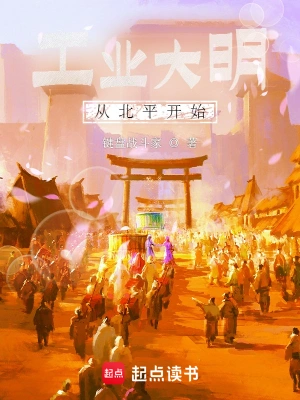
Industrial Ming Dynasty Begins in Beiping
工业大明从北平开始
- Status
- Completed
- Length
- 2.4M Words
- Genre
- Historical
- Subgenre
- Song-Yuan-Ming Dynasties
- Updated
- 1y ago
- Source
- Qidian
Stats
717Chapters
0Votes
20.2kRecs
174.4kFans
Tags
Synopsis
More by this author

In booklists 3
Completed Novels I've Finished
All completed, so you don't have to wait for updates and can read them in one go. Quality guaranteed, since I've read them all, right?
38Books0Follows1yUpdated
Er Hu's Reading List
Good book recommendations
22Books137Follows1yUpdated

Ziyue’s Bookshelf
An old veteran reader testing books for poison... poison
22Books18Follows3yUpdated
Readers also read
 My Only Method: I Will Add More Points to Become Stronger at the End of Ming Dynasty
 My Father Is Wen Tianxiang, and We Win the Battle of Yashan from the Start
 Daming: Asking for the Throne at the Beginning, Lao Zhule Went Crazy
 A Guide to Building Civilization in a Primitive Tribe
 A Record of a Mortal's Journey to Immortality: I Earn Immortality by Grinding Achievements for Rewards
 I Built an Invincible Fleet
 Ming Dynasty: Taking Zhu Yuanzhang on a Tour of the Forbidden City
 Lord Evolution
 A Record of a Mortal's Journey to Immortality: Choosing Hextech in the Chaotic Star Sea
 The Iron Tide of Farming and War in Another World
 War of Resistance: An Engineer from Hearts of Iron
 Transmigrating to the Ming Dynasty: I Can Receive Modern Goods
 The Ming Dynasty: Wanli
 Dream of the Red Chamber: Starting in Liaodong
 The Red Chamber's Martial Saint
Reader comments 49
Google Translate
The reforms in this book are among the best in all novels. It makes people believe that even if the protagonist suddenly dies at this time, the reforms will not stop. In short, interest groups have emerged to promote reforms. I am looking forward to the subsequent external development, and hope to be able to write "development driven by huge interest groups" instead of "all my treasures are there". Let me sort out the time for everyone. The Battle of Jingnan in 1400 and the voyage to the West in 1405. At this time, the Age of Discovery had just begun, and the great geographical discovery was still nearly a hundred years away. While Timur was still alive, Japan had not yet entered the Warring States Period, Korean had no written language, Europe was still in the "dark Middle Ages", and the "literature" of the Renaissance was still in the books of Arabs.
I only saw oppression, oppression, deception, brainwashing, hypocrisy, and the death of Qimei's husband was just because of the protagonist's political needs. The protagonist brainwashes the soldiers to protect their homes and country, their dedication and their sense of mission. After setting up a murderer, Ye Xixian tortures the soldiers and beats them to death one by one. The protagonist does not even let out a fart, and he talks about ZG mode. It can be seen from this that you should not believe people who control the means of production. They stand too high and are no longer the same species as you. If you think you are a human being, he thinks you are just his means of production. They only bully and bomb. Politicians should go to the gallows.
Is the maturity of three views related to calming down and studying? There is also the possibility of directly rubbing the steam engine by hand. This shows that the author was not influenced by historical literature. I have watched a lot of time-traveling movies. They have always emphasized the relationship between history and industry. But industry has nothing to do with history. It took more than ten years to travel through time to make a steam engine by hand. This completely underestimates the craftsmanship supported by imperial power and money. With the support of these two aspects, you can make airplanes for more than ten years. This is no joke, look at our atomic bomb, it took three years to produce it. This is the result of the blessing of power and money. But the protagonist written by the author is not a mature adult who traveled through the past at all, he is like an immature teenager. They completely underestimated the overall situation of Wang Ye and Zhu Yuanzhang. Once there are any changes in society, they will know about it, especially steam engines. The atmospheric pressure will directly enter Zhu Yuanzhang's eyes. The eldest son who grew up in the palace will be very scheming. You don't have this at all. A novice. Not written at all. It would be okay if you wrote it as the eldest son of a small landowner.
The most poisonous thing about this book is that the protagonist, as the heir to the throne, only has one wife. I don't need to explain the influence of this book in ancient times.
In terms of foreign policy, if we do not kill the other party's ruling class and intellectuals, what is the difference between joint development, national integration, and capitalizing on the enemy? The fact that the people at the bottom do not rebel does not mean that the kings and leaders have no ambitions. For example, in the article, the development of Indochina requires the investment of manpower and material resources to drive the indigenous people to obtain resources and markets. Only then can we talk about ethnic integration and common development. It is not about establishing a vassal relationship and directly going in to provide warmth without even the control of the upper class. What if the vassal country becomes stronger and rebels. In addition, in the article, Siam forcibly annexed other countries and provoked sectarian-vassal relations. The author actually did not send troops to punish several years after the Western Expedition and even though supplies were sufficient. So how is this different from the so-called vassal states of the Ming Dynasty that engaged in tributary trade in the original history? Does this also count as entering and developing the Indochina Peninsula?
Reading comments is more interesting than reading novels. As soon as it is said that ancient China was stronger than ancient Western countries, a group of people jump out to refute it. It's really interesting.
Another book brainwashed by the West, still trying to get rid of Xu Jun
Every era has its own policies and developments. You cannot apply the present to the 13th century. It would be like using the American world trade economy to harvest the world without the British cultural colonization? Do you see the Great Qing Bird? Africa in the 13th century was similar to the orangutans in the zoo today. Are you talking to him about our peaceful development? Before nuclear weapons, the world was dominated by the jungle. Even with nuclear weapons, the United States would still use dirty bombs, depleted uranium bombs, bacteria, etc. Everywhere. Europe and the United States have emptied the North American continent of indigenous people. Apart from some netizens making fun of it, will other countries care? Because massacres are happening all over the world, the eldest brother is just talking about the second brother.
It feels quite confusing. Why is the protagonist still subject to imperial power when he has obviously reached a certain level of industrialization? It can be said that throughout the author's book so far, the protagonist's industrialized system has intensified huge political conflicts within the entire Ming imperial power. In this case, relying solely on political actions can no longer solve the problem. Why does the protagonist still fantasize about using political power to solve the problem? Just like the Chiang Kai-shek regime has always hoped to use political means to solve all problems. In fact, our great revolutionary mentor Mao Zedong has given the answer to the situation in the book. When politics cannot solve the problem, it must use violence to break the conventional political system and then establish a new political system. On the other hand, the whole book is different. The protagonist holds the weapon of industrialization, but is weak and tries to use politics to solve all problems and contradictions. If everything was so simple, why did Zhu Di use war as the only way to solve irreconcilable political contradictions and problems? Sometimes politics is not a panacea. For example, in the book, the political conflict between the protagonist and other forces has intensified to the point of irreconcilability, and he still tries to solve it through political means. This gives people the impression that he is not a qualified leader, but more like some Western politicians, who are smooth in form, talk nonsense, and play the blame game in the wrong form.
Forcibly carrying out the industrial revolution without progress in sociology will only revolutionize the Ming Dynasty itself, especially weapons and equipment... And it is even more ridiculous that the author writes that the Ming Dynasty has to consider palace battles. In this case, the industrial revolution cannot be completed at all, and it will only make the protagonist die faster.