


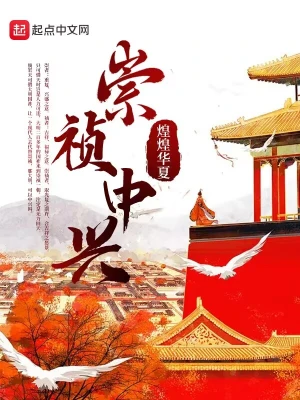
The Chongzhen Restoration
崇祯中兴
- Status
- Completed
- Length
- 236k Words
- Genre
- Historical
- Subgenre
- Song-Yuan-Ming Dynasties
- Updated
- 3y ago
- Source
- Qidian
Stats
95Chapters
0Votes
5.2kRecs
6.1kFans
Tags
Synopsis
More by this author
In booklists 2
Books Focused on Imagination and Logic
My list mainly recommends imaginative stories with smart characters, and has fewer power fantasies. I also make sure I've read every book on it. Some other books are pretty good too, such as Old Dao's This World Is on the Brink, Riding in Another World, and Half a Frog's From 1935 to 2020. Highly recommended.
69Books74Follows1yUpdated

Invincible Protagonists, Immortality, Cautious Cultivation, Behind-the-Scenes Schemes, and Historical Fiction
Every book here is one I love.
80Books337Follows2yUpdated
Readers also read
 Daming: Asking for the Throne at the Beginning, Lao Zhule Went Crazy
 My Only Method: I Will Add More Points to Become Stronger at the End of Ming Dynasty
 My Father Is Wen Tianxiang, and We Win the Battle of Yashan from the Start
 A Guide to Building Civilization in a Primitive Tribe
 A Record of a Mortal's Journey to Immortality: I Earn Immortality by Grinding Achievements for Rewards
 I Became a Tyrant in the Southern Ming Dynasty
 Great Ming: I, Zhengde, Am the True Daoist Emperor!
 Lord Evolution
 A Record of a Mortal's Journey to Immortality: Choosing Hextech in the Chaotic Star Sea
 Chongzhen: I Turned Things Around and Revived the Ming Dynasty
 Sun and Moon: Yongli 1656
 The New Han Dynasty, 1834
 The Sun and Moon Endure Forever
 The Grand Preceptor of the Ming Dynasty
 The Book of Chu: Annals of the Founding Emperor
 Three Hundred Years of the Ji Clan
 The Chief Grand Secretary
Reader comments 30
Google Translate
Why do some people always think that after the Ming Dynasty arrived in Wanli, the Taichang, Tianqi, and Chongzhen dynasties could be saved? Due to the financial ruin during the Little Ice Age, there were fewer and fewer homesteaders as the tax base, and the families of scholar-bureaucrats were separated from each other. However, in the early Ming Dynasty, the policy of preferential treatment of scholars became non-paying taxes. Commercial taxes are basically zero, and tariffs are also zero. Wanli wanted to collect some mineral taxes from the land belonging to the royal family, but the southern scholars made a five-person tombstone. The guards, nobles, and royal family that were supposed to be the foundation for maintaining the empire's rule like the Eight Banners of the Qing Dynasty were all in shambles, and they had to spend a lot of money on food every year. None of the nobles in the northern and southern capitals were willing to be loyal and loyal to Chongzhen. The generals on the three sides of the army and in western Liaoning gradually turned into warlords who listened to orders but not propaganda, and the three central battalions became a place where nobles drank blood and became servants.
Here are my personal opinions: 1. The slaughter of nobles, no matter how this is done, everyone who needs to know will know it, which means that the sign of hereditary and irreplaceable nobles has been smashed, and no one takes the nobles seriously anymore. It also means that no matter what happens in the future, everyone will not think that canonizing nobles is an honor, but thinks it may be a prelude to purges 2. Use Jin Yiwei to clean the top executives of the East and West factories. Once this precedent is set, Jin Yiwei will treat the eunuchs The fear no longer exists, which means that the imperial guards are no longer afraid of the imperial power, and there is no psychological burden for the subsequent dethronement of the left and right, that is, they have a sharp weapon in their hands and a murderous intention. It ranges from forming a local separatist group to at worst uniting all the forces that can be contacted to overthrow Beijing 4. The essence of a dynasty is to weave a sweet lie to safeguard the interests of the ruling class, that is, the three classes of the state (imperial power, eunuchs, nobles, bureaucracy, the army, etc.), The landlord class, and the peasants. The emperor is only a concrete representative of the national class. The emperor's power comes from the universal recognition of the national class 5. The imperial examination system is essentially a limited channel for the circulation of the national class and the landlord class. If the channel is too wide, the national class will be unstable. If the channel is too narrow, the landlord class will be resentful. The national class is also unstable.
The people have no place to stand. It is said that the people are so poor that they don't even have land on which to stick an awl. Our country has a vast territory. Why did the people in ancient times have no place to stand and where did so much cultivated land go? Let's take the Ming Dynasty as an example. The Ming Dynasty began to set up Huangzhuang, which was the emperor's private land, in the Yongle period. By the second year of Hongzhi, the land area occupied by the Huangzhuang was 12,800 hectares, and by the ninth year of Zhengde, the land occupied by the Huangzhuang had reached 37,595 hectares. The emperor of the Ming Dynasty already owned so much land privately, but its vassal kings owned an even larger area of land. 70% Of the land in the entire Chengdu Plain belonged to the King of Shu, 20% of the land was military settlements, and only 10% of the land belonged to the people. The land of King Chu spread all over Huguang, but this was not enough. He occupied the land all the way to Shaanxi. King Ji also occupied 50% of the cultivated land in Shanhua, Changsha. There were eight vassal kings in Henan who occupied a total of 320,000 acres of land, accounting for half of the cultivated land in Henan at that time. When he arrived at Shenzong, he also entrusted the land in Henan to King Fu, but the land in Henan was no longer enough, so King Fu went to occupy the cultivated land in Sichuan and Shanxi. Lü Kun during the Wanli period made a statistics, saying that since Taizu, princes have granted more than 60 titles, covering 2.4 Million hectares of land. Half of the cultivated land in the world belongs to the princes of the Zhu family. How much cultivated land did the Ming Dynasty court control? There is no accurate figure at present, but it is roughly between 4 million hectares and 8 million hectares, so Lu Kun said that the 2.4 Million hectares occupied by the Zhu family is already half of the world's arable land. This statement is not an exaggeration. It is precisely because so much land belongs to the Zhu family that the people have no place to stand. Li Panlong, a litterateur in the Ming Dynasty, said that only the green grass and kings and sun roads remain, and no disciples of the Zhu family can enter. The cultivated land at that time belonged to the princes and grandchildren of the Zhu family. Maybe some friends would say, didn't the princes of the Zhu family just occupy half of the land? Isn't there still half of it? How can you say that the people have no place to stand? In fact, not all the owners of large amounts of land are the princes of the Zhu family. Duke Chengguo has 1,300 hectares of land, Duke Dingguo and British Duke Hui Anbo each have 500 acres of land. Gu Dayong in the Zhengde period and Wei Zhongxian in the Tianqi period all occupy more than 10,000 hectares. If you add in the cultivated land owned by these people, how much cultivated land can be left for the people? Many people are talking about land annexation, but they can't figure out who is annexing land, or who has the ability to annex land on a large scale. Through the example of the Ming Dynasty, we can find that imperial power is the culprit of land annexation. Not everyone can do real land annexation.
At the end of any dynasty, there is no way to save it. The huge bureaucracy, heavy taxes, and endless refugees cannot be saved at all. The essence is that the county system captures people's power. The ability of the county system to absorb people's power is too strong, but there is no feedback at all. The life of the dynasty is destined to be short.
I said this will probably cause a fight. If you are dissatisfied, please be gentle. After Chongzhen came to power, first kill Yuan Chonghuan, don't listen to his nonsense for three years in Pingliao, and defend the Ningjin defense line, then at least the Manchu Qing will not attack the capital. Internally, don't rush to kill Wei Zhongxian, and don't abolish the Jin Yiwei, so that the civil servants won't be too arrogant. If you are lucky, even if you do nothing afterwards, you will have at least a few decades to survive. With the medical conditions in ancient times, Chongzhen would have died. As for his death, let him be flooded.
Come on Huanghuang! There are many famous fans in the history circle, but with these eight chapters, I believe this book will be a success!
If you want to make a comeback in the court at the end of the Ming Dynasty, only those who have been in the system will understand that if an individual fights against the collective within the system, no matter how talented you are, you will fail miserably. How much aura of wisdom does Chongzhen have to use to succeed?
I haven't read this book since it dealt with Mao Wenlong. He briefly brushed off the historical issues of Yuandudu and was extremely flattering. He was extremely disparaging to Mao Wenlong, saying he was a thief, and said he didn't owe him anything. This approach conflicts with my personal views, so I will abandon it. I went for a stroll this time and found that it was not on the shelves yet and had been interrupted many times. Maybe the author has personal reasons and doesn't know the inside story. But in terms of works, in the late Ming Dynasty, I have seen many late Ming Dynasties. Most of them treated Yuan Dudu in cold storage, or supported Mao Wenlong while dividing the Liaodong military group. If writing a book is not about making money, not about soaring data, but about going against the trend, then just pretend I didn't say it.
The conflict started from a very unique and awkward angle. The Apocalypse decree that King Xin's younger brother succeeded to the throne must have been unanimously approved by both internal and external parties. This idea that Wei Zhongxian and King Xin, who is about to ascend the throne, are going against each other is fundamentally untenable.
To solve the problems in the late Ming Dynasty, the solution is very simple, just let the farmers go back to farming. To allow farmers to go back to farming, we have to move away the five big mountains that burden farmers: taxes, labor, donations, rent, and debt. (1) Taxes From beginning to end, the Ming Dynasty was plagued by a serious problem: taxes were too low. Because taxes are too low, ordinary people cannot live under the pressure of taxes. The taxes in the Ming Dynasty were so low that even the cost of collecting them was not enough to maintain the daily expenses of the government. Therefore, the cost of collecting them had to be "solved by themselves" by the local government. So, should the government look to the poor to solve the problem, or should the government look to the rich to solve the problem? In the environment of the Ming Dynasty, there were no rich people without political background, so the answer was obvious, find the poor to solve the problem. And even if it is a formal tax, it is easier for the rich to evade it because they have power. So the taxes that should have been paid by both the poor and the rich are now paid only by the rich, and the rest falls on the poor. When Chongzhen levied three rates, he made "precise calculations" and believed that the three rates were completely within the range that farmers could afford, because he only counted legal taxes, but illegal taxes were ten times more than legal taxes. Even if the three rates were not levied, farmers would still be unable to afford it. For example, there are 10 households in this village with 3,000 acres of land. Two of them have 1,200 acres each, and the remaining 8 households have a total of 600 acres. Originally, if one bushel of land was collected per acre, and a total of 300 shi of grain was collected, everyone could afford it, and the government's expenses would be sufficient. However, the court wanted to "light corvee and pay little tax" and changed it to 30 tax per 1, and only levied 100 shi for grain. The two large households could each pay 40 shi, and the 8 small households paid a total of 20 shi. However, the government actually needs 300 shi, otherwise it will not even be able to pay the tax collector's salary. So who will come up with the remaining 200 shi? Of course, it is through various "bad rules" and all kinds of unbelievable excuses that are imposed on those small households. So, two large households own 80% of the land, but only need to pay 27% of the tax, and eight small households only own 20% of the land, but need to pay 73% of the tax. This is based on the premise that large households abide by the law and pay taxes according to regulations, but in actual implementation, they still have to evade taxes. Therefore, those small-scale self-cultivators nominally "enjoyed" the "benevolent government" of thirty-one tax, but in fact had to spend half of their income to deal with government exploitation, which was not much lighter than the exploitation suffered by tenant farmers. This has led to their poor ability to withstand natural disasters. Once a disaster occurs, the total harvest is not enough to pay taxes, what should we do? Then you have to escape, and so the refugees were born. (2) Service There were rules in the Ming Dynasty. People with meritorious status were not required to perform corvee service, and even the service silver had a certain amount of exemption. As long as you dare to dig a cat hole, someone will dig an undersea tunnel for it. In the environment of the Ming Dynasty, if there was no famous person in the family, it would be impossible to be a big landowner for a long time, and the family property would definitely be taken away. Therefore, most wealthy landowners have fame. The "appropriate exemptions" stipulated by the grassroots level mean that they simply don't pay a penny. Therefore, this regulation actually means that the issue of corvee service has nothing to do with the Jin gentry. Corvee service was supposed to mean "the rich should pay and the powerful should contribute." But now that the rich can no longer contribute, what should we do? Then we can only exert our strength to death. Not only people have to work hard, but animals also have to serve the Ming Dynasty. For example, if you have a cow at home, then your corvee will be much heavier than others, so heavy that you can't afford it at all. What should I do if I don't want to do corvee work? Sold the cow. How to farm the land after selling the cattle? Cannot be planted. What should I do if I can't plant the land? Escape. So the refugees were born. (3) Donation What should we do if normal taxation and the extortion accompanying taxation are still not enough for the daily expenses of local government, or cannot satisfy the desires of officials? Then come up with various excuses and make temporary arrangements. Including the transit of officials and troops across the border, it will bring a huge burden to the farmers, because these will become an excuse for the government to collect various assessments, taxes, and "temporary transfers." The so-called "temporary recruitment" is basically direct robbery. It would be even worse if the people who came to be "recruited" were not government servants but officers and soldiers. Especially during the Chongzhen period, the officers and soldiers who suppressed bandits took away your family's money, food, livestock, your wife, daughters, and even your head. What to do? When the army is suppressing bandits, the most dangerous thing is to be a commoner, but it is safer to be a bandit. After all, the bandits are the people who provide food and clothing for the officers and soldiers. In many cases, even if they are surrounded by the officers and soldiers, they can still spend money to buy a way out, while the common people can only die. (4) Rent Rent refers to the rent paid by tenants to landlords. I don't know what the original practice was. I only know that when the tenant farmers in Shicheng County, Jiangxi Province were fighting for rent reduction, they demanded "a reduction in rent, so that they can only pay seven or eight dou per stone." With a large population and little land, landlords and tenants are in a completely unequal relationship. Landlords rely on their fame to gain protection from the government, while tenants only have their own labor force, and their labor force can be replaced at any time. This makes tenant farmers have no right to speak without resorting to violence. Therefore, landlords can use various means to exploit tenants at will, such as making large buckets in and small buckets out, making tenants bear the transportation cost of delivering grain to the granary, adding one bucket of rice for every stone collected, asking tenants to work for their families for free, asking tenants to avoid taboos, and even sleeping with tenants' wives. If you are dissatisfied, you do not want to share the land. Others want to share it. If the land is leased to others, the landlord will still be the landlord, and your whole family will starve to death. Of course, there are also landowners who have good conscience and do not exploit their tenants. However, others have the ability to take care of you at any time, but you can only rely on their conscience. Can such a peaceful life really last long? (5) Debt Both farmers and tenant farmers generally face a problem. After dealing with the four major problems of taxes, labor, donations, and rent, there will be basically nothing left in this year's harvest, and they will not even have food to eat. Then, you have to borrow food. If you borrow money, according to the laws of the Ming Dynasty, the maximum monthly profit is three points, but in actual implementation, this is basically the minimum standard. It is even more outrageous to borrow grain. No matter you borrow it for half a year or three months, you have to pay back the summer grain as soon as you harvest it. For every stone you borrow, you have to pay back one stone and a half. What should I do if I can't afford it? Li Zicheng has already set an example. The master will hand you a piece of paper to the Yamen. He will first beat you, then show you the shackles, and make you kneel in the sun. You will not be given food or water. You will be released after three days of shackles. Nonsense, you will attract flies in three days. The combination of these five mountains ensures that farmers have no residual property and no ability to resist risks. If an accident occurs, their families will be destroyed. "Unfortunately", Chinese farmers do not have the custom of starving to death at home without food. None of these five mountains can be moved by the emperor. Once the mountain collapses, the emperor will be the first to be killed. These problems can be solved, but they cannot be solved by the emperor. If the emperor wants to touch these problems, he will betray most of his minions. An emperor without minions is nothing but an emperor. Chongzhen did not dare to shout the slogans of "three years of exemption from taxation" and "no errands and no grain". Completely clearing land and reforming the land tax across the country, not to mention how many people will be offended, there are not even available human resources. If he wanted to "suppress the troops and pacify the people", the soldiers would be suppressed by him first. Chongzhen naturally did not dare to support the permanent tenancy system and let tenant farmers press the landlords' heads to force them to sign contracts. Abolition of slavery, burning of body deeds, and burning of bonds would be even less daring. If you don't dare to do any of these, then you will just have to linger.