


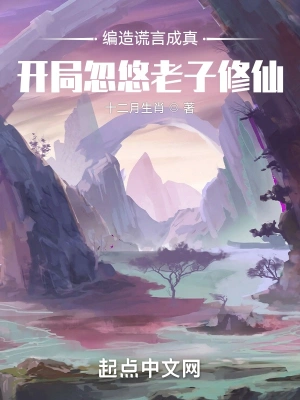
Making Lies Come True: Tricking Laozi into Cultivating Immortality from the Start
编造谎言成真:开局忽悠老子修仙
- Status
- Ongoing
- Length
- 507k Words
- Genre
- Eastern Fantasy
- Subgenre
- Xuanhuan
- Updated
- 3y ago
- Source
- Qidian
Stats
159Chapters
0Votes
14.7kRecs
108.8kFans
Tags
Synopsis
In booklists 1



Readers also read
 I Became a Dangerous Inlet
 The God of the Ming Dynasty: Qi Shaobao's Martial Arts and His Deeds Became a God
 Wu Wu Tabu
 A Three Hundred Year Old Knight Is Not an Immortal
 Forum Troll, Romance Master
 Great Ming: My Brother Is Zhu Yuanzhang, and I'm Founding America
 I Cultivate Divine Trees in the Late Ming Dynasty
 Hong Kong Films: In Wo Hop To, Uncle Deng Begs Me to Take Charge
 I’m Not a Suit-Wearing Thug, I’m a Chameleon Actor!
 I'm Timid in Journey to the West, but I Throw Punches Across the Heavens
 Huang Ting!
 Giant Pandas Become Immortals, Starting from Picking up a World
Reader comments 23
Google Translate
There are some poisonous points in the second chapter. The protagonist is a centenarian but not many people know about him. In the third chapter, I start to show me the creation of Pangu. It can be said that it perfectly transforms this book from a fairy grass into a grain. Later, some book friends said that this is obviously more and more like the prehistoric period, but they are still denying it.
That's it for now. The author has no idea what the readers want to read. The readers come here not to see the protagonist show off his power, or to see you list some Taoist classics with a few thousand words, but to see the performance of these saints after they are truly extraordinary. Watch them establish sects and watch their performance. You don't know what to write. The protagonist is just a golden finger behind the scenes, just copying some classics every day and cheating here. The readers are not fools. You can't make money like this. Do you think your writing is really good if you find a few people at the end of this chapter to say it is good? Take a look at the book review section!
I don't understand why the protagonist can't just write himself into the myth and describe himself as the reincarnation of the sages and powerful people. After completing some task of spreading knowledge, he can obtain the power of his previous life, restore his divine power, and reach the sky in one step. If you have to compile a few exercises at random and practice step by step, you are not as good as others. Do you really think that you are wiser than the ancient sages? Moreover, even the myth of Pangu's creation of heaven can be faked and turned into reality, so what's wrong with adding a reincarnated god to it?
I hope it is an orthodox myth, and don't talk about the ancient times. [Nuwa], [Fuxi], [Da Yi], etc. Are all ancestors and sages, not witches and demons from the ancient times.
How should I put it? The problem is relatively big. Within 100 chapters, it is basically based on the setting. In other words, as a civilization with cultivation, the time span is too short, 10 years, 20 years, such a span, and the span is still the kind of big one that can pull the eggs, and there are , the characters are not three-dimensional at all, very flat, like Laozi and Confucius, the writing is not three-dimensional, there are too many typos, sometimes I even swallow the setting, there are many such plots, there is not enough food and grass, there is a feeling that it is tasteless and a pity to abandon
There is a problem with the writing. The behind-the-scenes stream is not like the group portrait stream. Why do you keep writing protagonists? When you write about the Spring and Autumn Period and the Warring States Period, aren't you trying to capitalize on the popularity of various schools of thought? There are very few words about how to write about them. I always focus on writing about this moment of spiritual thoughts. There are hundreds if not thousands of these words.
The first chapter uses scientific knowledge to establish the character of an academic and heavenly person, and the next chapter popularizes feudal superstition, just like leading party members to sing praises to God before a Marxist-Leninist meeting.
This author keeps filling in the prehistoric setting, and he keeps trying to make sure I don't have it! It's really…
When there is no change at the beginning, it should be a cosmic worldview, and then later it is changed to a mythical worldview. How will the starry sky outside change? Did Pangu open the sky only to the scope of the earth, or did the entire universe change together?
The author has a common sense mistake. The pyramids in South America are the Temple of Asteca. They were built in the Song Dynasty, the Spring and Autumn Period and the Warring States Period. There is no shadow of it. You are wrong. They are not that old.