


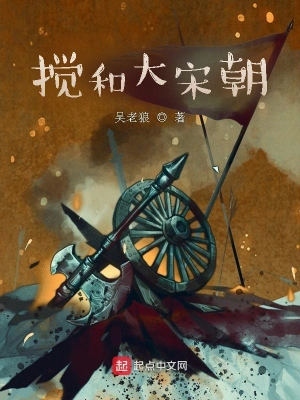
Stirring Up the Great Song Dynasty
搅和大宋朝
- Status
- Completed
- Length
- 653k Words
- Genre
- Historical
- Subgenre
- Alternate History
- Updated
- 4y ago
- Source
- Qidian
Stats
178Chapters
0Votes
38.7kRecs
8.1kFans
Tags
Synopsis
More by this author
 The Rebellious Officials and Traitors of the Late Qing Dynasty
 My Uncle, Emperor Taizong of Song
 Wreaking Havoc in the Great Qing
 The Qianlong Golden Age: No Matter How Hard It Is, We Must Rebel!
 The Han Dynasty Must Grow Stronger
 A Good Kid in the Three Kingdoms
 The Great Song's Powerful Chancellor
 The Northern Song Has a Good Disciple
 Back in the Ming Dynasty as a Talented Scholar
 Junk Food Aid for Shu Han
In booklists 1
Readers also read
 My Only Method: I Will Add More Points to Become Stronger at the End of Ming Dynasty
 My Father Is Wen Tianxiang, and We Win the Battle of Yashan from the Start
 A Guide to Building Civilization in a Primitive Tribe
 Daming: Asking for the Throne at the Beginning, Lao Zhule Went Crazy
 Slaughtering My Way Through the Marvel Universe: Starting with The Boys
 Transmigrating to the Ming Dynasty: I Can Receive Modern Goods
 Express Delivery Across Time and Space in the Northern Song Dynasty
 The Road Less Traveled
 The World of the Extreme Path: Tempering My Body Through Terror
 Liu Xie: I Really Just Want to Abdicate!
 A Plan to Revive the Northern Song
 Giant Ship Across the Song Dynasty: My Supplies Come from My Homeland
Back in the Ming Dynasty as a Talented Scholar
The Northern Song Has a Good Disciple
Junk Food Aid for Shu Han
The Great Song's Powerful Chancellor
A Good Kid in the Three Kingdoms
The Han Dynasty Must Grow Stronger
The Qianlong Golden Age: No Matter How Hard It Is, We Must Rebel!
Wreaking Havoc in the Great Qing
Giant Ship Across the Song Dynasty: My Supplies Come from My Homeland
Back in the Ming Dynasty as a Talented Scholar
The Northern Song Has a Good Disciple
Junk Food Aid for Shu Han
The Great Song's Powerful Chancellor
A Good Kid in the Three Kingdoms
The Han Dynasty Must Grow Stronger
The Qianlong Golden Age: No Matter How Hard It Is, We Must Rebel!
Wreaking Havoc in the Great Qing
Reader comments 34
Google Translate
When traveling through the Song Dynasty, the first thing is to never have any expectations for the Song Dynasty. This is just a puddle of shit, and it is still thin.
No system writing this time. Just write in your previous style. Stop working on system documentation
I really can't stand the last two system articles. Your previous style of Zhang Haogu and Tao Ying is really good-looking. The previous Song Dynasty movie was also pretty good.
It feels like we are going back to the same old path again, struggling to survive. What does a time traveler think of the feudal era? After rebelling and killing the officials' henchmen, he wants to live a happy life. What is the concept of the emperor and officials in the protagonist's mind? The difference between Lao Lang and other historical novels is that the protagonist feels too secure and feels awkward.
Isn't it good to write history properly? I have to write a system, but there is no sense of historical immersion, and it always feels like playing a game. I have been an old reader of yours for more than ten years, but I can't read your last two systematic articles at all. If you just write about history and hegemony, it would be better than this. If you just write about fighting against the Qing Dynasty, I can still read it. I think your editor has a grudge against you, and the systematic article is not suitable for you, and he still asks you to write it.
After half a year of struggling, and with the help of Taobao Goldfinger, I couldn't even raise an elite army of a thousand people, and they eagerly surrendered. I was speechless.
In recent years, Lao Lang has really regressed more and more as he wrote. Did he sell his account? According to the previous writing method, if he harmed the Qing Dynasty and returned to the Ming Dynasty to be a scholar at his peak, would he not be able to write good books?
Take a look at those historical hits. Do any of them have systems? You were originally making Roujiamo, but seeing that milk tea was selling well, you changed the soup in the Roujiamo to milk tea. Can you eat milk tea-flavored Roujiamo? Originally, Zhang Haogu and Wu Yingxiong wrote very well. Recently, anti-Qing articles in the late Ming and early Qing Dynasties have become very popular. Why not do what you are good at?
After the Song Dynasty moved south, emperors, nobles, civil servants, generals, landlords, and businessmen set off a frenzy to annex land. It is no longer an uncommon phenomenon for large landowners to charge a hundred thousand in rent. There are about 100,000 acres of polder fields in Shijiu and Gucheng Lakes in Lishui County, stretching for 84 miles, and are named Yongfeng Polder. At first it was owned by the government and shared by the common people. Later, the Song Dynasty gave Yongfengwei to Cai Jing, then to Han Shizhong, and later to Qin Hui. They were granted as much as 100,000 acres of land at one time, so the amount of land they occupied was huge. Qin Hui's "farm property was very rich" in Jinling, which can be seen in records such as Yongning Village, Jingshan Village, etc. Qin Hui's descendants are said to be "in decline" and "productive", but they still earn an income of 100,000 shi from renting rice every year. Zhang Jun, a military general of Qin Hui's party, liked to cultivate land. After he resigned, he still earned 600,000 dendrobium from renting rice every year. If the average land rent is less than one hu of dendrobium per mu, it equates to 600,000 to 700,000 acres of land. In 1151, Emperor Gaozong went to Zhang Jun's house. Zhang Jun met him and held a banquet, including hundreds of kinds of fine wine, food, and fruits. He also presented a variety of treasures, including a thousand taels of gold, more than 69,000 beads, 20 agate bowls, more than 40 pieces of various fine jades, a thousand pieces of silk, brocade and cotton, as well as various valuable antiques, calligraphy and paintings. Zhang Jun, who collected rent at home, was luxurious and extravagant, surpassing the nobles of the Northern Song Dynasty and even the Tang Dynasty. Bureaucrats such as Qin Hui and Zhang Jun all owned hundreds of thousands of acres of fertile land. Politically, they advocated surrender and compromise to maintain peace in Jiangnan, which reflected the interests of the large landowners who had annexed large tracts of land. In the early Northern Song Dynasty, there were no special legal provisions for landlords to kill tenants. It was not until the time of Zhezong Yuanyou (first author Shenzong Yuanfeng) that it was clearly stipulated that if the landlord beat the tenant to death, his crime would be reduced to one level, and he would be sent to a neighboring state. In 1131 (the first year of Emperor Gaozong's Shaoxing reign), the Southern Song Dynasty government stipulated that the crime should be reduced to one level and instead be distributed to the state. This actually reduced the legal status of tenants continuously. According to the "Records of the Years Since Jianyan", the tenants "had their lives taken lightly, and the rich dared to kill them". The tenants even lost their basic right to life. In 1190 (the first year of Guangzong Shaoxi), the Southern Song Dynasty also stipulated that tenants could not sue the landlords. This means that the tenants can only obey the landlord's will to slaughter and enslave, and they no longer have the right to complain. At the end of the Southern Song Dynasty, the wife of the bureaucrat Wu Sijing, Duan, accused the tenant brothers Xie Wuyi of "stealing and burying" the Wu family's land to the government, causing the Wu family's "feng shui to pass for six years." Without asking the reason, the local officials concluded that the Xie Wuyi brothers were competing with the landlords for land, disregarding their "ownership as tenants" and "bullying their mistresses and widows", and severely punished the Xie Wuyi brothers. Officials also believed that in matters like this, the government should come out to "lead the alliance". Otherwise, not only would the landlord Duan be "unburied," but in the future, tenants could seize landowners who were far away from their fields. So what was the use of setting up officials in the court? When the Yuan Dynasty destroyed the Song Dynasty, Kublai Khan had gradually established a feudal ruling order. When the Yuan army went south to fight, it no longer simply aimed at plundering slaves, but instead focused on preserving the wealth in the south of the Yangtze River. Therefore, after the fall of the Southern Song Dynasty, the system of exploitation in the south and the power of Han landlords basically continued. The Yuan Dynasty appointed Mongolian and Semu officials to rule in various places south of the Yangtze River. However, these officials are only greedy for wealth and do not know the affairs of Jiangnan. Therefore, they are often manipulated by wealthy southerners. "Yuan Dian Zhang·Xing Bu 19" contains a report from Hangzhou Road in the eleventh year of Dade: "People who control the government are everywhere, and Hangzhou is the most controlling one. Whenever an official comes to take office, he will try every means to stab him or ask for his relatives. If you know how to introduce someone, or bribe someone to brag about it, you will be tricked by him. He will first give it to you through taste, and then you will get a glimpse of what he likes, and then you will give him a beautiful woman if he is interested in sex, and bribe the king's silk to someone who is greedy for money. Those who are fond of strange people play with them. Gradually, their friendship becomes deeper, and they are regarded as brothers regardless of whether they are worthy or unworthy. ... Corrupt officials swallow their bait, and they only obey orders, do what they want to do, and stop when they want to stop." The official document said that the wealthy and merging families were "powerful and self-absorbed, powerful and difficult to control, and they insulted provincial officials, which is a child's play." Mongolian Semu officials had to rely on Han officials to handle official business, and to transport conscripts by sea to Qiangu to book books. And these officials often have friendships with local landowners, or they are from wealthy families, and they pay for their purchases. Communication up and down, both inside and outside are treacherous. Most of the government offices at all levels in Lufu, prefecture and counties are controlled by local wealthy landlords. Since the large landowners in the south of the Yangtze River were able to control the government, they could expand their land holdings unscrupulously. Landowners with many fields can collect rents of up to 200,000 to 300,000 dan per year, and tenant households can charge up to 2,000 to 3,000 dan per year. Cao Mengyan, a large landowner in Songjiang, occupied tens of thousands of acres of land in Dianshan Lake alone and accumulated millions of grains. The Mongols called him "Rich Manzi". Qu Tingfa, another big landowner in Songjiang, had a total of ten thousand hectares of his own land and land from tenants. He was known as the "Man of Many Fields". Most of the land in various places is concentrated in the hands of a few large landowners. The fields belonging to Fifty Capitals in Chong'an County, Fujian Province, have a total tax of 6,000 shi, of which 5,000 shi come from fifty large landowners. This means that five-sixths of the land is owned by fifty large landowners. Large landowners charge huge land rents and can continue to purchase land. After the fall of the Southern Song Dynasty, some official land was also seized by powerful landowners. The big landowners who arrogantly occupied one area had indeed "no title but the nobility of a king, no seal but the power of the government" (Zhao Tianlin: "Taiping Jinjing Policy"). After Zhu Yuanzhang ascended the throne, he ordered the compilation of the "Daming Code" modeled on the system of the Han and Tang Dynasties, allowing tenants to sue landlords. Landowners who injured tenants must pay compensation, and if they killed tenants, they had to pay with their lives. In this way, Chinese farmers regained the treatment of household registration and equalization of the people during the Han and Tang Dynasties, which they had lost for a full 240 years (from the founding of the Southern Song Dynasty to the founding of the Ming Dynasty).
What the Northern Song Dynasty lacked was not strength, but integrity