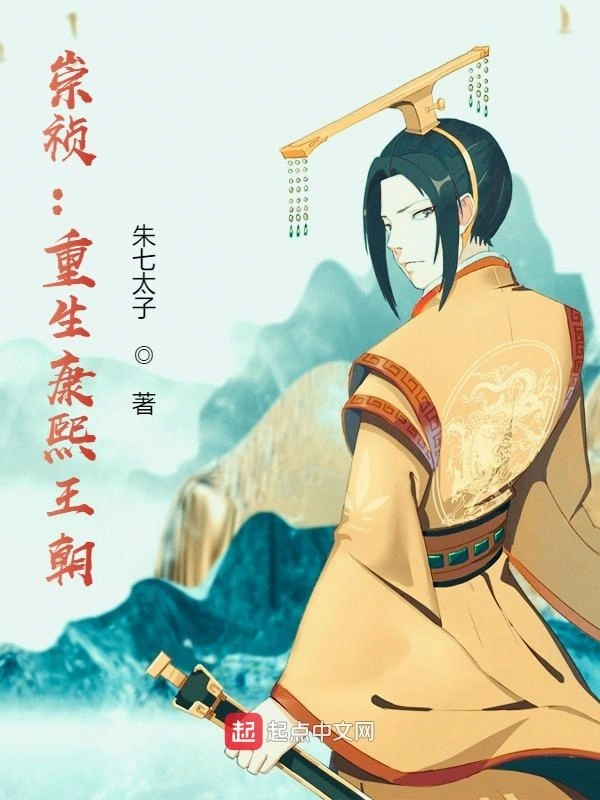
Chongzhen: Rebirth of the Kangxi Dynasty
崇祯:重生康熙王朝
- Status
- Completed
- Length
- 213k Words
- Genre
- Historical
- Audience
- Male
- Subgenre
- Qing & Republican Era
- Updated
- 4y ago
- Source
- Qidian
Stats
0Monthly votes
156Recommends
0Fans
100Chapters
Synopsis
Reader comments
Readers also read
 Please Call Me Your Majesty the Tsar
 1914 Begins with the Rejection of the Schlieffen Plan
 In the Red Mansion: Escort Daiyu to Beijing at the Beginning
 Talker in the Song Dynasty
 Taichang Daming
 Liu Xie: I Really Just Want to Give In!
 Covering the Sky, but the Heroine Script
 Is This the World of Pai Lao? Ada Thief!
 The Full-Time Master Left Tyranny and Became the King of Chainsaw Grinding
 The Ashes of the Southern Ming Dynasty
 The Immortal Sect Has Been Imprisoned for Eternity, I Will Deal with the Gods and Demons
 1900: the Road to Unification of Physics by Top Academics
Last time I saw a man from Yongle who wore Yongzheng, here comes another from Chongzhen who wore Kangxi.
Your Majesty, don't forget Prince Zhu. Your son is smashed! This is indispensable. This is the most important clan.
By the way, can Wang Shide appear? Wang Shide, courtesy name Kecheng and Shuanggao, was a native of Daxing County (now Daxing County, Beijing) in the Ming Dynasty. He wrote the book "Chongzhen Legacy". At the end of the Ming Dynasty, Wang Shide's son inherited his father's legacy, and the hereditary Jin Yiwei commanded the general affairs. At that time, Li Zicheng rose up and the war became more intense. The rebel army finally captured Beijing. The rivers were shattered and the emperor hanged himself. With a heart full of sorrow for the country's subjugation, Wang Shide fled with his family all the way to the south of the Yangtze River. From then on, he lived in seclusion, did not enter an official career, and settled in a plain civilian life. After the fall of the Ming Dynasty, some unofficial history notes were very critical of Emperor Chongzhen. Wang Shide could be said to be deeply disgusted by this, so he took up writing to counterattack, calling the authors of these books "heartless and unscrupulous people". In the book "Chongzhen Legacy", he tried his best to defend Emperor Chongzhen and the royal family in every possible way, and refute the so-called "untrue" words in the unofficial notes. In Wang Shide's writings, Emperor Chongzhen was diligent and thrifty, worked hard to govern, and took care of everything for the people's livelihood. It was only the corruption and incompetence of the officials that led to the overthrow of the country and the change of hands to foreigners. "Chongzhen Legacy" also tried its best to absolve the eunuchs of the eunuch's guilt, which is probably related to the fact that the author himself was a palace servant. Although there are many whitewashing words, the author often visited the palace and understood some specific situations, so the recorded content is still extremely valuable historical data. Since the "Chongzhen Legacy" records the historical events of the Chongzhen Dynasty, it praises Chongzhen's virtues, and contains many criticisms of the Qing court. All these violate the taboos of the Qing court. Therefore, in the forty-seventh year of Qianlong's reign, the officials of the Siku Library petitioned the court to ban it and destroy it. Probably because it was banned, the book has never been published in print. The Zhejiang Provincial Library has Zhang's handwritten banknotes in Haining, and the Nanjing Library and Peking University Library also have banknotes. There is also a collection of Shanjingshe manuscripts in "Collection of Chinese Unofficial History". This Wang Shide can be said to be the ultimate licking dog of Emperor Chongzhen. In history, Emperor Chongzhen ended up like a crooked neck tree in Meishan, but he still licked as always. It seems that he lived for more than eighty years before dying. Your Majesty should have a chance to find him now. For a person who defends his reputation in his previous life in every possible way, His Majesty can't help but be a little touched! After rebirth, it's hard to say whether you can fight against the Qing Dynasty and restore the Ming Dynasty. You can't continue to be the emperor in the Forbidden City by yourself, but let the people who cared about you in your previous life continue to feel sorry for you throughout your life. If Chongzhen really met Wang Shide, the place of meeting could actually be Si Ling, the mausoleum of Chongzhen's previous life. Wang Shide could pay homage to his late master, and Chongzhen could also go to the tomb of his previous life to repent, so that Chongzhen and Wang Shide could meet.
Zhu Youjian traveled through Kangxi? It seems that there is hope for overthrowing the Qing Dynasty and restoring the Ming Dynasty.
In fact, because the author of the novel "Emperor Kangxi", Er Yuehe, has insufficient historical data, many characters from the Kangxi Dynasty did not appear at all. For example, Chen Yanjing, the prime minister of the Qing Dynasty, was not written about. And how Kangxi put down Wu Sangui is also very simple. The only one left is Zhou Peigong. I hope the author will base his writing on historical data and come up with new ideas.
Then absolutely eunuch! What are you thinking about?
Wu Sangui regained the Ming Dynasty or Galdan re-established the Yuan Dynasty
This plot is interesting
I hope there are some new ideas and don't borrow too much from "Kangxi Dynasty"
No, Lin Ruhai has already appeared, so Daiyu can't come?
The Minister of Punishment retired and brought several large boxes with him. When Kangxi opened the box, he saw that they were all filled with iron nails Bo Shi Tongjin Original 2020-10-28 15:27 · Creators in the field of high-quality history In the 23rd year of Kangxi's reign in the Qing Dynasty, Emperor Kangxi encountered a difficult matter. At that time, Wei Xiangshu was 69 years old and had reached the age of becoming an official. However, Kangxi was very reluctant to let go because Kangxi knew that Wei Xiangshu was an honest official and it was a time of employment, so he was reluctant to let Wei Xiangshu return to his hometown. Wei Xiangshu knew that Kangxi had not approved his memorial, so he knelt in front of the Qianqing Gate and begged. Kangxi finally relented and agreed to Wei Xiangshu's request, and gave him a plaque to send the old minister back home along the way. Unexpectedly, as soon as Wei Xiangshu left the outskirts of Beijing, big trouble would arise. University scholar Suo Etu and others reported that Wei Xiangshu had brought several large boxes with him when he returned to his hometown, and the boxes were filled with treasures. They hoped that Kangxi would conduct a thorough investigation. After receiving the report, Kangxi was very confused, because Wei Xiangshu boasted that he "swore not a penny" and had been an official for many years. He was honest and honest and did not embezzle a penny. How did he get so much money? But Suo'etu said that he had a nose and eyes, and said that the box was very heavy and must be gold and silver. Kangxi was 30 years old at the time and was in his prime. After being encouraged by Suo'etu, he immediately sent people to intercept Wei Xiangshu. Kangxi regretted it as soon as he gave the order. After all, Wei Xiangshu was a veteran of two dynasties and had worked hard for the court for many years. Even if he embezzled some gold and silver, he should leave some dignity to the old minister. It's a pity that the order has been issued, and I regret it so much that I can only wait for the result. Let's talk about Wei Xiangshu first. Wei Xiangshu, courtesy name Huanji, was born in Yuzhou, Hebei Province. In the third year of Shunzhi, he became a Jinshi in high school, entered the Hanlin Academy, and later served as censor. From the day he became an official, Wei Xiangshu vowed not to embezzle any money from the people and was willing to be a poor official. He was an upright official and was not afraid of the powerful. Moreover, as a censor, his impeachments were based on facts and were never fabricated. He was praised by Kangxi as a model of honest officials. During the Kangxi period, Suo'etu, a great scholar, gained power in both the government and the public, and formed cliques for personal gain. Wei Xiangshu repeatedly wrote to impeach Suo'etu. In order to retaliate, Suo'etu tried every means to impeach Wei Xiangshu, but unfortunately he failed. In the eighteenth year of Kangxi, Wei Xiangshu was promoted from Zuodu Censor to Minister of the Ministry of Justice. He took the initiative to write a letter and refused to leave the position of Censor. Kangxi made an exception and made him serve as Minister of the Ministry of Justice and concurrently as Zuodu Censor. After that, Wei Xiangshu collected evidence and overthrew three frontier officials including Shanxi Governor Wang Keshan, which caused a sensation. In the 23rd year of Kangxi, Wei Xiangshu could not continue to serve as an official due to physical reasons, so he requested to retire and return to his hometown. Kangxi failed to retain him, so he had to let him return home. Unexpectedly, he got into trouble because he brought several large boxes. It turned out that when Wei Xiangshu passed by the post station, a postman helped carry his luggage. He found that Wei Xiangshu's box was very heavy and did not look like clothes, books, etc. It must be gold and silver treasures, so he reported it to Suo Etu. Suo'etu hated Wei Xiangshu so much, how could he miss this opportunity? So he complained to Kangxi and asked Kangxi to investigate Wei Xiangshu's "dirty silver" and punish Wei Xiangshu. It is said that Kangxi sent people to intercept Wei Xiangshu back from the suburbs of Beijing. Wei Xiangshu looked confused, thinking that Kangxi regretted letting him return home. Unexpectedly, Suo'etu and the others were already waiting for him at the gate of the palace. Wei Xiangshu seemed to understand what was going on. He immediately straightened his back and tilted his body to see what tricks Suo Etu had in store. After a while, Emperor Kangxi rushed to the scene. In front of everyone, Kangxi ordered people to open Wei Xiangshu's box. Suo'etu and others poked their heads, waiting to see Wei Xiangshu's joke. Unexpectedly, when the box was opened, everyone was dumbfounded - several large boxes were filled with nails. Seeing this result, Kangxi was also very embarrassed, so he forced a smile and asked Wei Xiangshu: "Why does Aiqing bring so many iron nails when she returns to her hometown?" Wei Xiangshu replied: "When I was young, every time it was windy and cold, I would go to Yuzhou Township. My house often collapsed and was damaged. I saw that the nails in the capital were slightly longer than those in my hometown, so I bought a few boxes and gave them to the villagers to strengthen their houses." Kangxi was very ashamed after hearing this, and ordered Wei Xiangshu to be rewarded with some gold and silver, and sent someone to send him back to his hometown. As for Suo'etu, he had already retreated to the back of the crowd. More than a year after Wei Xiangshu returned home, he died of illness at home. Kangxi was very sad and sent the Ministry of Rites to host his funeral and gave him the posthumous title "Minguo". During the Qianlong period, Qianlong still said: "You should be like Wei Xiangshu when speaking about officials." When you serve as an official, you should be honest and honest without losing your original intention, so that you can be famous for generations. Wei Xiangshu is a truly honest official. This article refers to "Manuscripts of Qing History" and "Prosecutors in History"