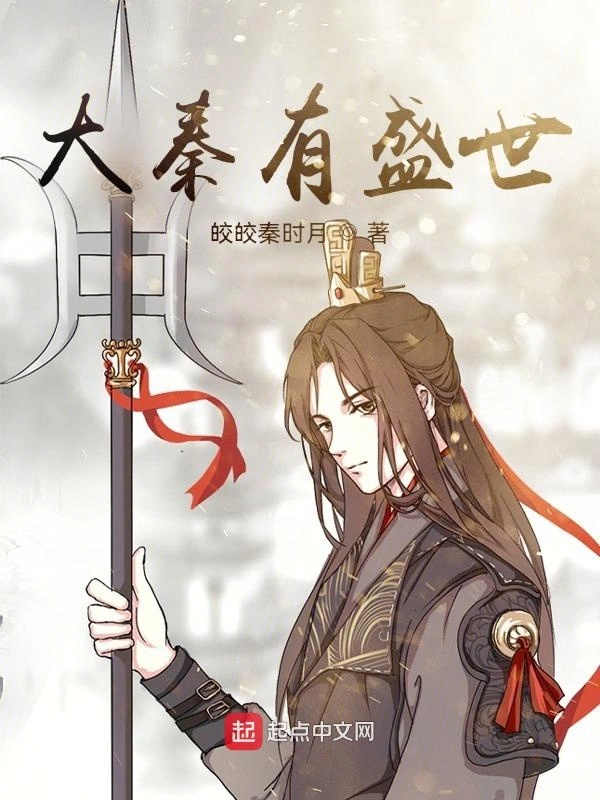
The Qin Dynasty Had a Prosperous Period
大秦有盛世
- Status
- Completed
- Length
- 1.8M Words
- Genre
- Historical
- Audience
- Male
- Subgenre
- Qin-Han & Three Kingdoms
- Updated
- 1mo ago
- Source
- Qidian
Stats
0Monthly votes
33.3kRecommends
87.2kFans
818Chapters
Tags
Synopsis
Reader comments
Readers also read
 1914 Begins with the Rejection of the Schlieffen Plan
 Talker in the Song Dynasty
 Please Call Me Your Majesty the Tsar
 In the Red Mansion: Escort Daiyu to Beijing at the Beginning
 Three Kingdoms: Ji Han Liu Zhang
 The Sun and the Moon Are Always There
 Liu Xie: I Really Just Want to Give In!
 The Tang Dynasty Began with the Heian Shi Rebellion
 Emperor Ning Has the Guts
 Travel Through the Ming Dynasty and Become a Tyrant
 The Age of Huangtian
 My Eldest Brother's Name Is Zhu Chongba
 Da Qin: Xuanwu Sect Succession Law
 Da Qin: Join the Spy Network at the Beginning
 Your Majesty, Fusu Has Rebelled!
 Qin Yan
A country has its limits
Why was ancient China only so big? Why can't the North invade Europe and directly unify Eurasia? Does China not want to become bigger? Why does China not annex it directly despite its vast territory and large population, but it also has neighboring countries and vassal states? The main reason that limits a country's expansion is transportation! First, the main benefit of a country's expansion is the output of the land, including grain, minerals, specialty animals and plants, etc. And these outputs need to be transported back to the treasury. Due to the influence of ancient transportation conditions, transporting materials requires a large number of people to escort them, otherwise they will be easily robbed by bandits, and the food, drink, housing and transportation of these people are all public funds. When the output benefit of a place is not even enough to cover the round trip expenses of the transportation team, you will lose money by occupying this land. What's more, the land in the north is grassland and cannot even grow crops, so it will naturally not be in the eyes of our farming civilization. We are not fools. Except for some emperors who are eager to show off their martial arts and expand their territories, who would do such a thankless thing? Second, some people have said that since the land output cannot keep up with the transportation costs, then we will not transport them at all and only transport some small and precious treasures. That will be alright. Once this happens, due to the communication inconvenience caused by transportation, the officials you send there are the feudal officials and overseas emperors, and the power is concentrated in the hands of one or a few people. Are you sure that the orders you issued in the past are still valid? Paying tribute every year, how is this different from the vassal system? Third, it is difficult to attack but difficult to defend. Conquering a distant land is a great test of logistical capabilities. If you want the army to win the war, you must first ensure that the soldiers are well fed, and this is a test of logistics. The three armies have not moved, and the food and grass go first. If you want to transport grain from all over the country, the smaller the land area, the smaller the grain loss; the larger the land area, the greater the loss. Ten kilograms of grain are transported from the south of the Yangtze River. When it reaches the north, less than one kilogram is left, which puts great pressure on logistics. It's a strategy that doesn't pay off. So there is a limit to the size of a country, and what limits it is transportation and communication capabilities. If you want to be rich, build roads first!
Frankly speaking, except for the time travel to Fusu in one step, the rest are full of literary youths Any doctorate in Chinese is superfluous As the author said, anyone who has learned well in the nine-year compulsory education can do well The first 5 chapters are mediocre Qin II is still Fusu even if he doesn't do anything I feel that after time traveling, I am not high-spirited, but still feeling sorry for myself Impressions after watching the first 5 chapters
Good guy, it's almost 300 chapters and we haven't even started yet. When will the prince be crowned?
The root cause of the Qin Dynasty's demise The Han Dynasty inherited the Qin system and inherited the imperial system of centralized monarchy. However, the social ethics behind this system (from Legalist society to Confucian-Legal society) have undergone earth-shaking changes. The root cause of the demise of the Qin Empire was that after unifying the world, it continued to follow the extreme legalist model, instead of turning to a moderate and stable Confucian-Legal society like the Han Dynasty. This is like driving a fast-moving carriage. It is not certain to fail, but it is extremely difficult to control. 1. Qin and Han Dynasty System: Overview of the Central Group System In the feudal dynasty, the king, as the core of the empire, drove the operation of the empire. The institutional structure behind it is generally shown in the figure below. Royal Circle: The weapon of the country must not be shown to others In the imperial city, there are three types of people closest to the emperor, the prince, the eunuch, and the relatives in the harem. This type of person has a natural political advantage over ministers. It is easy for them to use close relationships to occupy high positions, form cliques, and thus threaten the imperial power. 2. Central circle: the imperial power falls and powerful ministers emerge Among the hundreds of officials in the imperial court, the three princes: the prime minister, the Taiwei, and the imperial censor are the most noble. Among them, the imperial censor is in charge of supervision, the Taiwei is in charge of military affairs, and the prime minister is the head of the officials and directs the political affairs of the empire. The imperial censor was a ruthless character who monitored hundreds of officials, but had no real military and political power. Although the Taiwei was the nominal military leader, the highest military power in the empire was held by the king. The recruitment of troops exceeding fifty must be approved by the king. The general cannot mobilize his troops without the King's Tiger Talisman. Taiwei is just the king's military adviser. The person who is really likely to conflict with the imperial power is the prime minister. After Emperor Wu of the Han Dynasty came to the throne, he felt that the power of the prime minister was limited, so he established China and North Korea and established his own decision-making team. 3. Local circles: officials and ordinary people During the Qin and Han Dynasties, the empire implemented a system of counties and counties, and important local military and political affairs were carried out by county guards. The rise and fall of dynasties can be gleaned from the central government's control over local governments. During the Qin Dynasty, prefectures and counties were not divided into enfeoffments; military power was concentrated in the central government and strong supervision and assessment was exercised over local areas; by the end of the Eastern Han Dynasty, the central government was corrupt, and prefectures and counties recruited troops one after another, disobeying the central government, and started killing and causing rebellion. There is nothing wrong with the system, but what is wrong is the king and the ministers in the system In addition to the checks and balances of power, the central and local governments also have a two-out and one-in relationship. The two came out as government decrees and enlightenment, which were spread from the central government to all the people in the prefectures and counties. Once entering, it is an upward passage for local talents to enter the central government. In these three aspects, the Confucian and Legalist concepts of governing the country are quite different. See below for details. 2. Differences between Qin and Han: The Collapse of Legalist Society in Qin To analyze the demise of Qin, one must first clearly understand its prosperity. For the Qin State, Shang Yang's reforms established military merit, established prefectures and counties, suppressed aristocratic forces, and strengthened the centralization of monarchy. These are the things that the Six Kingdoms' reforms did. What really transformed the Qin Empire into a country of tigers and wolves was the social ethics behind the system - a Legalist society that eliminated private practices and implemented public laws. And the more fierce the competition, the more extreme the system will be promoted. The Warring States Period was a radical and bloody era, with constant killings and heroes emerging one after another. Even military wizards such as Wu Qi and Sun Bin cannot determine the world by themselves. If a hero wants to unify the world, he must change the system of a country. In terms of institutional reform, Shang Yang went the most profound and most effective way. Since then, although the six countries were sometimes able to outperform Qin in terms of military and diplomacy, they had fallen far behind in terms of long-term national destiny. From a border country to a country of tigers and wolves, how did Shang Yang do it? 1. The three major politics of Shang Yang's Legalism Before building legalist social relations, we must first understand Shang Yang's political philosophy: iron law controls people; the whole country system; and the one hole. Based on these three philosophical viewpoints, all political changes made by Shang Yang are natural and will happen naturally. Iron law controls people: it is the moral law of Legalism. In terms of looking at the relationship between people, Confucianism advocates not to do to others what you do not want others to do to you (the Silver Rule), and that a gentleman should be loyal, forgiving, benevolent and righteous, and even influence all living beings with virtue (the Golden Rule). Restricting the people with benevolence, righteousness and morality is a lofty state, but during the Warring States Period, it was very unrealistic. Legalism therefore went to the other extreme, completely abandoning benevolence and righteousness, and constructing the entire value system from the perspective of the worst aspects of human nature. The king is not afraid that his ministers will be disloyal, but makes him have to be loyal; he is not afraid that the people will cause chaos, but makes them unable to cause rebellion. In terms of education, choose violent deterrence rather than etiquette and moral education. Minor crimes should be severely punished, and the punishment should be severe. Nationwide system: Extreme competition requires a totalitarian system. If Qin wants to strive for hegemony, then hegemony must become the national goal. The ideal of the king must be thoroughly implemented in every citizen. The citizens may have their own unique ideals: to be a craftsman, a speaker... But under the Qin State's dream of hegemony, they were all ruthlessly crushed. The whole country is engaged in farming and fighting, striving for power and hegemony, which is the only ideal of the people. Among the six kingdoms, war is certainly a normal occurrence, but perhaps only the Zhao State during the period of King Wuling of Zhao could achieve such a thorough national system as Qin. An advantage: The nationwide system can mobilize huge institutional power, but if the power is used dispersedly, it will be in vain. At this point, Shang Yang had great political foresight and concentrated the entire country's strength on farming and war. As the saying goes, if it is not broken, it cannot be established; if it is not blocked, it cannot flow. They severely suppressed industry and commerce, drove away Confucian scholars and lobbyists, abandoned poetry, calligraphy, etiquette, and music, and pursued agriculture and war to the extreme! Thus, a country of tigers and wolves was created. 2. Legalist ethics is practice. The sage serves the country with one reward, one punishment, and one teaching. ——"Shang Jun's Book of Rewards and Punishments" (Legalist Social Ethical Relations) The ethical practice of Shang Yang's Legalists is reflected in the following five aspects. Yu Guo: The ultimate goal is to unify the six countries, and the country's basic national policy is farming and fighting. What about the Six Nations? How many countries can achieve a nationwide system and have a heroic leader who strives for hegemony? Yu Jun: The reason why a king becomes a king is not because of benevolence, justice and morality, but because of the status and power that the king relies on. The king controls his subordinates by relying on the two powers of punishment and reward. Reward for merit and punish for fault. But it is not enough to just enforce the law wisely. During the Spring and Autumn Period and the Warring States Period, countless sons committed regicide, and ministers committed crimes. The king must view the relationship between monarch and ministers and family with extreme interests. And magic power is one of the means. Yu Chen: Legalism never imagined that ministers would be absolutely loyal. It deeply saw the inconsistency between the interests of ministers and kings. All ministers have selfish motives, but the king only needs to control his selfish desires. Therefore, under the Qin State system, every effort has always been made to reuse talents, and at the same time, every effort has been made to check and balance powerful ministers. Yu Min: The Qin State treated its people very roughly. The purpose of the Qin State has never been to manage the world and benefit the people, but to establish dominance. In order to improve the administrative efficiency among the people, Shang Yang forcibly changed the customs of Qin State, letting brothers divide their families to increase production; letting neighbors sit together to supervise each other. For the common people, the empire only left one room for advancement, which was military merit. Regardless of merit or title, the empire's social hierarchy was completely related to war. Yu Fa: In terms of laws, Qin is famous for being strict and onerous. Minor crimes require heavy punishment, not seeking fairness and equality, but just for legal deterrence; if there is a criminal motive, punish even if not guilty, so that no one will dare to cause chaos again. In troubled times, heavy laws are used, and severe punishments in troubled times, although ruthless, are extremely functional and effective. Yu Jiao: Qin's education was cold and rude, everything was oriented toward farming and war, and morality was just an embellishment. In Shang Jun Shu 9, it is clearly stated that Confucian scholars, political strategists, businessmen, etc. Are the worms of society. If they were reused in the Qin State, the people would rush to imitate them instead of engaging in hard farming and fighting. It can be seen from this that the Qin Empire after Shang Yang's reform was already a totalitarian military system. It was profoundly powerful and terrifying. 3. The dragon has regrets: the collapse of the Legalist system How much destruction there is, there must be much restraint. When we see the Qin Dynasty When the empire is strong, we must see the huge risks behind this system. In order to pursue efficiency, the relationship between monarch and ministers and the relationship between monarch and people is directed towards absolute interests. If the king is unrighteous, why should his ministers be affectionate? Such a system is like a fast-moving machine. Extremely powerful, but also extremely difficult to control. But the First Emperor was not afraid. He was an eternal hero, with monopoly power and determination. Even if Zhao Gao had selfish intentions, he would not dare to act recklessly. Even if Chen Sheng and Wu Guang rebelled at that time, they would be quickly suppressed. During the First Emperor's period, wasn't the resistance of the Six Nations far stronger than that of the Second Qin Dynasty? The world was even more ferocious: Jing Ke and Gao Jianli were assassinated, and Bolangsha attacked... The First Emperor was so dominant that he could steadily control the turbulent situation. Under a peaceful and stable system, Emperor Wanli could rule for thirty years. The empire is stable as usual. But for Qin, in a fast-moving Legalist society, any mistakes will have a hundredfold consequences. After Qin Xiaogong, Qin Huiwang, Qin Zhaoxiang, and Qin Shihuang were all talented and capable. Furthermore, during the war, internal oppression and conflicts could be transformed into external killings; however, Qin II was already in peace, and he was too young and weak, but he was eager to take effect. Imitate the achievements of Qin Shihuang. Favoring eunuchs, killing ministers, alienating soldiers, and ignoring government affairs... He performed the drastic collapse of the empire to a first-class level and became irreversible. 3. The fall of Qin and the rise of Han: the reconstruction of Confucian and Legal society. The collapse of the Qin Empire made the people cheer. After Liu Bang entered the Pass, the people of Qin lined the streets and cheered, fearing that Liu Bang would not become the king of Qin. After the founding of the Han Dynasty, how to learn from the Qin Dynasty and rebuild society became a grand proposition for the thinkers of the Han Dynasty. Conquering the body and the land is easy, but it is extremely difficult to conquer the mind. 1. The twists and turns of foreign Confucianism and internal law (The journey of foreign Confucianism and internal law) History always advances slowly with the twists and turns of positive and negative, and competition has created an extreme Legalist society. Liu Bang is not unaware of the huge executive power of Legalist society, but for the people who have experienced wars for a long time, recuperation is what they desire most! In the early days of the founding of the Han Dynasty, it was here! Under this background, we pursue Huang Lao's philosophy and govern by doing nothing. The so-called governance by inaction does not mean doing nothing, but calming down the troops and easing the rule of officials. Externally, we make peace with the Xiongnu, and internally we use the elders to govern the villagers. Taoism pursues the political ideal of a small country with few people, hoping to abandon the morality of benevolence and justice and return to a primitive society. Although this political concept is unrealistic, it was the best political concept of that era. Make the people ignorant and have no desires, so that the wise will not dare to do anything. If you do nothing, everything will be cured. - "Tao Te Ching" However, things must be reversed. After more than sixty years of accumulation, the people have stopped fighting. The Han Empire began to encounter new crises, internal wealth accumulated, and corruption grew; externally, the Xiongnu became stronger and the army suppressed the country. The powerful leader Emperor Wu of the Han Dynasty revitalized, strengthened centralization, fought for years, and expanded the territory. In name, Emperor Wu was essentially a model of Legalist society, but compared to Qin, he was covered with a thin layer of Confucianism. It was a brilliant idea to avoid the disaster of destroying Qin. During the reign of Emperor Wu, Confucian scholars gradually became the class of scholar-bureaucrats who controlled political affairs in terms of ideology. (Confucian social ethics relationship) And Confucianism almost completely negated the ethical relationships in Legalist society, and thus restructured the ethical relationships between monarchs and ministers, monarchs and people, and families and neighbors. This change has a social background. The kings and princes in that period were from the same family, and the kings and princes inherited their status by their eldest son. The patriarchal law is the law of the country, and the monarchy is based on the blood relationship. The etiquette norms produced have the same effect as the current laws. During the Spring and Autumn Period and the Warring States Period, the economy gradually developed, and the small family replaced the clan economy; at the same time, the officialdom and officialdom gradually disintegrated, and ordinary people could also occupy high positions. In this context of the collapse of etiquette, the Legalists chose to deal with etiquette. The extreme denial of the system proved to be too radical for the society of the time. Confucianism, as opposed to Legalism, was not stupid. They knew that the implementation of clan-style "kinship" would go against the trend. How to establish the loyalty of ministers to the king? This became the pursuit of Confucian scholars in the Han Dynasty. ,,, ,,, ,,Fulfill the obligation of raising the people, and then enjoy the rationalized imperial rights. The relationship between the monarch and his subjects can be understood as a simulated father-son relationship. The filial piety between the son and the wife can be deduced to the following. This inference seemed foolish to later generations, but it was regarded as a norm at the time. The Han Empire practiced filial piety among the people and ministers. Those who were recommended to the center of the empire must strictly abide by the Three Guidelines and Six Disciplines. People. The relationship between the common people is no longer about the tension between inspectors and prosecutors, but the long-standing family ties and customs; between the monarch and his ministers, it is no longer about naked interests, but about loyalty and filial piety. It can be said that although such changes have reduced the efficiency of the legal system, it has given the imperial system greater adaptability. In terms of governing the people, Confucianism does not completely abandon the legal system. De Zhu Xing Fu. Mainly reflected in the Spring and Autumn Period. In handling cases, Confucius' ideas were used to analyze and convict crimes, thereby promoting filial piety and easing social conflicts. If the criminal's motives were good, the crime could be mitigated; relatives could hide their crimes from each other; in the eyes of Legalists, these extremely absurd decisions were not necessarily reasonable in that era, but they were appropriate. Summary: The Han Dynasty inherited the centralized imperial system, but the social ethics and the relationship between monarch and ministers under the system have undergone earth-shaking changes. The pure Legalist society has strong administrative and military efficiency, but it is extremely difficult to control and must have a powerful ruler. Therefore, in the Taiping Era, it was best to ease internal conflicts and reduce the efficiency of the empire. Fortunately, the Han Dynasty completed such a transformation.
Is it wrong to govern the country with benevolence and righteousness? If we use the feudal system, the rule of Huang and Lao, to alleviate the people's power, and then use Confucianism to unify thought (to put it harshly, there are many schools of Confucianism, you can always find a suitable one in the feudal era). Just like the First Emperor who unified the six kingdoms. Don't cherish people's power and abuse it. It was also a matter of time before Fu Su came to power and he would die sooner or later. 🙂 Are the survivors of the Six Kingdoms the castrated obedient people of the Song, Ming, and late Qing dynasties? Liu Bang and Xiang Yu, a great ancestor, a model for emperors of all dynasties, and a military strategist, were so easy to deal with, 🙂 and various princes. 🙂The First Emperor created the Great Unification, but Liu Bang was the successor who was able to fully implement the Great Unification.
Hurry up eunuch
The image of Fusu in the audition
Finished reading How to say it. It just doesn't feel right. Just like it's not spicy enough, it's like it's not salty enough. The affairs of the court, wars, political reform, people's livelihood, etc. Are not described in a simple and in-depth way. They are all just a dragonfly touching the water, just taste it, it is like chicken ribs, it is tasteless to eat, and it is a pity to throw it away. Is it because it's about the Qin Dynasty that I can't write such a heart-stirring and all-powerful plot? I don't know, I dare not say. That's it. Thinking after viewing.
Rare video of Jing Ke's assassination of Qin
Jing Ke stabbed the King of Qin, and the King of Qin walked around the pillar.
A very long reply of 1861 words, the author's attitude is very serious. However, online articles nowadays are full of cool articles. One of the few comments I saw said that the protagonist, as a time traveler, is very cautious all day long and is very unpleasant. Emm, trembling, walking on thin ice, I think the author's writing is very good and true, but it is less interesting than other online articles and the book before when Brother Zheng was still there, maybe the audience is small. π_π, I don't understand it, but I personally like it very much. Of course, if you can add some daily or implicit content to your daily life, it might be easier. Well, I haven't read this book for a long time. I accidentally opened it today. After reading a few chapters, there is not even a paragraph comment. The author is using his love to generate electricity. It's a pity that my wallet is not rich, and I don't even have the money to make a full reservation, so I can only skip and read -.-. A reward of 1,500 points and moral support is all I can do to help the author at the moment. Come on, the author is great. When I have some savings, I will definitely come back and order them all. (Axi, it's better not to say anything, it's so embarrassing😳)
Qin Dynasty Law 1. Height is the standard for criminal liability. Qin Law stipulates that if a minor commits a crime, he will not bear criminal responsibility or receive a reduced criminal punishment. Qin Jian's "Legal Questions and Answers" records: "A is not six feet tall. There is a horse that feeds it. Now the horse has been defeated by a man and cannibalized a stone of people's crops. Is it inappropriate to ask? It should not be discussed to pay for the crops." Also: "A stole cattle. When he stole the cattle, he was six feet tall. He was one year old. When he returned to Zhang, he was six feet seven inches tall. What does it mean to ask A? He should be the first person in the city." Height was established as the standard for bearing criminal responsibility. Refer to the Qin Slips "Cang Lv": "Lichen and Chengdan are not more than six feet and five inches high, and concubines are not more than six feet and two inches high. They are all small." That is, men are six feet five inches and women are six feet two inches (the size of the Qin Dynasty was smaller than today, six feet is about 1.38 Meters today). Those who reach this height begin to bear criminal responsibility, otherwise they will not bear criminal responsibility. 2. Distinguish between intentionality and negligence. "Qin Law attaches great importance to the difference between intentional crimes and negligent crimes. Intentional crimes are called "duan" and negligence is called "misconduct". Intentional crimes are punished with heavier penalties, while negligent crimes are punished with lighter sentences. 3. Theft is criminalized based on the value of the stolen goods. For the crime of theft against property, criminals are convicted according to different levels of stolen goods value. Those with a small stolen goods value are lightly convicted, while those with a large stolen goods value are severely convicted. 4. Joint crime will increase the punishment. That is to say, in terms of punishment for property infringement crimes, crimes committed by two or more people are subject to heavier penalties than individual crimes, and accomplices of five or more are considered serious crimes. 5. Repeat offenders and instigators of crimes shall be subject to heavier penalties. Those who commit crimes again after being sentenced for committing crimes and those who instigate minors to commit crimes shall be subject to heavier penalties. 6. Surrender to mitigate punishment. Qin Law stipulates that anyone who flees with borrowed public property and voluntarily surrenders will not be punished as theft, but as a fugitive. Lichen's concubine surrendered after running away while serving her sentence. She was only whipped fifty times to make up for her term of service. If you can take the initiative to eliminate the consequences of the crime after committing the crime, the penalty can be reduced or reduced. 7. False accusations and rebellion. Those who intentionally fabricate facts and falsely accuse others to convict an innocent person, or to convict a misdemeanor of a felony, constitute the crime of false accusation, and the false accuser shall be punished according to the penalty corresponding to the false accusation. 8. The principle of continuous sitting. The Qin Dynasty continued the joint sitting system of Shang Yang's period. No criminal acts were committed, but it was extremely common for people to be implicated in crimes because of some relationship with the criminals. It can be seen that the laws of the Qin Dynasty were not only strict, but also very scientific and humane. For example, the punishment for accomplices was increased, but the punishment for surrender was reduced. If the consequences of the crime can be eliminated after committing the crime, the punishment can be reduced or reduced, which gave ordinary people an opportunity to make meritorious deeds. Finally, let's look at the punishment names and crimes of the Qin Dynasty. 1. Death penalty. There were many types of death penalty in the Qin Dynasty. Commonly used ones include killing, gouging, cutting in half, splitting in chariot, beheading, abandoning the market, gouging the head, pulling ribs, cooking in a wok, beating in a bag, and fixed killing, etc., Which reflects the cruelty and arbitrariness of execution of death penalty. 2. Corporal punishment. Including ink (tattoo), , beheading of the left and right toes (mace), palace punishment, etc. Usually corporal punishment and hard labor punishment are used together. 3. Punishment. That is, imprisonment in later generations is a punishment that restricts the criminal's personal freedom for a certain period of time and forces unpaid labor. The Qin Dynasty spent a large number of prison sentences on the construction of military facilities and civil engineering projects. The punishments mainly include: Chengdan pounding, Guixin Baican, Lichen concubine, Sikou, Hou, etc., With additional corporal punishment, Kun and resistance, which are divided into different levels. It is generally believed that Qin's punishment did not have systematic provisions on the period of punishment. 4. Property punishment. That is, for certain crimes, criminals are forced to pay a certain amount of property as punishment. Penalties related to property punishment in Qin include debt punishment and redemption punishment: (1) Finance punishment is mainly financial punishment, and there are also property-related forced labor punishments, which are widely used. Minor criminals are punished with debt punishment, debt punishment, debt punishment, etc. (2) Ransom means paying a certain amount of ransom or providing a certain period of servitude in lieu of a sentenced sentence. There are many types of redemption punishments stipulated in the Qin law, which are divided into different levels from redemption of endurance, redemption of tattoo, redemption of palace to redemption of death. Those who had no money to atone for their sins could work in exchange for their sins. 5. Shameful punishment. The Qin Dynasty stipulated humiliating punishments such as Kun (shaving the prisoner's hair) and Nai (shaving the prisoner's beard). The punishment of humiliation is based on the ancient concept that "the hair and skin of the body are received by the parents and should not be abandoned lightly." The punishment of humiliation is often used as an additional punishment to the prison sentence. For example, in the Qin Dynasty bamboo slips, "kun tongs, Chengdan pound" and "endurance is ghost salary". 6. Other punishments. If it applies to the punishments of deposed, tempered, exempted, confiscated (confiscation of membership), and relocated for minor crimes committed by officials. There were many types of crimes stipulated in the laws of the Qin Dynasty. In addition to common crimes such as rebellion, banditry, and disrespecting the emperor, there were also crimes that punished ideological and speech crimes such as slander and evil speech, using the past to be different from the present, lying, speaking inappropriately, and writing letters, which reflected the characteristics of authoritarian laws. In addition, it also stipulates the crime of stealing and sealing, which punishes the crime of secretly moving field boundary signs in an attempt to usurp other people's property. In December 1975, 1,155 bamboo slips were unearthed from Qin tombs in Suihudi, Yunmeng County, Hubei Province, called "Yunmeng Qin Slips", which contain a large number of Qin laws, mainly including: laws, legal questions and answers, medical seals, ways of serving as officials, etc. The laws include "Eighteen Kinds of Qin Code", "Xiao Code" and "Qin Code Miscellanies", covering a wide range of content. The main code names found are: "Tian Code", "Stage Code", "Cang Code", "Jinbu Code", "Guanshi Code", "Gong Code", "Gongcheng", "Jun Gong Code", "Corvee Code", "Si Code" There are nearly 30 kinds of laws, such as "Empty Code", "Military Code", "Placement Code", "Execution Code", "Shi Chuan Code", "Executive Code", "Internal History Miscellaneous", "Wei Za Code", "Removal of Officials Code", "Removal of Disciples Code", "Cow and Sheep Class", "Fu Code", "Guard Code" and "Thief Catching Code". "The Way of Being an Official" stipulates the standards and requirements that officials should follow when serving as officials. This shows how detailed and complicated the legal provisions of Qin were.
There is only one reason for the demise of Qin. It was not suitable for this era, so it perished. It cannot be changed by one person traveling through time.
To be honest, this is the most perfect image of Ying Zheng in my mind
The enfeoffment system can govern the largest territory at the lowest cost, which is far better than Western colonial rule. As long as you are not stupid enough to do it on your own territory,
😏 Please don't subscribe, I'm waiting for bikini in the group
No matter what, the most powerful emperor. There are only two in my mind. Emperor Qin. Emperor Yongle. And what makes me most ashamed is. All the great powers miss our Qing Dynasty
11
I feel like you have found the reason why your book is not popular. The book is basically full of calculations, and there is no trace of human touch at all. Reality is not such a real method. This is a novel, not history. Besides, there are many humane kings in history. The typical ones are Liu Xiu and Zhu Youtang The Great Qin Empire's Xiaogong Shang Yang, King Huiwen and Zhang Yi The Romance of the Three Kingdoms Liu Bei, Guan Yu, Zhang Fei, Zhuge Liang, Cao Cao, Guo Jiaxun, Sun Sunquan and Zhou Yu Water Margin, not to mention Aren't these characters full of humaneness and deep affection that are loved by the audience? The characters in this book are calculated and guessed every day. Except for Xiao He, I have never seen anyone who feels sorry for the emperor. Then Xiao He was hidden by the author 🤫 In the early stage of the novel, there are two characters, the first emperor and the protagonist, and later there is Xiao He. The protagonist is now alone, with no close people around him. If it weren't for the reason of revitalizing China, I don't know how the protagonist could persevere.
Being self-righteous and writing too detailed will be a flaw
It looked amazing at the beginning, but it became more and more weak towards the end, and many characters gave me a very one-sided feeling. Especially the original plot after the First Emperor is gone, I always feel that without the support of the First Emperor, the personal charm of the protagonist plummets. Alas:-(Many of the plots in the back look messy, giving people a feeling of anticlimactic.
I won't read it for now. I'll wait until the author's plot advances beyond the Central Plains. It's boring to always write about the political struggle between the emperor and his ministers.
Isn't it written about Ying Zheng as the protagonist? How to travel through time and become Fusu. I have read several articles like this and have no interest in reading them. The author's writing style is indeed not good.
I felt that the author's writing was very immature. I recommended the Ming Dynasty TV series to the author. I felt that every character was not flat, and a lot of storytelling techniques needed to be pondered. The human world and sophistication in the court were not black and white. The characters were very three-dimensional and I could watch it over and over again. I was very shocked after watching it. However, many of the characters in this book are very ordinary. It feels like there are various extremes about historical figures, and it has a very unrealistic and abstract feeling. The plot rhythm is not well controlled, and the character structure does not feel established.
Ever since Ying Zheng listened to the sorcerer, the protagonist has changed from Fusu to the Qin Empire, and it doesn't look as lively and interesting as before.
I was bored reading books and came across a good book, The Warring States Period. Belongs to the Red Book The logic is self-consistent and the content is reasonable and popular. The most valuable thing is that the quantity is huge (you know 🤓) and you can't stop eating it I suggest you also go and check it out
The writing is not good, it's so uncomfortable to read
Don't be too harsh on your children, otherwise they will easily become second pillars. It's okay to put some pressure on you, but don't overwhelm yourself. Necessary care must be given. As a modern person, if you cannot educate your children to understand the principles of sticks and candies, it will be counterproductive. The monarchs of the Qin Kingdom in the past dynasties have basically endured hardships. When Yao grows up a little, he can be made anonymous and become a county official, and he can climb up bit by bit. Come from the masses, go to the masses. Wouldn't it be fun to wait for Yao to turn around and reflect on his father's teachings afterwards? Why should father and son kill each other? (To be honest, if we don't show any family affection, the father and son will kill each other)
After all, the writing skills are still poor. Would the nobles of the Qin Dynasty be named after two characters? Don't be ridiculous, Lu Buwei is a businessman.
No brains, a modern man returns to the throne as a god, a son of heaven. Emperor Xin's revolution, alas, was defeated by the princes and nobles.
It's enough if you don't break the theory of God, it's a gift from the Emperor of Heaven. That's it? No wonder it's so poorly written