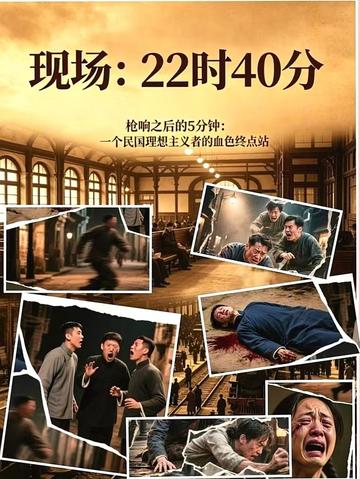
March 20, 1913, from 10:40 to 10:45 p.m. Shanghai, Shanghai-Nanjing Railway Station.
Song Jiaoren, father of China’s constitutional government and acting chairman of the Kuomintang, was shot and fell at the ticket gate. In the five minutes that followed, history veered into darkness.
10:40 PM is a “scene novel”: no protagonist, no omniscient narrator, only the eyes of thirty-five people who were there. As the assassin Wu Shiying pulled the trigger, he was thinking about eight hundred silver dollars. Green Gang boss Ying Guixin stubbed out his cigarette in a second-floor teahouse, weighing Yuan Shikai and Chen Qimei in his mind at the same time. The thief A Guang took advantage of the commotion to cut open a countryman’s pocket and steal two extra silver dollars. Lao Jiao, a discharged soldier, crawled forward on the ground; his body recognized the gunshot before his mind did. The fortune-teller Sun Banxian shouted as the crowd erupted, “I knew bloodshed was coming today!” He didn’t know who had fallen, only that business would be good tomorrow.
From Song Jiaoren’s visions as he lay dying to Yu Youren’s remorse, from a deaf-mute shoe shiner tracing a circle in blood to an eight-year-old beggar remembering the killer’s untied shoelace, from a British reporter pulling out his notebook to a Green Gang lookout pretending to count peanuts... Thirty-five pairs of eyes opened at once, and thirty-five memories each held a piece of the truth. No one at the scene saw the whole picture. Put them together, and you have history, though history remains unresolved.
Five minutes, thirty-five people, one assassination that remains unsolved to this day. This is not a biography of Song Jiaoren, but a collective resurrection of the “nameless bystanders” who were there. The truth is no straight line, but fragments exploding all at once within three hundred seconds.
So special and unusual