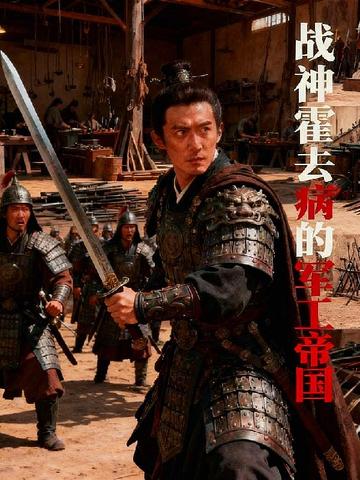
The War God Huo Qubing's Military-Industrial Empire is a historical biography centered on Huo Qubing, the military genius of the Western Han dynasty. Written in an epic style, it portrays how this celebrated young general, who won renown at eighteen and died at twenty-four, streaked across the heavens like a comet and reshaped the balance of power in Asia. The book not only depicts the battlefield legend of his campaign to Mount Langju Xu, but also delves into the technological foundations, military-industrial blueprint, and confidence of the age behind his brilliant victories.
Advances in ironworking technology during the Han dynasty gave Han forces their cutting edge: ring-pommeled sabers forged from repeatedly refined steel and powerful crossbows with a range of four hundred paces gave them a generational advantage over the Xiongnu. Standardized arrowhead production ensured reliable supplies, while precise surveying and the south-pointing compass enabled armies to maneuver accurately across the desert. The Qin Straight Road, beacon-tower network, and mature systems for managing and caring for horses all helped make his lightning-fast tactics possible.
From the Hexi Corridor to Lake Baikal, the work reveals both the martial beauty of war and the hidden currents of decision-making in Weiyang Palace, as well as the Han Empire's diplomatic networks. It offers fresh analysis of Huo Qubing's unusual bond as a subject to Emperor Wu of Han, his tactical complementarity with Wei Qing, and the far-reaching impact of his early death on the course of the war. This is not just the legend of a gifted general, but a sweeping portrait of the Han dynasty at the height of Emperor Wu's reign, showcasing the pinnacle of Chinese civilization's achievements in military technology, national mobilization, and the spirit of expansion.