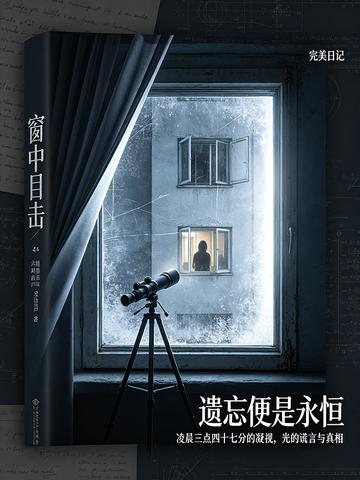
At 3:47 a.m., the criminal investigation unit of the Jiangcheng Public Security Bureau receives an emergency call. The caller is Ye Wan, twenty-eight, a former physics prodigy who now makes a living telling fortunes. She lives alone on the top floor of an old apartment building. She claims to have witnessed a murder in the building opposite through her telescope, while standing at her own window.
When Captain Song Ci arrives with his team, Chen Shusheng, the owner of the west apartment on the sixth floor of Building Three, is already dead. He has been stabbed in the chest, and the pool of blood beneath him has congealed. The doors and windows are locked from the inside. It is a locked-room mystery, with no way for the killer to escape.
This is not the first time Ye Wan has witnessed a murder. Seven years ago, her university adviser, Shen Weijun, a professor of optics, was killed in his home in exactly the same way. That case remains unsolved, and Ye Wan was the last person to see Shen Weijun alive.
Two witnesses, two cold cases, and a killer who has never gone away.
Ye Wan's home contains a notebook titled The Perfect Diary. For three years, she has recorded not her own life but a precise set of optical observations: the angle of the curtains, the color temperature of the lights, and changes in the glass's reflectivity. These data point to Shen Weijun's last unfinished research project, and to a truth overlooked for seven years.
As Song Ci gradually closes in on the truth, he realizes that Ye Wan has never “happened” to witness a murder. Every choice she has made, every silence, even her decision to live in front of that window, is part of a meticulously planned scheme. It began seven years ago, on the night she left and never managed to escape.
“What is perfect is not the diary, but the light. Light never lies. The ones who lie are always those who look at it.”







Sounds good to pass the time