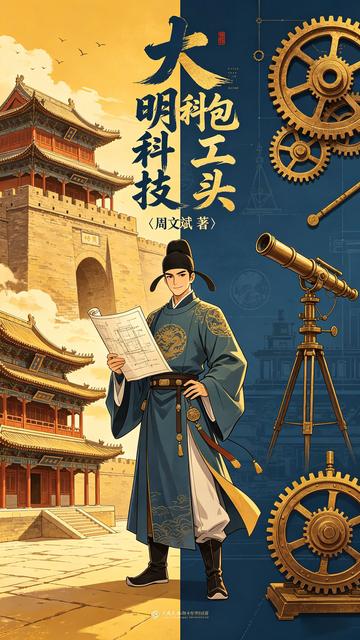
Zhou Wenbin, a struggling history student, pulls an all-nighter cramming The Exploitation of the Works of Nature before an exam when he gets electrocuted and transmigrates to the Xuande era of the Ming dynasty, becoming a poor scholar on the verge of starving to death. Other transmigrators bring a System or martial arts with them. All he has is half a notebook of physics notes covered in indecipherable scribbles and a power bank with no charge.
To keep from starving, he uses what he knows about high school physics to turn a broken temple’s bronze bell into an “automatic bell ringer,” build a “water-powered mill” for a tofu shop, and even make a “simple fire extinguisher” out of bamboo pipes and a pig’s bladder. Before long, he earns himself the nickname “Zhou the Oddball” in Yingtian Prefecture.
But life as an inventor isn’t easy. The Minister of Works calls his inventions “frivolous gimmicks” and tries to steal his blueprints. A eunuch from the Eastern Depot suspects he’s a “demon” and climbs over his wall in the middle of the night. Even the young widow next door, who sells rouge, clutches his plans for a “labor-saving water lifter” and insists he teach her to read.
Worse still, he discovers that his improved curved-beam plow looks remarkably similar to the one described in The Exploitation of the Works of Nature. Meanwhile, Song Yingxing, the man who wrote that book, is working as a judge in Yingtian Prefecture. He holds a copycat version of Zhou’s “vernier caliper” and asks with a frown, “Where did you learn to make this?”
Looking at the “binary calculator” he has cobbled together from an abacus, Zhou Wenbin suddenly realizes that perhaps the astonishing inventions recorded throughout history have always borne the mark of a transmigrator. His goal is not merely to survive: he wants to make the first whistle of the Industrial Revolution sound in this era ahead of its time, even if it means being branded a madman and roasted over a fire.