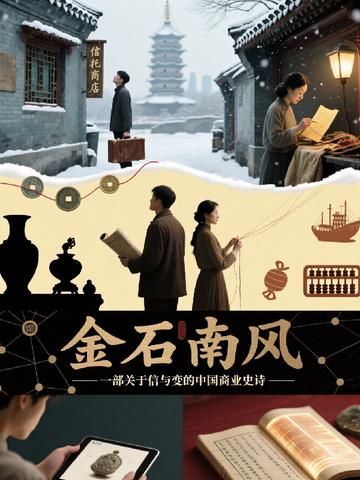
In the winter of 1978, two young people set out on wildly different paths beneath the same snowfall.
In a Beijing hutong, Lin Jianshan returns from the countryside and squeezes into a nine-square-meter room. Drawing on the sharp eye for antiques his grandfather taught him, he takes a temporary job at a trust store, handling old objects discarded by the times day after day. When he recognizes a damaged Ming dynasty bowl among a heap of “junk,” he has no idea that this choice will draw him into the undercurrents of the antiques trade and lead him to Jiangnan, a thousand miles away.
In an old house in Hangzhou, Shen Huaijin works the sewing machine at a glove factory day and night, just to support her sick mother. She is the daughter of a silk-making family, and all that remains of their heritage is a storeroom of damaged ancient books. When her mother falls gravely ill, she is forced to take a treasured sheet of Song dynasty paper to an antiques shop. There, she meets an old man who will change her life: “This sheet is worth ten yuan. But if you’re willing to learn the art of restoration, a complete Song edition could save your family.”
From Beijing hutongs to the Yiwu market, from Panjiayuan’s street stalls to the Shenzhen Special Economic Zone, from the world of antiques to the boom in e-commerce. Over forty years, he upholds the promise of “Jinshi,” while she weaves the transformation of “Nanfeng.” When fakes flood the market, capital runs wild, and tradition fades, can they keep their original promise: to let genuine things live on, and pass beautiful things down?