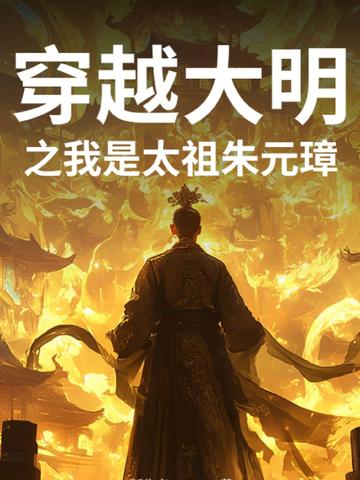
My name is Zhu Guangqianming, an academic drudge who studies Ming history.
On Tomb-Sweeping Day, I went to visit Zhu Yuanzhang’s tomb. In the dense woods behind the Ming Xiaoling Mausoleum, I found an ancient jade pendant covered in dirt. I casually wiped it clean, and a blinding flash erupted before my eyes as the world spun around me.
When I opened my eyes again, I was crouched in the corner of a ruined temple, dressed in rags with a completely shaved head. An old monk kicked me. “Zhu Chongba! What are you standing around for? Go fetch some water!”
Zhu Chongba. The name Zhu Yuanzhang used when he became a monk.
I nearly died on the spot.
But I soon realized this wasn’t a curse. It was heaven handing me a golden opportunity. I knew the course of history over the past six hundred years by heart: every battle, every court intrigue, every crucial decision. I knew who should be killed and who should be spared, where to find food, and where to seize history by the throat.
From Huangjue Temple to Haozhou, from serving under Guo Zixing to proclaiming myself emperor in Yingtian, every step I took landed on a turning point in history. But I wasn’t here to repeat the past. I was here to rewrite it.
Zhu Yuanzhang founded the Great Ming. I could build an empire ten times greater.
Unifying the Central Plains was only the beginning. I led my armies west, their iron hooves crushing the Eurasian steppes. My fleets sailed south, turning the South Seas into an inland lake. While the West still struggled through the Dark Ages, my cannons were already pointed at the English Channel.
As I unified the world with sword and steel, I used the steam engine to ignite the Industrial Revolution. The flagship of the Age of Exploration flew the dragon banner of the Great Ming.
Someone asked me what gave a history-obsessed bookworm the right to change the world.
I smiled and touched the jade pendant at my waist.
I memorized history long ago.
This time, I would write the Great Ming myself!