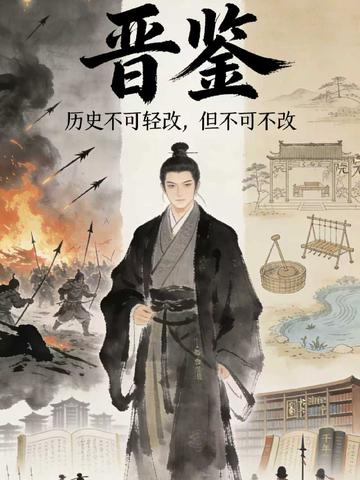
Shen Zhao, a modern man, transmigrates to the Taikang era of the Western Jin Dynasty and becomes Wang Zhao, an illegitimate son of the Taiyuan Wang clan. Armed with knowledge from a thousand years in the future, he tries to prevent the “War of the Eight Princes” and the “Yongjia Upheaval,” only to discover that history has an immense inertia of its own.
He treats the crown prince and is appointed a palace attendant to the Eastern Palace, proposes limits on the military power of the princes, and assists Sima Ai, the diligent and benevolent Prince of Changsha, in carrying out reforms. Every effort ends with him smashing headfirst against the iron wall of the powerful clans. When Sima Ai cries, “What wrong have the common people done?” amid the flames, when his page A-Man dies on the battlefield shielding him from an arrow, and when his beloved Jia Quan is bedridden with the lingering effects of the poison that once faked her death, Shen Zhao finally understands: the powerful clans want a puppet, not a wise ruler.
He turns to a longer battlefield: founding the Institute of Practical Learning to train technical talent, establishing the Four Seas Trading Company to build an economic foundation, and improving farm tools and waterworks. During the Yongjia Upheaval, when Luoyang falls, he organizes refugees to flee south, and the Black Armor Guards are nearly wiped out. After the Eastern Jin is established, the Institute of Practical Learning is burned down by the powerful clans as “strange tricks and wily arts.” In his later years, Shen Zhao is exiled to Guangzhou, where he writes the 300-volume Mirror of the Jin, concealing blueprints and “prophecies” far ahead of their time. He becomes both a participant in and a witness to history.
With the idea that “history cannot be easily changed, but it must be changed” at its heart, the novel explores the value of idealism amid structural constraints through the intertwined fates of Shen Zhao, Jia Quan, Lvzhu, Sima Ai, the Xiongnu leader Liu Yuan, and others. When the modern Shen Zhao is transmigrated by an electric shock in a library, and the Mirror of the Jin reappears a thousand years later, the two eras form a closed loop beneath the “Lanterns of the Shangyuan Festival.” Even if you cannot change the river's course, you can still be a stone that records its flow.


Let me give a brief review. As a time-travel novel, the pace is not sluggish, the writing style is simple and smooth, the logic is qualified, and the imagination is wide-open. It is worth recommending. It can be said that the author knows the history of the Western Jin Dynasty very well and has obviously done his homework.
It's super good-looking and the plot is exciting!