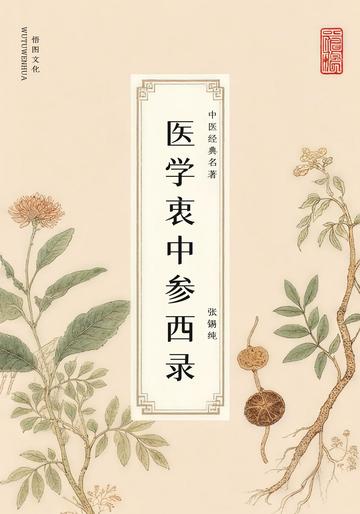
"Yi Zhong Zhong Shen Xi Lu" is a medical masterpiece written by the famous modern doctor Zhang Xichun (1860-1933), also known as "Zhong Zhong Shen Xi Lu". The book consists of thirty volumes and was originally published in seven installments from 1918 to 1934.
In this book, Zhang Xichun attempts to integrate the strengths of Chinese and Western medicine, adhering to the proposition of "Chinese medicine as the body and Western medicine as the function", that is, adhering to the theoretical framework of Chinese medicine while drawing on Western medicine techniques and anatomy and physiological knowledge. The "Zhongzhong" in the book's title refers to the way of traditional Chinese medicine, and "Shenxi" refers to the application of both Western medicine methods, reflecting the medical line of integrating Chinese and Western medicine.
In terms of content, "Medicine Zhongzhongshenxilu" contains five parts: prescriptions, single-medicine treatises, medical treatises, medical discourse and medical records. It not only compiles Zhang's many years of clinical experience, but also conducts in-depth discussions and innovative treatments for many diseases and syndromes, such as Yin deficiency, labor heat, Yang deficiency, wheezing, cholera, etc.
For example, in the treatment of "Lao Zang" (similar to tuberculous wasting disease), Zhang Xichun proposed that the cause is mostly deficiency of the lungs, spleen and kidneys, and the coexistence of Qi deficiency and blood stasis. Therefore, he advocated supplementing the method of promoting blood circulation, resuscitating, and resolving phlegm on the basis of strengthening, and there are treatment strategies of "flattening and reducing ini," "cooling and astringing," and "combination of sparing and nourishing", in which traditional Chinese medicine prescriptions are often combined with Western medicine or modern concepts to adjust.
In general, "Medicine in Chinese Medicine and Western Medicine" is an important work that embodies the modern Chinese medicine idea of "integration of Chinese and Western medicine". While adhering to the theoretical context of traditional Chinese medicine, it strives to introduce modern concepts and methods, providing ideas and models for the development of traditional Chinese medicine in the new era. For those who study Chinese medicine classics and understand the historical integration of Chinese and Western medicine, this book has high academic value and reference significance.