Plot Outline for The Hairpin in the Dry Well
Core Themes
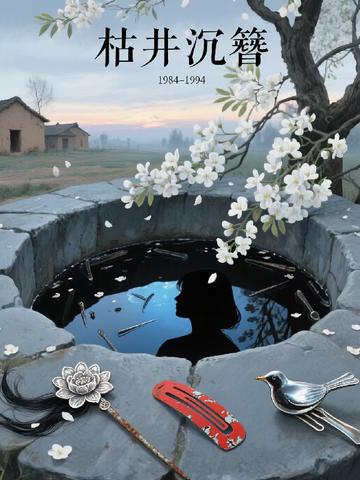
Set against Chenjiacun’s custom of “throwing hairpins into the dry well” from 1984 to 1994, the story weaves together the village’s buried history and tangled human relationships. It explores superstition and truth, trauma and reconciliation, and material things and emotional bonds, ultimately arriving at the idea that peace of mind is not something you can ask for; it takes the courage to face the past.
Volume One: Shadows Beneath the Pagoda Tree (1984–1987): Strange Incidents and Secrets Revealed
Central Conflict: The village custom of “throwing hairpins for good fortune” clashes with a series of bizarre events. Granny Wang’s strange behavior and the mystery surrounding the dry well sow doubts.
Key Chapters and Events
Cicadas and a Red Hairpin (Summer 1984)
Setting: Chenjiacun’s custom of “throwing hairpins into the dry well,” in which women toss hair clips and hairpins into the well for safety, along with the landmarks of the old pagoda tree at the village entrance and the dry well behind the village.
The First Strange Incident: Xiulian tosses a red plastic hair clip into the well to quiet her crying child. Niannia discovers bloodstained long hair beneath the pagoda tree’s roots, as well as a scrap of blue cloth that belongs to Auntie Li and went missing the year before, stained with the dry well’s black mud.
Characters Introduced: Eight-year-old Niannia, whose perspective guides the story; the mysterious Granny Wang, the only woman who does not throw in a hairpin, hinting that “there’s no god in the well”; the timid Xiulian; and the village secretary’s fiery-tempered wife.
Fingerprints on the Well’s Rim (Summer Rain, 1984)
Rising Suspense: After the rain, upside-down prints from a woman’s fingers appear on the rim of the dry well, her fingernails embedded in the pagoda tree’s bark. Niannia smells rouge drifting up from the well, the same scent worn by the village secretary’s wife.
Granny Wang’s Warning: She stops Niannia and Shuanzi from going near the dry well and reveals that “the dry well is an old well from the Wanli era. It was filled in, then...
 No Lights on the Road North
 Adjustable
 No Lights on the Night Road
 My Immortal Bones Shattered, I Rose in the Mortal World
 The Eye in the Screen
 Warm Jade, Deep Palm Lines
 Exorcism in Twin Locust Town
 Transmigrate into a Book as Yongzheng: A Young Abandoned Concubine’s Struggle to Survive in the Palace
 Night Shadows in the Ward