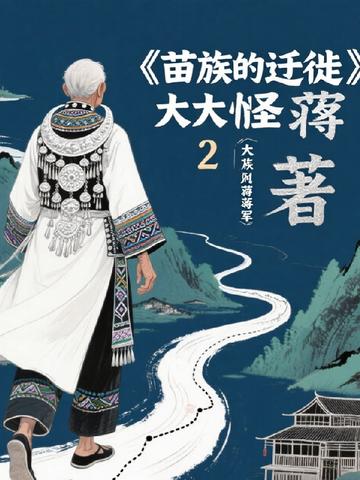
The Migration of the Miao is an epic spanning thousands of years of Miao history. Across five volumes, it offers a sweeping portrait of this ancient people’s suffering and glory.
The first volume, The Fall of Jiuli, tells how, after the Battle of Zhuolu, Chiyou’s descendants migrated south under the leadership of the priest Ayou and the weaver Sang Nü, recording their route in Miao embroidery. The second volume, Lament of Wuling, focuses on the campaigns of persecution during the Qin and Han dynasties. The shaman Long Laosi fights back with gu magic, while his daughter Alan leads the survivors into the remote mountains. The third volume, Flames of Wuxi, depicts the Miao people’s self-rule and uprisings in the Wuxi River region during the Tang and Song dynasties. A Yue, wife of the leader Yang Zaixing, passes down the memory of their resistance through song.
The fourth volume, Blood on Leigong Mountain, records the brutal crackdowns of the Ming and Qing dynasties. The uprising’s leader, Wu Bayue, is subjected to the horrific death by a thousand cuts, while his daughter A Yin melts silver objects into her dowry, secretly preserving the family’s wealth for future generations. The final volume, Dawn of the New Miao, spans a century of modern history, from Long Xiuying’s founding of a school teaching the Miao script to the present-day youth A Jie’s revival of lusheng music through electronic music, showing Miao culture reborn in the digital age.
Across its five volumes, the epic uses the melting down and recasting of silver ornaments as a metaphor. Ancient songs, Miao embroidery, shamanic magic, lusheng music, and other cultural codes intertwine to reveal how a people used the most resilient means to keep the spark of civilization alive amid the narrow confines of history.