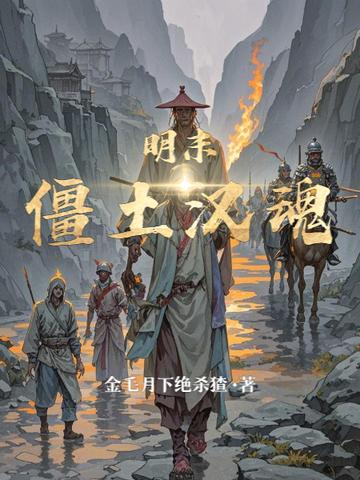
In the sixteenth year of Chongzhen’s reign, a little ice age sealed off the last wheat field in Shandong. The corpses floating in the Yellow River after its banks burst did not decay in the winter cold, and the “jiang plague” that fed on displaced people spread from Chenqiao Town. This was no natural disaster, but a death warrant delivered by an age of chaos.
When Zhao Cheng, a discharged frontier soldier, crawled out of the pile of bodies left by a Qing army camp massacre, all he had was half a broken blade. He had seen refugees kill one another over half a moldy bun, and the Qing army drive living people into corpse pits to feed the jiang plague. He had even watched the iron hooves of armored jiang trample the refugees’ last sanctuary. In the healer Su He’s medicine chest, anti-jiang water was more precious than wound salve. The orphan A Miao learned to stab jiang plague victims in the head before she learned to chop wood. Even Li, a scholar who knew only the Confucian classics, began marking “Qing army jiang release zones” on his maps.
They held the Yimeng Beacon Fort through the winter, kept armored jiang at bay with lime, and killed Qing army supply trains with traps. Yet they could not escape the Ming officials’ embezzlement or Dorgon’s mother nest of jiang hordes. From abandoned relay stations in Yanzhou Prefecture to the red cannons atop Nanjing’s walls, and then the terraced fields of Xianxia Ridge, these refugees were never defending just a city. They were defending the human heart from being devoured by the jiang plague, and the Han soul from being crushed under Qing army hooves.
When herbs from the Yellow River silt could cure the jiang plague, and volleys from repeating crossbows pierced Qing armor, they finally understood on this jiang-ridden land: to survive, they had to fight heaven, fight the dead, and fight the Manchus who wielded butcher’s knives. To pass on their legacy, they had to plant anti-jiang methods, farming skills, and the backbone to resist the Qing deep in the soil.
This is no elegy for the Ming. It is a survival manual written by the living for the living, on jiang-ridden soil.
 My Years as a Troll in the Hongwu Dynasty
 Sky Screen: It Begins with Showing Old Zhu the Nanjing Massacre
 Global Evolution: From the Start, I Awaken a God-Tier Extraction Talent
 Three Hours to Doomsday: I Cleared Out a Superstore with Ten Thousand Tons of Goods
 Global Transmigration: I Become a Saint by Refining All Things
 The Demon Suppression Bureau Is on the Case: If You're a Demon, Come Out and Face Your Death