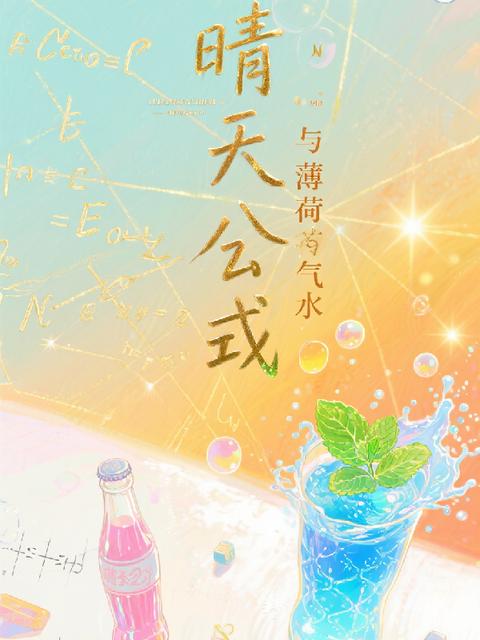
The third time the honor roll for the top students showed Jiang Zemo and Su Nian’an’s names side by side, no one knew that the cold-faced top scholar who could solve love letters with differential equations would one day slip a bottle of ice-cold mint soda into Su Nian’an’s hand during free time in P.E. class. His fingertips’ warmth still lingered on the bottle. Su Nian’an had just finished running 800 meters, her bangs clinging to her sweat-damp forehead. She froze as she took the soda. Jiang Zemo had already turned toward the basketball court, his white school uniform tracing a graceful arc in the sunlight. All he left her was a retreating figure with ears tinged red.
They’d been classmates for three years. The edges of Jiang Zemo’s scratch paper were always covered with inexplicable function curves. It wasn’t until Su Nian’an borrowed his eraser one day that she realized the curves, pieced together, formed her profile as she bent over a geometry problem. A maple-leaf bookmark was tucked into Su Nian’an’s notebook of mistakes, but no one knew it was just like the one Jiang Zemo had dropped in the hallway the day he won a physics competition. They were the twin “kids everyone else’s parents wish they had,” as their teachers called them, and the answers that always appeared side by side in their workbooks. Yet somewhere in a stolen glance, they quietly changed the words “rival” into “heart rate acceleration.”
This is a sweet coming-of-age story about two top students. They compete to see who can memorize “Ode to the Red Cliffs” first during morning reading, play physics-concept charades between the library stacks, and secretly sneak off to watch the stars after evening study, sharing a pair of earphones. Beneath Jiang Zemo’s tough exterior is an awkward tenderness: he uses the Lorentz force formula to calculate the odds of her shoelaces coming undone. Behind Su Nian’an’s gentle smile is a sly streak of playful probing. Whenever he explains a problem, she deliberately asks