For China's intellectuals in the twentieth century, one of the greatest historical tragedies was that they were among the first to dedicate themselves to saving their country and its people. They believed they understood the political climate better than anyone, yet in the end they were the most at sea in the political arena, constantly falling into disgrace and earning the contempt of others.
The book discusses three men. One was Zhang Dongsun, a philosophy professor at Yenching University who had long been immersed in politics and, after 1949, held a high-ranking position as a member of the Government Administration Council. Another was Wang Yunsheng, a journalist skilled in political commentary who served for many years as chief editorial writer for Ta Kung Pao. The third was Pan Guangdan, a Tsinghua professor trained in the sciences who knew little about politics, yet was just as eager to offer advice on China's political affairs. Before 1949, all three had excelled in different fields. After 1949, however, each suffered a devastating defeat in turn, and their careers never recovered.
Professor Yang Kuisong is not content to repeat the broad question asked in the past: Why did intellectuals in mainland China stop thinking and collectively change course back then? As more private records, newspapers, periodicals, and archival documents have come to light, he has found that the matter was not so simple.
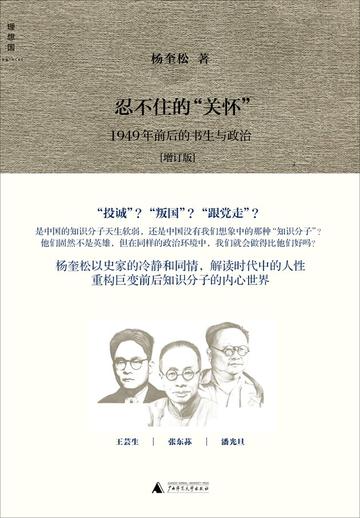



It is really difficult to explain history clearly. Teacher Yang's book tries to be as objective and fair as possible to tell the experiences of three representative figures who were caught in that period of history. Represented by Zhang, Chang, and Pan, Teacher Yang analyzed the mental journey of intellectuals under the historical environment, describing their return to the country with a patriotic heart and their desire to build the country, as well as their helplessness and insignificance in the face of politics before and after the founding of the country. It seems difficult for us to understand their choices, but it does not prevent us from admiring their greatness and dedication.
The analysis of three typical cases allowed me to find problems that I had never understood before, and it helped me understand why our predecessors chose such a path. With a rational, objective and serious attitude, the author analyzes the relationship between intellectuals represented by Zhang Dongsun, Wang Yunsheng and Pan Guangdan and politics. The author cited sufficient historical materials and restored many details. After the author analyzed the behavioral motivations and psychological activity trajectories of the three "big names" in detail, he also deeply analyzed their psychological activities, which is very sad. It is a pity that in such an era, it is difficult for intellectuals to protect themselves, so how can they illuminate mankind?
This is a relatively sensitive history. My parents have experienced it, but everyone has their own opinions. I opened this book because I was curious and wanted to understand. After reading it, I was immersed in the story and couldn't help but sigh. Teacher Yang's writing skills are sophisticated. He does not use personal thoughts to criticize, but tries to explain the causes and consequences of a story as clearly as possible, allowing readers to make their own judgments. Everyone's feelings after reading it should be different. I think I am too shallow to appreciate the efforts and dedication of my predecessors, so I admire even more every ancestor who contributed silently during that period of history.
Intellectuals in China in the 20th century were the first group of people to devote themselves to saving the country and the people. They thought they understood the political trends best, but in the end they were the most at a loss in the political field. The three people discussed in this book are Zhang Dongsun, a professor of philosophy at Yenching University, who has been immersed in political activities for a long time and served as a member of the Government Affairs Council after 1949; Wang Yunsheng, a newspaperman who is good at political commentary and has been the chief writer of Ta Kung Pao for many years; and Pan Guangdan, a professor at Tsinghua University who has a background in science, but who is still an outsider in politics and has actively wanted to make suggestions for Chinese politics.
The writing style of this book is very rigorous. Through the analysis of specific characters, the author gives us a deeper understanding of the intellectuals of that special period. The writing is smooth and well-organized. It tells complex historical issues in simple and easy-to-understand words. It is worth reading.
Through research and restoration of history, human behavior is inseparable from the background of the times. It is so good that people can't stop and don't know how to describe it. I have always liked Teacher Yang's books, as well as those by Teacher Shen and the late Teacher Gao.
Intellectuals and politics is a big topic, and it is also a topic that spans a lot of time and geography. There have always been different opinions. Different people have different opinions. But (I can't help but care) I still solved the problem and made it clear. Like 👍👍👍👍👍👍
As soon as I listened to the beginning, I had the urge to keep listening. That kind of rational expression is very helpful for clear thinking.
Read the experiences of three great intellectuals in two times, and have more thoughts about the history of that year. The gears of the times are still turning.
I like it very much, I like this kind of realistic book, the language is concise and smooth. It allows us to understand the true process of historical events. This book is highly readable and makes people unable to put it down.