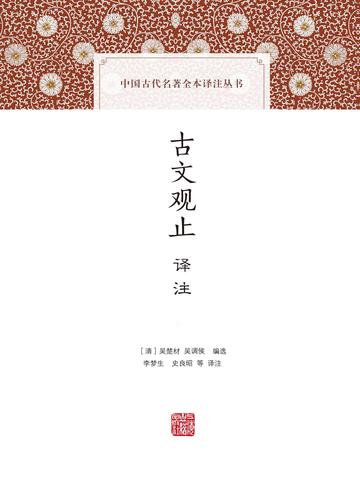
Translation Notes on Gu Wen Guan Zhi
古文观止译注
- Status
- Completed
- Length
- 654k Words
- Updated
- 4y ago
- Source
- Fanqie
Stats
8Reads
8.5Score
16Chapters
7.2kReads · all time
Tags
Synopsis
Reader comments
Readers also read
 Translation and Annotation of Gu Wen Guan Zhi (Set of Volumes 1 and 2)
 Finely Edited Commentaries on Ancient Texts
 Ancient Wen Guan Zhi (Middle School Student Edition)
 Guanwen Guanzhi
 Guanzhi on Ancient Texts: an Excerpt
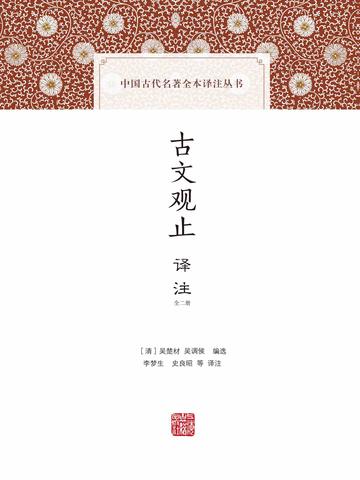 Translation and Annotation of Guwen Guanzhi (Two Volumes)
 Guanwen Guanzhi
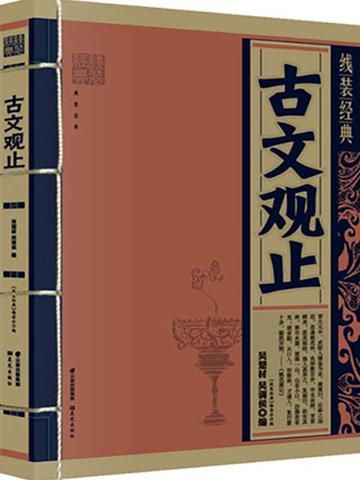 Guanwen Guanzhi
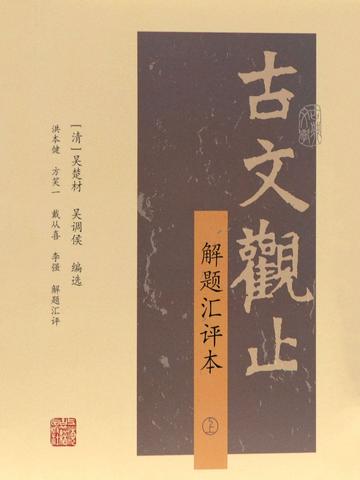 Guanzhi on Ancient Literature (Problem Solving Review Edition)
 The Finishing Touch of Ancient Prose
 Guanwen Guanzhi
 Guanzhi on Ancient Literature (Two Volumes)
 Guanwen Guanzhi
 Browse of Chinese Studies-Guanwen Guanzhi
 Wanjuanlou Chinese Studies Classics (Collector's Edition): a View of Ancient Literature
 Guanwen Guanzhi (Guomai Classic)
 Guanwen Guanzhi (Guomai Classic)
 Newly Compiled, Fully Annotated and Fully Translated Ancient Texts
 Illustrated Views of Ancient Literature
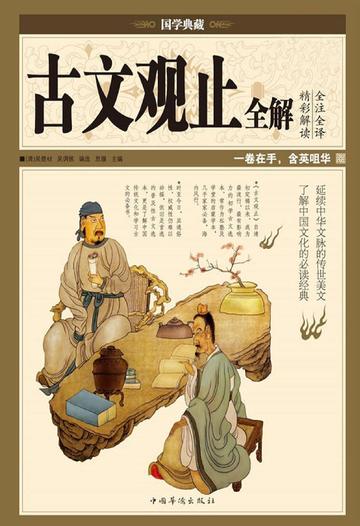 Complete Explanation of Ancient Chinese Literature
The wisdom of the ancients can only be known by reading ancient Chinese texts. The culture and literati that have lasted through the ages have contributed to the civilized blood of Chinese democracy, especially the articles of pre-Qin scholars. When I read "Guan Zhi Gu Wen", I always feel filled with emotion. I am amazed that this book is such a rare treasure, comparable to Suizhu and Bian Yu. I also marvel at the unique charm of ancient prose that is both majestic and condensed, both gorgeous and simple. My understanding is: the great wisdom and talent in the world are either written in ancient Chinese, foreign languages, or mathematical symbols. "Guwen Guanzhi" is more like a key, a key that can open the door of wisdom. Highly recommended, I benefited a lot from reading it.
This translation and annotation is highly recommended. After reading it for the first time, my reading comprehension of ancient Chinese has been enhanced, and I have also gained a lot of knowledge about ancient culture. This version is very good, and the explanatory notes are in the form of marginalia, highlighted in light orange. The translation annotations in the book are relatively detailed, not only explaining the meaning of the words, but also including a lot of ancient cultural knowledge (such as astronomy, calendar, geography, official positions, diet, customs, etc.). Each article is preceded by an introductory text by a Shanghai famous person, explaining the content, gist and writing style of the article, allowing people to appreciate the aesthetics of ancient articles. "Guwen Guanzhi" is not only about literature, many of the selected articles contain moral and political significance. It is the ancient law of life, and many of it can also inspire modern people.
Highly recommended. I once studied "Guwen Guanzhi" in college. The selection of documents in it is very professional, and the translation is also very good. It is very suitable for professionals to read and study. This book "Annotations on the Translation of Guwen Guanzhi" is more suitable for readers who are not majoring in ancient Chinese and are interested in it. It is also very suitable for middle school and high school students to read. The translation and annotations in this book are particularly meticulous and strive to be accurate, so that readers can accurately understand the ancient texts, learn from them, and appreciate the charm of humanity.
"Guwen Guanzhi" is an anthology of ancient Chinese literature, including many classical Chinese articles from the pre-Qin to the Tang Dynasty. The purpose of compiling and selecting this book is to provide readers with excellent ancient Chinese works from various periods for easy learning and appreciation. The author interprets this book through translation and annotations. The classic article "Zheng Bo Duan Yu Yan" is a real historical event that occurred in the Spring and Autumn Period of ancient China. It describes that Prince Chong'er of the State of Zheng was forced to go into exile in Yancheng because he was ostracized by his father and elder brother. Then he met Duan Ganmu, a wise and brave man there, and finally succeeded in regaining the rule of the State of Zheng through his help. Through the author's annotations in vernacular, our reading difficulty plummets.
Many articles from ancient Chinese texts are selected, and wonderful explanations are also given. "Zang Xibo came forward and said: "Anything that cannot be used to practice important events, and its materials cannot be used to make utensils, then the king should not pay attention to it. The duty of the king is to make the people's behavior comply with the laws and etiquette. Therefore, using the action of teaching important events to test the differences of laws is called laws; using materials to demonstrate the literary talent of utensils is called rituals. It is neither in compliance with the law nor in compliance with etiquette. This is called disorderly government. The repeated occurrence of disorderly government is the cause of decline. Therefore, spring hunting is called Sou, summer hunting is called Miao, autumn hunting is called Xiang, and winter hunting is called hunting, all in order to use these methods to teach important things during the leisure time. Every three years, troops are sent out for exercises (and used to test the results). After the exercises are completed, the troops are reorganized and returned. They go to the temple to drink and celebrate, worship ancestors, and count military artifacts. Highlighting the literary talent of utensils, vehicles, clothing, and flags, distinguishing the difference between noble and inferior, distinguishing the order of rank, and arranging the order of young people and old people are all in order to become familiar with this etiquette system that expresses majesty. "
I believe that everyone has more or less read "Guanwen Guanzhi". When reading, in order to improve one's appreciation of ancient prose, I often read translations and annotations like this. I have also read other versions, and I personally think this "Guwen Guan Zhi Translation and Commentary" is the best version. The phonetic notations and annotations of the words in the book are rich and detailed, and the layout is indeed better than the previous version. The book has its own Yan Ruyu. No matter when I was studying when I was young or now when I am working, I still like this book very much. It not only appreciates the profound cultural heritage, but also makes me understand many principles of life. Recommend!
This "Guwen Guan Zhi Translation Annotation" is really great! It is like a treasure that allows me, a housewife, to appreciate the charm of ancient culture. The selected articles in the book cover various types, and each article has profound thoughts and wonderful expressions. I especially like the historical prose in it. They make me feel as if I have traveled through time and space and feel the changes in ancient times. The translations and annotations are also very detailed, making it easy for a novice in classical Chinese like me to understand. This book made me more interested in ancient literature, and also allowed me to find a quiet spiritual corner in my busy life.