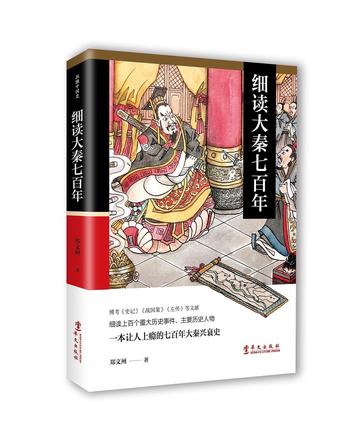
A Close Reading of Seven Hundred Years of Qin
细读大秦七百年
- Status
- Completed
- Length
- 208k Words
- Genre
- Historical
- Subgenre
- Unknown
- Updated
- 3y ago
- Source
- Fanqie
Stats
Tags
Synopsis
In booklists 11


Give Me Some Truly Great Reads. I'm Really, Really Out of Books
Looking for books similar to *Transmigrating into a Single-Player Game: I Broke the NPCs*.
Now This Is the Kind of Novel Chinese People Should Read
As fellow Chinese people, you'll feel your blood boil after reading this.




Stories About Niou Masaharu
Looking for books like *The Prince of Tennis: Entering Rikkai with Damocles Hanging Over My Head*. Anything about Niou is fine.
The Chu-Han Contention, the An Lushan Rebellion, and the Five Dynasties and Ten Kingdoms
A lord-simulation game. No transmigration, but it should blend with reality. No Three Kingdoms era either. Spring and Autumn, Warring States, the end of the Qin dynasty, or mid-to-late Tang are all fine
True Ancient Warfare, No Fantasy, Though a System Is Acceptable

Books That Can Help Improve Your Skills and Build a Side Hustle, Preferably One That Makes Money
Looking for books similar to Anyone Can Make Viral Short Videos.
Ancient Chinese History: The Three Kingdoms, Song, and Ming Dynasties
I've read all of these. They have their flaws, but at least they're readable and not painfully awful.
Looking for Novels About the Three Kingdoms, Sui and Tang Dynasties, Investiture of the Gods, and the Qin Dynasty
Ideally, it should be a System-based story.


Looking for Good Published Books ✌️
Looking for books like *A Short History of Chinese Philosophy*. Easy to understand and immersive. @Fighting Little Bear

Even a Leaf as Undemanding as Me Has Run Out of Books to Read. Please Recommend Some!
Um, I'm not picky, but I don't like power-trip stories. Please understand.


Looking for a Deep Novel. You Know, Real Depth? One That Gives You Something New Every Time You Read It
Reader comments 50
Google Translate
In 221 BC, King Qin unified the world and established the Qin Dynasty; in 207 BC, Prince Qin Ying surrendered to Liu Bang, and the Qin Dynasty perished. The powerful Qin Empire only existed for a short period of 14 years, but it took nearly 700 years for the Qin State to develop into the Qin Dynasty. The book is divided into six parts: "Rise, Confrontation, Soar, Expansion, Unification, and Collapse". It explores the subtleties of history, tells us the historical origins between the vassal state of Qin and the unified Qin Dynasty, and shows the wonderful history of military hegemony, political diplomacy, and economic reforms surrounding the Qin Dynasty.
Spring and Autumn wars. There is also the existence of righteousness and integrity. Warring States princes. Use every possible means. The end justifies the means.
Jia Yi, a famous political commentator in the Han Dynasty, once summed up the reasons for the demise of the Qin Dynasty: "If benevolence and righteousness are not implemented, the offensive and defensive momentum will be different." This statement makes sense. However, we should see that it is not enough and unreliable to simply place our hopes on the moral foundation of the ruler's "benevolence and righteousness". What is more important is that there should be a mechanism to limit the evil done by the monarch and limit the occurrence of evil to the smallest scope. The seven hundred years of Qin's history are condensed in such a small book. Its successful experience is worthy of reference by future generations; its lessons of failure are also worthy of reflection by future generations.
The writing is very nice, but I have bad eyesight, so I usually listen to books. Many times when I listen, I feel like there will be a protagonist coming out to comment (such as Tianmu). I don't know much about history, so I don't know the authenticity. But the author's writing style is really good, it's like a person telling you a story, which is different from those boring history books. And it sounds calming. Recommend!
I personally feel that the author's entry point into the book's writing process is slightly on the moral level, but the explanation is not biased, and it is still a good work. Thoughts after reading: Man himself is a complex body of contradictions, so the social system formulated by man is not perfect, and the execution process is more susceptible to the negative influence of human nature. When a system lags behind the current situation but is still implemented, the result will inevitably be a disaster. Similarly, when a system, no matter how perfect it is, is implemented beyond the current situation, the outcome will inevitably be disastrous. Therefore, the best policy is that the system must not have an ultimate form, must constantly change to adapt to the current situation, and must not be unbalanced and focus on one extreme.
It is concise and easy to understand, the language is fluent, and the profoundness of Chinese culture cannot be destroyed by a few elementary school textbook illustrations.
The writing is very good. It is indeed a pity that Qin was weak and became strong, and prospered and died. This is a family's struggle history Let me say that the Qin Empire and the Han Empire were the most powerful dynasties in China. If Qin did not unify its thoughts, future generations might still be in the Warring States Period. Qin unified the Han and Tang Dynasties and then began to manage the Western Regions. However, the country's fortunes were not good. After the Han Dynasty was conquered, ethnic minorities developed. Tang Wan When the country came to Korea, it happened that the involution was too great. The rise of nomads and Tibet hindered our external development. From then on, our external development was not good. For the next thousand years, we basically fought within our own homes. But in the end, we were finally ruled by a small tribe with more than 100,000 people.
Hu Hai, the second emperor of Qin, made the Qin Empire finally shine like a morning star for more than 700 years, but it eventually crashed. It cannot be said that even during the decades of the First Emperor's reign, the empire's achievements were mixed. The first half of the book mainly focuses on how King Qin proclaimed himself emperor; during the period of hegemony The Qin State had neither geographical advantages nor local talents; it all relied on the foresight and cherishment of talents of the king; the Qin State began to dominate the seven heroes; carefully reading the ups and downs of these seven hundred years, we not only lamented the rise, expansion and final unification and decline, but also paid New Year greetings in just a blink of an eye.
Afang Palace is fictional
Why do I feel that the author has a problem with Qin Shihuang later? But it's really a good book